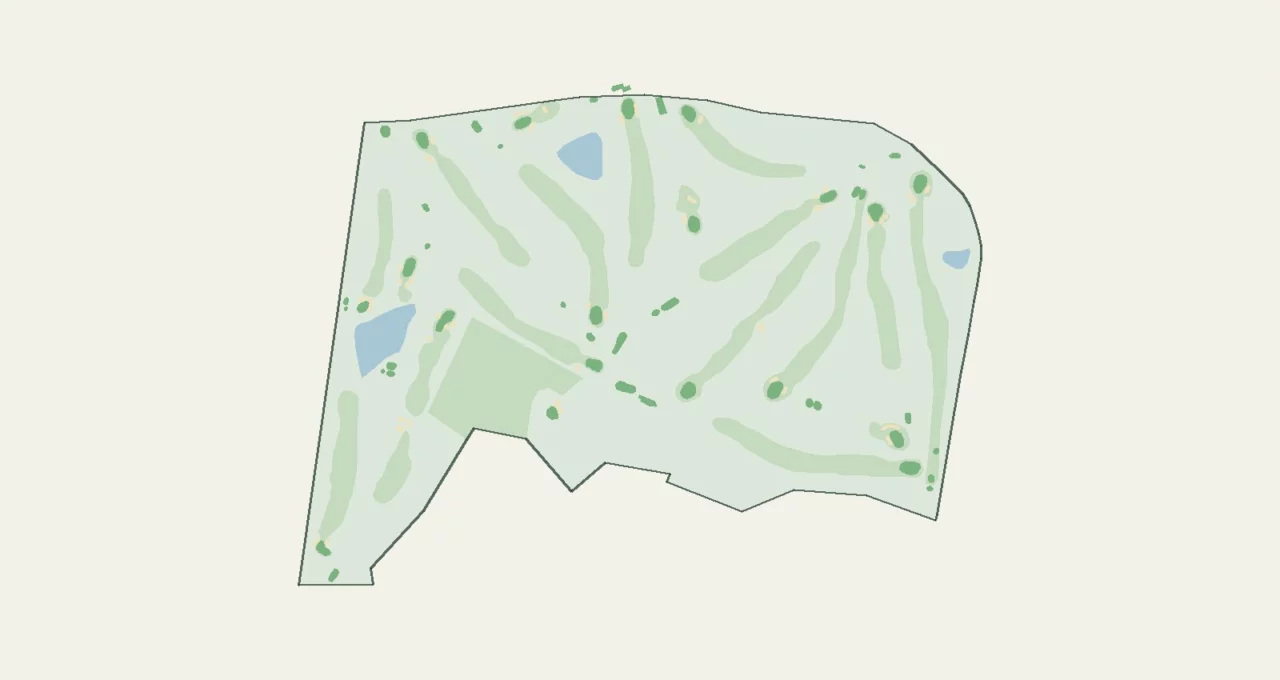
Layout of Duntryleague Golf Club from OpenStreetMap survey data (ODbL licence).
Duntryleague Golf Club
Holes
18 (club course tour; VisitNSW; Golf Australia); OpenStreetMap counts 36 hole lines, which reflects the mapping, not the course
By
70 from the blue and white tees (club scorecard; GolfNow; 18Birdies); 72 from the red tees according to the club's text and GolfNow, while the club's red hole table adds up to 71
Length
6,006 metres from the blue tees on the club's hole table (6,008 in its text), 5,787 from the white and 5,281 from the red (club course tour); 5,976 metres from the back markers (VisitNSW); 5,985 / 5,587 / 5,282 metres (Golf Finder)
Green fee
—
Best season
All year (GolfNow); cold winters with frequent morning frosts in Orange (Wikipedia)
Duntryleague Golf Club is an eighteen-hole course on the western side of Orange, in the Central West of New South Wales, laid out in the grounds of Duntryleague, a Victorian mansion built for the merchant James Dalton in the 1870s. The club gives its address as 195 Woodward Street, Orange NSW 2800. The mansion still stands on the highest point of the property, serves as the clubhouse and takes in overnight guests, and the course wraps around it through what the club calls botanical gardens. In a straight line, the middle of the course is a little under two kilometres west-north-west of the city centre as Wikipedia places it.
The club is active in 2026. Its website lists tee bookings for members and visitors, a club newsletter dated September 2026, junior and women’s programs running in November 2026, and annual tournaments into 2027. In April 2026 the club held a community open day to mark 150 years since the mansion was built. VisitNSW states that the course is open to the public, and the club’s visitors page sets out how non-members book a round.
The OpenStreetMap record for the course counts 36 hole lines, which is not the number of holes. Every source we read, starting with the club’s own course tour, describes a single eighteen-hole layout. The extra lines are most likely duplicated or alternative tees on the map.
A golf course in a merchant’s estate
The history of the estate is better documented than that of most country courses, because Duntryleague is on the New South Wales State Heritage Register. According to Wikipedia’s article on the property, which draws on the heritage listing, James Dalton, born in Ireland, began buying part of an older land grant called Campdale in 1872 and named it after his birthplace near Galbally, in County Limerick. The club’s accommodation page gives the original spelling as Doon-tri-liag and translates it as the fort of the three pillar stones. The house was designed by the Sydney architect Benjamin Backhouse in the Victorian Filigree style, and the family moved in in 1876. Golf Australia magazine and Wikipedia both mention a stained glass window in the house commemorating Dalton’s appointment as a Papal Knight.
Dalton died at Duntryleague in 1919. Golf Australia’s feature on the course says the property passed to his son, a Jesuit priest who could not accept it, and stayed in the hands of the Catholic Church for more than a decade. In 1935 the Orange Golf Club, which according to the same article had played on a small site nearby since 1901, bought the eastern part of the estate. Wikipedia puts the purchase at 73 hectares; the Top 100 Golf Courses guide gives 180 acres, which is the same area. The mansion was extended into a guest house with a new clubhouse in 1935 and 1936.
Who designed the course is not reported the same way everywhere. Wikipedia and the Top 100 guide say the club’s professional at the time, John Irving, mapped out the eighteen holes and that the architect Eric Apperly approved or modified the plans and supervised the work. Golf Australia credits the routing and design to Apperly and lists the course as his 1935 work. In 1949, according to the Top 100 guide, the club engaged the Latvian landscape architect Ilmar Berzins to draw up a master plan for the trees; Wikipedia dates his plan to 1949 in one place and 1950 in another, and says some 12,000 trees had been planted by 1975. Golf Australia counts about 168 tree varieties on the course today.
Dates for the club itself also vary. Golf Australia and most of Wikipedia give 1901 for the founding of the club, while one passage of Wikipedia says 1909. Planet Golf gives 1902 as the opening year, which seems to refer to the club’s first course rather than to Duntryleague. A senior golf magazine announcing the April 2026 celebrations described the club as founded in 1876; that is the year of the mansion, not of the club. The course directories give 1935 or 1936 for the present layout.
The course in figures
The club publishes its scorecard hole by hole on its course tour page, and that is the card we follow. From the blue and white tees, par is 70, made up of 35 on each nine, with four par 3s (the 4th, 7th, 11th and 17th), twelve par 4s and two par 5s (the 2nd and the 16th). GolfNow, 18Birdies and the Golf Finder directory also give par 70. From the red tees, the club’s introductory text and GolfNow give par 72. The club’s own hole table adds up to 71 from the red tees, with the 1st played as a par 5, while its description of the 9th says it plays as a par 5 for women, which would make 72. The Hole19 app gives par 72 for the course, apparently from the red card.
The hole lengths on the club’s table add up to 6,006 metres from the blue tees, 5,787 metres from the white tees and 5,281 metres from the red tees. The club’s introductory text gives 6,008 metres for the blue tees, two metres more than its own table. VisitNSW and the regional tourism site give 5,976 metres from the back markers, and Golf Finder gives 5,985 metres from the blue tees, 5,587 from the white and 5,282 from the red. Some apps label the same totals in imperial units; the figures match the metric listings, so we read them as metres.
Some older descriptions do not match the current card. The Golf Australia feature, published in 2012, gives the 1st as 431 metres and stroke index 5, the 14th as 281 metres and the 16th as 444 metres; the club’s card now has 434, 283 and 441 metres from the blue tees, with the 1st at index 2. The Top 100 guide describes the 4th as a 360-metre par 4 doglegging right and the 17th as a 182-metre par 3, where the club’s card has the 4th as a par 3 of 199 metres and the 17th at 169 metres. Holes may have been renumbered or rebuilt over the years; the club’s current card is the one to trust.
From the blue tees, the front nine measures 3,015 metres. It opens with the longest par 4 on the course, 434 metres, followed by the par 5 2nd at 478, the 3rd at 353, the par 3 4th at 199, two par 4s of 323 and 342 metres, the short par 3 7th at 151, the 8th at 328 and the 9th, a par 4 of 407 metres. The back nine, 2,991 metres, runs: 381 metres at the 10th, a par 3 of 178 at the 11th, then par 4s of 376, 408, 283 and 388 metres, the par 5 16th at 441, the par 3 17th at 169 and the 18th, a par 4 of 367 metres.
The club’s table shows several index figures per hole without explaining them. Reading the first figure as the stroke index, the 18th is index 1 from the blue tees, the 1st index 2 and the 15th index 3. The club’s own text, however, calls the 15th the hardest hole on the course, and on the red card the 15th is index 1. For course rating and slope, 18Birdies gives figures for three tees, but its tee names do not match the club’s, and GolfNow shows no ratings at all. We could not check Golf Australia’s official listing, so we give no rating here.
What it asks of you
Trees, all the way round
Duntryleague is a parkland course in the full sense. The club describes the layout as tree-lined and strategic, demanding accuracy off the tee, and its hole notes repeat the same warning: trees on both sides of the 1st, out of bounds and trees on the right of the 2nd, trees inside the dogleg of the 3rd, trees lining the 6th, 8th, 9th and 10th. Golf Australia observed in 2012 that the fairways were more heavily tree-lined than when the course was built, and one review summary describes tight landing zones. A ball that drifts into the trees often leaves no direct route to the green, so the first job on most holes is simply to find the short grass.
A flat front nine and a hillier back nine
According to Golf Australia and Planet Golf, the front nine is the flatter of the two and the easier walk, while the back nine, from the 13th onwards, has more pronounced changes of level, with more varied lies and stances. The club’s notes describe an elevated tee on the 6th, a fairway that rises on the 9th, an uphill second shot to an elevated green on the 12th, a carry over a gully on the 15th and a climb to an elevated green at the 18th. The 1st and 3rd involve blind or partly blind shots over rises, which is worth knowing on a first visit.
Small, sloping bent greens
The greens are bent grass and the fairways South African couch, according to the club, Golf Australia and the Top 100 guide; the Top 100 guide notes that couch was an unusual, drought-resistant choice for its time. One published review describes many greens as small and some as heavily sloped, with swales beside and behind them doing the work that bunkers do elsewhere. The club’s notes single out a two-tier green at the 4th, an L-shaped green with a two-tiered right side at the 15th, and a narrow, deep green at the 17th that plays about three clubs from front to back. 18Birdies lists the greens as fast.
Five holes to know
The 1st is a demanding start: the longest par 4 on the card, with a wide fairway but trees on both sides and a large unbunkered green that punishes misses left, right and long. The 14th, at 283 metres, looks easy on the card, but it doglegs right around tall gums to the smallest green on the course, according to Golf Australia, with a dam behind it. The 15th, a par 4 of 388 metres, asks for a tee shot on the left half of a fairway that slopes towards trouble, and the club warns that over the back is dead. The 17th is the only hole on the course with water to carry, a par 3 of 169 metres to that long, narrow green with deep bunkers on the right; one reviewer notes that, with tee and green both elevated, the water matters less than it looks. The 18th, which the club calls a championship maker or heart breaker, climbs to an elevated green where the approach must reach the back half without going over.
What that means for your game
Leave the driver in the bag where the fairway narrows, and play for position rather than distance on the tree-lined par 4s. On the par 3s, take enough club to reach the right tier, and on the 17th aim away from the right side. Save some energy for the back nine, which is where the climbing is. Spend time on the putting green before you start: on small, sloping bent greens, staying below the hole is half the battle. Club golfers will find the course long enough from the white tees; better players will find that the trees, rather than the length, decide the score.
What golfers say
We read reviews on golf apps, golf directories, review aggregators and accommodation sites, as well as the two published course reviews. Written comment on the course itself is not abundant, and many app reviews are a line or two. The points below are what recurs. They are other people’s opinions, not ours: we have not played the course, and we name and quote no one.
What comes up in its favour
- Course condition draws the most praise, with fairways and greens described as well kept and, in one feature, as the envy of many city clubs.
- The trees are the signature of the place, and the autumn and spring colours are singled out.
- The greens are described as true and quick.
- Reviewers like the variety of the layout, the direction changes and the four par 3s, each different from the others.
- The heritage mansion and its gardens give the round a setting that few country courses can match.
- Staff are described as friendly.
What comes up against, or should be weighed
- The course is rated hard, and the tight landing zones and trees punish wayward driving; recovery shots from under the trees can be close to impossible.
- Blind tee shots and approaches on the opening holes can catch out first-time visitors.
- The back nine is the more tiring walk.
- Value for money is rated less warmly than the condition of the course.
- Guests who stay in the mansion mention rooms showing their age, and the club itself warns of creaky stairs and floorboards and says there is no disabled access to the mansion guest rooms.
- The water at the 17th comes into play less than its name suggests, for anyone who hoped for more of it.
Staying, eating and practising
The mansion has 14 ensuite guest rooms, according to the club, several with balconies and one overlooking the 1st and 9th fairways, and a separate three-bedroom flat on the ground floor, the Margaret Dalton Lodge, which is the accessible option. The club offers stay-and-play packages and mansion tours. VisitNSW describes a licensed bar, a brasserie, a barbecue area and four clay tennis courts at the clubhouse; we have not found the tennis courts on the club’s own site and cannot confirm them. The club lists trading hours from 7.30am every day, closing at 8pm on Sundays and Mondays and later on other days.
For practice, the club’s golf centre refers to demonstration days held on its range, and GolfNow lists a driving range, a chipping area and a putting green. The club has PGA professionals on staff, offers lessons and club fitting, and runs junior and women’s introductory programs.
Who it suits
Duntryleague suits golfers visiting Orange who want a classic tree-lined parkland round in a historic setting, and anyone interested in course history: few Australian courses sit around a heritage-listed house that doubles as a guest house. Mid handicappers will find the white tees a fair test; high handicappers should expect to lose a ball or two to the trees and may prefer a quieter time of day. The mansion makes it an obvious base for a golf weekend in the region, and Orange has other courses within a short drive for a second round.
Getting there and when to go
The club is at 195 Woodward Street, on the western side of Orange and a short drive from the city centre. Orange is about 254 kilometres west of Sydney according to Wikipedia, and Golf Australia puts the drive at about four hours over the Blue Mountains. Orange railway station is on the Main Western Line, served daily by the Central West XPT between Sydney and Dubbo, and Orange Airport is about 15 kilometres south of the city. We have not checked local bus services and give none.
Visitors book tee times online through the club’s visitor booking page, and the pro shop can be reached on (02) 6362 4072. Golfers from reciprocal clubs need a letter of introduction. The dress code is smart casual on the course, the practice areas and in the clubhouse; steel spikes, tracksuits, sports jerseys and singlet-style tops are among the items not allowed. The club expects a round of eighteen holes to take about four hours and a quarter, and carrying a sand bucket to fill divots is compulsory. Motorised carts and pull buggies are available, and carts must stay on the paths and outside the blue lines around the greens.
GolfNow lists the course as open all year. Orange sits at about 860 metres above sea level, and Wikipedia describes its winters as cold and wet with frequent morning frosts, and its summers as warm; in winter an early tee time can mean waiting for the frost to lift. Autumn, when the planted trees change colour, and spring are the seasons reviewers single out.
How this page was made
The factual frame comes from public sources read in November 2026. The club’s website provided the address, telephone number, scorecard and hole notes, grasses, visitor rules, dress code, carts, accommodation, trading hours, golf centre and programs, and the evidence that the club is operating in 2026. Wikipedia’s articles on Duntryleague and on Orange provided the history of the estate, the architects, the purchase, the heritage listing, the distances, the elevation and the climate. Golf Australia magazine’s 2012 feature and Planet Golf provided the design attribution, the club’s earlier history, older hole lengths and the contrast between the two nines; the Top 100 Golf Courses guide provided the routing credit, the tree master plan, the grasses and a published review. VisitNSW provided the public access, the back-marker length and the clubhouse facilities. GolfNow, 18Birdies, Hole19, Golf Finder and a tee-time aggregator provided alternative cards, the season, the practice facilities and review themes, and accommodation booking sites the comments on the guest rooms. A senior golf magazine provided the April 2026 anniversary. OpenStreetMap provided the coordinates, from which we calculated the straight-line distance to the city centre.
Several sources disagree, and we have said so in the text. Par is 70 from the blue and white tees everywhere, but 71 or 72 from the red tees depending on how the club’s own pages are read. Back-tee lengths range from 5,976 to 6,008 metres. The 1st, 4th, 14th, 16th and 17th have different lengths, pars or indexes in older reviews than on the current card. The design is credited to John Irving with Eric Apperly, or to Apperly alone. The club’s founding is dated 1901, 1902, 1909 or 1876 depending on the source. The club calls the 15th its hardest hole while its card gives index 1 to the 18th. OpenStreetMap counts 36 hole lines for an eighteen-hole course.
We could not open the State Heritage Register entry, which returned an error, nor Golf Australia’s official course listing, so no course rating or slope is confirmed. Several review pages refused our requests and were read only through search excerpts. We have not confirmed the tennis courts. We give no green fees or membership prices.
We have not played this course, and this page is no substitute for a round. The club has not paid for this page, has not seen it before publication and has no say over its content. If you know the course and something here is wrong or out of date, write to us and we will correct it.
Other courses nearby
Closest to this one in our Australian directory:
- Dunheved Golf Club — 164 km
- Antill Park Country Golf Club — 174 km
- Bankstown Golf Club — 191 km
- Asquith Golf Club — 194 km
The hole to know
Redwood Lagoon, a par 3 of 169 metres from the blue tees and the only water carry on the course, to a long, narrow green that plays about three clubs from front to back, with two deep bunkers on the right (club course tour); the Top 100 guide gives 182 metres.