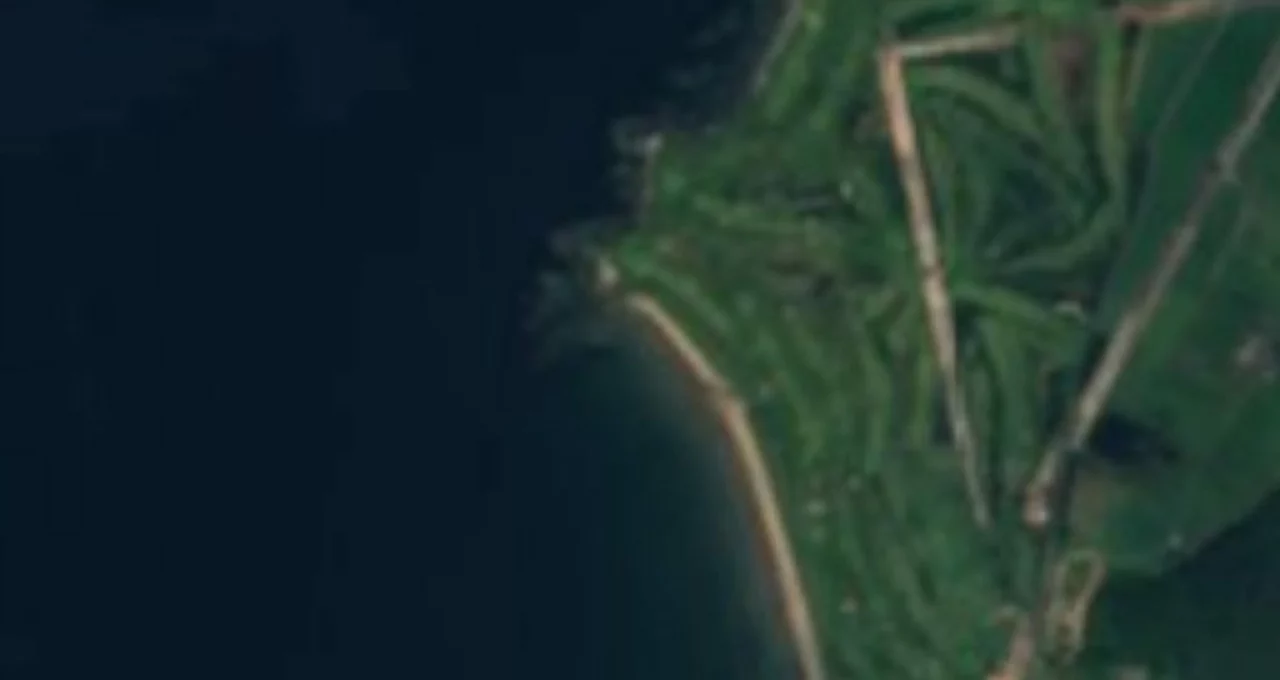
Turnberry (Ailsa Course) and its surroundings from space. Sentinel-2 cloudless 2016 satellite image by EOX IT Services GmbH (contains modified Copernicus Sentinel data), CC BY 4.0.
Turnberry (Ailsa Course)
Holes
18
By
71
Length
7,489 yards from the Black tees, par 71 (Golfshake, Top 100 Golf Courses); 6,543 yards from the White tees (Golfshake); Wikipedia's card gives 7,448 yards
Green fee
—
Best season
—
Turnberry is a links resort on the coast of South Ayrshire, in south-west Scotland, between the village of Maidens and the town of Girvan. Its address is Maidens Road, Turnberry, KA26 9LT, and Wikipedia places it about 50 miles south of Glasgow. The land runs along the Firth of Clyde, looking out to the granite island of Ailsa Craig and, on a clear day, to the hills of Arran and the Mull of Kintyre. The resort has more than one course; this page is about the Ailsa, the championship links that hosted the Open in 1977, 1986, 1994 and 2009, with a shorter section on the other courses further down.
The Ailsa is a par-71 links of 7,489 yards from the Black tees, according to the Golfshake and Top 100 Golf Courses listings. Its present layout is largely the work of Martin Ebert of Mackenzie & Ebert, who rebuilt it in 2015 and 2016 and returned for a second, smaller round of work in the winter of 2024-25. The course’s own pages are on the Turnberry website.
Since 2014 the resort has been owned by the Trump Organization, which bought it from Leisurecorp that year and renamed it Trump Turnberry, according to Wikipedia. The encyclopaedia adds that Donald Trump stepped down from his directorships in 2017 and that control passed to his sons. That is all this page says about the ownership; what follows is about the golf.
From a railway hotel to an airfield and back
Golf at Turnberry began at the start of the twentieth century. Wikipedia credits Willie Fernie, who won the Open in 1883, with an initial 13-hole course in 1901, later extended. Top 100 Golf Courses lists Fernie together with A. N. Weir as the original designers, with a revision by C. K. Hutchison in 1938. The hotel on the ridge above the links, designed by the architect James Miller, opened on 17 May 1906 alongside a railway station that served it until 1942. The sources do not agree on the founding date of the course itself: Wikipedia gives 1901, one review site 1902, and a Scottish golf guide and Wikidata 1906, the year of the hotel.
The two world wars both took the land away from golf. During the First World War the Royal Flying Corps used Turnberry as an airbase to train pilots in aerial gunnery, and the hotel served as a hospital. After 1918 the two courses were rebuilt and named Ailsa and Arran. In the Second World War the site again became an airfield, with runways laid across the links, and Wikipedia estimates that around 200 people died at the base. The 12th hole, Monument, takes its name from the memorial to the airmen of both wars that stands on the rise to its right.
It was not obvious after 1945 that the Ailsa would return. The rebuilding fell to Philip Mackenzie Ross, who between 1949 and 1951 removed the wartime concrete and reshaped the course, which reopened in 1951. His routing is the one on which the Ailsa’s championship reputation was built, and it remained essentially in place until 2015.
Four Opens and other championships
The Ailsa first hosted the Open in 1977. Tom Watson and Jack Nicklaus played the last two rounds together and pulled clear of the field; Watson won by one stroke with a total of 268, after closing rounds of 65 and 65. The contest became known as the Duel in the Sun, and in 2003 the 18th hole, until then called Ailsa Hame, was renamed after it.
In 1986 Greg Norman won by five strokes on 280, level par, with a second-round 63 among his four rounds. In 1994 Nick Price won on 268, one stroke ahead of Jesper Parnevik. In 2009 Tom Watson, then 59, came to the 72nd hole needing a par to win, made bogey and lost the four-hole play-off to Stewart Cink, who won on 278.
The course has also staged the Senior Open seven times (1987, 1988, 1989, 1990, 2003, 2006 and 2012), with Gary Player winning twice and Tom Watson winning in 2003; the Women’s British Open in 2002, won by Karrie Webb, and in 2015, won by Inbee Park; the Walker Cup in 1963; and the Amateur Championship in 1961, 1983, 1996 and 2008. All of these figures come from Wikipedia’s records of the championships. GOLF.com reports that the Bridges Cup, a match between American and international mid-amateurs, is scheduled at Turnberry from 5 to 7 October 2026.
Will the Open return?
The Ailsa has not hosted the Open since 2009, and the R&A has addressed the question several times in public. On 11 January 2021 its then chief executive, Martin Slumbers, said that the R&A had no plans to stage any of its championships at Turnberry and would not do so in the foreseeable future, adding that it would not return until it was convinced the focus would be on the championship, the players and the course itself.
His successor, Mark Darbon, has spoken about it since. In 2025 he said the R&A was carrying out feasibility work on a possible return, and that the main obstacles were logistical and commercial: road, rail and accommodation around the course. Reports from that time note that the 2009 Open drew around 120,000 spectators, while recent Opens have drawn more than twice as many. In April 2026, when the R&A named Royal Lytham & St Annes as the venue for 2028, Front Office Sports reported him as saying that Turnberry was still in the R&A’s thinking, that the R&A liked the course, and that the challenges were mainly off the course. On 15 July 2026, at the R&A’s press conference before the Open at Royal Birkdale, he said R&A teams had recently been to Turnberry to do feasibility work, which he described as usual practice at its venues, and that there was good dialogue but nothing substantial to report. No date for a return has been announced. With St Andrews hosting in 2027 and Royal Lytham in 2028, 2029 is the earliest year still open.
The resort’s own position is that it would like the Open back: when the 2024-25 works were announced, its general manager told Golf Course Architecture that Turnberry hoped to stage the championship again.
The 2016 redesign and the 2025 refinements
Martin Ebert’s work in 2015 and 2016 was the largest change to the Ailsa since Mackenzie Ross. The course closed and reopened on 1 June 2016. According to Top 100 Golf Courses and the PerryGolf blog, every tee, green and bunker was rebuilt, with sandier root zones for drainage, and five holes were completely new. The most visible change was at the lighthouse. The old 9th, a par 4 played from a tee on the rocks to a fairway on the headland, became a par 3 played across the bay to a green set below the lighthouse; the 10th became a par 5 running around Castle Port Bay with its green close to the water’s edge; and a new par-3 11th was built along the shore. The 5th and the 14th also became par 5s, the par-3 6th was given a new tee higher in the dunes, and the 17th, previously a par 5, became a long par 4. On the 18th the tee shot was redefined and a wartime bunker removed. Reviewers commonly describe the stretch from the 4th to the 11th as running continuously along the coast.
One review site credits the 2016 work to Martin Hawtree; every other source we read, including the resort, names Martin Ebert, and this page follows them.
Ebert returned in October 2024. Golf Course Architecture reported that work began on 21 October 2024 and was planned to last six months, with the course run as a nine-hole loop in the meantime. The resort says it reopened in May 2025; a travel trade report gives June. The 7th green was moved to the edge of the cliff, which Ebert described as unusual on a links; the 8th was given new tees further right, which straightened the line and removed a blind approach; new banking was built behind the greens at the 12th and 15th; and the 13th, 14th and 17th received smaller adjustments to tees and greens.
What it asks of you
The Ailsa is long from the back. Golfshake lists six sets of tees: Black at 7,489 yards (par 71, SSS 77), an Open set at 7,204 yards (par 70, SSS 74), White at 6,543 yards (par 71, SSS 73), Yellow at 6,134 yards (par 71), a Trophy set at 6,100 yards (par 69) and Red at 5,406 yards (par 74, SSS 72). Another listing gives the White tees as 6,511 yards with a course rating of 72.0 and a slope of 130, and the Black tees a rating of 77.0 and a slope of 139. Wikipedia’s scorecard totals 7,448 yards. A Scottish golf guide still prints the pre-2016 card (6,440 yards from the White tees, par 70), and Fairways Scotland gives a par of 70 for its 7,489 yards; that matches the Open set rather than the everyday par of 71.
From the back tees, Wikipedia’s card has five par 3s (the 4th, 6th, 9th, 11th and 15th) and four par 5s (the 5th, 7th, 10th and 14th). Hole lengths vary considerably between sources, because they quote different tees. The 9th, for example, is 248 yards on Wikipedia’s card and on one review site, 187 yards on a 2018 hole-by-hole review and 175 yards in GOLF.com’s preview of the 2026 Bridges Cup. The 2018 review also lists the 7th as a par 4 of 491 yards, while the back-tee card treats it as a par 5.
The holes keep the Scots names they carried before the redesign: Ailsa Craig, Mak Siccar, Blaw Wearie, Woe-Be-Tide, Fin Me Oot, Tappie Toorie, Roon the Ben, Goat Fell and Bruce’s Castle going out; Dinna Fouter, Maidens, Monument, Tickly Tap, Risk-an-Hope, Ca’ Canny, Wee Burn, Lang Whang and Duel in the Sun coming home. Several of them describe the hole. Blaw Wearie means out of breath and usually plays into the prevailing wind; Dinna Fouter means don’t mess about; Ca’ Canny means take care; Lang Whang, a long whack, is the 17th.
The wind is the main variable, and reviewers return to it constantly: on an exposed coast the same hole can play very differently from one day to the next, and the long par 4s on the back nine become difficult into a breeze. The opening holes run away from the shore. The 1st is a par 4 to a raised, bunkered green; the 2nd doglegs left to an uphill approach with bunkers at the front of the green; the 3rd is a long par 4.
The 4th, Woe-Be-Tide, moved closer to the beach in 2016 and starts the coastal run. The 5th is a par 5 that bends left below the dunes to an elevated green. The 6th, Tappie Toorie, is a par 3 played from a tee high in the dunes, which one reviewer compares with the Postage Stamp at Royal Troon. The 7th, Roon the Ben, has been the main subject of the 2025 changes: its green now sits on the cliff edge, so the approach has the sea close on one side. The 8th, Goat Fell, named after the highest peak on Arran, is a par 4 with a large green and, since 2025, a straighter line from the new tees.
The 9th, Bruce’s Castle, is the hole most photographed and most discussed. The tee shot is played over the rocky inlet towards a green below the lighthouse, with the remains of Turnberry Castle, traditionally given as the birthplace of Robert the Bruce, beside the hole. The lighthouse itself dates from the 1870s and now holds a halfway house on the ground floor and a two-bedroom suite above, according to GOLF.com. The 10th, Dinna Fouter, follows the curve of the bay as a par 5; a bunker with an island of grass in the middle, often called the doughnut bunker, sits in the lay-up zone short of the green, and GOLF.com describes it as a hole on which anything from eagle to a big number is possible. The 11th, Maidens, is a par 3 with rock along the left.
The back nine turns inland after the 11th. The 12th, Monument, has strongly contoured greens; the 13th, Tickly Tap, a large and deceptive green; the 14th, Risk-an-Hope, climbs through bunkers and heather as a par 5 and gives the last view back to the lighthouse. The 15th, Ca’ Canny, is a long par 3 with several tee angles. The 16th, Wee Burn, is a par 4 with Wilson’s Burn in front of the green and a slope that feeds weak approaches back into it; one reviewer calls it the hardest approach on the course. The 17th, Lang Whang, is a long par 4 since 2016, and the 18th, Duel in the Sun, is a par 4 whose tee shot was reshaped in the redesign, with bunkers and gorse to avoid; GOLF.com notes that birdie is hard to come by there.
The other courses at Turnberry
The King Robert the Bruce course, by Martin Ebert, opened in June 2017 on the site of the former Kintyre course, which Wikipedia says had opened in 2001 to a design by Donald Steel. The resort gives it as a par 72 of 7,203 yards; Wikipedia gives 7,204. It runs past the ruins of Turnberry Castle and has holes named after local landmarks, among them Leerie Licht, the 3rd, with the lighthouse in view, and Bruce’s Hame, a finishing par 5. Golfers may drive their own buggies on it, unlike on the Ailsa.
The nine-hole Arran course, par 31 according to Wikipedia, no longer exists in that form. Golf Course Architecture and other golf publications reported that in August 2026 it was replaced on the same land by Trump’s Twelve, a 12-hole par-3 course with holes from 70 to 206 yards, built by the resort’s own team. The resort also has a golf academy with a driving range, indoor simulators and a putting green.
What golfers say
The Ailsa is one of the most reviewed courses in Britain, on rating sites, booking platforms, golf travel blogs and in golf magazines. Golfshake shows a five-star average from more than 150 reviews, and Top 100 Golf Courses places it high in its rankings for Scotland and for Britain and Ireland. The points below summarise what recurs in that material. They are other people’s opinions, not ours, and we name no reviewer.
What comes up in its favour
- The coastal stretch from the 4th to the 11th, and the 9th to the 11th in particular, is singled out more than anything else; reviewers who knew the course before 2016 generally say the redesign improved it.
- The setting: views across the Firth of Clyde to Ailsa Craig and Arran, the lighthouse and the castle ruins.
- Condition: reviewers describe good playing surfaces and drainage, and several note the improvement since the 2016 and 2025 works.
- The history of the four Opens and the Duel in the Sun, which many visitors say is part of the reason they came.
- Service and hospitality at the resort, including the halfway house in the lighthouse.
What comes up against
- Cost is the most frequent reservation: reviewers regularly describe the Ailsa as one of the most expensive rounds in Europe, and several say the value depends on the weather on the day.
- Wind and rain can make the course very hard for higher handicaps, and the bunkers are described as severe.
- Caddies get mixed reports: some reviewers praise them, while others describe inexperienced caddies who did not know the course.
- Pace of play: a round of four and a half to five hours is often mentioned, and some groups with caddies report falling behind.
- Tee times need to be booked well ahead in season, and short winter days limit the playing window.
Getting there and when to go
Turnberry lies on the A719 coast road, off the A77 between Ayr and Girvan. Fairways Scotland puts the drive from Glasgow at around an hour and a half; Glasgow Prestwick Airport is the nearest airport, about 20 miles away by road according to a route planner. The railway station that once served the hotel closed in 1942. There is a bus link from Ayr. Booking and contact details are on the resort’s tee times page, and the resort can be reached on +44 1655 331000.
The resort’s FAQ says that non-residents can play both championship courses, booking tee times in advance online or through the resort, and that no handicap certificate is required. A golf travel guide adds that players should be of a standard equivalent to a handicap of about 24 for men and 32 for women; the resort’s own pages do not say so. The dress code requires collared shirts, tailored trousers or shorts and golf shoes, and excludes jeans. On the Ailsa, buggies are allowed only with a medical certificate and must be driven by a caddie; electric trolleys can be hired, and caddies can be booked in advance.
The resort does not publish a season. Links courses in Ayrshire are generally playable all year, and the resort charges different rates by season, but the Ailsa can be closed for work: it was shut from October 2024 into the spring of 2025. Summer gives the longest days and the most demand; spring and autumn are quieter, and several reviewers recommend them. Check the course calendar before travelling, especially around events such as the Bridges Cup.
Green fees
Rates vary by course, season and time of day and are set by the resort: see the resort’s own tee times and rates page.
How this page was made
The factual frame comes from public sources: OpenStreetMap for the location and outline of the course; the Turnberry website for the address, the course descriptions, the hole names and the 2025 works, and the resort’s FAQ on trumphotels.com for the visitor conditions, buggies, trolleys, caddies and dress code; Wikipedia and Wikidata for the history from 1901, the hotel, the wartime airfields, the Open and other championship results, the ownership, the Kintyre and Arran courses and the scorecard; Top 100 Golf Courses and the PerryGolf blog for the original architects and the 2016 redesign; Golf Course Architecture for the 2024-25 works and for Trump’s Twelve; Golfshake for the tee sets, pars and SSS; GOLF.com for the lighthouse, the Bridges Cup and the description of the 9th, 10th and 18th; Front Office Sports and other golf media for the R&A’s statements of 2025 and 2026; and press reports of January 2021 for the R&A statement of that date.
Where sources disagree, we say so. The founding date of the course is given as 1901, 1902 or 1906 (Wikidata gives 1906). One review site attributes the 2016 work to Martin Hawtree rather than Martin Ebert. The length from the back tees is 7,489 yards on Golfshake and Top 100 Golf Courses and 7,448 yards on Wikipedia; the par is 71 on most sources and 70 on Fairways Scotland, which matches the Open tees; one guide still prints the pre-2016 card. Hole lengths differ with the tees quoted, and one review lists the 7th as a par 4. The 2025 reopening is dated May by the resort and June by a trade report. The King Robert the Bruce course is 7,203 yards for the resort and 7,204 for Wikipedia. Some guides still describe the Arran and Kintyre courses, both since replaced.
The opinion section summarises reviews on Golfshake, Top 100 Golf Courses, Tripadvisor, golf travel blogs and review sites, read in October 2026. We report recurring themes rather than individual voices, and we reproduce no quotations from reviewers. Nobody from Panxis has played or visited this course, and this page is no substitute for a round.
The resort has not paid for this page, has not seen it before publication and has no say over its content. This page contains no commercial link and earns us no commission. If you know the course and something here is wrong or out of date, write to us and we will correct it.
Other courses nearby
Closest to this one in our British directory:
- Prestwick Golf Club — 15 mi
- Kilmarnock (Barassie) Golf Club — 19 mi
- Brodick Golf Club — 22 mi
- Annanhill Golf Club — 23 mi
The hole to know
Bruce's Castle: a par 3 created in the 2015-16 redesign, played from a clifftop tee across the rocks of Castle Port Bay to a green below Turnberry lighthouse, beside the remains of Turnberry Castle.