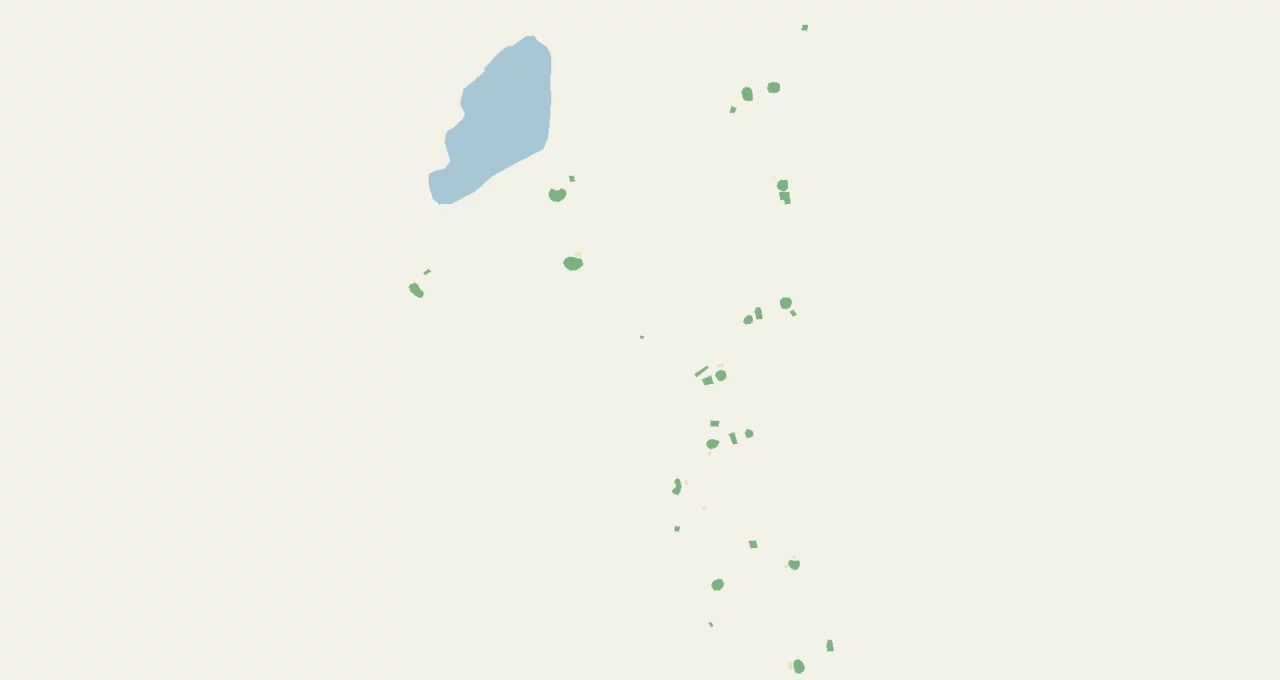
Layout of Brodick Golf Club from OpenStreetMap survey data (ODbL licence).
Brodick Golf Club
Holes
18
By
65
Length
4,750 yards from the white tees (club scorecard; the holes add up to 4,740); 4,468 yards, par 64, from the yellow tees
Green fee
—
Best season
—
Brodick Golf Club is an 18-hole course on the Isle of Arran, at the northern edge of Brodick, the island’s main village and the place where the ferry from the Ayrshire coast comes in. It lies on flat ground where the Rosa Burn reaches Brodick Bay, with the shore along one side and Goat Fell, at 874 metres the highest summit on Arran, rising behind. The club describes the course as a mixture of parkland and links golf, and says it is within walking distance of the ferry terminal. Golf directories give its postcode as KA27 8DL. Official details, the scorecard and the course plan are on the club’s own website.
By the numbers, it is a short course. The club’s scorecard gives a par of 65 over 4,750 yards from the white tees, with eight par 3s, nine par 4s and a single par 5. The yellow tees measure 4,468 yards for a par of 64, and the red tees 4,394 yards for a par of 67. Those figures put it among the shorter 18-hole courses in Scotland, but almost every source that describes it, from the club to golf directories, makes the same point: the yardage understates how hard it plays.
A club from 1897 and a course from 1913
The club dates itself to 1897, a date repeated by golf directories and by the Dutch Wikipedia entry on the course, the only encyclopaedic article about it we found. The early history is documented by Golf’s Missing Links, a site that researches courses that have disappeared, drawing on a report in the Ardrossan and Saltcoats Herald of 16 July 1897 and on Nisbet’s Golf Year Book for 1904. According to that research, the first Brodick course was a nine-hole layout designed by Jack Duncan of Glasgow for the Brodick Public Hall Company Ltd. It was officially opened on Saturday 10 July 1897, when Robert McLelland struck the ceremonial first drive.
That first course was not where the present one is. It sat in an elevated position near Knowe and West Mayish, on the slopes above the village, and its main hazards were hedges, dykes and trees rather than water or sand. The same research lists club officials in 1903 and 1904, including a secretary, a captain and a green-keeper, and records a course record of 33 for the nine holes. According to Golf’s Missing Links, the club moved to its present site, the low ground by the Rosa Burn and the bay, in 1913.
Beyond that, the record thins out. We found no source that names the designer of the course on the present site, or says when it reached 18 holes. The club’s website publishes no history page. We therefore name no architect for today’s course: Jack Duncan’s name belongs to the 1897 nine on the hill, not to the layout golfers play now.
One of seven courses on the island
Arran has an unusually dense collection of golf for an island of its size. Golf on Arran, the island’s joint golf website, lists seven courses: Brodick, Corrie, Lamlash, Lochranza, Machrie, Shiskine and Whiting Bay, and promotes an Arran Golf Pass for visitors who want to play several of them. Brodick is the closest of them to the ferry pier, and so the one that most golfers stepping off the boat will reach first.
The club also lists reciprocal arrangements with Carradale and Dunaverty, both on the Kintyre peninsula, and with St Cuthbert’s in Prestwick.
What it asks of you
The ratings tell the story better than the yardage. Golf directories that publish World Handicap System figures, among them GolfNow, Golfshake and MyGolfDays, give a course rating of 63.4 with a slope of 109 for men from the white tees, 63.2 with a slope of 109 from the yellow tees, and 66.6 with a slope of 116 for women from the red tees. These ratings are not printed on the scorecard the club publishes. A rating of 63.4 against a par of 65 means that a scratch golfer is expected to beat par, which is what a short course with eight par 3s would suggest. A slope of 109 is a little below the standard value of 113, so the course is rated slightly easier than average for a higher-handicap player. Where the challenge lies is in the detail: tight lines, trees, water and greens that are small targets for short irons.
Most of the strokes are on the par 3s. Eight of them account for more than a quarter of the white-tee yardage, and they range from 126 yards to 225. The par 4s are mostly short, from 251 yards to 398, which gives many holes a choice between an iron for position and a driver that brings trouble into play. There is one par 5, and the stroke index makes it the hardest hole on the course.
Water matters more than its share of the land would suggest. The Rosa Burn, which comes down from Glen Rosa and enters the bay beside the course, cuts through the middle of the layout. The club’s course plan shows it separating the holes around the clubhouse from the long arm of the course that runs north along the burn and the stretch that runs east along the shore. Golf on Arran describes two par 3s that need an accurate shot across the water of the Rosaburn, and the club’s local rules allow a provisional ball at the 4th and the 15th, the two holes where a ball may be lost in the burn. A small pond sits between the 17th and the 18th on the same plan. Along the bay, holes 10 to 13 run beside the beach. The local rules also deal with overhead power lines, roads and paths that count as part of the course, and young trees that must be protected.
The 18 holes
From the club’s scorecard: hole name, then white yards, yellow yards in brackets, par and stroke index for men. The scorecard also gives red tees for women with their own pars and stroke indexes, noted where the par differs.
- 1st, Cloy: 398 yards (387), par 4, stroke index 5. A par 5 from the red tees.
- 2nd, Schoolhouse: 319 yards (192), par 4 from the white tees, par 3 from the yellow, stroke index 15.
- 3rd, Fisherman’s: 163 yards (119), par 3, stroke index 7.
- 4th, Rosa: 129 yards (125), par 3, stroke index 17.
- 5th, Ben Nuis: 460 yards (460), par 5, stroke index 1.
- 6th, Turkey Oak: 272 yards (265), par 4, stroke index 13.
- 7th, Shortcut: 160 yards (156), par 3, stroke index 11.
- 8th, Firs: 170 yards (167), par 3, stroke index 3.
- 9th, Strabane: 379 yards (373), par 4, stroke index 9. A par 5 from the red tees.
- 10th, Boathouse: 398 yards (365), par 4, stroke index 10. A par 5 from the red tees.
- 11th, Ormidale: 361 yards (356), par 4, stroke index 2.
- 12th, Lagoon: 251 yards (251), par 4, stroke index 16. A par 3 from the red tees.
- 13th, Intore: 190 yards (185), par 3, stroke index 6.
- 14th, Turf Dyke: 169 yards (162), par 3, stroke index 18.
- 15th, Smacks: 126 yards (118), par 3, stroke index 8.
- 16th, Bill’s Wid: 275 yards (272), par 4, stroke index 14.
- 17th, Hendry’s Park: 295 yards (295), par 4, stroke index 4. A par 3 from the red tees.
- 18th, Memorial: 225 yards (220), par 3, stroke index 12. A par 4 from the red tees.
The opening hole is one of the two longest par 4s, 398 yards heading away from the clubhouse. The 2nd changes character with the tees: from the white tees it is a short par 4, from the yellow tees a long par 3 of 192 yards, which is why the course plays to par 64 from the yellow tees. The 3rd and 4th then bring the golfer to the Rosa Burn. The 4th, named Rosa after it, is the shortest hole on the front nine and the easiest on the stroke index, but it is one of the two holes for which the local rules provide a provisional ball, because the shot crosses the water.
The 5th, Ben Nuis, is the hole the sources single out. It is the only par 5, 460 yards from both the white and the yellow tees, and stroke index 1. Golf on Arran calls it a great par 5 with views of Ben Nuis and Ben Tarsuin, two of the peaks of the Arran hills, and GolfNow describes it as the standout hardest hole on the course, on which a par is a very good score. The club’s plan shows it running north, up the long arm of the course beside the burn, towards the 6th and the 7th at the far tip.
The 8th, Firs, is a par 3 of 170 yards but stroke index 3, harder on the card than most of the par 4s. Through the middle of the round, the 9th, 10th and 11th are the longest run of par 4s, between 361 and 398 yards, heading east and then back along the bay. The 11th, Ormidale, is stroke index 2. The 12th, Lagoon, is a short par 4 of 251 yards from both men’s tees, reachable in one for longer hitters, and a par 3 for women.
The closing stretch is mostly short holes. From the 13th to the 15th come three par 3s in a row, of 190, 169 and 126 yards. The 15th, Smacks, is the shortest hole on the course and the second hole on which the burn must be carried; the local rules again allow a provisional ball. The 16th and 17th are short par 4s, the 17th, Hendry’s Park, rated stroke index 4 despite its 295 yards. The round ends with the Memorial, a par 3 of 225 yards back to the clubhouse, the longest of the short holes and a demanding finish on a course where most par 3s ask for a short iron.
Yardages: the sources disagree
The numbers for Brodick vary from one source to the next, and we found no single published set that is clearly the current one. The club’s scorecard prints a white-tee total of 4,750 yards, but its own hole-by-hole figures add up to 4,740; the yellow and red totals, 4,468 and 4,394 yards, do add up. GolfNow and MyGolfDays give 4,747 yards from the white tees, and GolfNow gives 4,540 from the yellow tees. The club’s course page, and golfcourse.wiki after it, give 4,332 yards for the course. Golfshake lists red tees of 4,423 yards and a par of 61, which matches no other source and is probably an error. The Dutch Wikipedia article gives the lengths in metres, 4,341 for the white tees, 3,981 for the yellow and 4,067 for the red, which convert to roughly 4,750, 4,350 and 4,450 yards. The par of 65 from the white tees, 64 from the yellow and 67 from the red is consistent across the club and most directories. The course plan published with the local rules refers to rule numbers from before the 2019 revision of the Rules of Golf, so the printed material the club makes available is at least several years old. This page follows the club’s scorecard.
What golfers say
Brodick is reviewed on golf booking and rating platforms, on travel review sites and on map listings. At the time we read them, GolfPass showed an average of 4.4 out of 5 from about 70 reviews, Golfshake 4.3 out of 5 from 23 reviews, TripAdvisor between 3.8 and 3.9 from around 30 reviews, and Google 4.4 from more than 160, as reported by an aggregator. GolfNow’s UK listing showed no reviews. The points below summarise what recurs. They are other people’s opinions, not ours; nobody from Panxis has played the course, and we name no reviewer.
What comes up in its favour
- The setting is the most frequent theme: views of Goat Fell and the surrounding hills, and of Brodick Bay, are praised in reviews on every platform.
- Many reviewers say the course plays much harder than its length, and enjoy it for that: tight lines, trees and water ask for precision rather than distance.
- The two par 3s across the burn are singled out as memorable holes, and some reviewers mention the course’s feature holes in general.
- The welcome comes up often: reviewers describe friendly, helpful staff in the pro shop and the clubhouse, and some praise the food and drink.
- Convenience for visitors is a recurring point, since golfers can walk from the ferry and play on the day; groups describe it as a good stop on a golf trip to the island.
- Pace of play is described as good, and several reviewers find the course suits golfers of all levels.
What comes up against
- Condition is the main complaint, and it is inconsistent rather than uniformly poor: some reviews describe the course in excellent shape, while others report wet fairways with little grass, drainage problems and patchy, sandy or bumpy greens.
- Practice facilities are described as limited; directories mention a putting green but no driving range, and the Dutch Wikipedia article makes the same point.
- Some golfers find the narrow fairways restrictive, and some holes are described as quirky or underwhelming next to the best ones.
- At least one review considers the visit somewhat expensive for what the course offers.
- Food and drink are praised by some and described as limited by others.
- One recurring point on map listings concerns walkers rather than golfers: some people using paths across the course report confrontations with members.
Getting there and when to go
For most visitors, Brodick is reached by ferry. Caledonian MacBrayne sails from Ardrossan to Brodick, a crossing Wikipedia puts at less than an hour, and also runs a service from Troon. In 2026 CalMac has a chartered vessel on the Troon route, and it announced that between 7 September and 8 October 2026 there would be no sailings from Ardrossan because of harbour works, with all Brodick services moved to Troon. Check the current timetable on the CalMac website before travelling. There is also a route from Claonaig on Kintyre to Lochranza, at the north of the island.
The club’s visitor page gives practical advice. A golfer arriving on the mid-morning ferry can walk from the pier to the course and be on the first tee by 11.30, and one taking the early ferry can play 36 holes with lunch in between. Trains from Glasgow Central to Troon are timed to meet the ferry, and ScotRail sells combined rail and sail tickets. Foot passengers can leave their car at Ardrossan harbour; those taking a car across must book the ferry in advance and arrive 30 minutes before departure.
Visitors are welcome. Tee times can be booked online through the club’s booking system, by phone or by email, and both groups and individuals can book up to six months ahead. The club asks visitors to confirm their booking one or two weeks before the date, and sets out a cancellation policy on its visitor page, including a full refund when a ferry is cancelled or the course is closed, and flexibility for delayed ferries. Buggies, trolleys and clubs can be hired from the pro shop, which also sells golf supplies and club clothing. The clubhouse has a restaurant and bar overlooking the course.
The club does not publish a season as such, but it sets separate visitor rates for April to October and for November to March, which indicates that the course stays open through the winter, weather permitting. Given the reviews about wet ground, golfers visiting outside the summer months may want to check conditions with the club first. The club’s open competitions, a ladies’ tri-am in May, the Arran Open for men in June and a men’s senior open in September, are worth knowing about, either to enter or to avoid when booking a casual round. The live webcam on the club’s website gives an idea of the weather before setting out.
Green fees
Visitor rates, including the separate summer and winter rates and the cost of buggy, trolley and club hire, are set by the club: see the club’s visitor information page.
How this page was made
The factual frame comes from public sources: OpenStreetMap for the location of the course; the club’s website for the description of the course, its scorecard (hole names, yardages, pars and stroke indexes), its course plan and local rules, the visitor information on booking, ferries, trains and hire, the clubhouse, the reciprocal clubs and the open competitions; Golf’s Missing Links, citing the Ardrossan and Saltcoats Herald of 1897 and Nisbet’s Golf Year Book of 1904, for the 1897 nine-hole course, its designer, its opening and the move of 1913; Wikidata and the Dutch Wikipedia article for the identification of the course, its founding date and its lengths in metres; Golf on Arran for the holes across the Rosaburn, the par 5 and the other courses on the island; GolfNow, Golfshake and MyGolfDays for the course and slope ratings and their yardages; the English Wikipedia article on Brodick for the ferry crossing time and the height of Goat Fell; and the Caledonian MacBrayne website for the 2026 ferry arrangements.
Where sources disagree, we say so. The white-tee total is 4,750 yards on the club’s scorecard, 4,740 when its holes are added up, 4,747 on GolfNow and MyGolfDays, and the club’s course page gives 4,332 yards. The yellow tees measure 4,468 yards on the card and 4,540 on GolfNow. Golfshake gives a par of 61 that no other source supports. One directory describes the 3rd as a par 4 with a dogleg, while the club’s card makes it a par 3; we follow the card. No source we found names the designer of the present course, and the only architect on record, Jack Duncan, designed the 1897 course on a different site.
The opinion section summarises reviews on golf booking and rating platforms, travel review sites and map listings, read in October 2026. Some platforms, including TripAdvisor and GolfPass, blocked direct access, and we relied on the summaries and excerpts available to us. We report recurring themes rather than individual voices, and we reproduce no quotations from reviewers. Nobody from Panxis has played or visited this course, and this page is no substitute for a round.
The club has not paid for this page, has not seen it before publication and has no say over its content. This page contains no commercial link and earns us no commission. If you know the course and something here is wrong or out of date, write to us and we will correct it.
Other courses nearby
Closest to this one in our British directory:
- Kilmarnock (Barassie) Golf Club — 20 mi
- Prestwick Golf Club — 22 mi
- Turnberry (Ailsa Course) — 22 mi
- Annanhill Golf Club — 25 mi
The hole to know
Ben Nuis: the only par 5, 460 yards from the white and yellow tees and stroke index 1, running north beside the Rosa Burn with views of Ben Nuis and Ben Tarsuin.