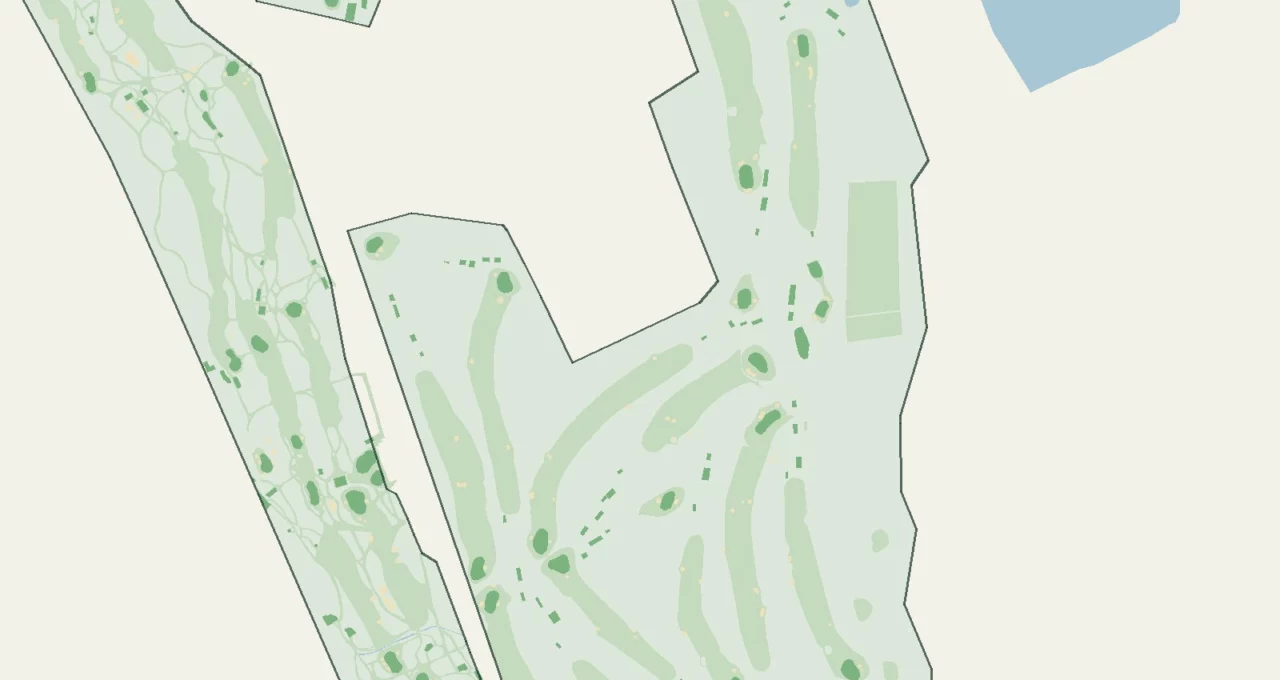
Layout of Dundonald Links from OpenStreetMap survey data (ODbL licence).
Dundonald Links
Holes
18
By
72
Length
7,100 yards from the championship tees, 6,725 medal, 6,370 middle, 5,595 front (club course guide); 7,272 yards from the black tees on the rated card (Stymie)
Green fee
—
Best season
Year-round; the club publishes rates for every month, main season early May to mid-October
Dundonald Links is an 18-hole links on Ayr Road at Gailes, on the Ayrshire coast between Irvine and Troon, postcode KA11 5BF. It is a modern course on old golfing ground. The first Dundonald layout was laid out by Willie Fernie, the 1883 Open champion, and opened in 1911; the present course was designed by the Californian architect Kyle Phillips, best known for Kingsbarns, after Loch Lomond Golf Club bought the site in 2003. The club’s current course guide makes it 7,100 yards and par 72 from the championship tees; the rated card published by Stymie stretches it to 7,272 yards from the black tees, with a course rating of 76.0 and a slope of 139. Since 2019 it has belonged to Darwin Escapes, which added a clubhouse, rooms and lodges that opened in 2021.
It sits in a crowded neighbourhood. Top 100 Golf Courses notes that Dundonald lies next to Kilmarnock (Barassie), Glasgow Gailes and Western Gailes, all much older links, and Stymie puts Western Gailes at no distance at all, which is roughly right: the two are separated by the railway. In that company Dundonald is the newcomer with the hotel attached. It has nevertheless built a tournament record of its own, including the Scottish Open of 2017, several editions of the Women’s Scottish Open and Final Qualifying for The Open. Top 100 Golf Courses currently ranks it 39th in Scotland and 5th in its Ayrshire and Arran list.
Fernie, the army and Kyle Phillips
The club’s history page tells the earlier story in some detail. Dundonald Links was formally constituted on 23 March 1911 and opened within three months, on a course Fernie laid out with John Tulloch, the professional at Glasgow Gailes, supervising the work. At about 6,700 yards it was, according to a local newspaper of June 1911 quoted by the club, one of the longest courses in the country, a bold length in the early years of the rubber-cored ball. A clubhouse followed and was formally opened in 1913, when the factor to the Duke of Portland announced that the Duke would present a cup for an annual competition.
The club’s history then turns into a list of interruptions. The course closed in 1918 and did not reopen until June 1920, when an open amateur tournament marked the occasion; in 1922 James Braid supplied a new bunkering plan. In 1940 the army commandeered the course and the clubhouse, and the club secretary of the day recorded that the links was unrecognisable within a week. The military kept the site as a camp into the 1960s. Top 100 Golf Courses adds that it was known as Dundonald Camp and that landings for D-Day were rehearsed there, and that the name Dundonald is said to mean Fort Donald, with fortifications nearby going back to about 200 BC.
The modern course began as part of a golf and residential project called Southern Gailes. According to Top 100 Golf Courses, the housing never happened, and Loch Lomond Golf Club bought the course in 2003 to give its members a links to go with their parkland course on the loch, commissioning Phillips to finish the design. The club says Phillips first saw the ground in 2003. His stated approach, quoted on the club’s website, was to use the strongest natural features of the site and build grander landforms over the rest. The result is a links of dunes, gorse and burns that also has, unusually for the coast, stretches framed by pine trees.
In 2019 Loch Lomond sold the course to Darwin Escapes, which the club says launched a large development plan that included further course work with Phillips himself, a new clubhouse and accommodation. The clubhouse is built of local whinstone with a roof planted with dune grass, and houses the Canny Crow restaurant, a whisky room, a gym and the golf shop. Wikipedia reports that it was named best clubhouse in Scotland in 2025, the second such award in three years.
The tournament record
The club lists the events in order. Dundonald hosted the first stage of European Tour Qualifying School from 2008 to 2011, Senior Open qualifying in 2012 and the Boys Amateur Championship in 2014. The Ladies Scottish Open came in 2015 and 2016, and the men’s Scottish Open in 2017, when Rafa Cabrera Bello closed with a 64 and beat Callum Shinkwin in a play-off. The Women’s Scottish Open has been played here every year since 2022, under a succession of sponsors’ names; the club says Lottie Woad won the 2025 edition in her first event as a professional, at 21 under par and by three shots. Dundonald was also one of the four venues of Final Qualifying for the 2026 Open, on 30 June 2026, alongside Burnham and Berrow, Royal Cinque Ports and West Lancashire.
What the course asks of you
The club’s own summary is generous fairways, undulating greens and a wide choice of tees, and the hole guide bears that out. Par is 72, made of ten par 4s, four par 3s and four par 5s, split evenly between the nines at 36 each. On the club’s guide the championship tees measure 3,550 yards out and 3,550 back for 7,100 yards, the medal tees 6,725, the middle tees 6,370 and the front tees 5,595. The rated card on Stymie, which reflects the course as currently measured for handicap purposes, gives the black tees at 7,272 yards (76.0 and 139), the blue at 6,831 (74.0 and 135), the white at 6,422 (72.2 and 130) and the red at 5,527 yards, rated 72.9 with a slope of 134. Stymie also lists a separate set used for Open qualifying in 2026, 7,213 yards with a slope of 143, which is a reminder of what the course can be when it is asked to defend itself.
The opening hole is not a gentle handshake: a par 4 of 460 yards from the back, to a green with a bunker 20 yards short and all the trouble on the left. The 3rd, the first of the par 5s at 540 yards on the club’s guide, has a ditch encroaching from the right, and the club advises laying up short of a fairway bunker from the tee. The 4th is a par 3 of 215 yards that usually plays into the prevailing wind. The 6th, only 170 yards, is the one the club calls very tricky, with a cavernous ditch to the left and a right to left wind that is hard to read from a sheltered tee. The 7th is a right to left dogleg of 405 yards with deep revetted bunkers and a green 27 yards long; the 8th, 395 yards, plays to a plateau green with the Isle of Arran behind it.
The back nine opens with the 10th, 465 yards to a 38-yard green with no protection at the front, on which the club advises aiming at the 11th green in the distance. The 11th is the hole most visitors talk about afterwards. At 120 yards it is the shortest on the course, with large bunkers across the front, a steeply sloped green and, behind it, a deep pot that GolfMagic and several reviewers call the Cauldron and that cannot be seen from the tee. The 12th, 350 yards, is the shortest par 4, a plateau fairway and a flat elevated green with three hidden pot bunkers and a view of the Firth of Clyde. The 13th, 410 yards, runs beside the railway to a two-tier green behind a meandering ditch.
The finish is stern. The 15th is a par 3 of 215 yards that, in the club’s words, plays every inch of its length, to a small green with a large bunker front left. The 16th, 470 yards into the prevailing wind, is stroke index 1 on the Stymie card and the hole the club calls the hardest on the course, with a long approach to a two-tier green; the club’s own advice is that a bogey there is still a good score. The 17th is a right to left dogleg of 420 yards whose corner the club recommends against cutting, and the 18th is the longest hole, a par 5 of 560 yards with cross bunkers, a ditch in front of the green and pot bunkers behind it, overlooked by the clubhouse balcony.
Two practical points. The club requires golf shoes on the course, and its information for players sets out a fog policy: no play starts if the first bunker on the left of the 1st fairway cannot be seen from the white tee, and one long blast on the horn means everyone leaves the course.
What golfers say
Dundonald is reviewed at length on Top 100 Golf Courses, where 75 ratings give an average of 4.5 out of five, with its facilities scored highest and its variety lowest; GolfMagic, Golf Monthly and Bunkered have also published reviews. The points below summarise what recurs. They are other people’s opinions, not ours. Nobody from Panxis has played the course, and we name no reviewer.
What comes up in its favour
- The clubhouse, the practice ground and the staff. Even reviewers who are lukewarm about the course describe the facilities as first class, and one reviewer who knew the old, basic clubhouse found the new one transformed the visit.
- The green complexes: large, undulating greens with steep run-offs that reward imagination around them.
- The 11th, a short hole that reviewers say can give up a birdie or a double bogey with equal ease, and the strong finish, particularly the 16th and the par 5 18th.
- The sense of seclusion. Several reviewers note that each hole feels insulated from the others and that other groups are rarely in sight.
- Playability. With four or five sets of tees, reviewers find it a fair test for most handicaps and a genuine one from the back.
What comes up against
- It is a man-made links, and some traditionalists say so. The phrase American style recurs in reviews, sometimes attributed to the starter himself, along with the view that the course is more solid than spectacular next to its older neighbours.
- The challenge can feel repetitive, and the severity of the run-offs punishes a player who is not striking the ball well. Choosing the right tee matters.
- Fairway bunkers and burns are penal; one reviewer treats a fairway bunker as close to a penalty stroke.
- Green speed has been inconsistent at times, with complaints of slow greens after spring overseeding and of a practice green running slower than the course.
- For a links, some fairways are narrower than visitors expect, and trees come into play on a few holes.
Getting there and when to go
The club says Dundonald is about 10 minutes from Glasgow Prestwick Airport, 30 minutes from Glasgow Airport and around an hour and a half from Edinburgh Airport. From Glasgow, take the M77 south towards Kilmarnock and Ayr, follow the A78 towards Irvine at the Dutchhouse roundabout and continue north for 5 miles; at the next roundabout take the second exit, and the entrance is half a mile further on the left. By rail, the club points golfers to the regular trains from Glasgow to Prestwick and a taxi from there. The car park sits east of the clubhouse, and there is accommodation on site in rooms and lodges for those who would rather not drive at all.
Visitors are welcome and book tee times online, with instant confirmation; groups of fewer than four may be paired with others. Top 100 Golf Courses notes that the course is open seven days a week, which matters on a coast where several neighbours restrict visitors to certain days. Caddies, hire clubs, electric trolleys and buggies with GPS are available and should be booked ahead, according to the club. The club publishes rates for every month of the year, so the course plays all year, with the main season running from early May to mid-October. Scottish residents have a dedicated rate on limited tee times early in the year, bookable online up to 14 days ahead with photographic identification and proof of address on the day. Bookings more than a year ahead go through the reservations team.
The wind comes off the Firth of Clyde, and the club’s hole notes repeatedly mention the prevailing wind; pack layers whatever the month. Nearby courses in this directory include Kilmarnock (Barassie) a short drive south, Prestwick and Turnberry, whose Ailsa course was also first laid out by Willie Fernie. Phillips’s earlier links on the other coast is Kingsbarns.
Green fees
Visitor rates vary by season and by day of the week, with separate rates for residents of the resort and for Scottish residents. They are published by the club on its green fees page, and tee times are booked through its online booking system.
How this page was made
The factual frame comes from public sources: OpenStreetMap for the location; the club’s website, read in October 2026, for the address, the 1911 history, the Phillips design, the change of ownership, the tournament record, the hole-by-hole guide and its yardages, the clubhouse, the directions, the booking arrangements, the caddie and hire services and the information for players; the rated card published by Stymie for the course ratings, slopes, stroke indexes and current measured yardages; Top 100 Golf Courses for the Southern Gailes project, the wartime camp, the 2019 sale, the rankings and the 75 ratings; GolfMagic for the Cauldron bunker and the review themes; Golf Monthly and Bunkered, as indexed, for review themes; GolfPass, as indexed, for an older card; the English Wikipedia article for the clubhouse award; Wikidata for the identifiers.
Where sources disagree, we say so. The opening date of the modern course is 2005 for Top 100 Golf Courses and GolfMagic, while several other sources say 2003, the year Loch Lomond bought the site and Phillips first saw it; the club does not give an opening year. Lengths differ: the club’s hole guide gives 7,100 yards from the championship tees and 5,595 from the front; Stymie’s rated card gives 7,272 from the black and 5,527 from the red; GolfPass, as indexed, gives 7,100 yards rated 76.3 with a slope of 138; one review gives 5,627 yards from the reds; Top 100 Golf Courses says 6,415 to 7,300 yards. The white tees are 6,422 yards (72.2 and 130) on Stymie and Golfify but 6,340 yards (71.7 and 135) on GolfPass, and 6,370 yards for the middle tees on the club’s guide. The club’s own pages disagree on the Ladies Scottish Open, one listing 2015 and 2016 and another 2015, 2016 and 2017. Wikipedia credits the course to Willie Fernie and gives Loch Lomond Golf Club as owner, which describes the original layout and the owner before 2019; Wikipedia places the course in North Ayrshire and Wikidata in South Ayrshire. We follow the club’s account and the address.
The opinion section summarises reviews on Top 100 Golf Courses, GolfMagic, Golf Monthly and Bunkered, read in October 2026. We report recurring themes rather than individual voices, and we reproduce no quotations from reviewers. Nobody from Panxis has played or visited this course, and this page is no substitute for a round.
The club has not paid for this page, has not seen it before publication and has no say over its content. This page contains no commercial link and earns us no commission. If you know the club and something here is wrong or out of date, write to us and we will correct it.
Other courses nearby
Closest to this one in our British directory:
- Western Gailes Golf Club — 0 mi
- Kilmarnock (Barassie) Golf Club — 1 mi
- Annanhill Golf Club — 5 mi
- Prestwick Golf Club — 5 mi
The hole to know
Par 3 of 120 yards, the shortest hole on the course: large bunkers across the front, a steeply sloped green and a deep pot bunker behind it, hidden from the tee.