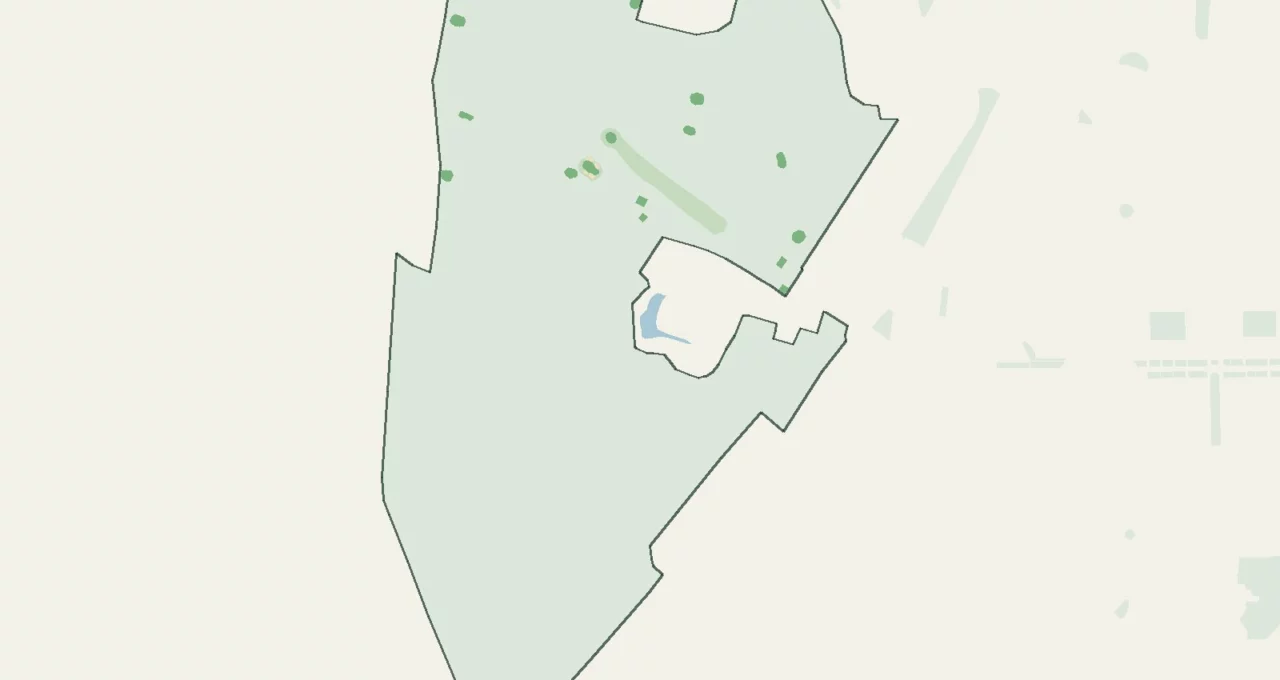
Layout of Caprington Golf Club from OpenStreetMap survey data (ODbL licence).
Caprington Golf Club
Holes
18 (plus a separate 18-hole footgolf course)
By
69 from the white and red tees, 68 from the yellow tees (club scorecard)
Length
5,832 yards from the white tees, 5,439 yellow, 4,980 red (club scorecard); other sources give 5,300 to 5,483 yards for older layouts
Green fee
—
Best season
Open to visitors every day, 7am to 8pm according to the club's visitors page
Caprington is an 18-hole parkland course on Ayr Road, on the south-western edge of Kilmarnock in East Ayrshire. It is the older of the town’s two public courses: it opened in 1909 as Kilmarnock Municipal Golf Course, and the members’ club that plays over it took the name Caprington Golf Club in 1958. Since July 2015 the course and clubhouse have been run by the members themselves, as Caprington Community Golf Club, after a community asset transfer from the local council and its leisure trust. The club’s website is capringtongolfclub.com.
The current scorecard, published on the club’s website, gives a par of 69 and 5,832 yards from the white tees, with a course rating of 69.3 and a slope of 122. It is short by modern standards, and the shortness is shaped by an unusual card: five par 3s, two par 5s, and two of the short holes over 200 yards. The course is open to visitors every day, and alongside it the club runs a separate 18-hole footgolf course, the version of the game played by kicking a football into oversized holes.
From a council course to a community club
The club’s own history page is the main account of the early years. Plans for a municipal course were drawn up through 1907 and 1908, and on 13 March 1909 the Kilmarnock Standard published the planned layout. On 18 May 1909 Kilmarnock Municipal Golf Course was formally opened for play by Councillor H. S. Dunn. The club is candid about what it does not know: there are no firm records of when the first golf club took up residence, and from trophies still played for today it infers that the first club to treat the course as home was the Ossington Club, from around 1916. In 1934 or 1935 that club became the Umberley Club, named, it seems, after Umberley House on the estate, and it remained so until 1958.
The research site Golf’s Missing Links, which documents lost and altered courses, adds detail from the Golfer’s Handbook and the Kilmarnock Herald. It says the course was also known as the Riccarton course, after the nearby village; that the first professional, from 1909, was David Kilpatrick, who is also listed as greenkeeper in the late 1920s and 1930s; and that John Anderson, a son of the Open champion Jamie Anderson, set a course record of 70 in June 1909. Its entries from the Golfer’s Handbook show a membership of around 600 in the late 1920s and 1930s. The landowner kept grazing rights under the lease to the town, it adds, so there were always sheep on the course.
In 1958 the club’s founding members drew up the constitution that changed its name to Caprington Golf Club. The club says there is no definitive record of why. It suggests that the opening of Kilmarnock’s second public course, Annanhill, in 1957 may have prompted the committee to choose a name more representative of the local area and of the estate land it occupies. The same year, the club notes, the local paper reported a referendum on whether golf should be allowed on a Sunday, with some local ministers firmly against.
The course of 1968
The course played today is not the one opened in 1909. According to the club, the Cunninghame family’s Caprington Estate, which leased the ground, needed some of it back for building, including Umberley House, and made new ground available in exchange. On that ground Kilmarnock’s resident professional, Jack McLean, designed and laid out a new 18-hole course and a 9-hole course for, in the words of the newspaper report the club quotes, the less energetic. Golf’s Missing Links dates the sale of a large part of the old course to a private builder to 1966 and says many of the old holes and the original clubhouse were lost.
The new courses and a first purpose-built clubhouse with locker rooms were opened on 31 May 1968. The club records that the president of the Scottish Golf Union attended and remarked that the town now had two 18-hole courses and a 9-hole course for its residents. After the official lunch, four professionals played a foursome over the new course: Frank Rennie of Prestwick and Jack McLean against W. S. McDonald of Prestwick St Nicholas and Matthew McCrone of Strathaven, the second pair winning by 3 and 2. As laid out, the club says, the course measured 6,551 yards with a standard scratch score of 71, and its 9th hole, at 598 yards, was reckoned to be the longest in Scotland. Today’s card is more than 700 yards shorter, and its longest hole is 542 yards; the club does not describe when or why the layout changed.
Membership grew, and the council-built clubhouse soon proved too small. In 1978 and 1979 the club bought land directly from the estate, and in 1980 it opened its first privately owned clubhouse, a timber building. In 1989 committee and members extended it into the clubhouse used today. In 2015, after years of preparation with East Ayrshire Council and East Ayrshire Leisure Trust, the course was transferred to Caprington Community Golf Club, managed by a board of directors through a limited company; the club gives the date of the handover as 6 July 2015. A leisure trust document on sport in Kilmarnock confirms the transfer and describes the club as offering an 18-hole parkland course, youth programmes, regular tournaments and a separate 18-hole footgolf course.
The ground has an older history. Historic Environment Scotland’s inventory of the designed landscape of Caprington Castle, the Cunninghame family’s seat a little under a mile to the north-west, records that the landscape has been compromised by the building of a golf course, and that a golf clubhouse occupies a site near the entrance to the south-east drive. A walking guide that crosses the course describes the ruin of Blacksyke Tower beside the path, an engine house from the days of the Caprington coal mines; the 2nd hole on the card is named Tower.
Who laid it out
The club credits Jack McLean, Kilmarnock’s resident professional, with the 1968 courses. Golf’s Missing Links names John McLean as professional and greenkeeper at Caprington from the Second World War until his retirement in 1974, says he designed and laid out Annanhill, opened in April 1957, and says he built the new 18-hole and 9-hole courses at Caprington after the 1966 sale. The Dutch Wikipedia article also credits Jack McLean. It seems very likely that these are the same man, Jack being a common form of John, but no source we read says so in as many words. Two online directories credit James Braid with a design in 1927; we found nothing to support that, and it does not fit the club’s own history.
What it asks of you
The figures below come from the scorecard on the club’s website. There are three sets of tees. From the whites the course measures 5,832 yards, par 69, with a course rating of 69.3 and a slope of 122. From the yellows it is 5,439 yards, par 68, rating 67.6 and slope 117. From the reds it is 4,980 yards, par 69, rating 69.6 and slope 117. The one difference in men’s par between tees is the 5th, a par 4 of 272 yards from the whites that becomes a par 3 of 207 yards from the yellows. A slope above 113 means the course plays somewhat harder for a higher-handicap golfer than the rating alone suggests.
The front nine is 2,881 yards and par 34 from the whites; the back nine is 2,951 yards and par 35. The par 3s are the defining feature. Two of the five, the 4th at 226 yards and the 11th at 207 yards, are long enough to call for a wood or a long iron for many golfers, while the 2nd, at 124 yards, is a short pitch. The stroke indexes put the hardest holes in a run on the front nine: the 6th, Loudoun View, at 447 yards, is index 1, and the 7th, Cunningham, at 443 yards, is index 3. On the back nine the 13th, Spittal Hill, is the longest hole on the course and index 2.
Directories describe the course as parkland, with tree-lined fairways, small greens and natural water hazards. The club itself publishes no hole-by-hole notes, so we cannot describe individual holes beyond the card; its course page singles out four of them with photographs, the 2nd, the 8th, the 14th and the 18th.
The card, hole by hole
White yardage first, then yellow and red, with the men’s par and stroke index.
- 1st, Umberley: par 4, 389 yards (359, 358). Index 11.
- 2nd, Tower: par 3, 124 yards (107, 98). Index 15.
- 3rd, Fir Wood: par 4, 346 yards (297, 250). Index 9.
- 4th, The Bell: par 3, 226 yards (218, 211). Index 5.
- 5th, Up and Over: par 4, 272 yards; par 3, 207 yards from the yellows (203 from the reds, par 4). Index 17.
- 6th, Loudoun View: par 4, 447 yards (441, 381). Index 1.
- 7th, Cunningham: par 4, 443 yards (433, and a par 5 of 428 yards from the reds). Index 3.
- 8th, Damhead: par 4, 328 yards (321, 304). Index 7.
- 9th, Elbow: par 4, 306 yards (298, 255). Index 13.
- 10th, Plateau: par 4, 334 yards (307, 275). Index 12.
- 11th, Earlston: par 3, 207 yards (193, 188). Index 8.
- 12th, Caprington: par 4, 261 yards (256, 249). Index 18, the easiest hole on the card.
- 13th, Spittal Hill: par 5, 542 yards (490, 415). Index 2.
- 14th, Auld Road: par 4, 382 yards (364, 359). Index 10.
- 15th, White House: par 4, 359 yards (333, 306). Index 6.
- 16th, Wee Mary: par 3, 192 yards (178, 176). Index 4.
- 17th, Peace and Plenty: par 5, 503 yards (472, and a par 4 of 364 yards from the reds). Index 14.
- 18th, Hame: par 3, 171 yards (165, 160). Index 16.
Several names point to the surrounding landscape: Earlston is a hamlet just beyond the course, Umberley recalls the house and the club’s old name, and Hame, the closing hole, is Scots for home. The round finishes on a par 3, which is uncommon. The 12th, at 261 yards, is the shortest par 4 and the hole the card rates easiest.
What golfers say
Public reviews of Caprington are fewer than for the better-known Ayrshire courses. The material we found is a review summary on Wanderlog drawn from Google reviews, the rating on the Hole19 app, where the review text was not visible to us, and short descriptions in golf directories. The points below summarise what recurs. They are other people’s opinions, not ours; nobody from Panxis has played the course, and we name and quote no one.
What comes up in its favour
- Value for money is the most consistent theme, with the course described as exactly what a community course should be.
- Course condition is praised, in particular true greens and well-kept fairways.
- Members, staff and the starter are described as friendly and accommodating.
- The course is considered an easy walk and not overly long, which suits golfers who carry their own bag.
What comes up against
- There are no buggies for hire, according to the review summary; the club’s website does not mention any.
- Hospitality is described as limited, and one summary advises bringing refreshments. That conflicts with the club’s own clubhouse page, which lists food on Saturdays and Sundays; the bar’s weekday hours are evenings only, which may explain the difference.
- The modest length means the course will not test a strong player in the way the nearby coastal links do.
Facilities and how to play it
The club’s visitors page says the course is open to visitors every day from 7am to 8pm, and that tee times are booked through the starter’s office on 01563 521915. Visiting parties are welcome, with golf-only or golf-and-catering packages; catering for groups is arranged by email to capringtonbookings@gmail.com. Annual membership application forms, which require a recent photograph, are available from the starter’s office.
The clubhouse, according to the club, has separate dining and lounge areas, a bar with a large-screen television, pool and snooker tables, a golf simulator room, a dance floor, a stage and a projector. The kitchen serves snacks and meals all day on Saturdays and Sundays and caters for functions on request. The bar opens in the evenings on weekdays, from midday on Fridays in summer and from late morning at weekends; the steward can be reached on 01563 535904. The club’s home page lists regular competitions and social matches for members, and the access to the simulator and function suite that comes with membership.
Footgolf Kilmarnock, the club’s 18-hole footgolf course, is separate from the golf course and booked through the same starter’s office; football colours are not allowed in the clubhouse. The 9-hole golf course of 1968 is described in older sources, and the Dutch Wikipedia article gives it a par of 30, but the club’s current website mentions only the 18-hole course, and we could not confirm whether the short course is still played. One golf directory lists a practice area and a putting green; the club does not describe its practice facilities.
Getting there and when to go
The club’s address is Ayr Road, Caprington, Kilmarnock, KA1 4UW, on the south-western edge of the town. Annanhill, Kilmarnock’s other public course, is about two and a half kilometres to the north-north-west in a straight line, going by the two courses’ coordinates in OpenStreetMap, which makes the two courses easy to combine on a trip based in the town. One directory notes easy access from the A77 and from Glasgow. A walking route described online starts from the club car park, and its author asks walkers to park elsewhere when the course is busy.
The course is open all year, and the club’s daily hours, 7am to 8pm, apply without a seasonal distinction on its visitors page; a third-party listing gives shorter hours, so check with the starter, especially in winter, when daylight in Ayrshire ends in mid-afternoon. A short, inland parkland course is a sensible alternative when wind makes the coastal links hard work.
Green fees
Daily tickets for adults, concessions and children are set by the club: see the club’s visitors page for current prices.
How this page was made
The factual frame comes from public sources: OpenStreetMap for the location and outline of the course; Wikidata for the identifiers; the Caprington Golf Club website for the history from 1909 to 2015, the 1968 layout and opening match, the designer, the scorecard with its yardages, pars, stroke indexes, course ratings and slopes, the visitors’ arrangements, the clubhouse, the footgolf course and the address; Golf’s Missing Links for the Riccarton name, David Kilpatrick, John Anderson’s record, the membership figures, the grazing sheep, the 1966 land sale and John McLean’s career; an East Ayrshire Leisure document for the 2015 transfer and the footgolf course; Historic Environment Scotland’s inventory of Caprington Castle for the estate and its golf course; a walking guide for Blacksyke Tower; the Dutch Wikipedia article for an older scorecard; GolfPass for a confirmation of the current white-tee rating and slope; and Wanderlog, Hole19 and golf directories for the opinions and descriptions summarised above.
Where sources disagree, we say so. The opening year is 1909 on the club’s site, Golf’s Missing Links and Wikipedia; one directory gives 1911, another 1927 with James Braid as architect, and GolfPass gives 1958, the year of the present club name. Par is 69 on the club’s card and on GolfPass; the Dutch Wikipedia article, citing a 2012 guide, gives 68 from the whites, 67 from the yellows and 70 from the reds, over a layout with a par-4 17th; another scorecard site gives 67 and 5,483 yards, and one directory gives 68 and about 5,300 yards. The Dutch Wikipedia article says the 1909 course began with nine holes, while Golf’s Missing Links describes an 18-hole and a 9-hole course from the start; the same article’s account of the 1958 Sunday golf referendum and of the 1966 sale does not match the club’s history or Golf’s Missing Links, and we have followed the latter two. Two directories name a par-3 7th with a water hazard as the signature hole, but the 7th on the current card is a par 4 of 443 yards, and no water is marked on it. The club’s daily hours differ from those on a third-party listing. Golf’s Missing Links calls the designer John McLean, the club Jack McLean. The 1golf.eu, GolfPass and Golfify pages refused our requests, and we found no Golfshake page for the course.
The opinion section summarises reviews and directory descriptions read in October 2026. We report recurring themes rather than individual voices, and we reproduce no quotations from reviewers. Nobody from Panxis has played or visited this course, and this page is no substitute for a round.
The club has not paid for this page, has not seen it before publication and has no say over its content. This page contains no commercial link and earns us no commission. If you know the course and something here is wrong or out of date, write to us and we will correct it.
Other courses nearby
Closest to this one in our British directory:
- Annanhill Golf Club — 1 mi
- Kilmarnock (Barassie) Golf Club — 5 mi
- Dundonald Links — 6 mi
- Western Gailes Golf Club — 6 mi
The hole to know
Hame: a par 3 of 171 yards from the white tees (165 yellow, 160 red) that closes the round, an uncommon finish; the club features it among the four holes pictured on its course page.