Putting at home through frost and temporary greens: three carpet drills for a British winter
Frost on the greens and a hole cut in the approach do your putting no favours. A strip of hallway carpet, two coins, a cup and some masking tape can keep your start line, your pace and your nerve in shape until spring, as long as you know what a floor will never teach you.
In brief
- A carpet is flat and slower than a green, so it cannot teach reading or exact pace, but it trains start line, stroke length and pressure well.
- Coin gate: two coins only just wider than the ball, a few inches ahead. Twenty putts, count the ones that pass without a touch.
- Cup drill: four balls at three feet, all in a row or start again. Skirting-board ladder: finish short of the wall from three distances with one beat.
- BIGGA explains why frozen greens are kept closed, and the Himalayas at St Andrews opens daily only from April. Recalibrate on long putts first in spring.
It is a Saturday in January, the frost has not lifted, and the notice in the clubhouse window says temporary greens all day. You can still go out and putt into a hole cut in the approach, or you can stay in and do something more useful on the hallway carpet. Most golfers who choose the hallway waste it. They tap balls into a mug from a couple of feet, hole nearly all of them, and go to bed believing their putting is in good order. A few weeks later they step onto a proper green in March and leave the first putt eight feet short. The carpet did not let them down. They simply asked it the wrong questions. Asked the right ones, a strip of floor will keep three parts of your putting sharp until spring: where the ball starts, how far it rolls, and whether you hold your nerve over the short one. Here is how to ask them, and what a British winter adds to the picture.
Be honest about what a floor can do
Start with the limits, because they shape everything else. A carpet is flat, it has no grain worth the name, and it is almost always slower than a green that has been cut and rolled. No amount of time on it will teach you to read a slope, and it will never tell you how quickly the 7th at your club runs in May. If someone promises otherwise, check what they are selling.
What a floor does reproduce faithfully is the first few inches of every putt. The direction the face points when it meets the ball sends the ball off on its line, whether the surface underneath is wool, nylon or fine bent grass. The length of your backstroke, and the beat you swing it to, decide how firmly the ball is struck, and a stroke that repeats on the carpet tends to repeat on grass. Your routine, your patience and the little jolt of nerves over a putt you have to hole are just as real in the spare room as on the 18th.
So divide the work cleanly. Indoors, you train start line, stroke length and pressure. Outdoors, when the real greens are back, you learn the reads and fine-tune the pace. Accept from the start that the first outing in spring will need half an hour of adjustment, and it will not come as a shock.
Choosing your strip of floor
Look for the longest straight run in the house. In a lot of British homes that is the hallway or the landing, and four or five yards of it is plenty. A short-pile carpet is ideal, because the ball rolls true and does not wander in the fibres. A deep, soft carpet will make the ball hop and die, which tells you nothing. Laminate, wooden boards and kitchen tiles are far too quick for any work on distance, although they are perfectly good for the start-line drill, where pace hardly matters.
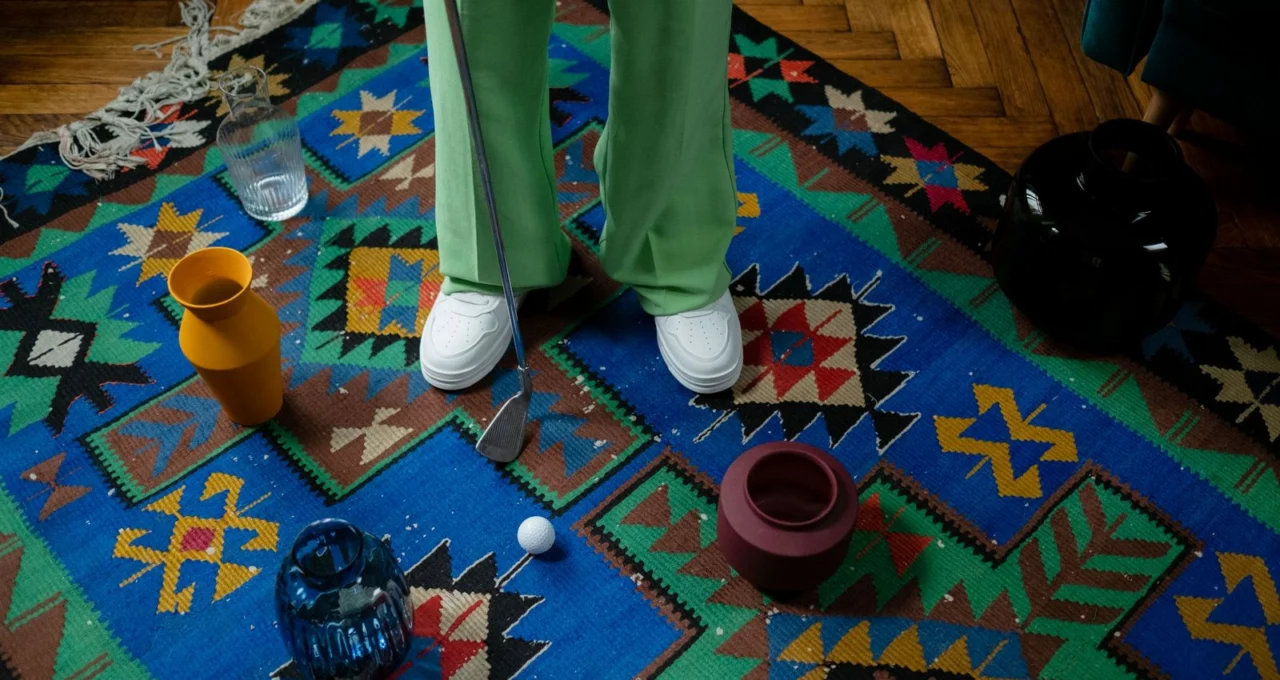
You will need three or four balls, two coins of the same size, a roll of masking tape and a cup or a tumbler. Run a length of tape along the floor as a straight reference line. It costs pennies, and it shows you at a glance whether the ball has started where you meant it to. If you have a small mirror, lay it beside the ball now and again to check that your eyes sit over the ball or just inside it. A few seconds of phone video from behind does the same job for your shoulders, which should be square to the tape rather than pointing a little left.
Drill one: two coins and a narrow gap
Place the two coins on either side of the tape line, a few inches in front of the ball, with a gap between them only just wider than the ball. Now putt through the gap. There is no hole and no target beyond it. The only question is whether the ball slips between the coins without touching either one.
This is the most direct feedback you will get anywhere in golf. A ball that keeps nicking the left-hand coin was struck with the face shut. One that keeps catching the right-hand coin came off an open face. Because the coins are so close to the ball, there is nothing else to blame, no borrow, no bobble, no spike mark.
Begin with a generous gap so you can find your rhythm, then squeeze it until there is barely any room. Hit twenty and count the clean ones. Resist the urge to steer, because a guided stroke is precisely the habit that falls apart on the course. Once you are getting through the tight gap almost every time, slide the coins further out, to around a foot ahead of the ball, so that a tiny error in the face has more room to show itself.
Drill two: four balls round a cup
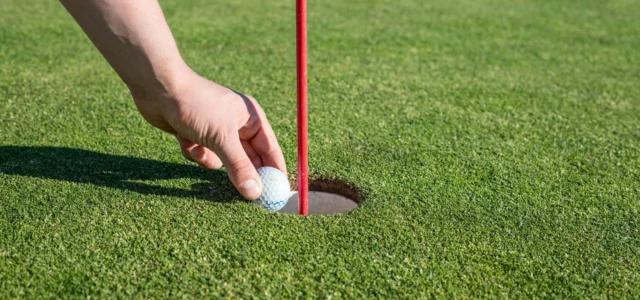
Short putts are rarely missed for lack of technique. They are missed because the golfer knows what is at stake. To train that, the drill has to carry a penalty, so lay a cup on its side or stand a tumbler on the carpet and set four balls around it at three feet, one at each point of the compass.
The rule is simple and slightly cruel. All four must drop in a row. Miss any of them and you pick the balls up and begin again from the first. When you can clear the set, move the balls out to four feet, then five. It is the streak that does the work, because the fourth putt of a run carries the same small weight as a three-footer for a half on the 16th.
Go through your whole routine on every putt, even at home with nobody watching. Look at the line, set the putter behind the ball, take one last look, and go. Golfers who skip the routine in the hallway tend to find that it deserts them in the monthly medal.
Drill three: the skirting-board ladder
Distance is where most strokes are saved on a green, and part of it lives in your hands rather than in your eyes. Lay a strip of masking tape across the floor about a foot and a half out from a wall, so that the space between the tape and the skirting board becomes your target zone. Then mark three starting spots, roughly six, ten and fourteen feet back from the tape.
Putt one ball from the nearest spot and try to finish it in the zone. Move to the middle spot, then the farthest, then work your way back. Any ball that taps the skirting board counts as a miss, which is a fair imitation of the course, where a putt that races past leaves you a return you do not fancy.
The secret is to keep the same beat for all three lengths. A longer putt asks for a longer backstroke, not a quicker one. Count it under your breath if it helps, “one” back and “two” through, with the gap between the words identical from every spot. If the short putts get a hurried jab and the long ones a lazy swing, the ladder will show you within a couple of rounds.
Remember what you are building here. It is a reliable link between how far the putter travels and how far the ball rolls, not a feel for any particular number of feet. That link will need retuning on grass, because the greens will almost certainly be quicker than your hall. A golfer whose stroke already scales predictably with distance retunes in a handful of putts. One who controls pace by hitting at the ball has to start from scratch every spring.
Where the carpet earns its keep in a British winter
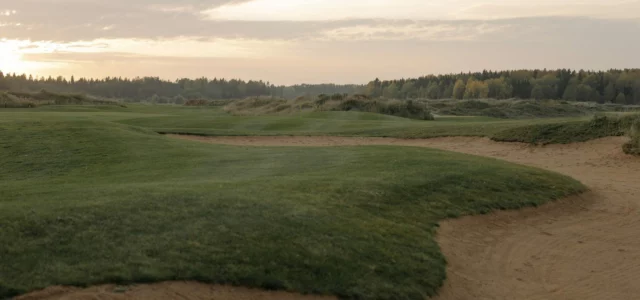
Frost puts the real greens out of bounds. On a frosty morning the grass on a green is frozen solid, and the greenkeepers have good reason to keep you off it. Scott Reeves of BIGGA, the British and International Golf Greenkeepers Association, has explained that walking on a frozen plant can crush its frozen cells, and that a green which is soft on top but frozen a little way down can suffer sheared roots. That is why so many clubs send members to temporary greens when the frost is down, and why a December or January putting stroke can go weeks without meeting a proper surface. The hallway is not a substitute for a green, but it keeps the stroke ticking over while the real thing recovers.
Temporary greens teach the wrong lessons. A hole cut into a fairway or an approach is bumpy and slow, and you can get into the habit of giving every putt a firm rap just to keep it on line. Use the ladder at home to protect the softer, measured stroke you will need when the proper greens return, and play the winter putts for what they are.
Even the most famous putting green in Scotland takes a break. The Himalayas, the undulating putting course beside the Old Course at St Andrews, is run by the St Andrews Ladies’ Putting Club, which was founded in 1867. The club says the green is open to the public at weekends in March and then daily from April to October. If the oldest putting club in the game puts its green to bed through the darkest months, a few evenings on the landing carpet is hardly a lack of ambition.
Your floors are part of the plan. Wall-to-wall carpet on the landing is a gift for the ladder, while a boarded hall or a tiled kitchen is better kept for the coin gate. If you also want to set up a proper mat, an alignment stick and a mirror, our winter practice guide for British golfers covers that kit and the rules that decide whether a winter card counts for handicap.
Little and often, with a scorecard
Ten minutes on three or four evenings a week will do far more than an hour on a Sunday. Stop when your attention drifts, because a tired stroke is not one you want to groove. A sensible running order is a quick check in the mirror, twenty putts through the coins, two trips up and down the skirting-board ladder, and the cup drill to finish, so the session always ends with something you can win.
Write the scores down. A line in the notes app on your phone is enough: clean putts through the gate out of twenty, and your longest streak round the cup. Watching those figures creep upwards is what keeps people going through February, and they point you straight at whichever part of your putting needs the next session.
The first Saturday back on proper greens
When the frost has gone for good and the temporaries are filled in, resist the temptation to start with the short ones. Go to the practice green and run your ladder again, this time from around 20, 30 and 40 feet. Notice how much shorter the backstroke needs to be for the same distance, and let your hands adjust before you trust any of the three-footers. Our guide to lag putting and avoiding three-putts walks you through finishing that calibration on grass.
Before you roll up the tape
- Use the carpet for start line, stroke length and pressure, and leave reading greens and exact pace for the real thing.
- Coin gate: two coins only just wider than the ball, a few inches ahead, twenty putts, count the clean ones.
- Cup drill: four balls at three feet, all four in a row or start again, with your full routine every time.
- Skirting-board ladder: finish in a taped zone short of the wall from three distances, one beat, longer backstroke for longer putts.
- Keep the true carpet for distance work and the hard floors for the gate.
- Ten minutes, three or four evenings a week, with the scores noted on your phone.
- On the first visit back, recalibrate on long putts before you trust the short ones.
None of this needs anything you would have to buy. Masking tape, two coins and a cup will see you through a winter of frost delays and temporary greens, and you will walk onto the first proper green of spring with one less thing to fret about.
Sources: the explanation of frost damage comes from Scott Reeves of BIGGA, interviewed in the association’s publication Your Course and reported by National Club Golfer. The founding date and opening season of the Himalayas come from the St Andrews Ladies’ Putting Club, both read in November 2026. The drills are standard coaching practice and are presented as such. Panxis Golf has no commercial relationship with any product or facility mentioned, and no retailer is named.