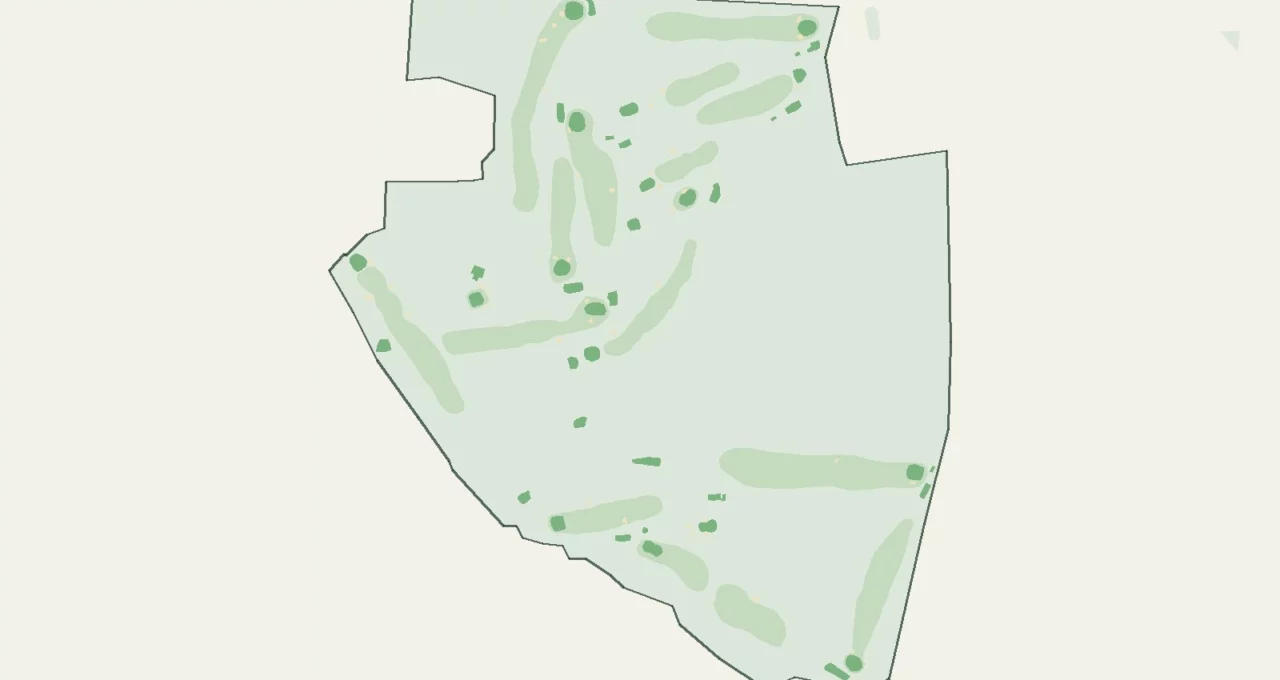
Layout of Seaford Head Golf Club from OpenStreetMap survey data (ODbL licence).
Seaford Head Golf Club
Holes
18
By
71 from all tees (club scorecard)
Length
5,806 yards from the white tees (competitions only), 5,502 yellow, 5,039 red (club scorecard, 2026); 5,848 yards in several guides and booking sites
Green fee
—
Best season
Year-round; the course says it is open 364 days a year
Seaford Head Golf Course sits on top of the chalk at the eastern end of Seaford, East Sussex, on the high ground that runs from the town towards Seaford Head, Hope Gap and Cuckmere Haven. The address is Southdown Road, Seaford, BN25 4JS. It is an eighteen-hole course of par 71, measuring 5,806 yards from the white tees on the club’s scorecard, with a course rating of 68.0 and a slope of 112. It is owned and managed by Seaford Town Council, which makes it a public course in the full sense: anyone can book a round, and the members of Seaford Head Golf Club play their competitions over the same ground.
Two things set it apart. The first is the site. The holes run over open clifftop downland with the English Channel along one side, the Seven Sisters cliffs and Beachy Head to the east and Seaford Bay and the South Downs behind, and the course’s own pages make the views the heart of the offer. The second is its age. The club traces golf on Seaford Head back to 1887, which places it among the earliest golf in Sussex, even if, as we explain below, the club that was founded here in that year now plays somewhere else.
Seaford has two golf courses, and they are easy to confuse. Seaford Golf Club, at East Blatchington on the northern side of the town, is a separate club on a different course, designed by J.H. Taylor. This page is about the council-owned course on Seaford Head.
Sheep, a twelve-hole course and a town council
According to the history published by the course, a small group of local residents met on 6 August 1887 to set up a golf club for Seaford, and the club held its first general meeting on 8 September of the same year. The course says Seaford and Eastbourne were the first two golf clubs established in Sussex. The land, near Seaford Head, was leased from Launcelot Harison of Sutton Place, and the first layout was a twelve-hole course on grazing ground still shared with sheep. The course credits the design of those twelve holes to a Mr Thompson of Felixstowe and says the course was extended to eighteen holes in 1889.
That club was Seaford Golf Club, and it did not stay. The history published by Seaford Golf Club says it outgrew its site and its clubhouse, could not agree terms with a landowner who had his own ideas for the course and for building on the land, and in 1907 moved inland to Bullock Down at East Blatchington, where J.H. Taylor laid out the course it still plays today. A catalogue entry at the National Archives, describing records held by the East Sussex Record Office, adds a detail from the years before the move: a social club, the Union Club, was founded in 1901 for members of the golf club, then based on what is now the Seaford Head course, whose clubhouse was a wooden building with only basic facilities. We have found no reliable account of who played on the head between 1907 and the late 1920s.
The course itself says that in May 1928 ownership of the course and clubhouse passed to Seaford Urban District Council, and the same National Archives entry lists council files on the purchase of the Seaford Head golf course and clubhouse covering 1927 to 1946. The course has stayed in public hands ever since, today under Seaford Town Council, whose Golf and The View Committee oversees both the course and its bar and restaurant.
The war left its mark. The course says the military requisitioned the land in 1940 and ploughed it for food production, that traces of the ploughing can still be seen on the 4th, 15th and 18th holes, and that the course was reconstructed in 1946. We have not found the name of whoever rebuilt it, and the course credits no architect for the present layout. The ground is far older than any of this: Historic England lists a hillfort and a bowl barrow on Seaford Head as a scheduled monument, first protected in 1938, and its excavation work places the fort in the early Iron Age. The monument lies on the same headland as the course, whose own history mentions both a Saxon camp and the Iron Age. Historic England added the site to its Heritage at Risk register in November 2021 because of cliff erosion, and a 2022 project led by Archaeology South-East and University College London recorded features on the headland before the sea takes them.
The most recent chapter is the clubhouse. Seaford Town Council approved a new building in 2013, and its annual report for 2018 to 2019 lists the completion of The View bar, restaurant and golf facility among the year’s achievements. A contractor’s project page describes changing rooms, a new pro shop and a large bar and function room. The course says it is open 364 days a year.
What the course asks of you
The figures below come from the scorecard published by the course in 2026 and from the course handicap tables dated from 1 April 2024. There are three sets of tees. The white tees measure 5,806 yards, with a course rating of 68.0 and a slope of 112, but the scorecard reserves them for authorised competitions, so visitors normally play from the yellow tees, which measure 5,502 yards, rated 66.5 with a slope of 107 for men. The red tees measure 5,039 yards, rated 69.1 with a slope of 113 for women. Par is 71 from every tee: 36 out and 35 home, with four par 3s, the 4th, 10th, 12th and 16th, and three par 5s, the 5th, 13th and 18th.
By the standards of an eighteen-hole course this is short, and the course does not pretend otherwise: it speaks of tees playable for all abilities and of a layout that often plays firmer and faster than courses inland. Length is not what makes it hard. The wind is. On an exposed clifftop with nothing between the fairways and the Channel, many of the course’s own hole notes mention it, and the stroke indexes show where the trouble is. The 1st, a par 4 of 394 yards from the whites called The Ravine, is stroke index 1; the 11th, The Brow, a par 4 of 366 yards with a blind approach, is stroke index 2; the 6th, The Well, is stroke index 3; and the 15th, The Gap, is stroke index 4.
The front nine
The course’s hole by hole guide is unusually frank, and it gives a good picture of the round. At the 1st the ball runs to the left, so the advice is to aim right of centre and keep the approach to the right side. The 2nd, The Dew Pond, is 312 yards and drivable for long hitters, with danger on both sides; the course suggests a mid or long iron instead. The 3rd, The Plateau, is a short par 4 of 273 yards played uphill to an elevated green that needs enough club. The 4th, The Pill Box, is the first par 3, 174 yards from the whites to a long, narrow, flat green exposed to the wind, with out of bounds beyond it.
The 5th, The Valley, is the first par 5, 485 yards from the whites, and the course presents it as a risk and reward hole where a drive to the left opens a chance of eagle or birdie, to a large green sloping from back to front. The 6th rewards accuracy over distance, and on the 7th, The Copse, trees catch drives that stray right and the wind makes the approach longer than it looks. The 8th, The Steps, finishes on an elevated green where a short miss leaves an awkward chip, and the 9th, The Warren, a par 4 of 328 yards from the whites but only 281 from the yellows, usually plays into the wind and the slope; the course says par there is a good score.
The back nine
The back nine opens with two very different par 3s around a long par 4. The 10th, The Drop, is 138 yards from the whites, downhill to a green that falls away and from right to left. Then comes The Brow, before the 12th, The Hell Hole, at 104 yards the shortest hole on the course, where a false front catches anything underhit and the course’s advice is that being long gets the best results. Reviewers say the walk up to and around the 11th and 12th is the steepest of the round.
The 13th, The Recovery, is a par 5 of 474 yards and the furthest point from the clubhouse, with views of the Seven Sisters. The 14th is named after them and usually plays into the wind, with a bunker in front of the green waiting for anyone who misses to the right. The 15th narrows where a long drive would finish, so the course recommends laying up short of the gap, and the wind swirls around a green that slopes from left to right. The 16th, Hit and Run, is a par 3 of 148 yards to another long, narrow green. The 17th, The Cliff Edge, is a short par 4 of 288 yards that long hitters can reach only when there is no wind.
And then the 18th, The Head. It is a par 5 of 507 yards from the whites and 484 from the yellows, starting with a big downhill drive from a tee high above the fairway, with Seaford Bay spread out below; beware the bunker and the out of bounds beyond the green. The course calls the drop from the 18th tee one of the most photographed tee shots on the south coast, and it is the hole golfers mention first.
Course rules and changes
The course’s rules forbid practice on any tee, fairway, green or bunker and forbid sharing a bag of clubs at any time. A single player has no standing on the course and must give way to any match. The dress code asks for golf shoes, no jeans and tops to be worn at all times, and the local rules are posted on the notice board in the foyer. In October 2026 the course status page showed the course open, with preferred lies on the 15th fairway.
The finish may change. In July 2024 the council’s Golf and The View Committee approved an initial redesign plan for the 17th green and the 18th tees, to be put to the public and stakeholders for comment, and its members discussed the impact of future coastal erosion on the course. Minutes from April 2025 record that an ecologist had been engaged and that the next step was the planning process with the South Downs National Park Authority. We have found no decision on the works or any timetable, so the holes described above are those of the current card.
What golfers say
The points below summarise the golfer reviews published on GolfPass, where the course is recommended by the great majority of around ninety reviewers, and the summary of Google reviews shown by the travel site Wanderlog, which gives an average of 4.6 out of 5 from more than nine hundred ratings, almost all of them four or five stars. They are other people’s opinions, not ours. Nobody from Panxis has played the course, and we name no reviewer.
What comes up in its favour
- The views, above all. Reviewers keep coming back to the panorama of the Seven Sisters, the South Downs and Seaford Bay, and some say the coast as far as the Isle of Wight can be seen on clear days.
- The 18th. The drop from the tee to the fairway far below is the hole nearly every review singles out.
- The greens and the turf. Many reviewers describe the greens as fast and true, some as among the best they have putted on, and several note that the course drains well on its chalk and is rarely closed.
- A layout where placement matters more than power, playable for higher handicaps but not easy for anyone once the wind gets up.
- Value for money, and a friendly welcome in the pro shop, the bar and the restaurant, with breakfast and food after the round often mentioned.
What comes up against
- The wind. On the exposed clifftop strong gusts make the ball, and sometimes the trolley, hard to control, and some reviewers found the course a real ordeal on a stormy day.
- The hills. Several reviewers warn that the course is steep and undulating, with the climbs around the 11th and 12th the hardest, and suggest a buggy for golfers who are not fit.
- Pace of play. Experiences differ: some report a brisk round on a weekend morning, others slow play on busy days and too many groups on the tee sheet.
- Length. Golfers looking for a long championship test may find it short from the yellow tees, and the white tees are kept for competitions.
- Occasional comments on the speed of the greens, found slower than usual on one visit.
Getting there and when to go
The course lies at the far eastern edge of Seaford, below Seaford Head. By road, the course’s directions are to leave the A259, the coast road between Brighton, Newhaven and Eastbourne, and follow the brown tourist signs to the golf course. Seaford railway station, the terminus of the branch line from Lewes, is roughly a mile from the course in a straight line by our measurement on the map, so the walk is possible for golfers who travel light. The course says its car park closes at the same time as The View bar and restaurant, which it gives as 7.30am to 6pm on weekdays, 7am to 6pm on Saturdays and 7am to 5.30pm on Sundays.
Visitors book tee times through the course’s online visitor booking page, linked from its home page, or through the pro shop; societies are asked to contact the pro shop directly. The shop, run by the course’s professional staff, opens at 6.30am in summer and 7am in winter at weekends, and at 7am in summer and 7.30am in winter on weekdays. It hires out pull trolleys and sets of clubs, offers custom fitting in an indoor studio and repairs, and lessons are available with the PGA professionals. Buggies are available for hire, according to the course’s fees page; we have found no published rules on when they may be used.
The course says it is open 364 days a year, and the chalk under it drains quickly, so it is one of the more reliable places to play in Sussex in winter. The best of it, though, depends on the weather more than the calendar. A clear, calm day from late spring to early autumn shows off the views and lets the short par 4s be attacked; a day of strong wind turns a course of under 5,600 yards from the yellow tees into a very different test. Check the course status page before setting out, and bring a layer even in summer.
The headland around the course is worth the time if you are not in a hurry. Seaford Head is a Local Nature Reserve of about 150 hectares, part of the Seaford to Beachy Head Site of Special Scientific Interest, with chalk grassland, cliffs, shingle and rock pools. Part of it is owned by the town council and managed by the Sussex Wildlife Trust, and the rest belongs to the Seven Sisters Country Park and the National Trust. The coast path from the course leads on to Hope Gap and Cuckmere Haven, with the classic view of the Seven Sisters cliffs.
How this page was made
The factual frame comes from public sources: OpenStreetMap for the location and our distance measurements; the course’s website, run by Seaford Town Council and read in October 2026, for the address, the history, the hole by hole guide, the course rules, the course status, the booking arrangements, the pro shop and the opening times; the scorecard and the two course handicap tables published there for the lengths, pars, ratings and slopes; the club history published by Seaford Golf Club, its profile on Top 100 Golf Courses and a National Archives catalogue entry for the years before 1928 and the move to East Blatchington; Seaford Town Council’s annual reports, newsletter and committee minutes of July 2024 and April 2025 for the clubhouse and the planned redesign of the finishing holes; Historic England and University College London for the hillfort; the English Wikipedia article on Seaford Head for the nature reserve; the GolfNow listing for its tee table. Wikidata identifies the course as Q7440378.
Where sources disagree, we say so. Several guides and booking sites give the length as 5,848 yards, while the current scorecard totals 5,806 from the whites; the yellow tees are 5,502 yards on the scorecard and 5,622 on some third party scorecards. One scorecard site gives a standard scratch score of 66, an older measure that the 2024 ratings have replaced. The course’s own hole by hole page gives some women’s stroke indexes that differ from the printed scorecard; we have followed the scorecard. The course says the original course was extended to eighteen holes in 1889, while the Top 100 Golf Courses profile mentions only the twelve-hole layout. The course dates council ownership to May 1928, while the council’s files on the purchase in the National Archives catalogue cover 1927 to 1946. Both Seaford Golf Club and the Seaford Head course claim the 1887 foundation; on our reading it is the same club, which began on the head and moved inland in 1907. Wikidata places the course a few hundred metres west of the point we use from OpenStreetMap. We have not found who reconstructed the course in 1946 or who designed its present layout, and we have left the architect out rather than guess.
The opinion section summarises the golfer reviews on GolfPass, as shown in its search summaries, and the summary of Google reviews shown by Wanderlog, read in October 2026; we could not open the GolfPass review pages themselves. We report recurring themes rather than individual voices, and we reproduce no quotations from reviewers. Nobody from Panxis has played or visited this course, and this page is no substitute for a round.
Neither the course, the town council nor the club has paid for this page, seen it before publication or had any say over its content. This page contains no commercial link and earns us no commission. If you know the course and something here is wrong or out of date, write to us and we will correct it.
Other courses nearby
Closest to this one in our British directory:
- Seaford Golf Club — 2 mi
- Worthing Golf Club — 23 mi
- Dale Hill Golf Club — 24 mi
- The Richmond Golf Club — 50 mi
The hole to know
The Head, a par 5 of 507 yards from the whites and 484 from the yellows, opening with a big downhill drive from a tee high above the fairway with Seaford Bay below; the course calls it one of the most photographed tee shots on the south coast.