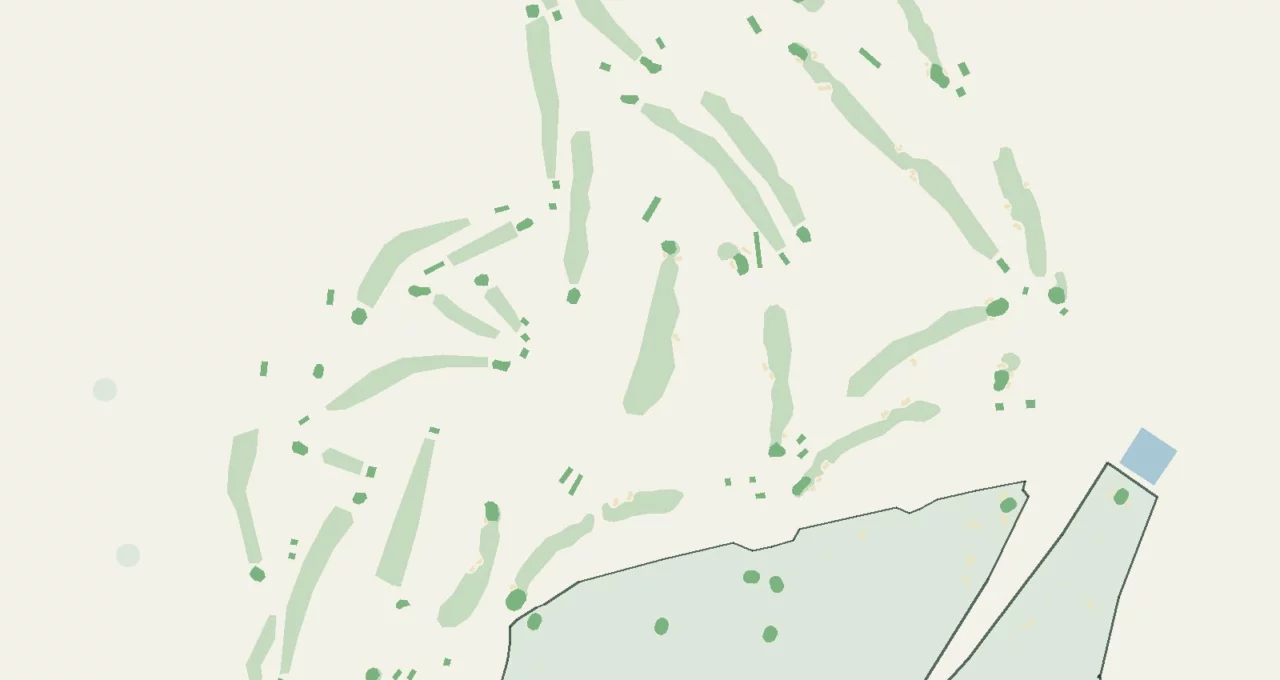
Layout of Worthing Golf Club from OpenStreetMap survey data (ODbL licence).
Worthing Golf Club
Holes
36 (Colt Course, formerly the Lower, 18 holes; Vardon Course, formerly the Upper, 18 holes), plus a short academy course
By
Colt Course: 71 for men from all tees, 75 for women; Vardon Course: 66 for men, 70 for women
Length
Colt Course: 6,557 yards from the white tees, 6,208 yellow, 5,781 red (club scorecard); Vardon Course: 5,206 yards from the white tees, 5,001 red, 3,758 blue (club scorecard)
Green fee
—
Best season
Open all year; the club describes both courses as well drained, and both have rated winter tees
Worthing Golf Club sits on the lower slopes of the South Downs on the northern edge of Worthing, in West Sussex, inside the South Downs National Park. Its address is Links Road, Worthing, BN14 9QZ, in the Salvington district, and the Iron Age hill fort of Cissbury Ring rises a little under a mile to the north. The club was established in 1905 and is a private members’ club with two eighteen-hole courses. For most of their history they were known as the Lower Course and the Upper Course; the club has since renamed them the Colt Course and the Vardon Course, after the two men it credits with their design.
The Colt Course, the former Lower, is the longer and better known of the two: par 71 and 6,557 yards from the white tees on the club’s current scorecard, laid out largely in a valley. The Vardon Course, the former Upper, follows the ridges above it and is much shorter, par 66 and 5,206 yards from the whites, with six par 3s and no par 5. Top 100 Golf Courses calls the Lower the more exacting of the two downland courses and places it fifteenth in its list of the best courses in Sussex. The club also has practice facilities, which Wikipedia describes as a short academy course, a covered driving range, short-game areas and several putting greens.
From a farmhouse and a Vardon layout to two Colt courses
The club’s heritage page tells the early story. The founders took a commanding position on the slopes of the Downs and converted an old farmhouse into a clubhouse; Wikipedia identifies it as the former Warren farmhouse, dating from the nineteenth century. The first hundred and fifty members joined in 1905. Douglas McEwan was appointed the first club professional and, with the honorary secretary, Dr O. Gethin Jones, laid out a temporary nine-hole course, the first six holes of which opened in 1905.
The committee then approached Harry Vardon, the leading player of the day and a six-time Open champion. According to the club, Vardon designed an eighteen-hole course together with a further nine holes, and these opened in 1906 with a 36-hole exhibition match that drew a large gallery. Wikipedia names the other player in that match as James Braid, the five-time Open champion; the club’s own page does not name the players. In September 1907 the course staged its first professional tournament, and in 1911 Vardon remodelled it to create two new holes.
The decisive change came after the First World War. The club bought the land and the clubhouse in 1921 and, in its own words, approached Harry Colt to design two new courses to replace the existing ones. Top 100 Golf Courses describes the same commission as a redesign of the whole scheme, with the No. 1, or Lower, course placed largely along the valley and the No. 2, or Upper, course on the ridges above. The club’s heritage page says the new courses opened in 1923, and by 1924 the greenkeeping staff had grown to a head greenkeeper, two horsemen, six greensmen and three labourers. In 1925 the National Trust bought Cissbury Ring, the eighty acres of downland that overlook the courses, and the club bought its first tractor and mowing units. The names Lower Course and Upper Course were adopted in 1927.
The club’s history records some eight hundred members by the early 1930s, and a professional’s shop that opened in August 1939, days before the outbreak of the Second World War. The war brought financial hardship, and shareholders and members made voluntary donations to keep the club going. The clubhouse was extended in 1972 with a new dining room and dance floor, a bar followed in 1980, and between 1979 and 1982 the club built twenty-four sheds for the motorised buggies that were becoming popular, with nine more in 1996. The centenary in 2005 was marked with a book on the club’s history, which the club sells from its office.
Recent work on the courses and the clubhouse
The most significant recent work concerns the bunkers on the Colt Course. The club says that in 2016 Tom Mackenzie, of the golf course architects Mackenzie and Ebert, carried out a historic research study of the Lower course and produced from it a design audit and hole-by-hole recommendations. The trigger was the bunkering, which over time had become outdated in position because of modern driving distances and needed reshaping because of the way it collected water. The club describes the bunker works as being carried out by Marcus Terry of 1st Golf with the club’s own greenkeeping team under the course manager, George Barr, funded by a members’ levy, with three to four holes completed each year. The heritage page does not date that paragraph precisely, and we found no announcement that the programme has finished, so the state of the bunkers on any given hole may differ from older photographs and descriptions.
Wikipedia adds that the clubhouse was modernised in 2023, with a terrace, bar, dining areas, a snooker room and space for private events. The renaming of the two courses after Colt and Vardon is recent too: the club’s earlier website still used Lower and Upper alongside the new names, and the current site, archived from late 2025, uses Colt and Vardon throughout. The club has also published a strategic plan for 2025 to 2030.
What the course asks of you
The figures below come from the scorecards on the club’s current website. The hole descriptions draw on the professional’s tips from the club’s earlier website, whose hole-by-hole guide gave slightly different yardages from today’s card; where the two differ, we quote the current card.
The Colt Course (formerly the Lower)
From the white tees the Colt Course measures 6,557 yards, par 71, with an outward nine of 3,116 yards and par 35 and an inward nine of 3,441 yards and par 36. The yellow tees measure 6,208 yards and the red tees 5,781 yards, both par 71 for men; for women the course is par 75 from the yellow and red tees, because several long par 4s become par 5s. The club publishes a course rating of 72.1 and a slope of 125 from the men’s whites, 70.4 and 122 from the men’s yellows, and 68.3 and 120 from the men’s reds. There are also winter tees: 6,032 yards from the men’s winter green markers and 5,683 yards from the women’s winter purple. There are four par 3s, at the 3rd, 7th, 9th and 14th, and three par 5s, at the 6th, 8th and 16th.
The club describes the Colt as a championship course of rolling hills and a sweeping valley under Cissbury Ring, with dramatic topography, strategic bunkering, fairways running through wildflower rough and woodland, and excellent drainage. Top 100 Golf Courses singles out the stretch before the turn, played in a sheltered valley known as Deep Bottom under the shoulder of Cissbury Ring, as the best part of the course.
The round starts gently. The 1st, 341 yards, is a slight dogleg from right to left that the earlier hole guide calls a friendly opener, though the south-westerly wind can affect it. The 2nd is a different matter: 459 yards, stroke index 1, a long par 4 that needs two good shots to reach the green. The 4th, 370 yards, is listed as driveable with a strong following wind, with trouble on both sides of the fairway, and the 5th, 427 yards and stroke index 4, asks for a good drive to avoid the fairway bunkers.
The holes into the valley are the ones the reviews keep returning to. The 6th, a par 5 of 520 yards, opens the run. The 7th, 186 yards, is a tough par 3 to an elevated, sloping green where par is a good score. The 8th, a par 5 of 510 yards, climbs a fairway that bends slightly from left to right towards Cissbury Ring, and its green punishes a ball on the wrong side of the hole. The 9th, at 122 yards the shortest hole on the course, is played across the valley to a raised green heavily protected by sand.
The turn brings the highest drama. The 10th, 369 yards, drops from an elevated tee some 80 feet to the fairway, according to the earlier hole guide, and needs a long drive if the long, narrow green is to be reached in two. Reviewers mention the view from that tee, across the hills and the town to the English Channel. The 11th is a short par 4 of 283 yards that can be driven with the wind behind, but its green slopes severely from front to back. The 12th, 447 yards and stroke index 2, is described by the club as the toughest drive on the course, with out of bounds down the left and trouble on the right. The 13th, 424 yards from an elevated tee, is exposed to the wind.
The finish is long. The 15th is a par 4 of 433 yards and stroke index 3. The 16th, a par 5 of 526 yards on the current card, is the longest hole on the course: an uphill tee shot into the prevailing wind to a generous fairway and a large green that slopes from right to left. The earlier hole guide gave the 16th as 486 yards, and we have not found an explanation for the difference. The 17th, 398 yards, needs a good drive between out of bounds on the left and trees on the right, to a green that slopes away from front to back, and the 18th, 394 yards, finishes at what Top 100 Golf Courses describes as a bowl-shaped home green.
The Vardon Course (formerly the Upper)
The Vardon Course runs along the ridges above the valley. The club says it has panoramic views of the Sussex coast from Beachy Head to the Isle of Wight, and describes it as shorter than the Colt but a subtler challenge, with narrower margins, undulating ground and an exposure to the wind that rewards control over power. It also presents it as a course where golfers of all abilities feel welcome.
From the white tees it measures 5,206 yards, par 66, with an outward nine of 2,480 yards and par 32 and an inward nine of 2,726 yards and par 34. The red tees measure 5,001 yards, par 66 for men and par 70 for women, and there is a shorter set of blue tees at 3,758 yards. The club gives a course rating of 65.8 and a slope of 113 from the men’s whites and 64.5 and 109 from the men’s reds; for women, 71.2 and 119 from the whites and 69.5 and 115 from the reds. The par 3s are the 2nd, 4th, 5th, 7th, 12th and 14th, ranging from 125 to 209 yards, and the longest hole is the 11th, a par 4 of 396 yards.
Short does not mean flat. The 1st, 363 yards, is an uphill par 4 to a severely sloping green, which the earlier hole guide calls a challenging opener. The 4th is the hardest of the short holes: an uphill par 3 of 209 yards on the current card, often played into the prevailing wind. The 6th, 335 yards, is stroke index 2 on the current card and needs an accurate second shot to a raised green. The 10th, 392 yards and stroke index 1, is called the most challenging hole on the course: uphill to a raised green set at an angle to the line of play. Later on, the 13th, 332 yards, is a dogleg to the right where long hitters may take an iron from the tee to set up an approach to a heavily sloping green; the 16th, 272 yards, is a downhill par 4 to a narrow green that longer hitters can reach from the tee; and the 17th, 371 yards and stroke index 3, plays longer than its length because it runs uphill, with a semi-blind second shot.
What golfers say
The points below summarise the golfer reviews of the Lower course published on Top 100 Golf Courses, three of them, dated 2021 and 2026, together with the club’s own descriptions where they bear on the same themes. We found no published reviews of the Vardon Course that we could read, and the course listings on GolfPass and Today’s Golfer could not be opened. Three reviews are a small sample. These are other people’s opinions, not ours: nobody from Panxis has played either course, and we name no reviewer.
What comes up in its favour
- The setting. Reviewers describe genuine Sussex downland, with big climbs rewarded by spectacular tee shots and views out to sea, the 10th tee in particular.
- The greens. All three reviews make the greens a central feature: firm, fast and well presented, a pleasure to putt on for one reviewer, and the main defence of the course for another.
- Strategy and the ground game. Firm turf lets low shots run on, so position and accuracy count as much as length, and the course is described as testing every part of the game.
- Individual holes. The 2nd, 8th, 9th, 10th, 11th to 13th, 14th and 16th are all singled out, the 8th most often, as a par 5 through big landforms towards Cissbury Ring with a two-tier green.
- The welcome. Reviewers mention friendly pro shop staff, good food and service, busy practice greens and the drive in past the houses and under the centenary clock.
- A 36-hole day. One reviewer recommends pairing the Lower with the Upper for a full day’s golf.
What comes up against
- Hard to hold. Firm greens with big slopes make approaches difficult to stop and downhill putts intimidating, especially from above the hole.
- Weather. One reviewer found the course a tough ask in wind that later turned to rain; the club itself says the prevailing wind means a good score has to be earned.
- The routing. One reviewer finds it clunky in places, to the point of missing out a hole by accident, and some out of bounds, on the 1st and 5th, slightly blind.
- Forced carries and rough. One reviewer dislikes the hazards that must be carried, finds the rough beyond the fairways closer to parkland than to fine downland turf, and suspects the trees on the 6th are later additions.
- Variety. Ratings for variety come out a little lower than those for strategy, greens and facilities on the Top 100 scale.
Getting there and when to go
The club is on Links Road in Salvington, on the northern edge of Worthing. By our measurement on the map, Worthing station is about two miles to the south in a straight line, and West Worthing station is a similar distance to the south-west; both are further by road. The A27 passes about a mile to the south, as Arundel Road and Upper Brighton Road, and the A24, Findon Road, runs north up the Findon Valley less than a mile to the east.
The setting is part of the appeal. Cissbury Ring, the Iron Age hill fort just to the north, belongs to the National Trust, which bought the eighty acres in 1925 according to the club’s history. The courses sit inside the South Downs National Park, and the club’s description of the Colt mentions wildflower rough and ancient woodland.
Worthing is a members’ club, but its website has sections for visitors, green fees, societies, open competitions and etiquette, and invites enquiries by telephone on 01903 260801. We could not read the green fee and visitor pages themselves, so check booking arrangements and any restrictions on times directly with the club through its website. The pro shop is run as Rampion Golf, and the club’s Golf Academy offers coaching. Wikipedia says the club has more than 1,500 members and that the kitchen serves food daily from 8am. We found no current information on buggy hire for visitors; the club’s history mentions buggy sheds built for members’ buggies from 1979, which says nothing about hire today, so ask the pro shop.
The club describes its two courses as well drained, and both carry rated winter tees, so both are played through the winter. For the views along the coast from the Vardon ridges and the wildflowers in the rough, late spring and summer are the obvious time to go, when firm conditions also bring the ground game the reviewers enjoy into play. Being high on the Downs and close to the Channel, both courses are exposed: the club and the reviewers agree that the wind is a constant factor.
How this page was made
The factual frame comes from public sources: OpenStreetMap for the location and our distance measurements; the club’s website for the address, the two scorecards with their ratings and slopes, the course descriptions and the heritage page, read in October 2026. The club’s website blocked our requests with an access refusal (HTTP 403), so we read it through copies held by the Internet Archive: the current site, archived in 2025 and 2026, for the scorecards and course descriptions, and the club’s earlier website for the heritage page and the professional’s hole-by-hole tips. We also used Top 100 Golf Courses for its course description, its Sussex ranking and its golfer reviews; the English Wikipedia article on the club; Wikidata, which identifies the club as Q8037218 and gives 1905 as its inception; and a Golfmagic news item on the club. GolfPass and GolfAdvisor were consulted through search results only, because their pages refused access. Today’s Golfer was behind a paywall and has not been used.
Where sources disagree, we say so. The club’s current scorecard gives the Colt Course as 6,557 yards from the whites; Wikipedia gives 6,505 yards in its infobox and 6,521 in its text, GolfAdvisor 6,505 and GolfPass 6,521. For the Vardon Course the scorecard gives 5,206 yards, the figure in Wikipedia’s text, while its infobox and GolfPass give 5,211. The earlier hole-by-hole guide on the club’s website gives yardages that differ by a few yards on most holes and by forty on the 16th of the Colt, and Wikipedia names the 6th as the longest hole on the Colt, whereas on the current card it is the 16th. The attribution of the Vardon Course is not straightforward either: the club’s course page says Vardon designed it in 1905 and Harry Colt updated it in 1925, while its heritage page says Colt designed two new courses to replace the Vardon layouts and that they opened in 1923; Top 100 Golf Courses and Wikipedia also describe Colt as laying out both courses after the First World War, Wikipedia dating the two courses to 1923. We report 1923 as the opening of the present courses, as the club’s history does. Wikipedia names James Braid as Vardon’s opponent in the opening exhibition of 1906; the club’s history does not name the players. Wikipedia describes a six-hole academy course, and Golfmagic, in a news item about events in 2020, a seven-hole par 3 course; we have not given a number.
We could not open the club’s green fee, visitor, practice facilities and clubhouse pages, or the hole pages on its current website, so access conditions, buggy hire and the current hole descriptions come from the sources named above or are left out. The bunker programme on the Colt Course is described by the club without a completion date; we have not assumed it is finished.
The opinion section summarises the three golfer reviews of the Lower course on Top 100 Golf Courses, read in October 2026. We report recurring themes rather than individual voices, and we reproduce no quotations from reviewers. Nobody from Panxis has played or visited either course, and this page is no substitute for a round.
The club has not paid for this page, has not seen it before publication and has no say over its content. This page contains no commercial link and earns us no commission. If you know the club and something here is wrong or out of date, write to us and we will correct it.
Other courses nearby
Closest to this one in our British directory:
- Seaford Golf Club — 22 mi
- Seaford Head Golf Club — 23 mi
- Dale Hill Golf Club — 38 mi
- Fulwell Golf Club — 41 mi
The hole to know
The 10th on the Colt Course, a par 4 of 369 yards from the white tees, played from an elevated tee that drops some 80 feet to the fairway, with views across the town to the English Channel; a long drive is needed to reach the long, narrow green in two.