Out into a south westerly: three headwind mistakes that cost two clubs
A headwind puts no extra spin on the ball. It raises the ball's airspeed, so the same spin makes more lift, more height and a steep landing well short of the flag. The arithmetic, the club to take, and the reading error that ruins the shot before you draw one.
In brief
- Into the breeze costs roughly twice what the same wind behind you hands back. Club for that, not for an even split.
- One yard of playing distance per mile per hour of headwind. A 20 mph wind is two clubs, not one.
- Take the extra club and swing at three quarters to a chest high finish. Both halves, or neither works.
- The prevailing south westerly is why a links runs out and back, and why the card misleads on a breezy Tuesday.
Wind is the one hazard on a British golf course that moves, and the one that most golfers answer by doing precisely the wrong thing. The ball finishes thirty yards short, pitches almost vertically and stops dead, and the instinct is to hit the next one harder. That is how a two club wind becomes a four club afternoon.
None of it is mysterious. It is arithmetic, and the arithmetic is lopsided: a headwind takes roughly twice what the same wind behind you hands back. Three mistakes account for nearly all the damage, and all three are committed before the club moves.
What a headwind actually does
Begin with the thing almost everybody has wrong. A headwind does not make the ball spin faster. Whatever spin left the face is whatever your strike put on it, and no amount of wind can add to it.
What the wind adds is airspeed. The ball’s speed relative to the air it is travelling through is its own speed plus the speed of the air coming the other way, and both lift and drag rise steeply with that figure. The same spin rate therefore generates more lift. The ball climbs higher than you intended, hangs about, gives the wind longer to work on it and drops out of the sky at a steep angle a long way short of the flag.
That is the entire mechanism. The ball balloons because the air got quicker, not because the ball got spinnier. It matters because it tells you what to do about it: give the wind less height and less time, and stop handing it extra spin of your own.
Two figures are worth carrying about with you. A serviceable rule of thumb is one yard of extra playing distance for every mile per hour of headwind, and half a yard fewer for every mile per hour of tailwind. A 20 mph wind in your face adds roughly 20 yards to the shot, which for most of us is two clubs. The same 20 mph at your back removes about ten, which is one.
Launch monitor modelling published by Golf Digest makes the point with a single club. A tour standard 7 iron carrying 166 yards in still air carried 17 yards fewer into a 10 mph headwind, and 13 yards further with the same wind behind it. Into the breeze costs more than downwind pays, every time, and every wind decision should start from that.
Mistake one: swinging harder
The expensive one, and very nearly involuntary. The wind shoves at you, so you shove back: you take the club you would have taken on a still day and you go after it.
Every part of that makes matters worse. More clubhead speed off a lofted face means more backspin, and more backspin in air that is already producing extra lift is the exact recipe for a ball that climbs, stalls and falls. A harder swing also moves the strike, high on the face with a wood and thin with an iron, and it costs you balance on a day when balance is already in short supply.
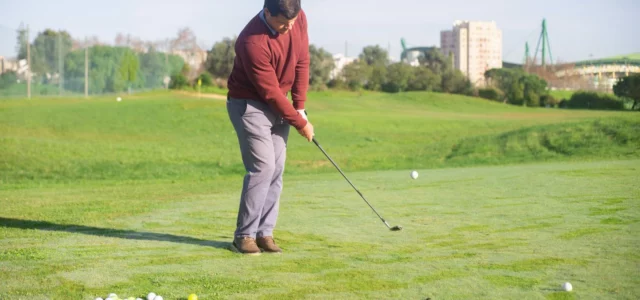
The old line about swinging easy when it is breezy is right, and golfers still come unstuck with it, because they swing easy with the same club. Easy is half the instruction. The other half is more club.
Mistake two: one club when the sum says two
Most golfers do adjust. They simply adjust as though wind were even handed, adding a club into it exactly as they take a club off downwind. The arithmetic above says that leaves you a club short.
Do it properly. Judge the wind in fives: 5, 10, 15 or 20 mph. Precision is not required and most of us overstate it anyway. Add a yard per mile per hour to your genuine carry number rather than the one you wish you carried, then choose the club that covers the total with a smooth swing rather than with your finest strike of the year.
Then do the part that makes it work: swing the bigger club at about three quarters and finish short, hands no higher than your chest. A 7 iron ridden at eighty per cent flies lower and holds its line far better than a 9 iron flushed. If the ball has to stay down, take the loft off by changing club rather than manufacturing a low shot with a lofted one, which is how golfers end up leaning on the handle and delofting into a flier nobody can control.
The knockdown setup is small and repays a bucket of balls: ball half an inch back of normal, grip down an inch, weight slightly on the lead side, stance a shade wider, and a backswing you could halt at any point. The short finish is the part people leave out, and it is the part that keeps the spin down.
Mistake three: reading the wind in the wrong place
The third is a reading error, and it ruins the shot before a club is drawn. Golfers read the wind from where they are standing, and where they are standing is usually the most sheltered spot on the hole.
A tee cut into a stand of pines tells you nothing. A green sitting in a hollow lets the flag hang limp while the air streams across the top of the dunes twenty feet above it. Tossed grass reports what the air is doing at ankle height, which is not where the ball will spend the next six seconds.
Read the tops of the trees, the highest flag in view, and the clouds. Where the treetops and the flag disagree, believe the treetops. On an exposed links hole with nothing to read at all, the wind on your cheek at the top of the backswing tells you more than the one you felt walking up the fairway.
The same mistake has a second half: a headwind magnifies whatever curve you have already put on the ball. A fade that drifts eight yards on a calm evening drifts twenty into a stiff breeze. Aiming at the flag with your usual shape is the same error as aiming at it with the wrong club. Aim where the wind and your shape will actually put the ball, and when the wind is across, ride it rather than holding the ball against it. Holding a ball into a crosswind means more spin, and spin is the one thing you cannot afford today.
What the wind does around the green
Approach play gets the attention and the short game quietly gives away as much. Into the wind a pitch lands steeply and checks harder than you expect, so the ball that should have released to eight feet stops at twenty. Downwind the same shot skids. Change the shot rather than the effort: into the breeze a low running chip with a 9 iron beats a high wedge, because a wedge posts the ball straight up into the fastest air available.
On the green, 20 mph and above genuinely moves a slow ball, particularly over the last three feet where it is barely rolling. Widen the stance and shorten the stroke.
One rule is worth knowing, because on exposed courses it comes up. If wind moves your ball at rest there is no penalty and you play it from its new spot. The exception is on the putting green: if you had already lifted and replaced it there, you put it back where it was. That is Rule 9.3, and it is the reason not to mark and replace on a windy green until you are ready to putt.
Where British golfers meet it
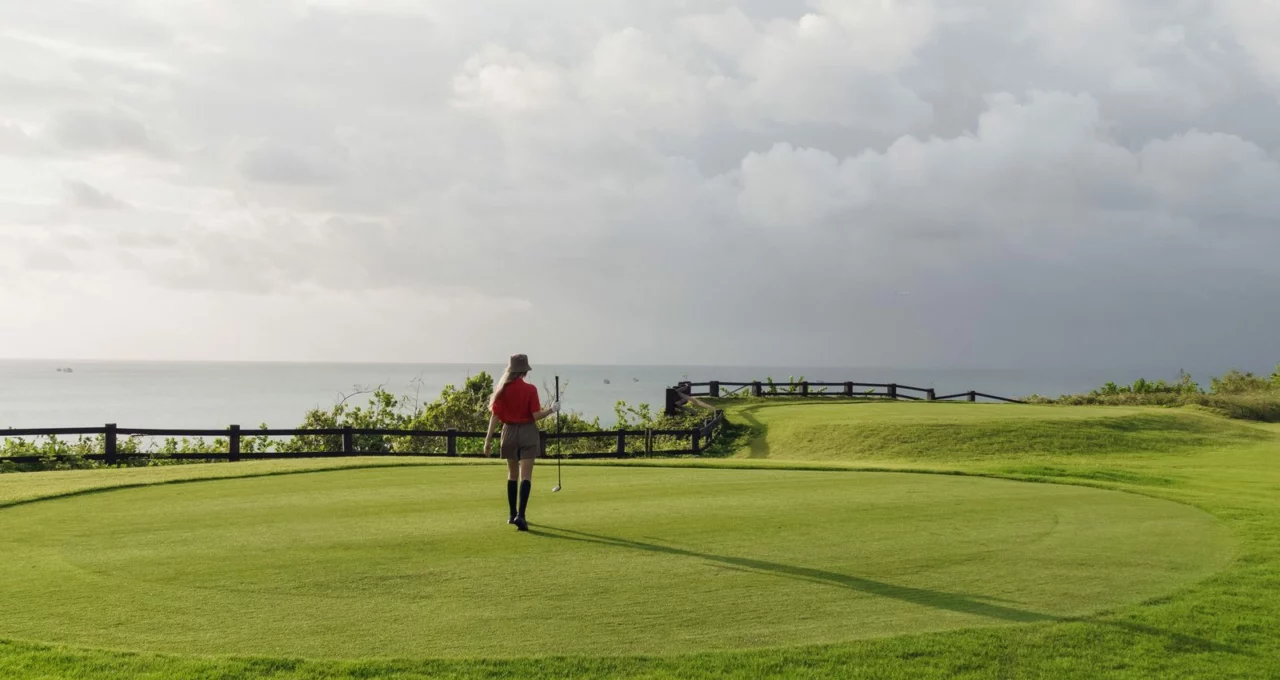
Britain is a windy island with a prevailing south westerly, which is the single most useful fact in British course strategy. It is the reason the classic links is routed out and back: nine holes with the wind and nine into it, so the two halves demand completely different clubs off the same yardages.
That routing is the reason a links scorecard misleads. The outward nine at a championship links can play two clubs longer than the card on a Tuesday and two clubs shorter on the Thursday, and nothing about the course has changed. The Open rota courses on the Lancashire coast and the Kent coast, the Ayrshire links, and the Angus and Fife coast all work this way, and the east coast adds its own complication: a cold North Sea wind carries dense air, so the ball flies shorter again before the wind has done anything to it.
Inland, the picture changes with the ground. Heathland and downland courses in the south sit on open, elevated ground and catch far more wind than their tree lined photographs suggest, particularly in winter when the leaves are down and a belt of trees that sheltered the fourteenth in July stops doing so in January. Wales and the north west coast get the Irish Sea version, which arrives with rain in it. Parkland courses in the Midlands are the genuinely sheltered ones, which is why golfers who learn there find a coastal open a very difficult week.
Preparing for it costs nothing beyond what you were going to spend anyway. Choose the windiest afternoon of the month rather than the calmest and hit half a bucket straight into it, because that is the only way to learn what your own ball does rather than what a chart says it should. Winter twilight rates on a links, when the wind is at its most honest, are the cheapest golf in the country and the best classroom for this. And if your range faces one way only, go on the day the wind is against it.
Five things to try in your next round
- Judge the wind in fives, add a yard per mile per hour, and club for the total.
- Take the extra club and swing at three quarters to a chest high finish. Both halves, every time.
- Read the treetops, not the flag and not the grass you threw in the air.
- Aim for the curve the wind will give you, and ride a crosswind instead of fighting it.
- Round the green go lower and longer: a running 9 iron beats a high wedge into the breeze.
None of this asks for a different swing. It asks for a different club, a different aim and a reading of the air taken somewhere other than beside your own feet. The golfer who takes two more clubs and swings at three quarters comes off a links with a card worth signing. The one who takes the same club and hits it harder spends the afternoon in the revetted bunkers short of the green.
Rules references are to the Rules of Golf as they stand in 2026, in particular Rule 9.3 on a ball moved by natural forces.