Plains wind, lake breeze and the Gulf: three headwind mistakes
A headwind does not put extra spin on the ball. It raises the ball's airspeed, which is why the same spin produces more lift, more height and a steep landing well short of the flag. The arithmetic, the club to take, and the reading error that ruins the shot before you draw one.
In brief
- Into the wind costs about twice what the same wind behind you gives back. Club for that asymmetry, not for a symmetrical one.
- One yard of playing distance per mile per hour of headwind. A 20 mph wind is two clubs, not one.
- Take the extra club and swing at three quarters with a chest high finish. Both halves, or neither half works.
- Read the treetops and the highest flag in view, not the limp flag in a hollow and not the grass you threw in the air.
A headwind is the only hazard on a golf course that moves, and the only one that most golfers respond to by doing the exact opposite of what works. The ball comes up thirty yards short, lands steep, and the reaction is to swing harder next time. That is how a two club wind turns into a four club problem.
There is nothing mysterious about what the air is doing. It is arithmetic, and the arithmetic is not symmetrical: a headwind takes about twice as much as the same wind behind you gives back. Three mistakes account for almost all of the damage, and all three are made before the club moves.
What a headwind actually does
Start with the thing nearly everyone gets wrong. A headwind does not make the ball spin faster. The spin leaving the face is whatever your strike put on it, and the wind cannot add to it.
What the wind adds is airspeed. The ball’s speed relative to the air it is flying through is its own speed plus the speed of the wind coming at it, and both lift and drag climb steeply with that number. So the same spin rate produces more lift. The ball rises higher than you planned, hangs in the air longer, gives the wind more time to work on it, and drops out of the sky at a steep angle well short of where you aimed.
That is the whole mechanism. The ball balloons because the air got faster, not because the ball got spinnier. Which matters, because it tells you what to do: give the wind less height and less time, and stop feeding it extra spin of your own.
The numbers are worth carrying in your head. A useful rule of thumb is one yard of extra playing distance for every mile per hour of headwind, and half a yard less for every mile per hour of tailwind. A 20 mph wind in your face therefore adds about 20 yards to the shot, which for most golfers is two clubs. The same 20 mph behind you takes off about ten, which is one.
Launch monitor modeling published by Golf Digest makes the same point with a single club. A tour standard 7 iron carrying 166 yards in still air carried 17 yards less into a 10 mph headwind, and 13 yards more with that same wind at its back. Into the wind costs more than downwind pays. Every wind decision you make should start from that asymmetry.
Mistake one: swinging harder
This is the expensive one, and it is almost involuntary. The wind is pushing against you, so you push back. You take the club you would have taken in still air, and you go after it.
Every part of that makes the problem worse. More clubhead speed off a lofted face means more backspin, and more backspin in air that is already generating extra lift is exactly the recipe for a ball that climbs, stalls and falls. A harder swing also shifts the strike, usually high on the face on a wood and thin on an iron, and it costs you balance in conditions where balance is already scarce.
The old line about swinging easy when it is breezy is correct, and golfers still fail with it, because they swing easy with the same club. Easy is half the instruction. The other half is more club.
Mistake two: taking one club when the number says two
Most golfers do adjust. They just adjust as though wind were symmetrical, adding one club into it the way they take one club off downwind. The arithmetic above says that is a club short.
Do it properly. Estimate the wind in fives: 5, 10, 15 or 20 mph. You do not need to be accurate, and most golfers overestimate anyway. Add a yard per mile per hour to your actual carry number, not to the number on the sprinkler head, and then pick the club that covers the total with a smooth swing rather than the one that covers it with your best strike.
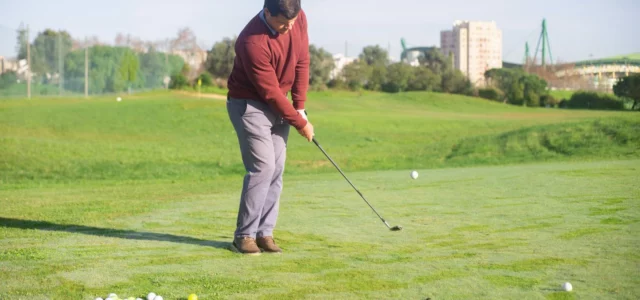
Then do the thing that makes it work: swing that bigger club at about three quarters and finish short, hands no higher than your chest. A 7 iron ridden at 80 percent flies lower and holds its line better than a 9 iron flushed. If the shot needs to stay down, take loft off the club rather than trying to manufacture a low ball with a lofted one, which is how golfers end up leaning on the handle and delofting into a flier they cannot control.
The setup for the knockdown is small and worth practicing: ball a half inch back of normal, grip down an inch, weight a touch on the lead side, stance a little wider than usual, and a backswing you could stop at any point. The shorter finish is the part people skip, and it is the part that keeps the spin down.
Mistake three: reading the wind in the wrong place
The third mistake is a reading error, and it costs the shot before the club is chosen. Golfers read the wind from where they are standing, and where they are standing is usually the most sheltered spot on the hole.
A tee box is often cut into trees. A green sits in a bowl, so the flag hangs limp while the wind runs across the top of the trees twenty feet above it. Tossed grass tells you what the air is doing at ankle height, which is not where your ball is going to spend the next six seconds.
Read the tops of the trees, the highest flag you can see, and the clouds. If the treetops disagree with the flag, believe the treetops. On an exposed hole with nothing to read, the wind on your face at the top of your backswing is a better guide than the one you felt walking up.
The same mistake has a second half: a headwind magnifies whatever curve you already put on the ball. A fade that drifts eight yards in still air can drift twenty into a stiff breeze. So aiming at the flag with your normal shape is the same error as aiming at the flag with the wrong club. Aim where the wind and your shape will put the ball, and if the wind is across, ride it rather than holding the ball against it. Holding a ball into a crosswind means more spin, and more spin is the one thing you cannot afford today.
What the wind does around the green
Approach shots get the attention, and the short game quietly gives away as much. Into the wind, a pitch lands steeply and checks harder than you expect, so the ball that would have released to eight feet stops at twenty. Downwind, the same shot skids. Change the shot rather than the effort: into the wind, a low running chip with a 9 iron beats a high wedge, because a wedge sends the ball straight up into the fastest moving air available.
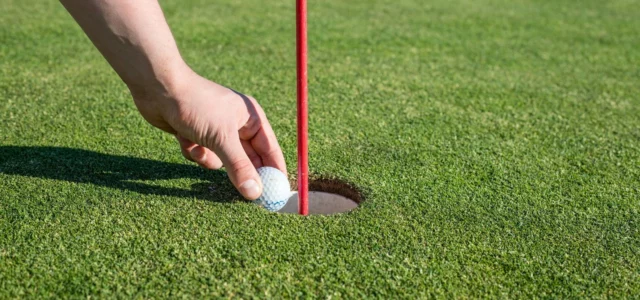
On the green, wind at 20 mph and above genuinely moves a slow ball, especially in the last three feet where it is barely rolling. Widen your stance and shorten the stroke.
One rule to know, because it comes up on exposed courses. If wind moves your ball at rest, there is no penalty and you play it from its new spot. The exception is on the putting green: if you had already lifted and replaced the ball there, you put it back where it was. That is Rule 9.3, and it is the reason not to mark and replace on a windy green until you are ready to putt.
Where American golfers meet a real headwind
American golf has more wind than its reputation suggests, and it is very unevenly distributed. Golfers in the sheltered parkland of the Ohio Valley or the wooded Northeast play whole seasons without a two club wind, then travel and find one on every hole.
The plains are the constant. Oklahoma, Kansas, Nebraska and the Texas panhandle sit under prevailing southerlies that blow through the golf season, and courses there are routed with it in mind: out into it, home with it. Coastal Texas is its own case, where the Gulf breeze at Corpus Christi and Galveston is a daily event rather than a weather condition.
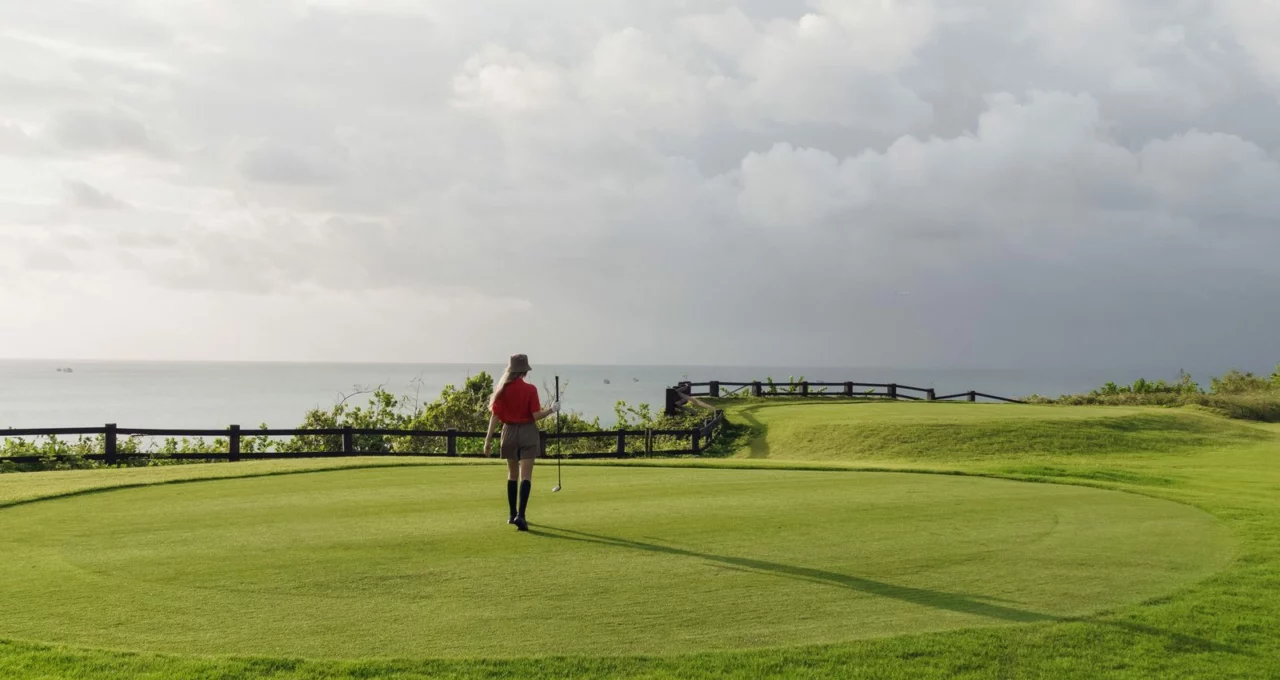
Then there is water. Chicago area courses along Lake Michigan and the Wisconsin lakeshore get a genuine sea breeze in summer afternoons, and the same is true of the Great Lakes shore through Michigan and Ohio. Florida golf runs on the afternoon sea breeze, which arrives from the east on the Atlantic side and the west on the Gulf side and reverses the playing character of the same course between morning and afternoon. The Pacific coast, from the links style ground at Bandon in Oregon down through the Monterey peninsula, adds cold, dense, wet air to an onshore wind, which is how a 150 yard shot becomes a mid iron.
Practicing for it costs nothing, which is the good news. Pick the windiest afternoon of the month rather than the calmest, and hit half a bucket into it at the range: the cost is the same bucket you were going to buy, and it is the only way to learn what your own ball does. Twilight rates at a municipal course, the cheapest tee times in the country, buy a quiet nine in the late afternoon breeze, when the wind is usually at its strongest and nobody is behind you. And if your range runs in one direction only, go on the day the wind is against it.
Five things to try in your next round
- Estimate the wind in fives, add a yard per mile per hour, and club for the total.
- Take the extra club and swing at three quarters with a chest high finish. Both halves, every time.
- Read the treetops, not the flag and not the grass you threw.
- Aim for the curve the wind will give you, and ride a crosswind instead of fighting it.
- Around the green, go lower and longer: a running 9 iron beats a high wedge into the breeze.
None of this asks you to swing differently. It asks you to club differently, aim differently and read the air somewhere other than where your feet are. The golfer who takes two extra clubs and swings at three quarters walks off a windy course with their handicap intact. The one who takes the same club and hits it harder spends the afternoon chipping from the front bunker.
Rules references are to the Rules of Golf as they stand in 2026, in particular Rule 9.3 on a ball moved by natural forces.