Wedge distances: the three lengths you are missing
Three swing lengths across three wedges gives nine numbers between about 40 and 110 yards. You are not learning technique, you are learning how far the swings you already make actually go.

In brief
- Nine o'clock, ten thirty and full, with three wedges: nine repeatable distances.
- Measure in carry, with your own balls: range balls fly meaningfully shorter.
- Keep the tempo identical and let backswing length set the distance.
- Let the shaft stay closer to vertical so the bounce can save a heavy strike.
- Practice the awkward numbers, not the full swings everyone can already hit.
Inside 100 yards, most amateurs have one shot: a full swing with whatever wedge is closest to the number. That is why the ball finishes twenty yards short or long from a distance where it should finish twelve feet away. The fix is three swing lengths, learned once and reused for the rest of your golfing life.
This is the highest-return practice in golf for a simple reason. A mid-handicapper faces a shot between 40 and 110 yards several times a round, converts almost none of them into birdie chances, and has never once measured what their own swings produce from those distances.
Three lengths, not three swings
Think of your lead arm as the hand of a clock, viewed from in front. Nine o’clock, where the arm is parallel to the ground. Ten thirty, roughly halfway between that and the top. And full.
Each of those positions produces a repeatable distance with each wedge. Three wedges times three lengths gives nine numbers, which typically covers everything between about 40 and 110 yards with no gaps worth worrying about.
The critical point: you are not learning new technique. The swings are the ones you already make. You are learning how far they go, which is information you do not currently have and which costs nothing to acquire.
Measure them once, write them down
Go to a range with a launch monitor, or an empty field with a rangefinder and your own balls, and hit ten shots from each position with each wedge. Discard the best one and the worst one. Write down the number that repeats, not the number you would like.
Use carry, not total. Roll depends on the ground, which changes every week, and you are choosing a club to land the ball somewhere.
Use your own balls if you possibly can. Range balls fly meaningfully shorter than premium balls, and building your chart from range rocks means every wedge on the course flies past the flag. If range balls are all you have, note that the chart is a range-ball chart and add a small correction once you have checked it on a course.
Then tape the nine numbers to the shaft of your pitching wedge, put them on the back of a yardage book, or keep them in your phone. A chart you cannot see standing over the ball is a chart you will not use.
Rhythm decides the number, not effort
The most common fault is to make the same backswing every time and control distance with hand speed, which works beautifully on the range and collapses entirely under pressure.
The reason is that speed is a variable you have to judge, and judgment is the first thing that goes when a shot matters. Length of backswing is a position, and positions hold up.
So keep the tempo identical across all three lengths and let the length set the distance, the way a pendulum does. If it helps, count the swing: the same count for a nine o’clock and a full swing, with the club simply travelling further in the same time.
Ball position and the low point
For partial wedges, play the ball just back of center with the weight slightly favoring the lead side, and keep it there through the shot. The club should reach the bottom of its arc after the ball, taking a small divot in front of where the ball was.
Golfers who try to help the ball into the air move their low point behind it, which produces the fat and thin pair that ruins wedge play: one shot dead into the ground, the next one bladed over the green, both from the same intention.
A useful practice check: put a tee in the ground an inch in front of the ball and try to clip it after impact.
Bounce is the friend you are not using
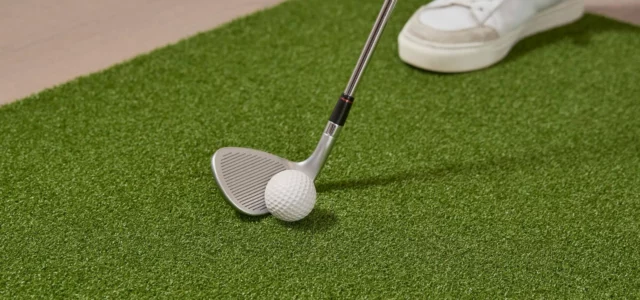
The rounded sole of a wedge is designed to skid rather than dig, which is what saves a slightly heavy strike on soft turf.
Presenting the club with the shaft leaning far forward, which is what golfers do when they are trying to compress the ball, takes the bounce out of play and puts the leading edge into the ground. A small miss becomes a chunk.
On partial shots, let the shaft stay closer to vertical than feels natural. The ball will come out slightly higher and land softer, which is what you wanted anyway.
The other two variables: lie and wind
A ball sitting down in rough will come out with less spin and more roll, so a chart number is a starting point rather than an answer. From a flyer lie, meaning grass trapped between the face and the ball, a wedge can go ten to fifteen yards further than the chart says, which is where a great many balls end up over the back of the green.
Wind matters more on a wedge than golfers assume, because a wedge shot spends a long time in the air relative to its distance. Into the wind, take one more swing length rather than swinging harder, since a harder swing adds spin and spin is what the wind punishes.
Uphill and downhill lies change the effective loft. The general rule is that the ball flies lower and further from a downhill lie and higher and shorter from an uphill one, and that adjusting the club is more reliable than adjusting the swing.
Practice in the gaps, not at the full number
Every golfer can hit a full sand wedge. Almost nobody can hit 63 yards, which is exactly the sort of number a golf course produces.
Spend one session hitting to a flag at an awkward distance, adjusting the swing length until the ball lands beside it, and pay attention to what the successful swing felt like. That is the distance you will face on the course and the one nobody rehearses.
A good practice game: pick three targets at odd distances, hit two shots at each in rotation, and never hit the same shot twice in a row. Random practice transfers to the course; block practice makes you good on the range.
Where to measure them in the U.S.
An hour in a launch monitor bay is the fastest route, and it produces all nine numbers in one session. Indoor simulator centers rent bay time by the hour in most American cities, and two large U.S. golf retailers both have monitor bays, with single-category fitting sessions from around $99.99 if you want a fitter present.
Outdoors, a range with marked targets and your own balls works if you take a rangefinder, and a grass range is considerably better than mats for wedge work because mats forgive the heavy strike that grass punishes. Municipal practice facilities with grass tees are worth seeking out for exactly this.
If you want the numbers from real rounds rather than from practice, shot-tracking systems such as Arccos and Shot Scope record wedge distances from actual lies across a season, which for course use is the most honest data available.
Panxis Golf has no commercial relationship with any retailer, facility or system mentioned here.
What to do this month
- Record nine numbers: three wedges times three swing lengths, in carry.
- Use your own balls, and write the chart down somewhere you can see it on the course.
- Practice one full session at distances that are not full swings.
- Keep the tempo identical and change only the length of the backswing.
- On the course, pick the swing that matches the number rather than the club that gets you there.
Wedge play is the cheapest scoring gain in golf because it needs no equipment and no athleticism, only nine numbers you do not currently have.
How this page was put together
Fitting session prices and monitor-bay availability were taken from PGA TOUR Superstore and Golf Galaxy (United States). Panxis has no commercial relationship with these retailers.