Nine wedge distances for British conditions: the clock system, wind and winter turf
Inside 100 yards most club golfers own one swing and guess the rest. Measure three backswing lengths with each wedge once, write the carries down, and adjust them for the wind and the ground rather than swinging harder.

In brief
- Nine o'clock, half past ten and full, with three wedges, gives nine numbers.
- Keep the tempo the same and let backswing length set the distance.
- Record carry, not roll: British turf ranges from baked links to winter mud.
- Into the wind take more swing, not more effort; on firm links, pitch it shorter.
- Rule 4.3a(3) lets you use distances gathered before the round.
Watch a Saturday four-ball at most British clubs and you will see the same thing on the par 5s. A decent drive, a steady second, and then from 70 yards a full swing with a sand wedge that either flies the green or is decelerated into the turf. The shot that should set up a par putt costs a bogey.
The fix is not a new swing. It is three backswing lengths, measured once with each wedge, written down and trusted on the course. Nine numbers, and most of the guesswork inside 100 yards disappears.
The clock system
Picture yourself from the front, with your lead arm as the hand of a clock. Three positions cover almost everything:
- Nine o’clock, with the lead arm parallel to the ground.
- Half past ten, roughly halfway between that and the top.
- Full, your normal controlled wedge swing.
Three lengths with three wedges gives nine distances, usually spread between about 40 and 110 yards with no worrying gaps. Nothing here is new technique: these are swings you already make. What you do not yet have is the carry distance each one produces, and that costs nothing but a practice session.
Keep the rhythm, change the length
The instinctive way to hit a shorter wedge is the same backswing with less speed. It can look fine on the range and falls apart in a medal, because judging speed is exactly what nerves take away. A backswing length is a position, and positions survive pressure.
So keep the tempo identical for all three swings and let the length alone decide the distance, like a pendulum. Some golfers count: the same “one, two” for a nine o’clock swing as for a full one, with the club simply travelling further in the same time.
Measuring your nine numbers
You need carry distance, not total. On a British course the roll after landing varies enormously, from a firm links in a dry July to a sodden parkland in February, so the number that matters is where the ball lands.
- Hit ten balls with each wedge at each length.
- Ignore the longest and the shortest.
- Write down the carry that keeps recurring, not the one you would like.
A range with ball tracking makes this quick. Hoebridge Golf Centre in Surrey has Trackman in every bay of its floodlit range, and Trafford Golf Centre in Manchester has 53 bays with Toptracer. A personal launch monitor does the job anywhere, as does a quiet practice ground with a flag and a rangefinder.
One warning about range balls: they usually fly shorter than the ball you play. If range balls are all you can use, label the chart accordingly, then check a few numbers with your own ball on the course and adjust.
Keep the chart where you can see it over the ball: a sticker on the shaft, the back of your yardage book or your phone. Rule 4.3a(3) allows you to use information gathered before the round, such as club distances from earlier practice; what it does not allow is processing distances recorded during the round into club recommendations.
Getting the strike right
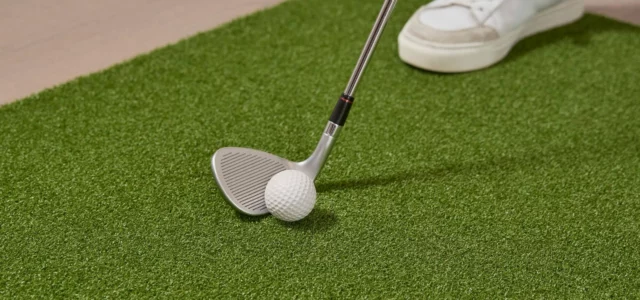
Ball position. For part swings, place the ball just behind the centre of your stance with the weight slightly towards the lead foot, and keep it there. The club should bottom out after the ball, taking a shallow divot in front of it.
The low point. Trying to scoop the ball into the air moves the bottom of the swing behind the ball and produces the fat-thin pair: one shot into the turf, the next skulled through the green. Push a tee into the ground an inch ahead of the ball in practice and try to clip it after impact.
Bounce. The rounded sole of a wedge is designed to glide rather than dig. Lean the shaft hard towards the target and the leading edge digs instead, turning a slight heavy strike into a proper chunk. On soft British winter turf this matters twice over. Let the shaft sit closer to vertical than feels natural on part shots; the ball comes out a little higher and lands softer, which is what you wanted.
When your numbers need adjusting
Wind. A wedge spends a long time in the air for the distance it travels, so wind moves it more than golfers expect. Into the breeze, go up a swing length or a club, and swing no harder, because extra effort adds spin and spin is what the wind exaggerates. On an exposed links, a lower punched wedge or a putt from off the green is often better than any lofted shot.
Flyer lies. With grass trapped between the face and the ball, spin drops and the ball can come out well beyond your chart number. Plan for the ball to run and land it shorter.
Slopes. From a downhill lie the ball tends to come out lower and run further; from an uphill lie, higher and shorter. Changing club is more reliable than changing the swing.
Firm links turf. In a dry summer on seaside ground, a wedge that pitches on the front of the green may not stop at all. Sometimes the best 60-yard shot is a lower one pitched short and allowed to run, which is where knowing your carry numbers really pays.
Winter. Cold air and soft ground both take distance off, and a ball that plugs on landing does not release. Many golfers find their chart runs a few yards short from November to March.
Practise the awkward numbers
Every golfer can hit a full sand wedge. Almost nobody can hit 63 yards on demand, and 63 yards is exactly the kind of number a golf course gives you.
In one session, set a target at an awkward distance, work the swing length until balls land beside it, and pay attention to how that swing felt. Then play a rotation game: three targets at odd distances, two balls to each in turn, never the same shot twice in a row. Varied practice like this carries onto the course; hitting fifty balls to one flag mainly makes you good on the range.
If your club has a grass short-game area, use it rather than mats. Mats forgive a heavy strike that turf punishes.
Where to measure and fit wedges in the UK
Ranges with ball tracking. Hoebridge’s Trackman range and Trafford’s Toptracer bays, mentioned above, are two examples; many British golf centres now offer similar technology by the bucket or the hour.
Custom fitting centres. If your gaps look wrong, the problem may be the lofts rather than the swing, and a fitting will show it. Some specialist golf shops run fitting centres with launch monitors, and some say they refund the fitting fee if you buy on the day. Hoebridge also offers fittings with its PGA professionals and Trackman.
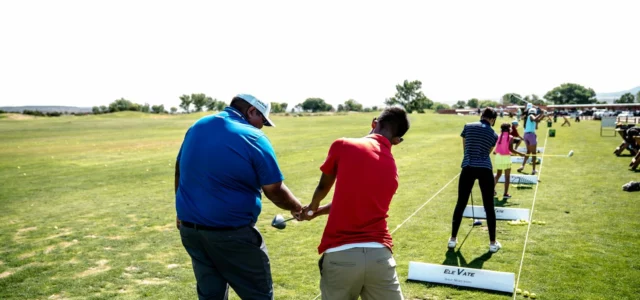
Your club professional. A short-game lesson on the practice green with your own ball is often the most direct route to reliable wedge numbers, and a PGA Professional can be found through the PGA Play directory.
Panxis Golf has no commercial relationship with any retailer, venue or organisation named here.
This month
- Measure nine carry numbers: three wedges, three swing lengths.
- Use your own ball wherever possible and keep the chart in sight on the course.
- Hold the tempo constant; change only the length of the backswing.
- Adjust for wind, flyer lies, firm links turf and winter conditions.
- Spend one session on awkward in-between distances, rotating targets.