Golfer’s elbow: warning signs, rehab, NHS physio self-referral and winter mats
That ache on the inside of the elbow after a heavy strike off a mat or frozen ground is rarely serious, but it is slow to clear if you keep hammering it. Most golfers get rid of it without an operation by easing off, loading the tendon back up gradually and knowing which symptoms belong in a GP's surgery.
In brief
- Golfer's elbow, or medial epicondylitis, is an overloaded tendon where the wrist-curling muscles attach to the bony point on the inside of the elbow.
- Tingling in the ring and little fingers, a pop with swelling, an elbow that locks, night pain or no progress after six to eight weeks all mean a professional opinion first.
- Rehab moves from isometric holds to slow wrist curls; a forearm strap has modest evidence and steroid injections give relief that tends to fade.
- In many parts of England you can self-refer to NHS physiotherapy, and clubs can make fairway mats compulsory in winter under Model Local Rule E-12.
You notice it first on the drive home after a cold session at the range: a nagging soreness on the inside of the elbow, nothing dramatic. Then it turns up when you lift the kettle or haul the trolley out of the boot, and eventually it makes you wince at impact. Golfer’s elbow is common, irritating and slow to clear, but rarely serious, and most golfers get rid of it without an operation. What decides how long it hangs about is mostly what you do in the first month. Here is how to tell what you are dealing with, which symptoms need a professional straight away, what helps the tendon recover, how to keep playing sensibly, and where to turn for help in the UK, winter included. It is general information for adults, not a diagnosis.
The tendon behind the ache
Doctors call it medial epicondylitis. With your arm by your side and the palm facing forward, the knobbly point of bone on the inside of the elbow is the medial epicondyle. The forearm muscles that curl the wrist and roll the palm downwards share a tendon that anchors onto it, and every firm grip, wrist flick and jolt of the clubhead into the ground pulls on that anchor.
The trouble is usually not a sudden inflammation but a tendon asked to do more than it can currently tolerate. Long-running cases look more like worn tissue that has failed to repair itself, which is why clinicians increasingly say tendinopathy. The lesson follows directly: such a tendon recovers when it is loaded again, carefully and progressively, not when it is rested indefinitely. If the pain sits on the outer side of the lead elbow instead, that is tennis elbow; the logic, and most of the advice below, is the same.
Is it really golfer’s elbow? Three quick checks
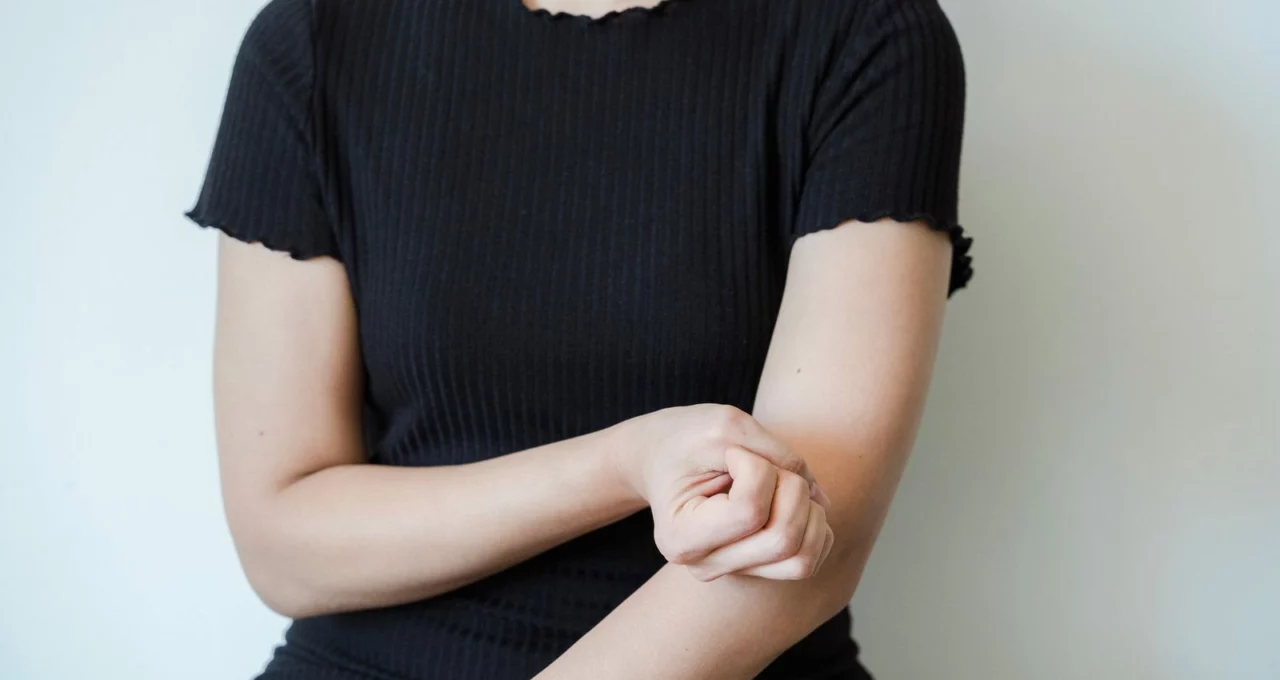
The usual pattern is a tender spot on or just below the inner bony point, stiffness first thing in the morning that eases as you get going, and an ache that returns after use. Gripping hard, shaking hands and carrying a bag with the palm up are classic triggers; on the course, heavy shots that catch the ground first hurt most.
- Resisted wrist curl. Forearm on a table, palm up, wrist over the edge. Curl the hand upwards while your other hand pushes gently down. Pain at the inner elbow points to the flexor tendon.
- Pressure test. Press a fingertip on the inner bony point and just in front of it. Tendon pain is usually sharply localised there.
- Grip test. Squeeze a rolled-up towel hard with the arm straight. Pain on the inner side fits the picture.
Red flags: get it looked at first
Skip the home programme and get a professional opinion promptly if you notice any of these:
- Tingling, pins and needles or numbness in the ring and little fingers, or a weak, clumsy hand. The ulnar nerve, your funny bone, runs in a groove just behind the inner elbow and can be squeezed there.
- A pop or sudden sharp pain on one shot or after a fall, followed by swelling or bruising.
- Locking, catching or lost movement, so the arm will not fully straighten or bend.
- Pain at night or at rest that no position eases, or a hot, red, swollen joint, especially with a fever.
- No progress after six to eight weeks of doing the sensible things below.
Diagnosis is normally made by examination; scans are generally kept for cases that do not behave as expected.
How the swing overloads the inner elbow
Muscles strengthen within weeks; tendons take months. Trouble starts when the load climbs faster than the tendon can follow.
A burst of practice. A golfing holiday with two rounds a day, or the first dry weekend of spring after months away. The jump matters more than the total.
Heavy contact. A steep swing that drives the club into the ground sends a jolt up the shaft. Mats and hard ground do not give like soft turf.
Strangling the grip. A tight trail-hand hold keeps the flexors working from takeaway to finish, and throwing the club from the top adds to it.
Everything else. A long day on a mouse, a weekend with secateurs and a spade, a new gym habit full of pull-ups. The tendon adds it all together.
Settling it down and building it back
Conservative treatment works for most people, but mild cases take weeks and established ones often several months. The approaches with the best support calm the tendon first, then rebuild what it can tolerate.
Back off, without stopping. Reduce or pause whatever sets it off, golf included if necessary, but keep using the arm day to day. A rule many physiotherapists use: an activity is fine if pain stays mild during it and the elbow is no worse the following morning.
Load it, step by step. This is the heart of rehab. It usually begins with isometric holds, keeping the wrist still while pushing against your other hand for around half a minute, which many people find eases pain. Then come slow eccentric wrist curls with a light dumbbell or a tin of beans, palm up, taking three or four seconds to lower. Grip work and slow forearm rotation with a light hammer complete it. Move up only when the current level feels easy.
Ice and painkillers, with care. Ice after activity and anti-inflammatory tablets or gel can take the edge off for a few days, but they do not mend the tendon. With stomach, kidney or heart problems, or other medicines, ask a pharmacist first.
A forearm strap. A counterforce strap worn just below the elbow spreads the pull away from the sore point. Some golfers play more comfortably with one; the evidence is modest. It is a short-term support, not a treatment.
Injections and surgery. A steroid injection can bring fast relief, but studies on elbow tendinopathy, mostly tennis elbow, suggest the benefit fades and symptoms often return within months. Surgery is only considered for the few who have not improved after many months of well-run rehab.
Keeping a card in your hand while it heals
Plenty of golfers carry on with a gentler game during rehab, as long as pain stays low and the morning-after check is fine.
- Take preferred lies when the club has them in force, and chip out sideways rather than heaving at a ball buried in rough.
- Spend more time putting and chipping than on full swings.
- Hold the club lightly, around four on a scale of ten, and do not let the trail hand do all the work.
- Warm the forearms up in the car park: wrist circles, gentle stretches, a dozen half swings.
- Use a trolley, and do not lift the bag out of the boot with the sore arm.
Worn, shiny grips make you squeeze harder, so a fresh or slightly softer grip can help, and some players find graphite iron shafts kinder than steel. Grip size is a question for a qualified club fitter.
Stopping it coming back
- Ramp up gradually. After a break, add rounds and range sessions over several weeks. There is no need to chase two hundred yards off the tee on your first day back.
- Keep the forearm work. Two short sessions a week are cheap insurance.
- Use the big muscles. A swing driven by the hips and upper back asks less of the arms. If your back is grumbling too, our piece on the golfer’s back through winter has movements worth adding.
- Improve the strike. A lesson on hitting ball before turf is as good for the elbow as for the card.
Where to get help with golfer’s elbow in the UK
NHS physiotherapy, sometimes without a GP. Physiotherapy is free on the NHS. In England, the NHS website says that in many areas you can refer yourself to community musculoskeletal (MSK) services, which include physiotherapy, without going through your GP. It depends on where you live, so search for your local MSK service, and expect a wait: the NHS itself warns lists can be long. In Scotland, Wales and Northern Ireland, check your health board or trust website.
Your GP. The surgery is the right door for any red flag, for pain that is not shifting, or if you are unsure what you are dealing with. A GP or a first contact physiotherapist in the practice can examine the elbow and refer you on.
NHS 111 when it cannot wait. In England, NHS 111, by phone or at 111.nhs.uk, is there when you think you need medical help now and cannot reach your GP, and will point you to the right service. The other nations have their own urgent advice services.
A private physiotherapist. “Physiotherapist” is a protected title: by law only people on the Health and Care Professions Council (HCPC) register can use it, and you can check anyone’s registration online. The NHS also suggests a chartered physio, with MCSP after their name, and the Chartered Society of Physiotherapy has a search to find one. Ask whether they treat golfers and will check the nerve and neck as well as the tendon.
Your PGA professional. A club pro cannot treat a tendon, but can spot the heavy strike or vice-like grip that keeps aggravating it. Mention the elbow at the start of the lesson.
Winter golf. A British winter is hard on the inner elbow in two ways: waterlogged fairways invite you to dig the club in, while frosty or frozen ground sends a harsher jolt up the shaft on any heavy shot. Under the Rules of Golf, a club’s Committee can adopt preferred lies (Model Local Rule E-3) and can make fairway mats compulsory (Model Local Rule E-12) on all fairways or only some, whenever a putter is not being used. Details vary, so check the notice board or club website before you go out. On mats, sweep the ball rather than hitting down hard, and treat a frozen morning as a good one for forearm exercises at home. The quiet months are also the time to finish rehab properly rather than flaring up again at the first spring medal.
Your first fortnight
- Today: run the three checks and read the red flags. If one applies, contact your GP, or NHS 111 if it cannot wait, before any exercises.
- Days one to seven: drop full swings off mats and hard ground, keep putting and chipping, and do isometric holds once or twice a day.
- Days eight to fourteen: add slow wrist curls every other day and note how the elbow feels each morning.
- After two weeks: keep building the load. If nothing is improving, see whether your area offers NHS self-referral, or book a chartered physio.
- Once it is quiet: keep two forearm sessions a week and book a lesson on your strike.
Golfer’s elbow is mostly a test of patience. A few weeks of sensible loading and gentler golf beat months of gritting your teeth through it. Respect the morning-after rule, build the tendon up gradually, and the inside of your elbow should soon go back to being something you never think about.