Golfer’s elbow over a Canadian winter: rehab plan, warning signs and who pays for physio
An inner-elbow ache that shows up at the end of the season and is still there when you lift the kettle is usually a tendon that took more load than it could handle. The long Canadian off-season is the ideal window to rebuild it, provided you rule out the warning signs first and load it patiently rather than just waiting for spring.
In brief
- Golfer's elbow, or medial epicondylitis, is an overloaded wrist flexor tendon on the bony knob inside the elbow, often triggered by mats, hard ground and a tight grip.
- Tingling in the ring and little fingers, a pop or swelling after one shot, a locking elbow, night pain or no progress after six to eight weeks call for a doctor first.
- Recovery rests on progressive loading, from isometric holds to slow eccentric wrist curls; a strap helps modestly and cortisone relief tends to fade.
- You can book a physiotherapist without a referral in Canada, but public funding is narrow, for example limited to specific groups in Ontario and BC; PGA of Canada pros and Golf Canada simulator tracking help with the return.
The last weeks of a Canadian season have a pattern. You squeeze in one more twilight nine, a bucket on a frosty mat, a few rounds on hard, dry fairways, and then one morning the inside of your trail elbow aches when you pick up the kettle. You blame the cold. Two weeks later it is still there when you open a jar or shake hands. That is the classic start of golfer’s elbow, and the timing is not a coincidence: a tendon pushed hard at the end of the season, then left alone for a long winter, often comes back in spring exactly as cranky as it was in October. The upside of the Canadian calendar is that you have months to fix it before the courses open. Here is how to tell what you have, when to see a doctor first, how treatment works and where to find help in Canada.
One caution up front: this is general information for adults, not a diagnosis. Read the warning signs before you start any exercise.
A tendon problem, not a joint problem
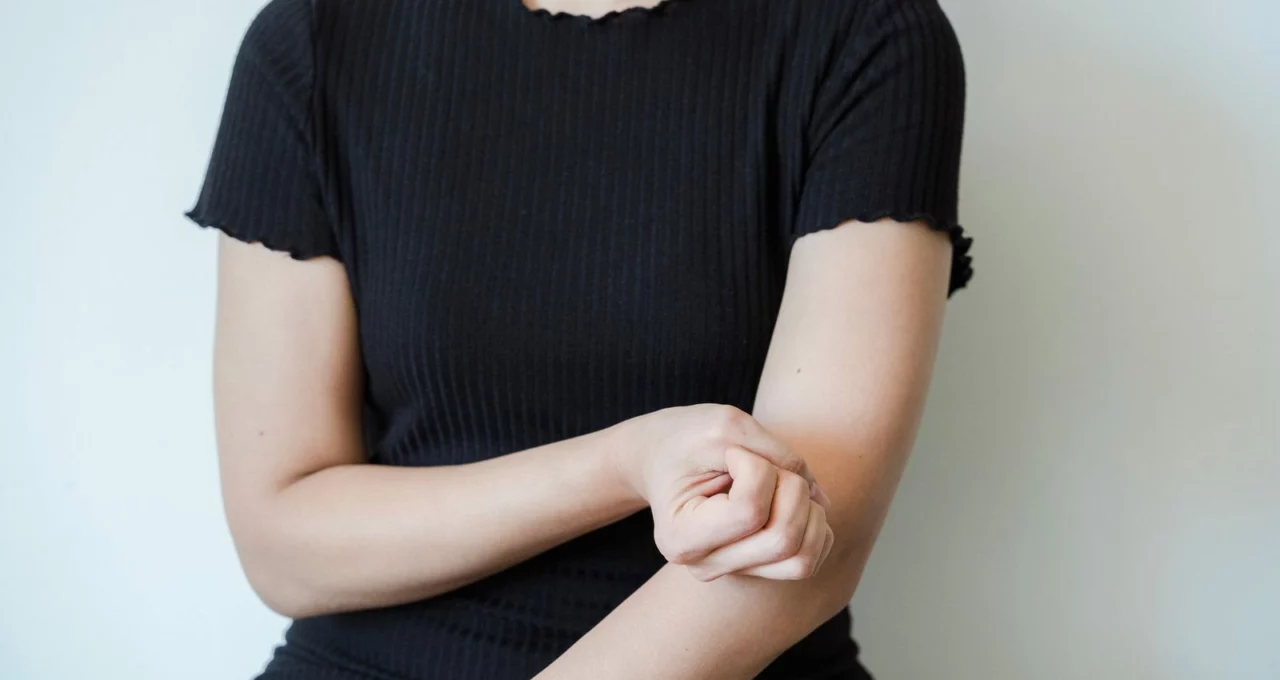
Doctors call it medial epicondylitis. The medial epicondyle is the knob of bone you can feel on the inside of your elbow, on the little-finger side when your palm faces up. The muscles that curl your wrist and turn your palm down all start from that knob through one shared tendon. Every time you squeeze the grip, hold the wrist angle into impact or absorb the jolt of the club meeting the turf, that tendon takes the strain.
Despite the “itis”, a long-standing case is usually less inflammation than a tendon whose repair has stalled, which is why clinicians often say tendinopathy. A stalled tendon responds to the right amount of load; complete rest calms it but rarely rebuilds it.
Tennis elbow, on the outside of the elbow, is its mirror image. Golfers get both, and the treatment logic is the same.
Signs that point to golfer’s elbow
- Tenderness right on the inner knob, sometimes running a short way down the forearm.
- Pain when you grip hard, carry a grocery bag with the palm facing forward, or turn a stiff door handle.
- Stiffness first thing in the morning that loosens up, then returns later in the day.
- On the course, a jab at impact, worst on heavy shots, shots off frozen or baked ground, and balls hit off a range mat where the club cannot dig.
A quick self-check: sit with your forearm on a table, palm up, and try to curl your wrist upward while your other hand holds it down. If the familiar pain shows up on the inside of the elbow, the wrist flexor tendon is the most likely culprit.
When to skip the self-care and see a doctor
Some symptoms do not fit an ordinary overuse tendon. Book an appointment with your family doctor or a walk-in clinic before you treat it yourself if you notice any of the following:
- Tingling, numbness or weakness in the ring and little fingers. The ulnar nerve runs right behind the inner knob, in the spot people call the funny bone. If it is irritated or compressed, the plan changes.
- A pop, sudden pain or swelling after one specific shot, such as catching a root or the frozen edge of a bunker. That suggests an acute tear rather than slow overload.
- An elbow that locks, catches or will not fully straighten or bend. That points inside the joint, not at the tendon.
- Pain at night or at rest that wakes you up, or that comes with fever, redness or a joint that feels hot.
- No real progress after six to eight weeks of sensible care. Time to have someone look at it properly.
How the golf swing overloads the inner elbow
It builds up when the load climbs faster than the tendon can adapt. In Canadian golf, a few patterns recur.
- Season-opening binges. After five months off, the first warm weekend brings a large bucket on Saturday and 36 holes on Sunday. The tendon has done nothing since October.
- Mats and hard ground. Domes and simulator bays mean hitting off mats over concrete, and early and late in the season the turf can be hard as a parking lot. A fat shot that would have taken a divot in July sends the shock straight up the shaft.
- A death grip. Squeezing the club hard, especially in the trail hand, keeps the forearm flexors working the whole swing. Cold hands make players grip tighter without realizing it.
- Swing patterns. Casting the club early, a flip through impact or a steep angle of attack that buries the leading edge all add stress. A lesson can be as useful as any exercise.
- Worn grips. Slick or thin grips encourage squeezing.
- Life outside golf. Shovelling snow, racquet sports or a weekend of renovations load the same tendon.
Treatment that actually moves the needle
Calm it down, but do not shut it off. Relative rest means cutting out what clearly provokes the pain, such as range sessions, hard gripping tasks and heavy lifting with the palm up, while keeping the arm moving in daily life. A rough guide many clinicians use: mild discomfort during an activity is acceptable if it settles within a day and is not worse the next morning.
Rebuild the tendon in stages. Progressive loading is the heart of recovery. A typical progression looks like this:
- Isometric holds first. With the forearm resting on a table, palm up, press the hand upward into your other hand or under a table edge without moving the wrist. Hold for a slow count of 30 to 45 seconds, rest, and repeat a handful of times. These often ease pain in the short term.
- Then slow eccentrics. Holding a light dumbbell or a filled water bottle, palm up, use the other hand to help lift the wrist, then lower it slowly on its own over three or four seconds. Start light, add weight only when the current load feels easy.
- Then strength and grip. Full wrist curls, forearm rotations with a hammer held near the head, and grip work with a soft ball or a towel wring. Finish with exercises for the shoulder and upper back, since a weak chain above puts more work on the forearm.
Tendons adapt slowly, and many people need several months of consistent work. The Canadian winter is well suited to that.
Ice and anti-inflammatories, with care. Ice after a provoking activity can take the edge off. Over-the-counter anti-inflammatory pills or gels may help for short periods, but they are not suitable for everyone, especially people with stomach, kidney or heart concerns or who take other medication. Ask a pharmacist before using them regularly, and do not use them to mask pain so you can play.
The counterforce strap. A strap worn just below the elbow aims to spread the pull on the tendon. The evidence behind it is modest. Some golfers find it makes a round more comfortable; it does not repair anything, and it should not be pulled so tight that your fingers tingle.
Cortisone injections. A steroid shot can bring quick relief, but in tendon problems that relief often fades within weeks, and some studies suggest results over the longer term can be worse than with exercise alone. If your doctor offers one, ask how it fits into a loading program rather than replacing it.
Surgery is rare. It is usually only considered after many months of well-conducted conservative care that has not worked, and the decision belongs with an orthopaedic surgeon.
Keeping your clubs in play
You do not always have to stop entirely. If the elbow tolerates it, adjust rather than abandon.
- Putt and chip first. Short swings with a light grip usually cause little trouble and keep your touch alive.
- Hit off grass, not mats, whenever you can, and tee the ball up even with irons during the rebuilding phase.
- Keep sessions short. Thirty balls with a full routine beats a jumbo bucket hit as fast as possible. Stop the moment pain changes from a dull awareness to a sharp jab.
- Club up and swing easier. If your 7-iron normally flies 150 yards, a smooth 6-iron to that pin stresses the elbow less than a forced 7.
- Warm up properly before the first tee. Our pre-round warm-up routine takes a few minutes and gets the forearms ready.
Where to get help in Canada
Physiotherapy without a referral. You do not need a doctor’s note to book a physiotherapist in Canada. The Canadian Physiotherapy Association, the national professional body, has long stated that Canadians have the right to see a physiotherapist without a physician’s referral. Private insurers sometimes still ask for one before they reimburse, so read your benefits booklet first. In Ontario, the College of Physiotherapists of Ontario keeps a public register if you want to check a licence.
Who pays depends on your province. For most working-age golfers, community physiotherapy is paid out of pocket or through an extended health plan at work. Public coverage is narrow and varies across the country. In Ontario, government-funded physiotherapy at community clinics is limited to people 65 and older, 19 and under, people of any age after an overnight hospital stay or day surgery in the previous 12 months for a condition that needs physiotherapy, and recipients of Ontario Works or ODSP. In British Columbia, MSP supplementary benefits make a partial payment toward physical therapy visits only for eligible groups, such as people who qualify based on income, within a yearly visit limit shared with other practitioners. In Alberta, physiotherapy is not an insured service under the provincial health plan, although Alberta Health Services funds care for certain conditions at its own sites and contracted clinics. Elsewhere, check with your provincial ministry of health and your insurer before you book.
A PGA of Canada professional for the swing side. The PGA of Canada website has a Find a Pro search by city, province or postal code. A teaching pro will not treat your elbow, but can spot the grip pressure or steep strike that keeps loading it.
Use the winter, with Golf Canada in the loop. The off-season is long enough to rehab the tendon first and reintroduce the swing gradually indoors. Simulator bays let you control the volume, and the Golf Canada app lets you log rounds and practice sessions at participating simulator facilities, so you can track how much you hit as you build back up.
Keeping it from coming back
- Keep two short forearm and grip sessions a week going after the pain has gone, through the winter and during the season.
- Ramp up in spring. Build from short swings to full sessions over a few weeks instead of starting the season with a marathon weekend.
- Hold the club with moderate pressure, and keep your hands warm on cold days so you do not clamp down.
- Prefer grass to mats, avoid hitting off frozen ground, and replace grips once they turn shiny.
If your elbow aches tonight, do the self-check, reread the warning signs, add a light isometric hold to your evening routine and drop the range for now. Treated with patience over the winter, most golfer’s elbows are quiet by opening day, with a stronger forearm than you had last fall.