Maple leaves in the long grass: escaping thick fall rough in one swing on Canadian courses
A clean escape from the rough costs about six feet of proximity. The second hack is what turns a bogey into a triple. Read the lie, take loft, swing hard, respect dew and frost, and know when one penalty stroke is the cheaper swing.
In brief
- Shot Scope: from 60 to 100 yards, golfers finish 40 feet away from the fairway, 46 feet from the rough and 56 feet from a bunker.
- Perched, half hidden or swallowed: how much of the ball you see decides the club, not the yardage.
- Ball back an inch, weight on the lead foot, face slightly open, firm grip and full speed through the grass.
- Leaves are loose impediments, but a ball that moves while you clear them costs a stroke under Rule 9.4b.
- Golf Canada's 2026 pace of play policy counts searching past three minutes as unreasonable delay.
An October Saturday in Ontario. The frost delay has lifted, the fairways are drying out, and the grass either side of them is still soaked, long after a full season of growth and full of yellow maple leaves. Your drive has found it. The flag is in view, 150 yards away, and the seven iron in your hand feels like a reasonable idea. It is the shot that turns a bogey into a triple.
Thick rough rarely ruins a hole on its own. What ruins it is the decision you make over a ball you can barely see, with a club that was never going to move it. Getting out well has almost nothing to do with strength and nearly everything to do with reading the lie, respecting what it allows, and knowing the price of the rules before you need them.
Six feet, not a catastrophe
Start by shrinking the fear, because fear is what produces the reckless second shot. Shot Scope, which tracks shots from real amateur rounds, looked at approaches from 60 to 100 yards. From the fairway its golfers finished an average of 40 feet from the hole. From the rough, 46 feet. From a bunker, 56 feet.
Six feet of proximity is the honest penalty for a clean strike from a playable lie in the rough. That is a tax, not a disaster. The disaster is a shot that grabs a fistful of grass, travels forty yards and leaves you in deeper rough at a worse angle. Do that twice and a five becomes a seven. Golfers who score well from the long grass are not pulling off miracles. They are refusing to hit the second bad shot.
One question before any club comes out
Stand beside the ball and ask what the worst realistic result is with the club you are thinking about, and whether the hole can survive it.
From a lie where half the ball is hidden at 150 yards, the realistic bad outcome with a seven iron is a scuffed shot of sixty yards that stays in the rough. The realistic bad outcome with a pitching wedge aimed at the fat part of the fairway is ninety yards on short grass, and a full shot to the green from there. The wedge is not the cautious play. It is the play whose bad day is still acceptable.
Then choose the widest way out rather than the shortest. A shot played sideways onto flat fairway beats a shot forward through a narrowing gap between two spruce trees. Playing it without sulking is a skill in itself, and it is worth more over a season than any recovery swing.
Three lies and what each one permits
Look at the ball before you look at the green. Rough lies come in three kinds.
Perched. The ball sits on top of the grass with a gap underneath. It looks like a fairway lie and it is not. Grass still comes between the face and the ball, so spin drops, the ball comes out lower and it runs further than you planned.
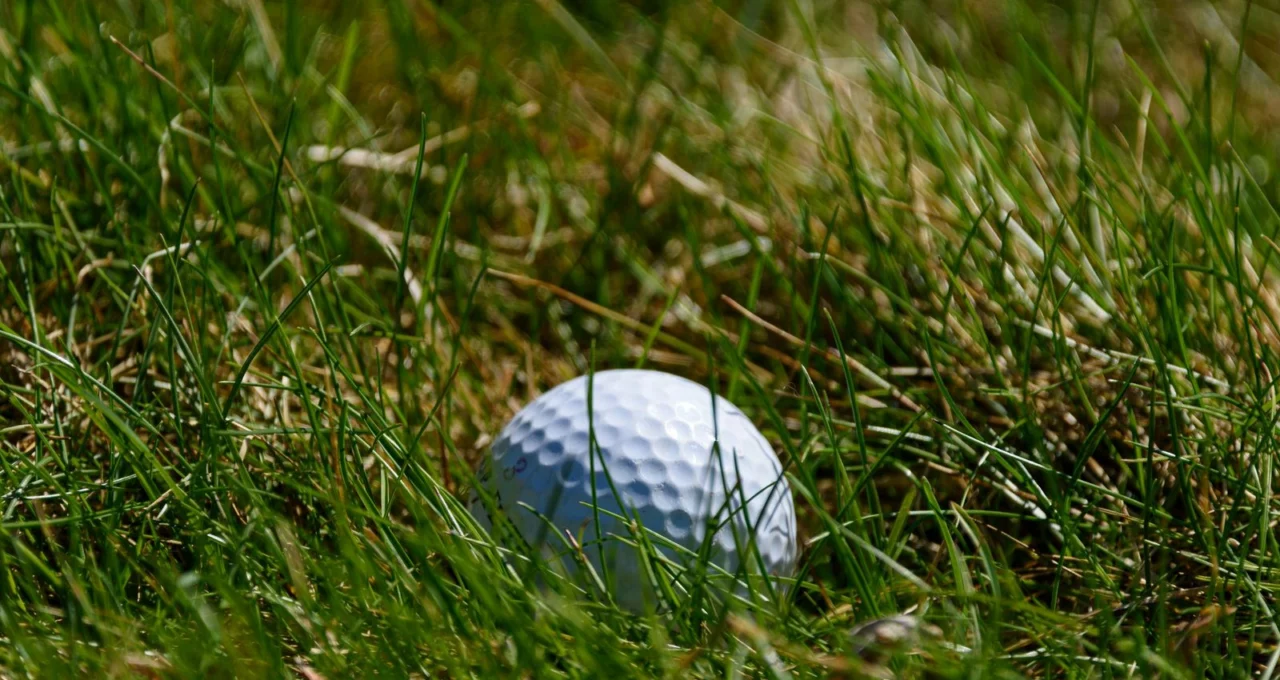
Half hidden. You can see the top half of the ball. This is the most common rough lie. A lofted club will get it out; a long club will not. Expect a lower flight with little backspin.
Swallowed. You only found it because you watched it land. No club produces distance from here. The only question is which direction gets you back to short grass in one swing, and whether one swing is even realistic.
Next, notice which way the grass is growing, without pressing anything down. Grass leaning toward your target lets the club through. Grass leaning back toward you, or across your line, wraps around the hosel and shuts the face before impact. That tells you more about the shot than the yardage marker does.
Loft gets you out; the hybrid lies to you
The clubs that work from heavy grass are the ones with loft and a short shaft. From a nine iron down, the face is steep enough to lift the ball and the swing is compact enough to control where the club bottoms out.
The hybrid is the trap. From light rough it is excellent: the rounded sole glides and the ball launches easily. From thick rough its longer shaft flattens the swing, the grass grabs the heel, the face closes, and the result is a low pull that goes nowhere useful. Long irons are worse still, because a three or four iron needs clean contact to get airborne and a thick lie has removed that possibility.
The one exception belongs to the fairway wood. If the ball is genuinely perched with air beneath it, a five wood can sweep it off the top. Once the ball has settled below the top of the grass, that option is gone.
Setting up to reach the ball first
The club needs to meet the ball before it meets the grass, so the swing has to come in steeper than normal. Three adjustments at address do most of the work.
Move the ball back about an inch from its usual spot. That steepens the path into the ball and moves the low point forward. Settle roughly sixty percent of your weight onto your lead foot and keep it there through the swing; hanging back is the usual reason the club enters the grass several inches early.
Open the face a few degrees, grip down half an inch and hold on more firmly than you would from the fairway. Grass wrapping the hosel will try to close the face, so an open start finishes square, and a loose grip gets twisted before the ball has left.
Then swing at full pace and hinge your wrists a little earlier. A club that slows down in heavy grass stops; a club that is still accelerating keeps going. From a ball that has been swallowed completely, treat it like a greenside bunker shot without the sand: steep in, hit down hard, and take sixty yards on short grass as a good result.
Dew, frost and the flyer
Canadian rough changes character through the season. In spring it is thin and soft. By September and October, after months of growth, it is dense at the base, and on many mornings it is wet from dew, overnight rain or melted frost.
Wet rough is heavier and it twists the face more than dry rough. On those mornings take one more club, grip a touch firmer and lower your ambition by a full category. The attempt at the green becomes a shot to the front edge; the ambitious recovery becomes a wedge back to the fairway.
The flyer is the opposite problem and it comes from light to moderate rough, not the thick stuff. A thin layer of grass slips between the grooves and the ball, spin disappears, and the ball comes out hot and low with no brakes. Plan on five to fifteen extra yards and a lot of roll: one less club, aimed at the front of the green.
Leaves, searching and the three-minute clock
Fall rough in this country comes with leaves, and the Rules treat them as loose impediments you may remove without penalty. The catch is Rule 9.4b: if your ball moves while you clear leaves around it, you add a penalty stroke and replace it. Take them away one at a time and stay clear of anything touching the ball.
Searching is gentler. If you accidentally move the ball while trying to find or identify it, there is no penalty; you put it back. You may lift it to identify it once you have marked the spot. What you may not do, anywhere in the rough, is improve your lie, your stance, your swing area or your line: pressing grass down behind the ball, snapping a branch or flattening a patch with practice swings brings the general penalty, two strokes in stroke play.
Rule 18.2a gives you three minutes from the moment you or your caddie start searching. After that the ball is lost and you return to where you played from, under stroke and distance. A provisional ball, announced as a provisional before you walk forward, saves that trip. Golf Canada takes the clock seriously in its own championships: its 2026 pace of play policy lists continuing to search after the three minutes have expired as an example of unreasonable delay.
When one penalty stroke is the cheaper swing
If you find the ball in a lie you cannot realistically play, you alone can declare it unplayable, anywhere except in a penalty area. Rule 19.2 charges one stroke and offers three options: play again from where you last played; drop on a line straight back from the hole through the spot of the ball, as far back as you like; or drop within two club-lengths of the spot, no nearer the hole. The last two need you to know where the ball is. If it was never found, only the first remains.
Use it whenever a realistic swing will not reach short grass, or whenever the swing itself is unsafe among roots and rocks. One stroke plus a full shot from the fairway is usually a bogey. Two hacks in a row is usually a seven.
Where to practise rough shots in Canada
Few driving ranges give you a strip of long grass to hit from, which is why most golfers meet this shot for the first time when it already counts. The workaround is playing time, and Canadian municipal golf makes it affordable.
In Toronto, the City’s courses sell nine-hole tee times only early in the morning or late in the evening, and a twilight rate lets you play as many holes as the light allows. At Don Valley, Toronto’s longest municipal course at 6,163 yards, laid out beside the Don River with elevation on its feature holes, an adult weekday round is $73.09 and the weekday twilight rate is $47.87, before HST. When nobody is close behind, a second ball dropped in the rough and played out teaches more than a bucket of range balls. Ask the starter first and wave faster groups through.
Calgary’s City courses offer the same opportunity on shorter layouts. Lakeview, a par-30 nine of 1,582 yards made of par 3s and 4s, charges an adult $25 from Monday to Thursday, and Confederation Park, a regulation nine of 3,203 yards, charges $35 on the same days. Both are quick enough for a late afternoon of rough practice. Lessons from the National Golf Academy run at Shaganappi, Confederation Park and McCall Lake as well as its dome, and a playing lesson on the course is where a coach can show you the lie-reading decisions in real grass.
Around Toronto, the Markham Golf Dome advertises 20 acres of practice areas, including an outdoor range, a short game area with a putting green and a bunker. Even without formal rough, the fringes of a large practice ground let you rehearse the steep, ball-first strike, and a range session with the ball back and weight forward builds the pattern for when it counts.
The course you travel to changes the problem too. Kananaskis Country Golf Course, in the foothills west of Calgary, routes its Mount Lorette front nine through forest, with the Kananaskis River running through both layouts, so missing the short grass there often means trees and water rather than long grass. Cape Breton Highlands Links, Stanley Thompson’s course inside a national park, has its own native surroundings. Cabot Links in Inverness, Nova Scotia, is a true links on firm, sandy ground by the Gulf of St. Lawrence, where the answer is more often a low running shot than a hack from heavy grass. Whatever the setting, the decision process above is the same. Panxis Golf has no commercial relationship with any course or academy named here.
Keep a rough tally for three rounds
- Every time you miss the fairway, write P, H or S on the card for perched, half hidden or swallowed.
- Next to it, write 1 if you were back on short grass in one swing, 2 if it took two.
- Circle every hole where you used a hybrid or long iron from the rough, and compare the scores.
- Note the frosty or wet mornings separately. The pattern there is usually one club and one category of ambition.
After three rounds, the count of twos tells you exactly what the long grass is costing you, and it is almost always the second decision rather than the first bad drive.
Proximity figures come from Shot Scope. Rules references are to the Rules of Golf of The R&A and the USGA, administered in Canada by Golf Canada, in particular Rules 7, 8.1, 9.4, 15.1, 18 and 19, and to Golf Canada’s 2026 pace of play policy.