Thick rough: how to get out without making the hole worse
The rough costs about six feet of proximity, which is nothing. The second hack costs a triple bogey, which is everything. How to read the lie, pick the club it allows, and know when the penalty is cheaper.
In brief
- Approach proximity: 40 feet from the fairway, 46 feet from the rough.
- A fifteen handicap scores the same from 120 yards in rough as from 150 in the fairway.
- Ball back an inch, sixty percent of the weight forward, face slightly open, firm grip.
- The hybrid is good in light rough and wrong in thick rough. Loft is what gets you out.
Thick rough is the only place on a golf course where the shot you want and the shot you have are almost never the same thing. The ball sits down, the flag is still visible, and something in you decides that a seven iron will work this once. It will not. The hole is rarely lost by being in the rough. It is lost by the second decision, taken over a ball you cannot really see, with a club that was never going to move it.
The part of rough play that matters has nothing to do with strength: reading the lie, taking the club the lie allows, and knowing when one penalty stroke is cheaper than another swing.
What the rough actually costs, in shots
The penalty is real but smaller than most golfers assume, and that matters, because fear of the rough is what produces the reckless recovery. Shot Scope, which records amateur rounds rather than range sessions, puts average approach proximity at 40 feet from the fairway and 46 feet from the rough. Six feet is the honest cost of a clean strike from a playable lie.
The same data makes a comparison that should change your thinking on the tee: a fifteen handicap facing 120 yards from the rough takes about as many shots to finish as the same golfer facing 150 yards from the fairway. Thirty yards of extra length roughly pays for the lie. The rough is a tax, not a disaster.
The disaster is what comes next. A shot that catches a handful of grass and travels 40 yards leaves you in rough again, deeper, with a worse angle. Two of those turn a bogey into a triple. Good rough players are not hitting heroic shots, they are refusing to hit the second bad one.
Read the lie before you look at the flag
Walk up and look at the ball, not the green. There are three lies and they allow three different things.
Sitting up. The ball is perched on top of the grass with daylight under it. This is the good news lie and the trap at the same time, because it looks like a fairway shot and is not. Grass still gets between the face and the ball, and the shot comes out low on spin and runs further than you expect.
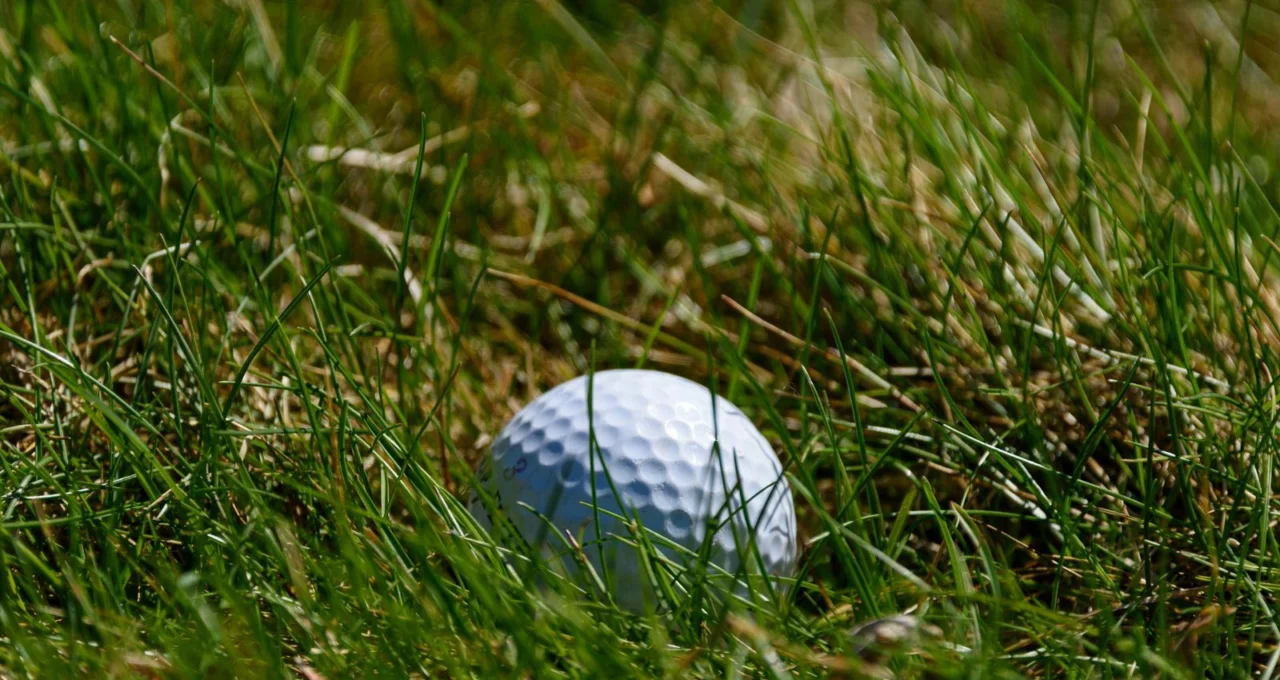
Half down. You can see the top half of the ball. Most rough lies are this one. A lofted club works, a long club does not, and the ball comes out lower than normal with very little backspin.
Buried. You found the ball because you saw it go in, not because you can see it now. Nothing produces distance from here. The only question is which direction gets you back to short grass in one swing, and whether one swing is realistic at all.
Then look at which way the grass is lying, without touching or pressing anything down. Grass leaning toward the target lets the club through. Grass leaning back at you, or growing across the line, grabs the hosel and shuts the face before impact. That observation tells you more than the yardage does.
The decision that saves the hole
Ask one question before you pull a club: what is the worst realistic outcome of this shot, and can I afford it? From a half down lie at 150 yards, the worst realistic outcome of a seven iron is 60 yards of scuffed contact into more rough. The worst realistic outcome of a pitching wedge aimed at the widest part of the fairway is 90 yards on short grass, leaving a full shot in. The wedge is not the timid choice, it is the choice with the better bad outcome.
Aim for the widest escape, not the shortest one. Sideways to a flat piece of fairway beats forward into a narrowing gap between trees, every time. Golfers who play that shot without sulking about it score better than golfers with prettier swings who will not.
A setup built to reach the ball
The club has to arrive at the ball before it arrives at the grass, which means a steeper swing than your normal one. Four changes at address do most of that work.
Play the ball an inch back of your usual position, which steepens the angle of attack and moves the low point forward. Put about sixty percent of your weight on the lead foot and leave it there: hanging back is the most common reason a club enters the grass four inches behind the ball.
Open the face slightly at address, grip down half an inch, and hold on more firmly than usual. Thick grass wrapping around the hosel closes the face through impact, so a face that starts a few degrees open finishes square, and a grip loose enough to be twisted has already lost the shot.
Speed is not optional
The instinct in deep grass is to steer, and steering means slowing down. A club decelerating through heavy rough stops when the grass grabs it, while a club accelerating keeps going. Swing at full pace, hinge the wrists earlier than you would from the fairway, and accept a shorter, uglier result. From a genuinely buried lie, treat it like a greenside bunker shot without sand: steep in, hit down hard, expect 60 yards, and be pleased with that.
The clubs that work, and the one that lies to you
Loft is what gets a ball out of grass. Anything from a nine iron down works in most rough: the face is steep enough to lift the ball, the shaft short enough to control the bottom of the swing.
A hybrid is the club that lies to you. It is genuinely good from light rough, where the rounded sole slides and the low center of gravity launches the ball. From thick rough it is the wrong tool: the long shaft flattens the swing, and there is enough mass in the heel to shut the face when grass catches the hosel, producing a smothered pull. Long irons are worse, because a three or four iron needs clean contact to launch at all, and a thick lie has ruled that out.
Fairway woods get one exception: a ball sitting up with real daylight under it can be swept off the top with a five wood. Below the top of the grass, it cannot.
The flyer comes from the light stuff
The flyer is not a deep rough problem. It happens in light to moderate rough, where a thin layer of grass slides between the grooves and the ball, kills the backspin, and sends the shot out hot and low with no stopping power. Expect five to fifteen extra yards and a ball that releases hard on landing, so take one less club and aim at the front of the green. It punishes the golfer who flies a perfect number at a back pin and watches the ball settle in the bunker behind it.
Wet rough is the opposite case. Water adds weight and wet grass twists the face far more than dry grass does, so after dew or overnight rain take one more club, grip harder, and lower your ambition by a category: the green in regulation attempt becomes a shot to the front edge, and the full recovery becomes a wedge back to the fairway.
Know when to take the penalty
You get three minutes to search once you begin looking. If you do not find the ball, it is lost and you go back to where you played from under stroke and distance. A provisional, announced as one before you walk forward, saves that trip and is the most underused shot in amateur golf.
If you find it in a lie you cannot play, you alone decide the ball is unplayable, anywhere except a penalty area. It costs one stroke and gives three options: play again from where you last played, drop back on the line from the hole through the ball as far as you like, or drop within two club lengths, no nearer the hole. Take it when a realistic swing does not get you back to short grass, or when the swing itself is unsafe. One stroke plus a full shot from the fairway is a bogey. Two hacks in a row is a seven, and it is the seven that ends rounds.
Two rules matter while you stand there. If you move the ball while searching you replace it without penalty, and you may lift it to identify it after marking the spot. But you may not improve the lie, your stance, your swing area or your line: pressing grass down behind the ball, bending a branch aside, or flattening the grass with practice swings next to it all cost two strokes.
Where to practice this in the United States
Almost no driving range in the country has a rough area, which is the real reason most golfers first hit this shot when it already counts. Two workarounds cover it.
Play a quiet evening nine at a municipal or daily fee course, and when nobody is close behind you, drop a second ball in the rough and play it out. Twilight rates at municipal courses are the cheapest tee times in American golf, and this costs $0 beyond the green fee you have already paid. Ask in the pro shop whether a second ball is allowed, and wave any group behind you through.
The other option is a range tee whose perimeter is genuine rough, common at resorts and private clubs. Ask in the pro shop rather than assuming.
Rough type changes the shot, and it changes by region. Cool season bluegrass and rye rough across the North is deep and grabby but fairly uniform. Bermuda rough through the South and much of Texas has grain: the ball settles into a mat that resists the club far more from one direction than another, so read which way it lies before you commit. Kikuyu on some California courses is stronger still and needs more loft than you think. Desert courses in Arizona and Nevada have little rough and a lot of native area, which is a different problem with a simpler answer, usually the unplayable.
Five things to try in your next round
- Look at the lie before you look at the flag, and put it in one of the three categories.
- Take the club the lie allows rather than the club the yardage suggests, and one more when the grass is wet.
- Move the ball back an inch, keep sixty percent of your weight forward, and grip a little firmer.
- From light rough with a good lie, take one less club and plan for the ball to run.
- Count how often you needed two shots to escape. That number, not fairways hit, is what the rough is costing you.
None of this makes the rough pleasant. It makes it survivable, which is the whole ambition: back on short grass in one swing, bogey taken when the bogey is on offer, and the hero shot from a buried lie left to the golfers who will be explaining their sevens afterwards.
Proximity and scoring figures come from Shot Scope, which records amateur rounds rather than practice sessions. Rules references are to the Rules of Golf as they stand in 2026, in particular the rules on searching, improving conditions and the unplayable ball.