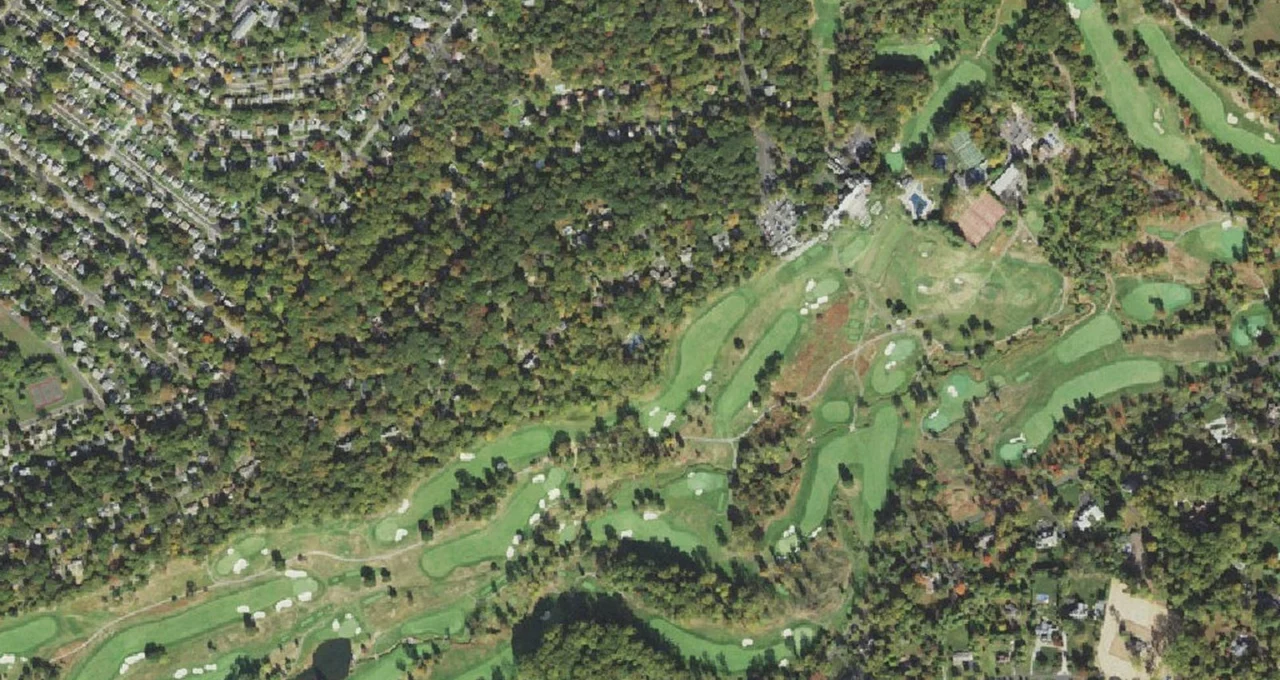
Huntingdon Valley Country Club from the air. Aerial imagery USGS, domaine public.
Huntingdon Valley Country Club
Holes
27 (three nines: Toomey, Flynn and Centennial; Toomey/Flynn is the main 18)
By
70 (men) and 73 (women) on Toomey/Flynn; each nine par 35
Length
7,198 yards from the Green tees on Toomey/Flynn (rating 74.8, slope 149) per the Pennsylvania Golf Association; GolfPass gives 7,042 yards and another directory 7,065
Green fee
—
Best season
—
Huntingdon Valley Country Club is a private golf club at 2295 Country Club Drive in Huntingdon Valley, Pennsylvania, in the northern suburbs of Philadelphia. Wikipedia places it in Upper Moreland Township, Montgomery County, on roughly 170 acres, and describes it as a golf, tennis and swim club with banquet and dining facilities. The Golf Association of Philadelphia, the regional amateur body, lists it as a private member club. The course is not open to the public: play is for members and their guests.
The club is one of the oldest in the region. The Golf Association of Philadelphia and Wikipedia date its organization to 1897, Wikipedia specifying June of that year, and the club’s own history calls it the first club in the Philadelphia area organized exclusively for golf. It has had two homes. The present one, two miles north of the first, opened on April 14, 1928, according to Wikipedia, with 27 holes laid out by the Philadelphia firm of William S. Flynn and Howard C. Toomey. Two of those nines, named Toomey and Flynn, form the main 18; the third, now called the Centennial nine, was left to grow over during the Depression and rebuilt in the late 1990s.
It is also a championship venue with a long record. The Golf Association of Philadelphia counts eleven Philadelphia Amateurs held here between 1898 and 2023, eight editions of its Open Championship, and more Amateur titles won by its members than by those of any other club. The first Pennsylvania Amateur was played here in 1909, according to the Pennsylvania Golf Association.
From Rydal to Huntingdon Valley
The sources tell the beginning in slightly different ways. The Golf Association of Philadelphia’s club directory traces the club to a practice device that Percy C. Madeira used to measure his drives; Madeira and friends then built a small nine-hole course on his property, and the members organized the club formally in 1897. The same directory and other Golf Association of Philadelphia material credit the original nine-hole layout to John Reid, a Scottish professional, at Rydal, Pennsylvania. The club’s history page, as shown by search engines, places that first course on both sides of Susquehanna Road in Baederwood, just north of Jenkintown; Rydal and Baederwood are neighboring places, and the two accounts do not contradict each other. The directory adds that the club bought a neighboring property and turned the Noble Mansion into its second clubhouse, and that the course was later extended to 18 holes.
Not every source agrees on the founding year. Another version of the club’s history, as indexed by search engines, says the club was organized in 1896 at the suggestion of George H. Frazier to his father, William W. Frazier, and a course ranking site, Top 100 Golf Courses, gives 1887, which looks like a slip. This page follows 1897, the date given by the Golf Association of Philadelphia, Wikipedia and the club’s main history page.
The club joined both the Golf Association of Philadelphia and the Women’s Golf Association of Philadelphia in 1898, the fifth club elected to each, according to the association. It hosted the second Philadelphia Amateur that same year, won by one of its own members, William P. Smith.
By the 1920s the club had outgrown its land. The club’s history, as shown by search engines, says it moved two miles north in 1928, to a site of 437 acres bounded by Edge Hill, Paper Mill, Terwood and Welsh Roads, most of which belonged to William W. Frazier, the club’s first president. The former grounds are now occupied by the Baederwood Shopping Center, car dealerships, office buildings and the Rydal Park residential complex, according to the same page. The 437-acre figure describes the site acquired at the time; Wikipedia gives about 170 acres for the club today, and we found no source explaining the difference.
Flynn, Toomey and the 27 holes
William Flynn, born in Milton, Massachusetts, in 1890 and died in Philadelphia in 1944, according to Wikipedia, is best known for his long work at Merion and for redesigning Shinnecock Hills in the early 1930s. He went into partnership with Howard Toomey shortly after the First World War; Wikipedia describes Flynn as the designer and Toomey as the engineer of the firm Toomey & Flynn. At Huntingdon Valley the firm laid out three nines, and the club, Top 100 Golf Courses and the course listings name the two nines of the main course after the partners. Wikipedia and several directories credit Flynn alone as architect, which simplifies a joint commission.
The third nine did not last long in its original form. According to Top 100 Golf Courses and a 2018 article in The Fried Egg, a golf architecture publication, the club let it fall into disrepair after the Great Depression, and only the Toomey and Flynn nines were kept up. Flynn’s own plan, The Fried Egg notes, called it the Nine Hole Course; it was later known as the C nine.
The club brought it back for its centenary. Top 100 Golf Courses and The Fried Egg credit the work to the architect Ron Prichard, and Top 100 Golf Courses says more than sixty years of overgrowth had to be cleared. The date varies: Planet Golf says the nine was rediscovered and rebuilt in 1997, the club’s history page, as shown by search engines, gives 1998 for its reopening, and a course directory lists 1999. Several original holes could not be restored because of environmental rules and an expanded driving range, and the routing was changed: the starting point moved and the hardest holes were placed in the middle of the nine, according to The Fried Egg. It now carries the name Centennial.
The professional who did trick shots
From 1938 to 1949, the head professional at Huntingdon Valley was Joe Kirkwood Sr., the Australian-born player famous for his trick shot exhibitions, according to Wikipedia. He succeeded George Low Sr. and spent eleven years at the club, combining his duties with tournament play and, after the Second World War, exhibitions. Wikipedia says the club eventually wanted a professional who would spend more time on the premises, and the two parted ways. Planet Golf credits Kirkwood with softening some of the greens on the opening nine; we did not find that detail in another source.
A light restoration and newer bunkers
In the 2010s the main 18 was tuned up by the architect Andrew Green. A 2016 Golf Association of Philadelphia publication lists Huntingdon Valley among the member clubs where he had worked, and The Fried Egg, in September 2018, described what it called a light restoration. According to that article, most bunkers were re-edged to their original shape and size, a few were fully reshaped and some that had been removed were brought back; tees were resurfaced, drainage was added and some fairways were widened. Tree removal, which had begun before Green was engaged, opened sightlines that over-planting had closed. At the time, green work was still under way, including an effort to restore the Redan character of the 3rd green.
The Centennial nine got new bunker liners more recently. Golf Course Trades reported that the club’s own staff installed a Capillary Bunkers liner there over a winter, after the bunkers, untouched since the 1990s rebuild, had filled with water in heavy rain; the club planned to extend the product to poorly performing bunkers on the Toomey and Flynn nines. The article is not dated on the page we read; the Asian Golf Industry Federation, which reported the same project, dates its article to May 2022.
A record of championships
The Golf Association of Philadelphia, in its preview of the 2023 Philadelphia Amateur, lists the eleven years the club has hosted that event: 1898, 1903, 1909, 1913, 1916, 1920, 1933, 1949, 1960, 2012 and 2023. Only Whitemarsh Valley Country Club has hosted it more often, according to the association. The same preview says Huntingdon Valley members have won 25 Amateur titles, more than double the next club; the list of champions printed in that preview adds up to 24, and a 2014 association article called the winner that year the 24th Amateur champion from the club, so the total depends on which count you trust. The championship’s two main trophies are named after men linked to the club: J. Wood Platt, who won at Huntingdon Valley in 1920, and Cameron B. Buxton, a member who won in 1916 and 1917.
The club also staged the first Pennsylvania Amateur, played on September 25, 27, 28 and 29, 1909. According to the Pennsylvania Golf Association, Harold B. McFarland of Huntingdon Valley won the medal and then beat A. W. Tillinghast, who would become one of the best-known architects of his era, 8 and 6 in the final.
The Golf Association of Philadelphia’s Open Championship has come here eight times. The association wrote that the 2011 edition, played on the Toomey and Flynn nines as a walking-only 36-hole event, was the club’s sixth, after 2003; its 2019 article on the 115th Open called that edition the eighth. We did not find the seventh. The Philadelphia Section PGA holds its William Hyndman III Memorial Classic at the club every year, according to the 2019 article, and the course has been used for USGA qualifying, including a U.S. Mid-Amateur qualifier in 2014 and a U.S. Amateur local qualifier on June 24, 2026, listed by the association.
Rankings have followed. Golf Digest, on its course page as shown by search engines, places the Toomey/Flynn course 12th in Pennsylvania for 2025 to 2026, after 10th in the previous edition; older lists cited by Wikipedia and a tourism website put it 8th or 9th in the state. Wikipedia also reports that Golfweek placed it 79th among classic courses in America in 2013.
What it asks of you
The main course is a par 70 for men and a par 73 for women, with two nines of par 35, according to the scorecard data of the Pennsylvania Golf Association and Wikipedia. That card has four par 3s and two par 5s: on a hole-by-hole card published by OpenGolfAPI, the short holes are the 3rd, 5th, 13th and 17th, and the long ones the 7th and 15th, which leaves twelve par 4s, many of them long.
The length depends on the tee and on the source. The Pennsylvania Golf Association lists eight men’s tee combinations on the Toomey/Flynn course, from 4,904 yards (Gold, rating 64.3, slope 128) to 7,198 yards (Green, rating 74.8, slope 149), with the Black tees at 6,316 yards (70.7 and 138) and the Red tees at 6,747 yards (72.9 and 141). This page follows those figures. Other listings differ: GolfPass gives 7,042 yards with a rating of 74.9 and a slope of 138, another directory gives 7,065 yards from the Black tees, and the OpenGolfAPI card adds up to 7,182 yards, a total that matches none of the published tees. Wikipedia gives 3,444 yards for the Toomey nine and 3,443 for the Flynn nine, which add up to 6,887 yards. The other pairings, Flynn/Centennial and Centennial/Toomey, are also par 70 and reach 7,219 and 7,231 yards from the Green tees, according to the state association.
The ground does most of the work. The Fried Egg describes a course set in a narrow valley; the front nine of the main 18 runs counter-clockwise around the edge of the property and the back nine clockwise inside it, so that the holes keep changing direction and the lies keep changing with them. Reviewers on Top 100 Golf Courses describe the outward half circling the upper rim of the site and the inward half dropping into the valley around Terwood Run, with uphill and downhill shots on both. The Fried Egg stresses firm, fast conditions rather than lush ones, with running fairways and tight lies, and greens with some grain that it found varied and rich in hole locations. Expect to play the ball along the ground at times, and to think about where it will come to rest on a slope.
The Toomey nine
The hole descriptions below come from Planet Golf, The Fried Egg and the reviews on Top 100 Golf Courses; the yardages come from the OpenGolfAPI card, which does not say which tee it describes, so treat them as an order of magnitude. A reviewer describes the 1st, about 380 yards and downhill, as one of the easiest holes on the course; the card gives 386 yards. The 2nd, a par 4 of 450 yards on that card, is ranked first on its stroke index, and Planet Golf says its green is unlike any other on the course. The 3rd, a par 3 of 233 yards, has a green with the look of a Redan that Planet Golf found too flat to suit the hole; The Fried Egg reported in 2018 that work to restore its Redan qualities was planned. Top 100 Golf Courses singles out the par 3s at the 3rd and 5th as the strongest one-shotters on this nine; the 5th measures 187 yards on the card, and its green was sketched by Andrew Green.
The 7th, a par 5 of 605 yards, is the longest hole on the OpenGolfAPI card. The 8th, a par 4 of 467 yards, has a green with falling edges and pockets, according to Planet Golf. The 9th, a par 4 of 460 yards and third on the stroke index of that card, finishes on what Planet Golf calls a severe ledge green, tilted from back to front.
The Flynn nine
Planet Golf considers the Flynn nine, the second half of the main course, the highlight of the club, and Top 100 Golf Courses notes that a winding stream comes into play on many of its holes. The 13th is a par 3 of 185 yards on the card; The Fried Egg says new tees refreshed it, the bunker on the left was improved and tree removal opened the views around it. The 15th, a par 5 of 575 yards, has a green with falling edges and pockets, and the 16th, a par 4 of 401 yards, leans steeply from left to right, in Planet Golf’s description. The 17th is a par 3 of 228 yards that Planet Golf simply calls cool.
The 18th, a par 4 of 486 yards on the card, is the hole every account comes back to. Planet Golf describes a strong par 4 along a shelf, with a bold second shot up a steep hill to a steeply angled green that narrows at the back, and Andrew Green published a rendering of its green, according to The Fried Egg. The stroke index of the inward nine is incomplete on the OpenGolfAPI card, so this page gives none for these holes.
The Centennial nine
The third nine is the longest on paper. Wikipedia gives 3,618 yards and a par of 35, and the card published by Golfing Record lists 3,618 yards from the Blue tees, with five par 4s of 430 yards or more: the 1st at 448, the 2nd at 430, the 7th at 451, the 8th at 460 and the 9th at 431. The 3rd is a par 5 of 602 yards, and the two short holes, the 4th and 6th, measure 213 and 202 yards. Top 100 Golf Courses notes that the three closing par 4s each run past 430 yards, which those figures confirm. The stroke index on that card simply follows the hole numbers, which suggests it is a placeholder, so this page does not use it.
What golfers are saying
This section draws on the reviews posted on Top 100 Golf Courses between 2017 and 2026, the accounts in The Fried Egg and Planet Golf, and the comments of players quoted by the Golf Association of Philadelphia before its championships. These are other people’s opinions, not ours; nobody from Panxis has played the course, and we quote no one by name. Because the club is private, the reviews come from a small number of members, guests and championship players.
What comes up in its favor
- The routing, which reviewers and The Fried Egg praise for its use of the valley, the changes of direction and the variety of holes, with a mix of short and long par 4s.
- Width and angles, which give players of different levels a way around, according to The Fried Egg.
- The greens, described as contoured, varied and quick, with many good hole locations.
- Firm, fast conditioning and turf that lets the ball run, mentioned by The Fried Egg, Planet Golf and several reviewers.
- A course that feels natural and true to Flynn’s design, and that reviewers consider one of the best in the Philadelphia area and underrated nationally.
What comes up against
- Difficulty: reviewers and championship players describe a stern test that punishes poor tee shots and leaves hard approaches, and a past Amateur champion said it exposes any weakness. Most of them call it fair.
- Few flat lies outside the tee boxes, a point several reviewers raise.
- Trees that had obscured sightlines on several holes, which The Fried Egg reported in 2018 were being removed.
- Some holes of the original third nine that could not be restored, and a 3rd green that Planet Golf found too flat for its Redan look.
- Access: the course is private, and reviewers who played it did so as guests or through member events.
How to play it
Huntingdon Valley is a private club, reserved for members and their guests, and it does not sell tee times to the public. The club’s website, as shown by search engines, describes two membership categories based on the level of golf activity, with full membership giving members and their families all the privileges of the club, including unlimited golf. Membership inquiries go through the club. One reviewer on Top 100 Golf Courses mentions playing the course during a Golf Association of Philadelphia member play day, open to golfers from the association’s member clubs; we did not confirm whether such a day is scheduled. The other route onto the course is competition: the association’s championships and USGA qualifiers held here are open to golfers who meet their entry conditions.
This page lists no green fee: the club does not publish guest rates, and they are a matter for your host. The club does not publish a cart or walking policy that we could read, so this page gives none; the 2011 Open, according to the association, was played on foot. Ask your host about the dress code and the house rules before you go.
The facilities
Besides its 27 holes, the club’s website, as shown by search engines, lists tennis, squash, paddle tennis, swimming, shooting, bridge, dining and a fitness center. Its swim team holds dual meets on weeknights in June and July. Wikipedia notes that the club was one of the first places to play squash tennis and reportedly held one of the first squash tournaments in the early 1900s. The club says its women’s golf team has won the Philadelphia Cup on numerous occasions. A practice range sits within the site; its expansion in the 1990s was one of the reasons some holes of the third nine could not be rebuilt, according to Planet Golf and The Fried Egg.
Getting there and when to go
The club is at 2295 Country Club Drive, Huntingdon Valley, PA 19006, and the club’s main number is 215-657-1610, according to the Golf Association of Philadelphia and the Pennsylvania Golf Association. Wikipedia places it about seven miles from Philadelphia. The club does not publish its golf season on the pages we could read, and this page gives none. Contact details and membership information are on the club’s website.
How this page was made
The factual frame comes from public sources consulted in October 2026: OpenStreetMap and Wikidata for the location; the Golf Association of Philadelphia’s club directory for the private status, the address, the phone number, the founding story and the 1898 membership; the association’s articles of 2011, 2019 and 2023 for the championships, the hosting years and the count of Amateur titles; the Pennsylvania Golf Association for the 1909 championship, the tees, the yardages, the ratings and the slopes; Wikipedia for the 1928 opening, the size of the site, the nines, the rankings, squash and the biographies of William Flynn and Joe Kirkwood Sr.; Top 100 Golf Courses, The Fried Egg and Planet Golf for the restoration of the third nine, Andrew Green’s work and the hole descriptions; Golf Course Trades for the bunker liners; OpenGolfAPI and Golfing Record for the hole-by-hole cards. Where sources disagree, as they do on the founding year, the date the third nine reopened, the number of Amateur titles, the size of the site and the total yardage, we say so and name the source we follow.
Several sources could not be read directly: the club’s website, Golf Digest and GolfPass blocked automated requests, and for those we relied on the excerpts shown by search engines, as stated above. We could not find the year of the club’s seventh Open, the exact date of the bunker project, a published cart or walking policy, the golf season or a stroke index for the inward nine. The opinion section summarizes public reviews and published accounts; we report recurring themes rather than individual voices. Nobody from Panxis has played or visited this course, and this page is no substitute for a round.
The club has not paid for this page, has not seen it before publication and has no say over its content. This page contains no commercial link and earns us no commission. If you know the course and something here is wrong or out of date, write to us and we will correct it.
Other courses nearby
Closest to this one in our United States directory:
- Fiddler’s Elbow Country Club — 40 mi
- Canoe Brook Country Club — 57 mi
- Dyker Beach Golf Course — 66 mi
- Geneva Farm Golf Course — 76 mi
The hole to know
A par 4 of 486 yards on the OpenGolfAPI card that closes the main 18 along a shelf, with a bold second shot up a steep hill to a steeply angled green that narrows at the back, according to Planet Golf.