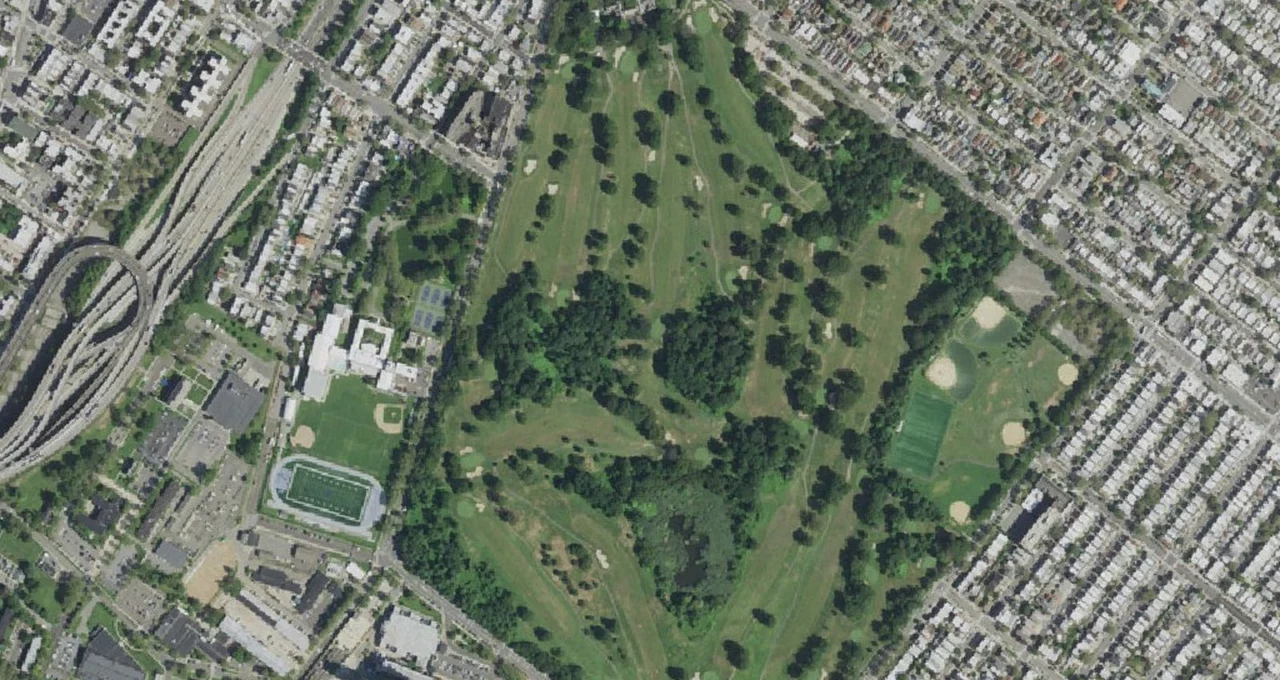
Dyker Beach Golf Course from the air. Aerial imagery USGS, domaine public.
Dyker Beach Golf Course
Holes
18
By
71
Length
6,438 yards from the Back tees (rating 70.5; slope 118 on the operator's card, 122 in GolfPass and 18Birdies); Wikipedia gives 6,548 yards
Green fee
—
Best season
Year-round when the weather allows, according to Wikipedia; closed when snow is on the ground, per Golf Pad
Dyker Beach Golf Course is a public, city-owned 18-hole course in the southern part of Dyker Heights, Brooklyn, on the edge of New York Harbor below the Verrazzano-Narrows Bridge. Wikipedia describes the land it occupies as stretching from the Belt Parkway in the south to 86th Street in the north, between Seventh Avenue on the west and 14th Avenue on the east, and puts the whole of Dyker Beach Park at 217 acres. NYC Parks lists the course at 86th Street and Seventh Avenue, which is where the clubhouse and the main entrance are. The course belongs to the City of New York and is run under a concession by a private operator.
On the scorecards published by golf directories and apps, Dyker Beach is a par 71 for men from the back and middle tees and a par 72 for women from the forward tees, measuring 6,438 yards from the back. The club credits the original design to Tom Bendelow in 1897 and a redesign to Jon Van Kleek in 1935, and the 1930s rebuilding was paid for with New Deal relief funds. In the 1950s and 1960s, according to The Met Golfer, it was the most played golf course in the world, with more than 100,000 rounds a year. This page sets out what public sources say about its history, its holes and what golfers think of it today.
A seaside park that became a golf course
The land was not meant for golf. Wikipedia and NYC Parks date the park to 1895, when the City of Brooklyn bought the first parcel, running from the shore of Gravesend Bay to about 92nd Street, and hired the landscape firm Olmsted, Olmsted and Eliot to design it. The Cultural Landscape Foundation describes the plan as a 50-acre tidal saltwater lagoon surrounded by plantings, a concert grove and playgrounds, with views over the Narrows. A long 2016 history by the local news site Hey Ridge quotes the Brooklyn Eagle of the time reporting that Olmsted expected it to become “the finest seaside park in the world.”
Very little of that was built. The site was mostly salt marsh, and both Hey Ridge and the Cultural Landscape Foundation say lack of money and complaints about mosquitoes stalled the work. In 1911 Charles D. Lay, a landscape architect for the Brooklyn parks department, proposed shrinking the lagoon to 16 acres and adding concert groves; that plan did not go ahead either. After the First World War the marsh was filled, starting in 1918 according to NYC Parks as cited by Wikipedia, with material dredged from Gravesend Bay according to Hey Ridge. The Cultural Landscape Foundation writes that the filled ground “quickly” became a golf course, expanding a small nine-hole course that was already using nearby land.
That earlier golf is where the history gets tangled. Hey Ridge, working from the Brooklyn Eagle archive, describes two private clubs on and around the site at the turn of the century: the Dyker Meadow Golf Club, which began playing in 1896 on roughly 28 acres across Seventh Avenue, and the Marine and Field Club, whose links ran south of 86th Street near 12th Avenue. Wikipedia says the Dyker Meadow Land and Improvement Company leased land to both clubs, which used a clubhouse built in 1898, and that Mungo Park Jr. was the professional at Dyker Meadow in 1898. The Dyker Meadow members lost their ground in 1916 when Poly Prep, the private school, bought it, and Hey Ridge reports that the club then said it would disband. The school still stands at 92nd Street and Seventh Avenue, on a site that Wikipedia says was offered by the parks commissioner of the day.
The municipal course came next. In 1922, Hey Ridge reports, Parks Commissioner John Harman proposed a city course at Dyker Beach that would absorb the Marine and Field links; between 1924 and 1927 the city acquired four more parcels, and three more lots were transferred in 1934, which completed the park as it is today. Hey Ridge dates the public opening of the course to June 1, 1928, and adds that the holes were reconfigured in 1927 and again in 1929. The Brooklyn Eagle reported in 1930, as quoted by Hey Ridge, that 67,000 rounds had been played the year before, 20,000 more than the year before that.
The layout golfers play now traces to the mid-1930s. Living New Deal, a project that documents New Deal public works, quotes a Department of Parks press release of May 7, 1936, announcing that the course had been “thoroughly reconstructed with new tees and greens throughout” with relief funds from the Civil Works Administration, New York’s Temporary Emergency Relief Administration and the Works Progress Administration. It dates the redesign by Jon Van Kleek to 1935 and 1936. Wikipedia credits Van Kleek with the clubhouse built in 1935 as well.
The busiest course in the world
Dyker Beach’s reputation rests less on design than on volume. Wikipedia, citing a 2007 feature in The Met Golfer, the magazine of the Metropolitan Golf Association, says that in the 1950s and 1960s it was the world’s busiest course, with more than 100,000 rounds a year, and cites a 1966 Golf Digest article counting 103,581 rounds in 1965. Sports Illustrated ran a story on it in 1955 under the title “Brooklyn’s Mad Golf Course,” and The New York Times described golfers in 1957 lining up at sunrise to get a number for a starting time. Numbers have since fallen: Hey Ridge reported in 2016, from figures supplied by NYC Parks, that 54,693 rounds had been played the previous year, which made Dyker the fourth most played city course behind Pelham-Split Rock, Clearview and Douglaston.
A few names recur in the course’s history. Wikipedia lists Willie “Wiffy” Cox, a tour player of the 1930s, as the professional from 1921 to 1935, and the Strafaci family: the five Strafaci brothers were regulars, and Thomas Strafaci and his son Thomas Jr. both served as professionals there. The best known link is to Earl Woods, the father of Tiger Woods. Wikipedia, The Met Golfer and David Owen of The New Yorker, as cited by Living New Deal, all say he took up the game at Dyker Beach in the early 1970s, Wikipedia specifying 1972, while he was stationed at Fort Hamilton, the Army post next to the course.
The course also carries a long tradition of public golf clubs. Wikipedia names four that play there: the Shore View Golf Club, incorporated in 1930 and one of the oldest public men’s clubs in the country; the Brookridge Ladies Club; the Sand Trappers Senior Golf Club, which plays on Tuesdays; and the Dyker Beach Women’s Golf Club.
The city stopped running the course itself in 1984, when, according to Wikipedia, operations passed to American Golf Corporation. In July 2009 The Brooklyn Paper reported the opening of a rebuilt clubhouse, funded and led by American Golf, with a ballroom, a dining area, a bar and an outdoor lounge; the building now doubles as a wedding and event venue. In 2008 the City Parks Foundation opened the CityParks Junior Golf Center next to the course, a six-hole facility offering free lessons to children aged 6 to 17, according to The Brooklyn Paper. In 2023 NYC Parks invited proposals for the renovation, operation and maintenance of six city courses, Dyker Beach among them, according to the City Record. We could not establish from a source we were able to open which operator holds the current licence, so we leave that question to the club and to NYC Parks.
What the course asks of you
Dyker Beach is a compact, tree-lined parkland course of moderate length on rolling ground that falls toward the water. On the back tees it is 6,438 yards. The middle tees measure 6,176 yards and the forward tees 5,366. The card carries four par 3s, eleven par 4s and three par 5s, which gives 36 on the front nine and 35 on the back. Golf Pad, a golf app publisher, sums up the character in a short course profile: no water to speak of, seven fairway bunkers, reasonably wide fairways, and difficulty that comes from trees, raised greens and the par 3s. It also notes that all three par 5s are under 500 yards.
The ratings differ depending on the source. A summary of the operator’s scorecard gives a rating of 70.5 and a slope of 118 from the back tees, 69.4 and 116 from the middle tees, and 70.2 and 117 for women from the forward tees. GolfPass and the 18Birdies app list higher slopes for men: 122 from the back, 119 from the middle, and a rating of 65.6 with a slope of 111 from the forward tees; 18Birdies adds women’s figures of 76.1 and 135 from the back tees and 74.7 and 132 from the middle. Whichever set is current, Dyker Beach rates as a course of average difficulty for its length.
The hole-by-hole card from the back tees, as published by OpenGolfAPI and 18Birdies, reads:
- Front nine: 1st, par 4, 426 yards; 2nd, par 3, 200; 3rd, par 4, 341; 4th, par 5, 458; 5th, par 4, 422; 6th, par 3, 175; 7th, par 5, 491; 8th, par 4, 370; 9th, par 4, 350. Out: 3,233 yards, par 36.
- Back nine: 10th, par 4, 400; 11th, par 3, 160; 12th, par 4, 334; 13th, par 4, 441; 14th, par 4, 428; 15th, par 5, 458; 16th, par 4, 388; 17th, par 3, 203; 18th, par 4, 393. In: 3,205 yards, par 35.
Two published descriptions go hole by hole: a detailed 2021 review on the independent blog Worldgolfer, and a 2013 DNAinfo feature on the best holes in New York City, with comments from the course’s general manager at the time. The holes they single out:
- The 1st, a 426-yard par 4 that opens with a downhill, semi-blind drive over a plateau, with trees right and fescue and a bunker left, according to Worldgolfer.
- The 3rd, a 341-yard par 4 that bends sharply left with a semi-blind tee shot, to a two-tier green with deep bunkers and a false front. Worldgolfer counts it among the best holes, and the bridge comes into view on the approach. DNAinfo described a 341-yard dogleg left with a blind fairway as a risk-reward hole where strong players can go for the green, and quoted the general manager saying of its bunkers: “you literally need steps to get out of it.”
- The 5th, a 422-yard par 4 and the number two stroke-index hole, with a downhill drive and an uphill approach. Worldgolfer calls it the toughest hole on the front nine. DNAinfo described a 422-yard par 4 “in the shadow of the Verrazano Bridge,” with an uphill, undulating green guarded by bunkers, as the hardest on the course.
- The 7th, a straightaway par 5 of 491 yards from an elevated tee, with out of bounds along the left beside the VA hospital and a cross bunker in the landing area.
- The 11th, a 160-yard par 3 to a narrow, elevated green. DNAinfo quoted the general manager saying it is “basically circled by a bunker.”
- The 13th, a 441-yard par 4, straight and uphill, and the number one stroke-index hole on the card, with views of the bridge from the fairway.
- The 15th, a 458-yard par 5 that climbs between trees on a sloping fairway to an elevated green that falls away short and right; Worldgolfer calls it the toughest of the par 5s.
- The 17th, the longest par 3 at 203 yards, uphill to a small, steeply sloped green with a deep bunker left. The operator’s card notes that it plays closer to 220 yards.
- The 18th, a 393-yard par 4 that doglegs blind to the right, with the parking lot and out of bounds on that side, finishing at a green bunkered long, left and right.
The greens are the element most often discussed. Worldgolfer found them slow but true in 2021. Recent app reviews, discussed below, rate them as the best-kept part of the course.
What golfers say
Dyker Beach is one of the most reviewed public courses in New York, and opinion is divided. What follows draws on the reviews visible on the Hole19 app (dated July 2022, May, June and September 2025, and June 2026), on the 18Birdies app (August and September 2026), on the April 2021 Worldgolfer review, and on the summary of Google reviews shown by the travel site Wanderlog, all read in October 2026. 18Birdies showed an average of 3.8 out of 5 from 733 ratings, and Wanderlog 4.1 out of 5 from 1,264 Google reviews. The GolfPass and Tripadvisor review pages could not be opened when we prepared this page, so we have not used them. These are other people’s opinions, not ours; we name no reviewer.
What comes up in its favor
- The greens: several 2025 and 2026 reviews call them good or very nice for a municipal course, and Wanderlog’s summary also mentions well-kept greens.
- The setting: views of the Verrazzano-Narrows Bridge, mature trees and a historic clubhouse that makes, in Golf Pad’s words, a country-club feel possible in the middle of Brooklyn.
- The layout: reviewers describe a fun mix of hole shapes and distances, scenic par 3s and a classic routing over rolling ground.
- Convenience and value: reviewers in Brooklyn praise it as a course close to home, and some rate it fair value by New York standards.
- Staff: some reviews mention friendly staff and, in 2022, a ranger keeping the pace reasonable.
What comes up against
- Pace of play: the most frequent complaint, from 2025 through September 2026, with mentions of packed tee sheets and one report of three hours for nine holes. Golf Pad notes that eight groups an hour go off on weekends.
- Fairways and tees: worn fairways, poor tee boxes and burnt-out or wet patches come up repeatedly, in 2021 and again in 2025 and 2026.
- Bunkers: described in 2021 as weedy with little sand; later sources mention work on bunkers and cart paths without saying whether it is finished.
- Carts and paths: older carts and cart paths in need of repair, although one June 2025 review reports new carts.
- Geese droppings and early closing times are mentioned in the Google review summary, as is the cost for golfers without a membership or resident discount.
Getting there and playing
Dyker Beach is open to everyone. Tee times can be booked on the course’s website, which says reservations open up to 10 days in advance and must be cancelled at least 24 hours ahead; a reservation fee applies. NYC Parks says New York City residents pay a resident rate on presentation of a valid permit and proof of residency, and that non-residents pay more. Weekday rates, weekend rates, twilight and nine-hole rates and the senior and junior discounts all change regularly: check them on the course’s website. The course also sells a players’ club membership for regulars.
Motor carts and pull carts are available, according to 18Birdies, and walking is allowed. For practice, the course says it has a full-size putting green and short-game areas, but no driving range on site; 18Birdies lists a mat range, so ask before you go. The club offers lessons and clinics, rental clubs and a pro shop, and the clubhouse has a restaurant and bar.
The course is open all year as long as the weather allows, according to Wikipedia, and Golf Pad adds that it closes only when there is snow on the ground and that the greens are usually at their best from mid-April to mid-October. Expect weekends in season to be busy: the advice that comes back most often is to book early or play on a weekday.
The main entrance is on 86th Street at Seventh Avenue. Measured on the map, in a straight line, the course lies about 7 miles south of Lower Manhattan, and the 86th Street station of the R subway line, at Fourth Avenue, is a little under a mile from the middle of the course; The Brooklyn Paper noted in 2008 that the B8 bus links the area to the subway. The Belt Parkway runs along the southern edge of the park. The rest of Dyker Beach Park, with its ball fields and courts along 14th Avenue and 86th Street, stays open to non-golfers; the course itself does not.
How we built this page
The factual frame comes from public sources: OpenStreetMap and Wikidata for the location and identifiers; NYC Parks, as cited by Wikipedia and in its concession and golf pages, for the address, the history of the park and the resident permits; Wikipedia’s article on Dyker Beach Park and Golf Course for the history, the clubs, the professionals and the round counts it cites from The Met Golfer, Golf Digest, Sports Illustrated and The New York Times; Henry Stewart’s 2016 history on Hey Ridge, built on the Brooklyn Eagle archive, for the park plans, the private clubs and the 1928 opening; Living New Deal for the 1935 to 1936 reconstruction; the Cultural Landscape Foundation for the Olmsted plan; The Brooklyn Paper for the junior golf center and the 2009 clubhouse; the City Record for the 2023 concession call; the course’s website, as indexed in search results, for the design credits, booking rules and practice facilities; OpenGolfAPI, 18Birdies, GolfPass and Golf Pad for the scorecard, ratings and course profile; and Worldgolfer and DNAinfo for the hole descriptions.
Where sources disagree, we say so. The founding date depends on what is counted: 1895 for the park, 1896 for the first Dyker Meadow golf according to Hey Ridge, 1897 for the course according to the club, and June 1, 1928 for the opening of the municipal course according to Hey Ridge. The club credits Tom Bendelow with the 1897 course, while Worldgolfer writes that George Strath laid out the Dyker Meadow nine in 1895 and that the designer of the Marine and Field links is unclear; we found no primary source settling it. Van Kleek is spelled Jon by the club and Living New Deal and John by Wikipedia, which credits him with the clubhouse rather than the course. Wikipedia gives the length as 6,548 yards, while every scorecard we found gives 6,438. Slopes from the back tees are 118 on the operator’s card and 122 in GolfPass and 18Birdies. Golf Pad counts ten par 4s where the card shows eleven, and says there is no water, while OpenGolfAPI lists two water hazards and Worldgolfer mentions water far right of the 13th. DNAinfo’s 2013 feature numbers the 341-yard hole as the 5th and the 422-yard hole as the 7th, where today’s cards make them the 3rd and the 5th; the order of the front nine may have changed since. Wikipedia gives the clubhouse a capacity of 300 for events, Wanderlog 600. Cox is listed as professional from 1921, before the 1928 public opening, presumably at one of the earlier clubs.
Some details will age: the ratings, the operator under the new concession, the booking rules, the practice offering and the reviews read in October 2026. The course’s website blocked our automated checks, so its content was read through search results. Nobody from Panxis has played or visited this course, and this page is no substitute for a round.
The course has not paid for this page, has not seen it before publication and has no say over its content. This page contains no commercial link and earns us no commission. If you know the course and something here is wrong or out of date, write to us and we will correct it.
Other courses nearby
Closest to this one in our United States directory:
- Douglaston Golf Course — 18 mi
- Canoe Brook Country Club — 20 mi
- North Hempstead Country Club — 23 mi
- Village Club of Sands Point — 24 mi
The hole to know
A 441-yard par 4 from the back tees and the number one stroke-index hole on the card, played straight and uphill, with views of the Verrazzano-Narrows Bridge from the fairway, according to a 2021 course review.