Entertainment golf: does the bay feed the course
Off-course participation now exceeds on-course participation in the United States. Whether that produces golfers depends less on the venues than on whether anyone is standing on the other side of the door with a cheap, short first round.
In brief
- A bay is a good place to build a swing and a bad place to learn golf.
- The step that matters is the first nine holes, not the first bucket.
- Mats forgive fat strikes, so the feedback loop never fully closes.
- Clubs that grew from this offer nine holes, twilight rates and a beginners' evening.
- Simulator time in winter is real practice if you arrive with a question.
Multi-level ranges with heated bays, food and a scoring screen have become the most visible growth in American golf. Whether they produce golfers or merely produce a good evening out is the question clubs and course operators have been arguing about for a decade, and the honest answer is that both sides are describing something real.
What the venues actually are
Topgolf, Drive Shack and their smaller competitors sell target practice with a beer and a screen. The balls carry a chip, the targets are scored automatically, and the golf content is genuine but incidental to the evening: most groups are there for the group, not for the golf.
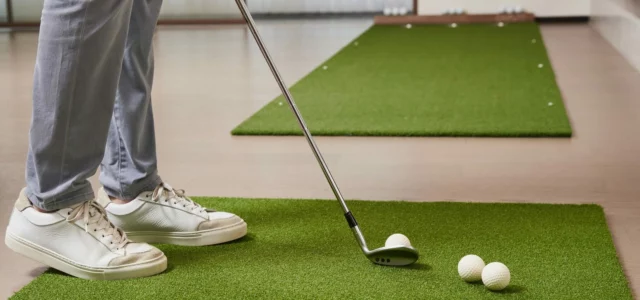
Simulator bars are the indoor cousin and have spread faster in the past few years than the big venues have. They charge by the hour for a bay, a screen and a hitting mat, they fit into a city block rather than requiring twelve acres, and they run through a northern winter when nothing else does.
Around both sits a third category that gets less attention: the short-game and adventure formats, from the putting-and-cocktails venues to the reinvented miniature golf that has appeared in several American cities. These sell golf as an evening rather than as a sport, and they sell it to people who would not walk into a pro shop.
The case that they feed the game
The National Golf Foundation has consistently reported that off-course participation now exceeds on-course participation in the United States, and that a meaningful share of people who start at a venue go on to play a course at some point.
The barrier argument is the strong one. For somebody who has never held a club, a bay with three friends, food and a scoreboard is an enormously lower barrier than a first tee with strangers waiting behind. There is no dress code to decode, no etiquette to get wrong, no five-hour commitment, and nobody watching who knows what a good shot looks like.
The demographic evidence points the same way. The venues skew younger and more mixed than the membership of most private clubs, which is precisely the population the game says it wants and has struggled to reach through its own channels.
The case that they do not
A bay teaches you to hit a ball at a target from a flat mat with no consequence. It teaches nothing about a sloping lie, a four-hour round, etiquette, rules, pace of play, or the specific misery of a lost ball in leaf cover.
It also teaches a version of the swing that does not fully transfer. A mat forgives a fat strike that grass punishes, the ball sits up perfectly every time, and there is no penalty for a shot that finishes forty yards right, so the feedback loop that produces course-ready golf never closes.
And plenty of venue customers have no intention of ever playing a course and are entirely happy about it. That is a legitimate outcome rather than a conversion failure, and treating those people as leads who failed to convert misunderstands what they bought.
What the numbers do not settle
Both things are true at once. The entertainment venues have brought millions of Americans into contact with a golf club, and most of those people are not turning into members of anything.
The interesting question for a course operator is therefore not the total but the on-ramp. The facilities that convert venue customers into golfers are the ones offering a short, cheap, low-pressure first round: a par-3 course at twilight, a nine-hole league where nobody is expected to be good, a beginners’ evening with clubs provided. The ones waiting for the phone to ring are not converting anybody, and then conclude that the venues do not work.
If you started in a bay
You already have the hardest part, which is making contact with a golf ball. What you are missing is the golf course, and the gap is smaller than it looks.
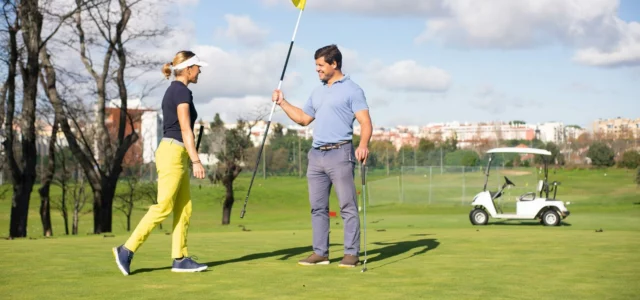
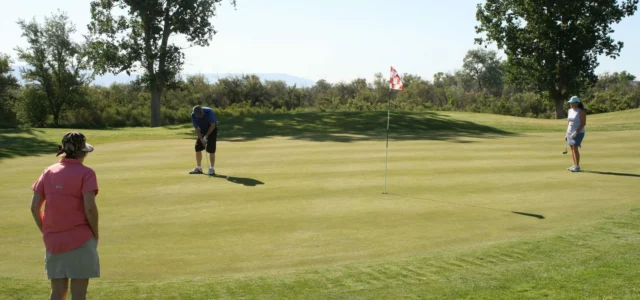
The fastest route is a par-3 or nine-hole course at a quiet time, ideally with somebody who can tell you where to stand and when to walk. An hour on a par-3 course teaches you the pace, the etiquette and the flow of a round, and the shots are the ones you have been hitting in the bay.
Two practical things to know before you go. Nobody minds a beginner who keeps up and repairs their pitch marks; ability is not the standard, behaviour is. And you do not need a full set: a hybrid, a 7-iron, a wedge and a putter cover a short course perfectly well, and most facilities rent clubs.
Learn the four rules you will actually use, which are the tee box, the lost ball and provisional, the penalty area, and the unplayable lie. Everything else can wait, and the USGA app answers the rest in under a minute.
If you are a club member
The venue crowd is the largest pool of prospective players your club will ever have access to, and reaching it requires an offer that does not begin with a full membership and a joining fee.
Three things show up wherever a club has actually grown from this source: nine-hole competitions that post for handicap, twilight rates that are genuinely cheaper rather than nominally cheaper, and an organized beginners’ evening with clubs available. None of them costs a club much, because the tee sheet at five o’clock is usually empty anyway.
The fourth, which more clubs are trying, is a simulator or an indoor bay of their own for winter. It keeps members playing through January and it gives the club something to offer the person who has only ever played indoors.
Using a bay properly as practice
Simulator time in winter is genuine practice if you use it with a plan, and expensive entertainment if you do not.
What works: building a carry chart for the whole bag, testing one swing change with ten shots before and ten after, and playing a simulated course to practice club selection and decision-making rather than hitting driver ninety times.
What does not: hitting a large bucket’s worth of drivers because the screen reports distance, which is the default behaviour of essentially every golfer in every bay in the country.
Where to find it in the U.S.
The large venue operators publish location maps and most major metropolitan areas now have at least one. Independent simulator bars are harder to find systematically and are usually best located by searching for indoor golf in your city, since the sector is fragmented and local.
For the step onto grass, look for the municipal short courses and nine-hole facilities in your area first, because they are the cheapest and least intimidating golf available. City and county parks pages list them, and GolfNow and TeeOff let you filter by number of holes and show twilight pricing.
For a first lesson, group clinics run by PGA professionals at public facilities are far less expensive than individual instruction and considerably more comfortable for a beginner, since everybody in the group is equally new.
Panxis Golf has no commercial relationship with any venue, course or booking platform mentioned here, and earns no commission.
The practical view
- A bay is an excellent place to build a swing and a terrible place to learn golf.
- The step that matters is the first nine holes, not the first bucket.
- Simulator time in winter is genuine practice if you arrive with a question.
- If you run a club, the offer has to start smaller than a membership.
- Somebody who only ever wants the bay is a customer, not a failed convert.
Entertainment golf is not a threat to the game and it is not a pipeline either. It is a large open door, and what happens next depends entirely on whether anyone is standing on the other side of it.