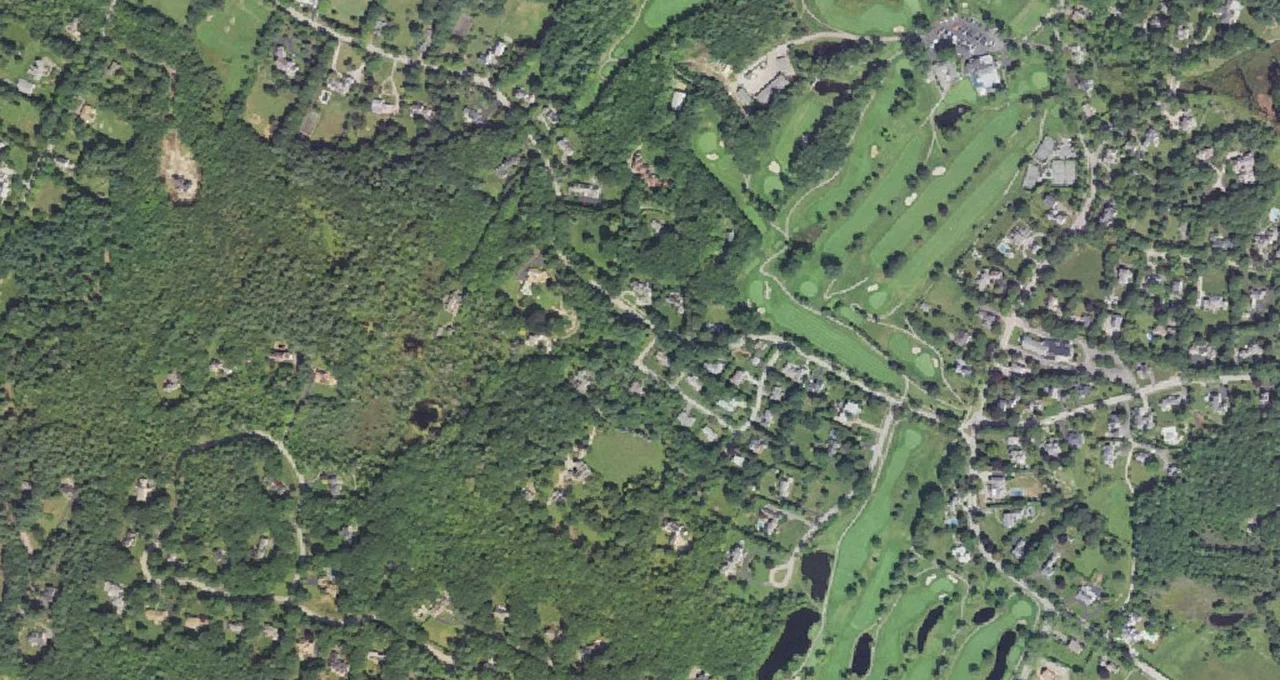
Abenaqui Country Club from the air. Aerial imagery USGS, domaine public.
Abenaqui Country Club
Holes
18
By
72
Length
6,639 yards from the Black tees on the club's scorecard (rating 72.5, slope 127); the club's About Us page says 6,635, and older directories 6,697
Green fee
—
Best season
The club says it supports about nine months of golf a year; one directory gives April 1 to November 15. No official season dates published
Abenaqui Country Club is a private, member-owned club at 731 Central Road in Rye Beach, a village in the town of Rye on the New Hampshire Seacoast, between Portsmouth and Hampton. Its 18-hole course is laid out on about 100 acres of fields, woods and marsh edge, roughly half a mile from the Atlantic shoreline in a straight line from the middle of the property. Golf has been played here since 1899; the club was incorporated in 1903, and that is the date on the cover of its scorecard.
The course is a par 72, with two nines of par 36. On the scorecard the club publishes, it measures 6,639 yards from the Black tees, with a course rating of 72.5 and a slope of 127, and 4,631 yards from the forward Silver tees. It hosted the New Hampshire Amateur in 1995 and again in 2022. Those figures, the long and tangled list of architects, and the many places where the sources disagree are set out below.
A summer club built by families from St. Louis
The history the club published on its earlier website, still readable in web archives, starts with a lease. In 1899 a local landowner, Charles A. Jenness, leased about 25 acres to George L. Allen of St. Louis, the club’s founder: an old orchard, a pasture and a field, everything but his house lot and garden. Before that, according to the same account, golf around Rye Beach was played on two primitive six-hole “pasture” courses, one on Sea Road and one near Little Boar’s Head. A member writing in 2016 on the website of another New Hampshire club places one of those early six-hole layouts beside the ocean and the Farragut Hotel.
Allen and four others, Francis E. Drake of Chicago, A. A. Carpenter of Cleveland, and two local men, Albert Batchelder and Frank C. Hall, combined the leased land with four acres they bought and built a nine-hole course on it. The clubhouse and the first tennis courts went up in 1900 on the club-owned parcel, where they still stand. In 1902 more land was leased to complete the nine holes, and a greenkeeper was hired. In 1903 the founders incorporated the Abenaqui Club and sold it the clubhouse, courts, leases and equipment in exchange for stock.
The club’s account describes Rye Beach at the turn of the century as the “St. Louis of the East”: most of its summer residents came from St. Louis, Chicago and Cleveland, with some New Yorkers and Philadelphians. Membership was about fifty families, who raised money for a small budget with teas, gymkhanas, dances and croquet tournaments, and played team matches against clubs in Portsmouth, New Castle and York, Maine, which grew into a league schedule.
The club’s name is a variant spelling of Abenaki, the name of the Native peoples of northern New England. None of the sources we read explains who chose it or why.
Hard years, and the man called “Mr. Abenaqui”
Money became a problem in the 1920s and stayed one for decades. The club records a mortgage with the New Hampshire National Bank in July 1926 to secure debentures issued the year before. At the annual meeting of September 1941, members learned that some of the land the club rented for the course was about to be sold, and that of some seventy known stockholders only eight were still members. A land committee raised money from members, bought 63.67 acres in August 1942, and conveyed them to a newly organized company, Abenaqui Club, Inc.
The central figure of the club’s history is Dr. George T. Bottomley, its longest-serving president, whom the club calls “Mr. Abenaqui.” By the club’s account, the Midwestern families who had founded it had stopped coming east, the Second World War had worn down the course and its equipment, and the club might have closed without him. He persuaded three benefactors, two former governors, Huntley N. Spaulding of New Hampshire and Alvan T. Fuller of Massachusetts, and Samuel H. Allen of St. Louis, whose family had long supported the club, to help cover the annual deficits until 1952, with no return expected. In 1962 he also secured from the Jenness family 13.48 acres of woodland that were about to be sold for house lots; that is where holes 16, 17 and 18 are today.
Bottomley pushed for course improvements every year, balancing invisible work such as drainage with visible work such as trees and flower beds. A course improvement tournament started in 1975, during the presidency of his eldest son, John, was renamed in his memory after his death in 1982. In October 1983 the active members bought the club and reorganized it as a nonprofit membership corporation. The club now presents itself as the only member-owned private club on the New Hampshire Seacoast.
Who designed it? Several answers
No question about Abenaqui gets more contradictory answers than this one. The club itself credits Alexander Findlay: its scorecard calls him the “original course architect” and “the father of American golf,” and its golf page says he produced “the quintessential New England country club” between coastal fields and marshlands. Findlay, a Scottish-born professional and designer who died in 1942, did carry that nickname, given to him by promoters at the Wanamaker department store, though his Wikipedia biography does not mention Abenaqui.
Course directories and a 2020 review on the Tiger Golf Traveler blog name Arthur Fenn, a New England architect of the same era, as the original designer; the blog notes that the scorecard says Findlay and that the record is unclear. A club-search site adds a renovation by Wayne Stiles in the 1930s, which we could not confirm elsewhere. Several sources list later work by Manny Francis, Geoffrey Cornish and Bill Robinson, and one adds Brian Ault. A travel site attributes the course to Donald Ross; we found nothing to support that.
The one redesign that the club documents is recent enough to be certain. In 1993 the membership approved a plan to rebuild the “outside nine,” holes 5 through 13, to a layout by Al Zikorus of Maine. The main goals, by the club’s account, were to fix drainage and secure water: the work added ponds and wells that the club says should carry it through droughts. The blog review notes that holes 17 and 18 had been reworked shortly before its 2020 visit. The member who wrote in 2016 doubted that anything of the original six holes survives. Given that history, the safest reading is that today’s course is the product of a century of changes on a site first laid out around 1900, not the intact work of any single designer.
What it asks of you
On paper, Abenaqui is modest in length: 6,639 yards from the back tees is short for a par 72 by modern championship standards. The difficulty is on and around the greens. Jim Schouller, the club’s head professional, told the New Hampshire Union Leader before the 2022 State Amateur that the greens would be the course’s main defense: very subtle, hard to read and kept fast because the Seacoast is cooler and less humid than inland New Hampshire. “You can’t read these greens. You only can remember them,” he said. On the 2nd, he added, he expects every putt to break toward the water, and it breaks away from it.
The setting is flat, as the blog reviewer noted, typical of a course near the sea, so the wind matters more than elevation. On the 15th, a par 4 of 301 yards from the Black tees, Schouller describes a hole that is drivable but high-risk: the prevailing wind off the ocean blows left to right, so a right-hander has to hit a draw into it to reach the green, and a lay-up leaves an awkward full wedge to a green where a back pin is hard to get close to. He called it his favorite hole, and said he has made both eagle and double-digit scores on it. He called the last two holes “scorecard killers”: the 17th, a par 5 of 563 yards, and the 18th, a par 4 of 420 yards that the blog describes as a dogleg with a forced carry over water.
The ground rules printed on the scorecard tell you something about the place too. Stone walls are an integral part of the course and, with white stakes, mark out of bounds; flower beds staked in blue are ground under repair with play prohibited, as are the crushed-stone French drains.
The scorecard gives the following pars and Black tee yardages, with the men’s stroke index in brackets. The front nine measures 3,326 yards and the back nine 3,313.
- 1st: par 4, 376 yards (13). A gentle start with a generous fairway, according to the blog review.
- 2nd: par 5, 475 yards (11). The green with the misleading break described by the head professional, beside water.
- 3rd: par 4, 405 yards (3).
- 4th: par 3, 152 yards (17).
- 5th: par 5, 560 yards (1). The hardest hole on the card for men; the blog review says it takes long, accurate shots to stay clear of a pond.
- 6th: par 4, 375 yards (7). The blog review describes a strongly contoured green with a back section you cannot see from the fairway, which makes some pin positions hard.
- 7th: par 4, 430 yards (5). The longest par 4 on the course.
- 8th: par 4, 367 yards (9).
- 9th: par 3, 186 yards (15). Water in play, but a large green, according to the blog review.
- 10th: par 5, 506 yards (8).
- 11th: par 3, 185 yards (16).
- 12th: par 4, 418 yards (10). Uphill, needing two good shots to get home, according to the blog review.
- 13th: par 4, 364 yards (12).
- 14th: par 4, 401 yards (4).
- 15th: par 4, 301 yards (14). The drivable hole into the sea breeze.
- 16th: par 3, 155 yards (18).
- 17th: par 5, 563 yards (2). The longest hole on the course.
- 18th: par 4, 420 yards (6). A dogleg finish over water.
The scorecard lists five sets of tees plus a combination. From the Blue tees the course measures 6,301 yards (rating 71.0, slope 122); the Blue and Yellow combination 5,946 yards (69.0 and 122); Yellow 5,644 yards (67.4 and 120); Green 5,279 yards; and Silver 4,631 yards. The card prints 70.6 and 121 beside the Green tees and 67.2 and 115 beside the Silver tees; the 18Birdies directory gives those same figures as the women’s ratings, and lists men’s ratings of 65.8 and 111 from the Green tees and 62.9 and 104 from the Silver tees. The Green and Silver tees have their own stroke index, which makes the 5th the hardest hole and the 11th the easiest.
For a club golfer, the numbers point the same way as the head professional’s advice: four par 3s under 190 yards and a short drivable par 4 give chances, but the closing stretch and the greens take strokes back. As Schouller put it before the 2022 championship, the players who do well are the ones who keep doubles and bogeys off the card rather than chase birdies.
Championships
Abenaqui has hosted the New Hampshire Amateur, the championship of the New Hampshire Golf Association, at least twice. According to the Union Leader, Bob Mielcarz of Concord Country Club won it there in 1995. The championship returned in July 2022, with 36 holes of stroke play followed by match play for the top 64. Rob Henley of Lake Sunapee Country Club opened with a 65, seven under par, which the Union Leader reported as the amateur course record; he was medalist after the stroke play but lost in the round of 32, on an extra hole. Brandon Gillis, runner-up the year before, won the title at Abenaqui, beating Jim Cilley 3 and 1 in the final, according to the Nashua Telegraph and other reports.
The club has also hosted events of the New Hampshire Senior Golfers’ Association, including a round in September 2015, and a pro-am listed on the New England PGA section’s tournament site. It runs its own member events, including the tournament named for Dr. Bottomley.
What golfers are saying
As a private club, Abenaqui has fewer public reviews than a public course. The most useful are a detailed account by the Tiger Golf Traveler blog after a round in 2020, the head professional’s comments in the press, and short ratings on golf apps and directories: about fifty reviews on 18Birdies, with an average close to the maximum, and a score of 7.4 out of 10 on First Loop, which ranks it 13th in New Hampshire. The detail below summarizes recurring themes rather than individual voices.
What they like
Conditioning comes first. App users rate the course condition highly, and the club itself says the course is known for “meticulous conditions.” The greens draw the most comment: fast, firm and subtle, and in one directory comment, fast enough to “command your full attention.” Players on 18Birdies rate the difficulty as hard and the green speed as very fast, and they describe a quick pace of play.
The atmosphere is the other recurring point. The blog reviewer describes a pleasant course with plenty of challenge that does not punish higher handicaps, welcoming members and good company all day. Others mention the sea breeze and the feel of an old New England summer club. One directory comment notes that the holes look plain but each has a nuance that changes the strategy, and the club points out that the head professional will find you a game when you have none.
What they like less
Not everyone loves the greens. One reviewer complains that heavy sanding makes them even faster and, at times, frustrating. The layout itself gets mixed marks: the blog notes older-style parallel holes, though without finding them unattractive, and short directory comments describe a charming seaside course that is not especially demanding and “mostly basic looking” at first sight, worth playing if you get an invitation. The course does not appear on the national rankings, as the blog reviewer pointed out. One app user also warned that some directories carry out-of-date yardages, ratings and even tee colors, which matches what we found.
Nobody from Panxis has played the course. This section is a summary of what others have written, not our own judgment.
Who can play
Abenaqui is private. The club says it is open to members and their guests for golf, tennis and social activities; there are no public tee times, and some directories put it plainly: visitors restricted, contact the club. New members are proposed by a current member, meet the membership committee, have their names posted for 30 days and are approved by the board of governors; the club says the process takes 45 to 60 days. Categories include full golf, intermediate (ages 21 to 37), junior, legacy, associate golf for those on the waiting list, and social membership, which includes a limited number of rounds each month. Every membership includes family tennis on the club’s four Har-Tru courts.
The club runs what it calls the oldest caddie program in the state, with roots in 1899 and typically about 40 caddies, aged 13 and over, trained at a caddie school each April. Carts are also available, and directories note that walking is permitted. Practice facilities listed by directories include a range, a putting green, a chipping green and a practice bunker. The professional shop has received the Platinum Golf Shop award from the Association of Golf Merchandisers, according to the club. The clubhouse, renovated and extended by the Maugel DeStefano firm, has a function room for 250 and a wrap-around deck over the course, and the club hosts weddings and outside events with a member sponsor.
The club says it now supports about nine months of golf a year, from a two-month summer season at the start; one directory gives a season of April 1 to November 15. The clubhouse is open year-round, according to the club.
Getting there
The club’s address is 731 Central Road, Rye Beach, NH 03871; the golf shop and the main office have separate phone lines listed on the club’s contact page. Measured in a straight line from the middle of the course, the Atlantic shore is about half a mile to the southeast, downtown Hampton about four miles to the southwest and downtown Portsmouth about seven miles to the north. Portsmouth International Airport at Pease is about seven and a half miles away, Manchester-Boston Regional Airport about 33 miles to the west, Boston Logan International Airport about 44 miles and downtown Boston about 45 miles to the south, and Portland, Maine, about 54 miles to the northeast. These distances are measured on the map and not by road.
Green fees
Abenaqui publishes no green fees, and none are given here. The course is open only to members and their guests; guest rounds are arranged through a member, and membership costs are given by the club’s membership office on request. For anything else, start with the club’s own website.
How this page was made
The factual frame comes from public sources: OpenStreetMap for the location, the address and the identifiers; Wikidata for the entity record; the club’s website for the scorecard (a 2020 card, with tees, yardages, pars, ratings, stroke index and local rules), the golf, membership, caddie, junior and contact pages, and its history page from an earlier version of the site, all read in copies kept by the Internet Archive between 2017 and 2025 because the live site refused our requests; the New Hampshire Union Leader, through its July 3, 2022 preview of the State Amateur, for the head professional’s comments on the greens and holes 2, 15, 17 and 18 and for the 1995 championship; Union Leader, Nashua Telegraph and New Hampshire Golf Association reports for the 2022 results; the Tiger Golf Traveler blog for its 2020 round; a 2016 article by a long-time member on the Candia Oaks website for the early six-hole courses and the list of later architects; the Maugel DeStefano Architects portfolio for the clubhouse work; Wikipedia for Alexander Findlay; and the 18Birdies, First Loop, Hole19, GolfNow, PrivateIQ, NewHampshireGolf.com and Yelp listings for directory data and reviews. We could not open the GolfPass and Golf Digest pages on the club, or the USGA course rating database, which refused our requests.
Where sources disagree, we say so. The founding date varies: 1899 for the first lease and course in the club’s history, on the caddie page and in several directories; 1901 in one directory; 1903 for the incorporation, on the club’s pages and scorecard. The original architect is Alexander Findlay for the club, Arthur Fenn for most directories and the 2020 blog review, and Donald Ross for one travel site, which we consider unsupported; the Wayne Stiles renovation comes from a single directory. Lengths differ too: 6,639 yards on the scorecard and golf page, 6,635 on the club’s own “About Us” page, and 6,697 or 6,213 yards in directories that still show older tees, with a par of 70 in some of them, against 72 on the card. 18Birdies gives 5,689 yards for the Yellow tees against 5,644 on the card. The edition number of the 2022 State Amateur is given as the 118th in the Union Leader’s preview and as the 119th in its own results report and on the championship’s scoring site. The club’s history spells the New Hampshire governor’s first name “Huntly”; we use the usual spelling, Huntley. It gives Dr. Bottomley’s presidency as 1944 to 1963 in one place and as beginning in 1945 in another, and calls the founder Mr. George L. Allen in one place and Dr. George Allen in another. The seasons given (about nine months for the club, April 1 to November 15 in one directory) are not official dates.
Some details will age: the head professional’s name, the membership categories, the caddie school dates, the shop award, the review counts and scores, and the clubhouse facilities are those published up to 2025 and read in October 2026. The opinion section summarizes reviews read in October 2026; we report recurring themes rather than individual voices. Nobody from Panxis has played or visited this course, and this page is no substitute for a round. The public material on a private club is thin, and this page is shorter on player opinions than it would be for a public course.
The club has not paid for this page, has not seen it before publication and has no say over its content. This page contains no commercial link and earns us no commission. If you know the club and something here is wrong or out of date, write to us and we will correct it.
Other courses nearby
Closest to this one in our United States directory:
- Brae Burn Country Club — 50 mi
- Blue Hill Country Club — 58 mi
- TPC Boston — 73 mi
- The Bay Club at Mattapoisett — 90 mi
The hole to know
A par 4 of 301 yards from the Black tees that the head professional calls drivable but high-risk: the ocean wind blows left to right, so a right-hander must draw the ball into it, and a lay-up leaves an awkward full wedge to a green that is hard to get close to with a back pin.