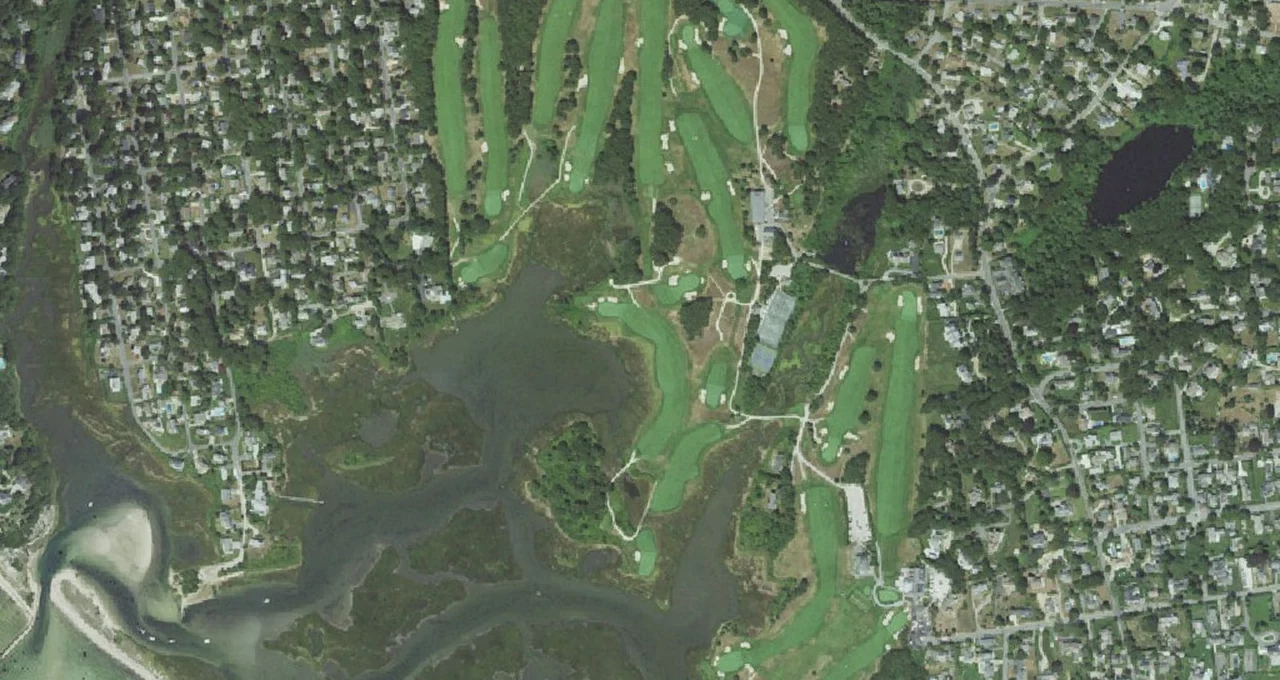
Hyannisport Club from the air. Aerial imagery USGS, domaine public.
Hyannisport Club
Holes
18
By
71 (men's tees) and 73 (Green tees), per Golf Course Gurus
Length
6,443 yards from the Black tees (rating 72.0, slope 132) per Golf Course Gurus and Top 100 Golf Courses; Mass Golf listed 6,348 yards in 2023 and GolfLink 6,257 yards
Green fee
—
Best season
—
The Hyannisport Club is a private golf and tennis club at 2 Irving Avenue in Hyannis Port, a village of the town of Barnstable on the south shore of Cape Cod, Massachusetts. Its 18-hole course sits on a rise above Nantucket Sound and winds around the marshes of Halls Creek. The club dates its founding to 1897 and describes the course as a classic Alexander Findlay and Donald Ross design. Membership is by invitation only, and the course is not open to the public: there are no public tee times and no green fee to publish.
It is also one of the best known private courses in New England for reasons that have little to do with golf. Joseph P. Kennedy Sr. joined in the 1920s, the Kennedy Compound stands about a third of a mile from the clubhouse, and John F. Kennedy played here often during his presidency. This page sets the history aside where it can and concentrates on what the course is, what it asks of a player, and what golfers who have played it say about it.
From six holes to Donald Ross
The course grew in stages, and its sources do not always agree on who did what. According to Wikipedia and The Fried Egg, the first six holes were laid out in 1897 by John Reid, a Scottish-born summer resident whom Wikipedia describes as one of the founders of the United States Golf Association. In 1902 Alex Findlay installed a nine-hole layout on land the club had added; Wikipedia says the club had by then gained access to a marsh and grown to about 60 acres.
The move to 18 holes came in 1913. Wikipedia attributes it to land bought from a dairy farmer, Charles Marchand. The Fried Egg reports that a Donald Ross researcher identified Ross himself as the architect of that expansion in 2021, on the strength of a 1913 article in the Boston Evening Transcript. The better documented Ross work came later. In 1930 the club bought more land, bringing the property to about 140 acres according to Wikipedia, and Ross drew plans for a longer layout with several holes pressed against the estuary. The Fried Egg says the club held those plans back after the 1929 crash and built them in 1936, the date Top 100 Golf Courses and Golf Course Gurus also give for the Ross redesign. Wikipedia says Ross revised 14 of the 18 holes, and that the course has changed little since around 1940.
Restoration has continued in recent decades. The Fried Egg reports that the club engaged the architect Ron Forse around 1990 for a long-term program that has widened corridors, restored bunkers and expanded greens, the green work in the late 2000s. Wikipedia adds that a superintendent found unused Ross drawings and that the club implemented parts of them between 2007 and 2010. At the time The Fried Egg wrote about the club, the second green was being moved back into a hillside on the left, following Ross’s 1930 drawings.
The card
The published figures vary from one directory to the next, which is common for a private club that does not post its scorecard online. Golf Course Gurus gives a par of 71 from the men’s tees and the following card: 6,443 yards from the Black tees, with a course rating of 72.0 and a slope of 132; 6,079 yards from the White tees, 70.7 and 128; and 5,480 yards from the Gold tees, 67.6 and 116. From the forward Green tees it lists a par of 73, 4,481 yards, a rating of 67.4 and a slope of 115. Top 100 Golf Courses also gives 6,443 yards in total.
Other sources give shorter totals. Mass Golf, the state association, listed the course at 6,348 yards from the back tees when it held its Four-Ball Championship there in 2023, and GolfLink lists 6,257 yards from its longest tees. We follow the Golf Course Gurus card for the table above and note the others; the club’s own card is the only one that settles the question. Either way, this is not a long course by modern standards. Its difficulty, as the next sections explain, comes from wind, firm ground and small greens rather than from length.
What it asks of you
The first thing every source mentions is the wind. The club sits on a perch above Nantucket Sound and takes the breeze off the water with nothing in the way. Mass Golf’s history of the club says its defense is rooted in the Cape Cod elements, swirling wind and dense fog, which make the small Ross greens play even smaller. A New York Times report from July 1963, quoted by Mass Golf, described fog and wet breezes off the Sound and a wind that could change direction within the hour. On a calm morning the course is a pleasant walk; on a windy afternoon the same holes ask for very different clubs.
The second thing is the ground. The Fried Egg describes conditions as reliably firm and the terrain near the estuary as topsy-turvy, with undulations that affect almost every hole. Many fairway landing areas carry no bunkers at all, so the contours, not the sand, decide where a drive should finish. The greens are generally low, open in front and fairly small, with subtle tilts, rolls and runoffs rather than dramatic internal contours. That invites the ball to be run in along the ground, which is exactly the shot a links-trained player would choose in a wind.
The third is accuracy into those greens. Reviewers on Top 100 Golf Courses describe them as small, very fast and often narrow, with bunkers along the long sides, so that a high approach that misses by a few yards can finish in sand on the far side. One review on that site called them the best conditioned greens in the region. The marsh is the other hazard, though the club treats it in an unusual way: the 1963 New York Times article reported that the scorecard then said there were no water hazards and that the marsh and adjacent waterways were played through the green. We could not confirm whether the current local rules still say so.
The routing alternates between the water and the interior. The Fried Egg lists the 3rd, 4th, 7th, 8th, 16th and 17th as the holes that come close to the water, with views from the 10th and 15th, while the 12th, 13th and 14th are the only holes entirely inland.
Holes golfers single out
The 3rd is a short par 4, 363 yards on The Fried Egg’s figures, that bends around an inlet of the marsh to a green almost surrounded by it. The player chooses between a safe tee shot to the right and a diagonal carry over the water to the left, and the open front of the green rewards a running approach.
The 4th, given at 410 yards by both Top 100 Golf Courses and Golf Course Gurus, doglegs left around Halls Creek, with marsh and fescue waiting for a drive that is cut too fine. Golf Course Gurus names it the hole where bogeys come most easily. The 8th, a par 3 of 202 yards according to Top 100 Golf Courses, asks for a tee shot carried over a wide stretch of marsh.
The finish is the part of the course that almost every review praises. The 15th is a par 3 that Golf Course Gurus gives at 185 yards, with a tee shot that drops about 20 feet into the full force of the wind and bunkers on both sides. The 16th is a par 5, 482 yards on the same card, that rises over a crest and comes back down to a green near sea level, framed by the Sound; The Fried Egg notes that it survives from Findlay’s nine-hole course. The 17th is the short par 3 that serves as the signature hole, 143 yards on the Golf Course Gurus card, played toward the water with Halls Creek on the right and a green tilted from back to front. The 18th is a par 4 of about 310 yards that tempts a long hitter to drive the green. Top 100 Golf Courses calls the closing holes, with their three peninsula holes, a demanding finish.
What golfers say
The public reviews of a private club are fewer than those of a resort course, and most come from guests and course raters who travel to play classic layouts. We read the reviews on Top 100 Golf Courses and Golf Course Gurus, the course profile on The Fried Egg, and the history published by Mass Golf. What follows are the themes that come back, not a count.
What they like. The setting comes first: reviewers describe water visible from every hole, helped by tree removal, and long views over Nantucket Sound. The routing is praised for the way it moves up, down and across a large property, and one reviewer rates the topography among the most naturally playable on the East Coast. The closing stretch from the 15th to the 18th is singled out again and again, as are the par 3s as a group. Conditioning gets consistent praise, especially the greens, and the course is described as easy to walk.
What they like less. The criticism is concentrated on the middle of the round. Golf Course Gurus finds most of the first fourteen holes flat and tree-lined, with few memorable moments, and does not rank the course among the very best in the state. The Fried Egg writes that several inland holes, the 6th, 9th and 11th among them, blend together in memory, and gives the club a respectable but not top rating because it does not stand out in any single category. One reviewer notes that water, despite being in view, rarely comes into play, and several warn that the small, fast greens with bunkers on their long sides punish a high miss more than the yardage suggests.
The weather. Nearly every source repeats the same warning: the course changes character completely when the wind rises, and fog can roll in off the Sound with little notice.
Getting there and getting on
Hyannis Port is a small village on the south shore of Cape Cod, part of the town of Barnstable, a short drive from the center of Hyannis. Cape Cod is reached by road over the Sagamore or Bourne bridges across the Cape Cod Canal. Hyannis has a regional airport, Cape Cod Gateway Airport, and is a departure point for ferries to Nantucket and Martha’s Vineyard. The club’s address is 2 Irving Avenue, Hyannis Port, MA 02647; its telephone number, as published on its website, is 508-775-0669.
Getting on the course is another matter. The club states that membership is by invitation only, and play is for members and their guests. The guest page sets out a detailed dress code: collared shirts for men, no denim anywhere on the property, soft spikes only on the course and practice areas, and hats worn facing forward. The club also asks members and guests not to name the club or its location when posting photos online. Its tipping policy mentions caddies and golf bag handlers, which suggests caddies are part of the experience, though the club publishes no caddie rates.
For a visitor without an invitation, the course is mostly seen from the road or from the water. Its history can be explored through Mass Golf’s archive articles, and the Cape has several public courses for those who want to play golf in the same wind.
How this page was made
This page is a factual presentation built from public sources; nobody from Panxis Golf has played or visited the course. The club’s own website gave the address, telephone number, founding year, the Findlay and Ross attribution, the invitation-only membership and the dress code and guest policies. Wikipedia gave the outline of the club’s history, the land purchases and the Kennedy connection. The Fried Egg gave the detailed design history, including the 2021 identification of Ross as the 1913 architect, the Ron Forse restoration and the current work on the second green, as well as the description of the terrain, greens and holes. Golf Course Gurus gave the scorecard with par, yardages, ratings and slopes, and the hole yardages for the 4th, 15th, 16th, 17th and 18th. Top 100 Golf Courses gave the 6,443-yard total, the 4th and 8th hole figures and the reviews. Mass Golf gave the 2023 yardage, the Four-Ball Championship and the content of the 1963 New York Times article.
Where sources disagree, as they do on the total yardage (6,443, 6,348 or 6,257 yards), on the exact length of the 17th and on Ross’s part in the 1913 expansion, we say so and name the source we follow. We could not find an official scorecard, a published golf season, cart rules, caddie fees or any public price, and we publish none. The opinions section summarizes public reviews; we report recurring themes rather than individual voices, and we name no reviewer.
The Hyannisport Club has not paid for this page, has not seen it before publication and has no say over its content. This page contains no commercial link and earns us no commission. If you know the course and something here is wrong or out of date, write to us and we will correct it.
Other courses nearby
Closest to this one in our United States directory:
- Farm Neck Golf Club — 19 mi
- The Bay Club at Mattapoisett — 26 mi
- TPC Boston — 53 mi
- Blue Hill Country Club — 57 mi
The hole to know
The signature par 3, 143 yards on the Golf Course Gurus card, played toward Nantucket Sound with Halls Creek on the right, bunkers and fescue around a green tilted from back to front.