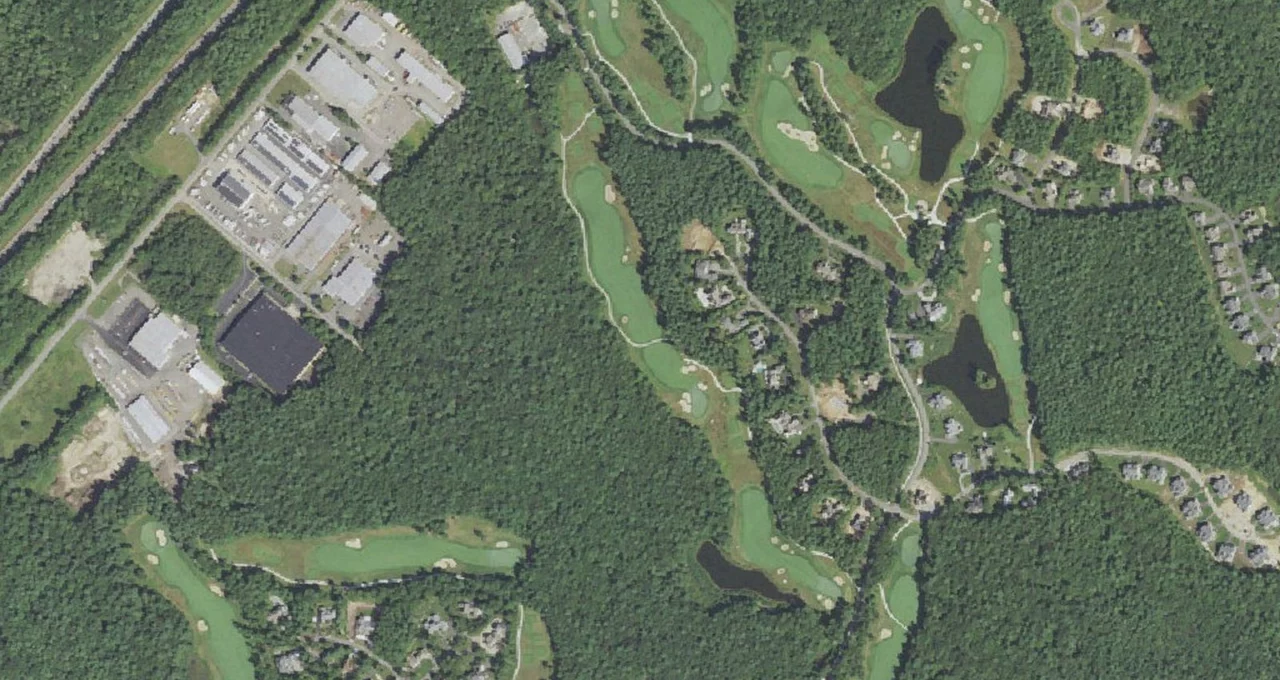
The Bay Club at Mattapoisett from the air. Aerial imagery USGS, domaine public.
The Bay Club at Mattapoisett
Holes
18
By
71
Length
7,008 yards from the Black tees on the club's scorecard (May 2020); 7,016 and 7,097 in some directories. The card gives no rating; one booking platform lists 74.1 and 134
Green fee
—
Best season
—
The Bay Club at Mattapoisett is a private, member-owned golf club and residential community at 63 County Road in Mattapoisett, a town on the north shore of Buzzards Bay in Plymouth County, Massachusetts, between New Bedford and the Cape Cod Canal. Its 18-hole course, designed by the architect Brad Booth with the PGA Tour player Brad Faxon, opened for play in 2004, according to the club. It is one of the youngest private courses in a part of the state better known for old seaside clubs, and its neighbor in the next town, The Kittansett Club in Marion, is one of them.
The course is a par 71, with a par 35 front nine and a par 36 back nine. On the scorecard the club publishes, dated May 2020, it measures 7,008 yards from the Black tees and 4,484 yards from the forward Silver tees, with seven sets of tees in all. The club describes it as a classic New England parkland course with bentgrass fairways and greens framed by British-style fescue. It has hosted stroke play for the Massachusetts Amateur, the New England PGA Section Championship and several national qualifiers. The figures, the people behind the course and the points where sources disagree are set out below.
A golf community on 625 acres
The Bay Club was planned as a whole community rather than a stand-alone course. The history page of the club’s residential website describes a master-planned, private, member-owned golf and lifestyle community spread over 625 rolling, wooded acres near Buzzards Bay. It gives the split: about 155 acres for the golf course and club facilities, about 270 acres for houses and about 200 acres kept as open space. A club directory describes the land as former farmland and woodland, and a course listing says that only about a tenth of the trees were removed when the holes were routed. The club says 88 percent of the original forest has been preserved.
The club’s timeline is short. The course opened for play in 2004. In 2005 a Sports and Activities Center of 10,000 square feet followed, with a year-round fitness center, an exercise studio, locker rooms with steam rooms and meeting space. In 2007, according to the same page, the developer Abbott Real Estate acquired 36 home sites, for houses of 2,000 to 3,000 square feet that come with a social membership in the club. A 2010 press release adds the other pieces of the club as it then stood: a Junior Olympic-sized pool, four lighted Har-Tru tennis courts and two platform tennis courts, a main restaurant called the Golf House, a halfway cafe overlooking the largest of the property’s three ponds, and a snack bar by the pool. The same release says one pond was stocked with largemouth bass and brown trout for seasonal fishing.
The founding date depends on whom you read. The club and Mass Golf’s 2024 article give 2004 for the grand opening; an earlier Mass Golf article, from 2020, says the club opened in 2003; and one private-club directory says it was established in 1997, which may refer to the start of the project rather than of golf. We follow the club’s 2004 for the opening of the course.
Who designed it
The club credits the course to Brad Faxon, the PGA Tour professional, working with the golf course architect Brad Booth; booking platforms and directories list the pair as William Bradley Booth and Brad Faxon. Reviewers on the Top100 Golf Courses site describe it as a Booth design with Faxon’s input, and one of them says the design shows clear signs of a tour player’s hand. A course listing adds that Faxon designed the practice facility so that every shot on the course could be practiced there. One course-planning website calls the course a Geoffrey Cornish design; we found nothing to support that, and Cornish appears in no other source we read.
The design is still being adjusted. A Top100 reviewer who played in August 2025 reports that tree removal has opened sight lines and made room for fescue across the property, that the main remaining wooded stretch is around the 11th and 12th holes, and that the architect Ian Andrew was advising on the bunkers. We found no club announcement or trade report of that bunker work, so it rests on that single account.
What it asks of you
At 7,008 yards from the back tees for a par of 71, the Bay Club is long by the standards of the region’s private courses, and it has been used as a test for strong players. Greg Yeomans, the club’s general manager and director of golf, told Mass Golf before the 2020 State Amateur that challenging the best players had always been part of the club’s mission. His advice then was to hold on early, get off to a solid start and expect to be challenged coming home. The same article noted that the course sometimes gets wind like its seaside neighbor in Marion, but that players would probably find it easier to drive the ball there.
The New England PGA’s preview of its 2025 Section Championship described wide fairways that look generous and can mislead, and called it a true approach-shot course where one misplaced shot on firm greens can lead to three-putts. Ben Egan, the head professional, spoke there of a balance of beauty and bite. During the same championship, the women’s champion described the greens as lightning fast. At a USGA qualifier in September 2024, Mass Golf reported that the par 4 13th produced at least 20 bogeys in one day of driving wind and the first rain at the course in 37 days.
The routing comes in two parts. According to the August 2025 Top100 review, holes 1 to 4, 17 and 18 stay close to the clubhouse, the golf shop and the practice area, while holes 5 to 16 lie farther out, beyond a wooded preserve; the walk from the 4th green to the 5th tee is about 200 yards. Another reviewer, in 2022, found the course easy to walk and noted that the best side of the fairway changes with the day’s pin positions.
The club’s scorecard gives the following pars and Black tee yardages, with the men’s stroke index in brackets. The front nine measures 3,407 yards and the back nine 3,601. Hole notes come from the August 2025 Top100 review unless stated otherwise.
- 1st: par 4, 368 yards (15). A dogleg with a wide fairway and bunkers placed to ask a question from the first tee shot.
- 2nd: par 4, 437 yards (5).
- 3rd: par 4, 477 yards (9). The longest par 4 on the course.
- 4th: par 3, 193 yards (17).
- 5th: par 4, 384 yards (7). A blind tee shot, then a downhill approach to an offset green guarded by slopes and bunkers.
- 6th: par 5, 554 yards (3). The longest hole, a sweeping dogleg right where hugging the right side brings risk.
- 7th: par 4, 359 yards (11). Water down the left, bunkers on the right.
- 8th: par 4, 414 yards (1). The hardest hole on the card: it sweeps from left to right past large sand and waste areas to a raised, pear-shaped green with bunkers on both sides.
- 9th: par 3, 221 yards (13). Water on the left and rocky mounds on the right; the 2010 release places the halfway cafe above the largest pond, overlooking the 9th and 10th holes.
- 10th: par 4, 376 yards (14). A short dogleg left to a green below the tee, where a low approach can run through.
- 11th: par 5, 537 yards (6). A dogleg left from the tee, with the green turning back to the right and no bunkers around it.
- 12th: par 3, 165 yards (18). The shortest hole, a raised green ringed by five bunkers.
- 13th: par 4, 426 yards (2). Mounds guard the corner of the dogleg; the hole that cost the 2024 qualifiers so many strokes.
- 14th: par 3, 227 yards (16). The longest of the par 3s.
- 15th: par 5, 553 yards (8). A sweeping hole from right to left with fairway bunkers and a large bunker short of a narrow green entrance.
- 16th: par 4, 398 yards (12). Bunkers off the tee, water on the right and a green on which a front pin is hard to hold.
- 17th: par 4, 479 yards (4). An uphill dogleg left to a green cut into the hillside, which the reviewer counts among the best holes.
- 18th: par 4, 440 yards (10). A two-tier green to finish.
Below the Black tees, the card lists the Blue tees at 6,438 yards, the Green at 6,097, the White at 5,731, the Gold at 5,446, the Red at 4,838 and the Silver at 4,484. The forward tees have their own stroke index, which makes the 6th the hardest hole and the 12th the easiest. The card carries no course rating or slope. A booking platform lists 74.1 and 134 for men from the Black tees and 65.6 and 117 from the Red; other directories give different figures, set out in the last section.
Read together, the card and the accounts point to a course whose strength is its par 4s: eleven of them, five over 420 yards from the back tees, with the 13th, 17th and 8th ranked among the hardest. The four par 3s are long as well, three of them over 190 yards, which one reviewer considered the weakest part of the design. For a club golfer the forward sets bring it down to a manageable length, but the greens, the fescue and the wind do not change with the tee.
Championships and qualifiers
For a course of its age, the Bay Club has hosted a good deal of competitive golf. Mass Golf reports that it held qualifying for the Massachusetts Amateur in 2016 and several USGA qualifiers, including one for the 2019 U.S. Senior Women’s Open. In July 2020 it co-hosted the stroke play of the 112th Massachusetts Amateur with The Kittansett Club, which held the match play: the 144 players played one round at each course on July 13 and 14. Mass Golf described it as the first live statewide championship held in Massachusetts during the COVID-19 pandemic.
In September 2024 the club hosted a qualifier for the 2025 U.S. Amateur Four-Ball. Two sides shot 65, six under par, to advance; one of them included Jared Winiarz, who became the first Mass Golf staff member to qualify as a player for a USGA championship.
The New England PGA has held its Pro-Assistant Championship at the club for 18 years, according to the section in 2025, including the 2022 and 2024 editions. In September 2025 the club was a first-time co-host of the 105th Section Championship with Kittansett, and held the final round. Ed Kirby of The Aquidneck Club won with 216, three over par, his second title in a row; Greg Kelly, the Bay Club’s lead assistant professional, shared the lead late in the final round on his home course before finishing tied for second at 217, a stroke behind. Kirby said afterward that both courses were in terrific shape but very difficult.
The Audubon designation
The club describes itself as the only Certified Silver Audubon Signature Sanctuary in Massachusetts. Audubon International’s Signature program covers courses and communities planned with environmental criteria from the start, and the Silver level recognizes work on wildlife habitat and on the efficient use of water and energy. A Golf Course Industry news item and a New England Real Estate Journal article put the club among only 66 courses worldwide at that level; that count dates from those articles and may have changed. A Mass Golf magazine feature in fall 2023 still listed the Bay Club as the only Silver-certified course in the state. The 88 percent of forest left standing is part of the same story, and so is the fescue that the club has let grow along the playing corridors, which a GolfPass reviewer also connected to lower maintenance costs.
What golfers are saying
As a private club, the Bay Club has few public reviews, and most of them are short. The main material behind this section is three reviews by panelists on the Top100 Golf Courses site, from 2022 and 2025, which give the course 4.0 out of 5 overall and rank it 50th in Massachusetts; a summary from Daniel Wexler’s book The American Private Golf Club Guide, as quoted on that site; a single member review on GolfPass; and short directory comments. We could not open the GolfPass, Golf Digest and GolfLink pages themselves, which refused our requests. The points below are other people’s opinions, not ours. Nobody from Panxis has played the course, and we name no reviewer outside the published panels.
What comes up in its favor
- Conditioning is the most consistent compliment: reviewers call it excellent, and at both the 2020 State Amateur and the 2025 Section Championship officials and players described the course as pristine or immaculate.
- The greens draw comment for their speed and contours: smooth and interesting, with run-off areas, and in one directory comment large and very slippery.
- The open, airy feel sets it apart from the tree-lined courses common in Massachusetts; one reviewer found the gently rolling ground and fescue almost British in character.
- Reviewers like its fairness: every shot is in front of you, strategy is easy to read, and fairway position matters according to the pins.
- It feels older and more settled than its age, in the words of two reviewers.
- The 8th, 15th and 17th are singled out as its strongest holes, and Wexler’s guide points to the two long par 4s that open the round and the two that close it.
What comes up against
- Several reviewers find few spectacular holes: a set of solid holes rather than memorable ones, in Wexler’s summary, and a course that is the sum of its parts in the words of one panelist.
- The par 3s, three of them long, are described by one reviewer as the weakest part of the design.
- The bunkers vary in style, which one reviewer thinks a more consistent approach would improve.
- One reviewer wished for more quirk and surprise. One short comment, seen in a search excerpt, calls it very nicely maintained but relatively easy, which sits oddly with its long card and the scoring at championships.
- A few holes have houses in view, as one would expect in a residential community.
Who can play
The Bay Club is private. Golf is for members and their guests; there are no public tee times on the club’s website, and directories describe access as by invitation or membership. The club lists a Full Golf membership, open to residents of the community and to people living elsewhere, which covers the course and all facilities; a Social membership, which covers tennis, fitness, the pool and dining but not the course or the practice area; and a limited number of junior golf memberships for ages 13 to 22, with instruction and interclub play. Prospective members are asked to request information from the membership office.
The practice facilities include a range, a putting green, a chipping area and a practice bunker, according to directories. In winter the club runs a heated Winter Golf Center with hitting bays, a putting green, chipping stations and a golf simulator, and offers golf fitness assessments in its Sports and Activities Center; it presents golf as a year-round activity for members. A booking platform says carts and club rentals are available, walking is allowed, metal spikes are not and proper attire is required. The same platform says there are no caddies, while a private-club directory lists caddie service; the club itself says nothing on the subject.
The club’s website lists Ben Egan as head golf professional, Greg Yeomans as general manager and director of golf, and Patrick Meehan as golf course superintendent.
Getting there
The club’s address is 63 County Road, Mattapoisett, MA 02739, on the north side of the town, in the area OpenStreetMap labels Cannonville; one booking platform gives 6 Bay Club Drive instead, which is a street inside the community. The club’s main phone line is listed on its contact page. Measured in a straight line from the middle of the course, Mattapoisett’s harbor and village are about a mile and a half to the south, downtown New Bedford about seven miles to the west-southwest and the Bourne Bridge over the Cape Cod Canal about twelve miles to the east. Providence is about 33 miles to the west, and downtown Boston and Boston Logan International Airport both about 49 miles to the north. Interstate 195 crosses Mattapoisett on its way from Providence to Cape Cod. These distances are measured on the map, not by road.
No official season is published. The course is in coastal southeastern Massachusetts, and the championships and qualifiers it has hosted were played between June and September.
Green fees
The Bay Club publishes no green fees, and none are given here. The course is open to members and their guests; guest rounds go through a member, and membership terms are given by the club’s membership office on request. For anything else, start with the club’s own website.
How this page was made
The factual frame comes from public sources: OpenStreetMap for the location, the address and the identifiers; Wikidata for the entity record; the club’s website for the scorecard (a card dated May 2020, with tees, yardages, pars and stroke index), the golf, membership and staff pages; the history page of the club’s residential website for the timeline and acreage; a 2010 press release for the facilities and ponds; Mass Golf for its 2020 State Amateur articles, including the general manager’s comments, and its 2024 report on the U.S. Amateur Four-Ball qualifier; the New England PGA for its 2025 Section Championship preview and results; Golf Course Industry, the New England Real Estate Journal and Mass Golf’s magazine, through search excerpts, for the Audubon designation; the Top100 Golf Courses site for three panel reviews, its state ranking and its summary of Daniel Wexler’s guide; and the TeeOff, Open Golf API, ForeTee and privateIQ listings for directory data. The GolfPass, Golf Digest, GolfLink and Golfify pages refused our requests; what we use from them comes only from search excerpts. We did not consult the USGA course rating database.
Where sources disagree, we say so. The opening year is 2004 for the club and most directories, 2003 in a 2020 Mass Golf article and 1997 in one directory, as a founding date. The par is 71 on the club’s card and website and 72 on one listing. The back-tee length is 7,008 yards on the card and in most directories, 7,016 in the headline of one booking platform and 7,097 in another directory. Wexler’s guide, as quoted, gives older yardages for several holes (443 yards for the 2nd, 449 for the 3rd, 226 for the 9th, 172 for the 12th, 233 for the 14th, 487 for the 17th and 447 for the 18th), which no longer match the card. The club’s golf page speaks of six layouts from 5,080 to 7,008 yards, and directories list a Red tee of 5,080 yards, while the 2020 card shows seven sets of tees, with the Red at 4,838 and the Silver at 4,484. Ratings vary: 74.1 and 134 from the Black tees on one platform, 74.2 and 136 at 7,097 yards in another directory, and, in a search excerpt from GolfPass, 72.4 and 141 for men and 80.8 and 152 for women; one reviewer cites a slope of 134 from the Blue tees. The architect is Booth and Faxon for the club, Booth with Faxon’s help for reviewers, and Geoffrey Cornish for one website, which we consider unsupported. One directory lists caddies and a booking platform says there are none. The street address is 63 County Road for the club and 6 Bay Club Drive for one platform. The Wikidata point for the course lies about a mile south of the OpenStreetMap outline. The count of 66 Silver Signature courses worldwide comes from older articles.
Some details will age: the staff names, the membership categories, the facilities, the Audubon status, the review scores and the state ranking are those published up to 2025 and read in October 2026. The opinion section summarizes reviews read in October 2026; we report recurring themes rather than individual voices. Nobody from Panxis has played or visited this course, and this page is no substitute for a round. The public material on a private club is thin, and this page is shorter on player opinions than it would be for a public course.
The club has not paid for this page, has not seen it before publication and has no say over its content. This page contains no commercial link and earns us no commission. If you know the club and something here is wrong or out of date, write to us and we will correct it.
Other courses nearby
Closest to this one in our United States directory:
- Farm Neck Golf Club — 21 mi
- TPC Boston — 30 mi
- Blue Hill Country Club — 39 mi
- Brae Burn Country Club — 50 mi
The hole to know
A par 4 of 414 yards from the Black tees and the hardest hole on the men's card: it sweeps from left to right past large sand and waste areas to a raised, pear-shaped green with bunkers on both sides, according to a 2025 panel review.