Hitting mats and wrist pain: why thickness misleads on a garage slab, a basement floor or a deck
Country Club Elite, Carl's HotShot, Net Return Pro Turf, SIGPRO Softy, TrueStrike and Fiberbuilt: U.S. prices in October 2026 from $479 to $1,399, and why a mat's total thickness says little about your wrists.
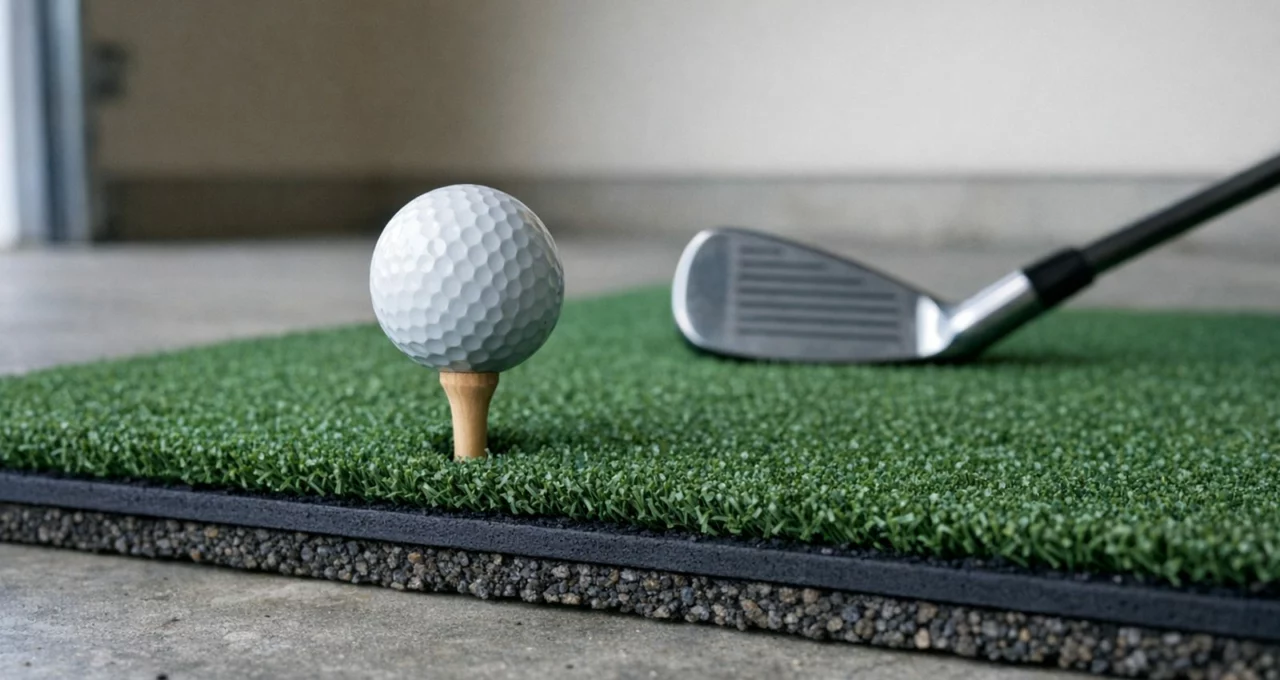
The home practice setup usually gets built from the net outward. The net is researched, the launch monitor is compared, and the mat is whatever came in the bundle or whatever looked thick enough in the photos. Then, a few weeks into the habit, the leading wrist starts to ache after a bucket of irons, or the elbow complains the morning after. Read enough forum threads about it and the word that keeps coming up is “thickness,” as in “I need a thicker mat.” It is the wrong word. What hurts is a surface that does not let the club keep moving after it reaches the ball, and the total thickness printed on the box says very little about that.
This page presents six mats Americans buy for garages, basements and simulator rooms, from $479 to $1,399, with what their makers publish and what owners say in public. It is a presentation of products and a reading of public opinion, not a test. Nobody at Panxis Golf hit a ball off any of these mats for this page, and nothing here was measured by us.
Why a mat can hurt when grass does not
On grass, a well-struck iron meets the ball first and then the ground, and the ground gives. The club takes a shallow divot and keeps traveling. The wrists feel very little, because the turf and the soil under it absorb the energy and let the head through. A mat cannot be cut. Whatever the club meets after the ball, it has to push through or bounce off, and the shock goes up the shaft into the hands.
That is why the golfers who complain most about mats are often the ones with a steep swing and a big divot pattern. A player who sweeps the ball barely notices the surface. A player who hits down hard into the ground feels every mat as a floor. Several forum regulars make exactly this point: the same mat can be fine for one golfer and miserable for another, because the swing decides how much of the club ever reaches the surface.
There is a second mechanism golfers describe, and it matters as much as hardness: grip. Dense, short nylon turf can hold the leading edge for a fraction of a second instead of letting it slide. Owners describe the club “grabbing” or “sticking,” with the wrist taking the twist. A slick or bristly surface that lets the sole skid tends to be easier on the joints, even when it is not soft at all.
A word of caution before going further. We found no controlled study that measures how often mats cause wrist or elbow injuries, and this page makes no medical claim. What follows is what makers publish and what golfers report. If a wrist or an elbow hurts for more than a few days, the right person to see is a doctor or a physical therapist, not a new mat.
What “thickness” means on a spec sheet
A mat listing can mean three different things by thickness, and they behave differently under the club.
- Pile height. How long the turf fibers are. Longer fibers let the club sink and can let you push a real tee in, but a long, dense pile can also hold the club and hide a fat shot.
- Foam or underlay. The layer that absorbs the shock. This is the part that protects joints, and it is often the part the listing describes least precisely.
- Total thickness. Pile plus foam plus base. A thick mat with stiff foam can be harder on the wrists than a thinner mat with soft foam, and a very soft mat can let the club bottom out on the concrete beneath it.
The forgiveness problem is the other side of the coin. A plush surface lets a club that hits an inch behind the ball slide forward into it and send it out looking almost normal. On grass, that same swing digs in and the ball goes nowhere. Golfers who move from a thick, soft mat back to the course often report that their contact was worse than the mat had been telling them. A softer mat is easier on the body, and it is also more generous with the truth.
When you read a listing, look for the pile height and the underlay described separately, the hitting area as distinct from the full stance area, whether a real wooden tee goes in, and whether the hitting strip can be replaced without buying the whole mat. A strip that can be swapped is a mat maker telling you where the wear goes.
Real Feel Country Club Elite
The Country Club Elite has been the default name in home mats for years, and it is the mat many forum discussions about wrist pain begin with, for better and worse. It is a classic one-piece construction: nylon turf over a foam backing, made in a range of sizes from a single hitting area to a full stance mat.
- What the maker lists: a 1-inch pile height, a 5/8-inch high-density foam backing, a total thickness of 1 3/4 inches, a surface that accepts a real wooden tee, holes on all four sides for rubber tees, and a three-year prorated limited warranty.
- Who it suits: a golfer who wants a familiar, durable surface that takes a tee, and whose swing is shallow enough that the dense pile does not grab.
Prices read in October 2026 at a U.S. indoor golf retailer: 4×5 ft $479, 5×5 ft $599, 5×8 ft $959, 5×10 ft $1,199.
Carl’s Place HotShot
The HotShot is built as a system rather than a single sheet. A base holds an insert where the ball sits, and the insert comes in three versions. That design answers the wrist question directly: you choose the strip according to how you hit, and replace only the strip when it wears.
- What the maker lists: sizes of 4×5, 5×8, 4×9 and 6×10 feet; a Standard strip, a Foam Divot strip and a Gel Divot strip; the Standard strip described as the only one that accepts real tees; the Foam strip described as designed to save your joints; a modular build so the worn section can be replaced; an optional non-slip base. Pile height and foam thickness are not given on the dealer page.
- Who it suits: a golfer who knows the joints are the issue and is willing to give up a real tee on iron shots to get a softer insert.
Prices read in October 2026 at a U.S. golf simulator retailer: 4×5 with Standard strip $599.95, with Foam Divot strip $779.95, with Gel Divot strip $839.95. The 6×10 runs from $1,271.95 to $1,511.95 depending on the strip. Replacement strips start at $95.95.
The Net Return Pro Turf
The Pro Turf is the mat The Net Return sells alongside its nets, and it is useful here as the thin end of the comparison. It is a large, roll-up surface meant to cover the whole hitting area in front of a net, more like a piece of good artificial grass than a padded hitting station.
- What the maker lists: 6 by 10 feet, about 3/4 inch thick, roughly 54 pounds, a 42-ounce nylon face over a 5 mm foam backing, two rubber tees included, indoor and outdoor use, and the option of using it as a 10-foot putting surface with a cup and flag accessory.
- Who it suits: a golfer who wants one surface for the whole bay, hits off a forgiving floor, or puts a separate hitting strip on top of it.
Price read in October 2026 at a U.S. golf simulator retailer: $599. That is the same money as a 5×5 Country Club Elite for a mat less than half as thick, which is exactly why total thickness should never be the only number you compare.
SIGPRO Softy
The Softy is the mat that made “soft” a selling point. Its maker builds it around a foam core under a long turf, with a hitting strip that comes out of the mat and can be swapped. It is the thickest mat on this page.
- What the maker lists, as reproduced by U.S. dealers: 4 by 7 feet, 2 1/2 inches tall, 21 pounds; a 1-inch turf over a soft foam insert; a hitting strip that holds a real tee and can be replaced without changing the mat; a description of turf density engineered to reduce injuries and of an absence of jarring vibration. A thinner Softy LITE is sold at about half the height, 1 1/4 inches.
- Who it suits: a golfer whose priority is the joints, who hits on concrete and wants a real tee on every club.
Price read in October 2026 at a U.S. indoor golf retailer: Softy 4×7 $999.99 (shown against a $1,249.99 list price), Softy LITE 4×5 $739.99, replacement Softy hitting strip $186.99. MyGolfSpy has published its own hands-on look at the Softy, and readers who want a test should read it there; we do not repeat its conclusions.
TrueStrike Single
TrueStrike takes a different route from the soft mats. Rather than a thick pile that lets the club sink, its makers describe a thin, firm strike surface over a gel insert, meant to let the club move down and through the way it would on turf. Owners who like it say it feels closer to a fairway than to a carpet; owners who do not say it feels firmer than they expected.
- What the dealer lists: a single-position hitting mat with a hybrid turf-and-gel construction that absorbs club impact, a modular design with replaceable range sections, and the TrueStrike manufacturer warranty, with no duration given on the page. Dealer pages elsewhere give the size and weight differently, so check them with the seller.
- Who it suits: a golfer who wants honest feedback on a fat shot and is ready to pay for a mat built around that idea.
Price read in October 2026 at a U.S. golf simulator retailer: $1,098.
Fiberbuilt Player Preferred Studio
Fiberbuilt is the other name forum posters reach for when the subject is wrist pain. Its design moves the turf off the base entirely: fibers set in a modular rubber foundation, with the hitting turf in its own section. It is the most expensive mat here and also the one owners most often credit with ending their joint complaints.
- What the dealer lists: sizes of 8×4, 10×4 and 12×4 feet in single, center and double hitting versions, 2 inches tall, a modular, shock-absorbing rubber base, a vibration absorption layer the maker says absorbs 94.7 percent of clubhead vibration, and a friction-fit tee holder for real tees. The 94.7 percent figure is the maker’s own claim and has not been checked by us.
- Who it suits: a golfer building a permanent simulator room who has had joint pain on other mats and wants to deal with it once.
Price read in October 2026 at a U.S. golf simulator retailer: 8×4 single $1,399, 10×4 center $1,599, 12×4 double $2,349. The listing showed a sold-out notice, so availability may depend on the size.
Side by side
| Mat | Size priced | Thickness listed | Real tee | Strip replaceable | U.S. price, Oct. 2026 |
|---|---|---|---|---|---|
| Real Feel Country Club Elite | 4 x 5 ft | 1 3/4 in total (1 in pile, 5/8 in foam) | Yes | Not stated | $479 |
| Carl’s Place HotShot | 4 x 5 ft, Foam strip | Not stated | Standard strip only | Yes | $779.95 |
| The Net Return Pro Turf | 6 x 10 ft | About 3/4 in (5 mm foam) | Rubber tees | No | $599 |
| SIGPRO Softy | 4 x 7 ft | 2 1/2 in | Yes | Yes | $999.99 |
| TrueStrike Single | Single position | Varies by dealer | Not stated | Yes | $1,098 |
| Fiberbuilt Player Preferred Studio | 8 x 4 ft | 2 in | Tee holder | Not stated | $1,399 |
The thickest mat and the thinnest mat sit $400 apart, and neither of those numbers predicts how a wrist will feel. Read the columns about the strip and the tee first: they tell you what the maker thinks wears out, and what it thinks you will do with a driver.
What golfers are saying
The same points recur in owner reviews, simulator forums and golf discussion boards, and they are remarkably consistent across brands.
On the plus side:
- Pain that stopped after a change of surface. The most common praise for the premium mats, Fiberbuilt and the Softy in particular, comes from golfers who say their elbow or wrist complaints went away after leaving a dense one-piece mat. They describe being able to hit a full session and wake up without soreness.
- A real tee on every club. Owners of mats that accept a wooden tee, whether the Country Club Elite or the Softy strip, say it is the detail they would not give up, because a rubber tee at a fixed height changes how they set up to the driver.
- Strips that can be swapped. Owners of modular mats praise being able to replace a worn hitting area for a fraction of the mat’s price, and to choose a softer or firmer insert as their swing or their joints change.
On the minus side:
- The mat that lies about fat shots. The most repeated criticism of soft and long-pile mats: a club that lands behind the ball still slides into it, and the ball flies. Golfers describe arriving at the course with contact far worse than their garage suggested.
- Dense turf that grabs. Golfers who take a divot describe classic one-piece mats as holding the leading edge, with the jolt going straight into the lead wrist. Several say the same mat felt fine for their sweeping playing partner.
- Concrete still underneath. Owners of thinner mats, and some owners of thick ones, say the floor comes through on a steep swing. The complaint is not the mat alone but the slab under it, and the fix they describe is a layer of foam or rubber flooring beneath.
- A strip that wears into a hole. The spot where the ball sits takes nearly every strike. Owners report the turf flattening, burning or wearing through in one place, and say the price of replacement strips is a cost they did not budget for.
Nobody is quoted by name here, nothing has been counted, and none of these impressions is a measurement. They are what comes back most often in public reviews and golf forums.
Where Americans hit off a mat, and what sits under it
In the United States the mat almost always goes on one of three floors, and the floor matters as much as the mat.
- The garage slab. The most common setup and the hardest floor in the house. A mat on bare concrete gets no help from below, so the underlay of the mat has to do all the work. Many owners put a layer of rubber stall matting or interlocking gym tiles under the hitting mat, which also keeps it from sliding. In winter, a cold garage stiffens foam and turf, and some owners say their mat felt noticeably harder in January than in June.
- The basement. Common in the Midwest and the Northeast, often over concrete under a thin carpet or vinyl. It is warmer than the garage, which helps the foam, but the ceiling usually decides what you can hit. Owners who hit irons only in the basement say a thinner, firmer mat is enough; owners who swing a driver there often have to raise the mat platform, which takes headroom away.
- The patio or deck. Popular in the South and the West, where hitting outside is possible most of the year. A deck flexes and is usually kinder to the wrists than concrete, but sun and rain age turf and foam fast. Owners who leave a mat outdoors talk about replacing the hitting strip each season.
Whatever the floor, the mat has to be big enough for your feet to stand on the same level as the ball. A small hitting strip on the floor with your feet on concrete puts the ball higher than your stance and changes the lie of every club. If you already own a home net, the mat is the piece most often replaced first, as we noted in our look at what home net buyers regret.
As for where to buy, Americans have four options. A golf superstore or indoor golf showroom sometimes has mats laid out where you can take a swing, which is worth more than any spec sheet. A golf simulator retailer, often online, carries the widest range and will tell you which mats pair with a given launch monitor. A pro shop can order a mat and may know which surface the local fitting bay uses. And the used market is busy, but look closely at the hitting spot before paying: a worn strip is the most expensive part to fix on some mats. Whatever the channel, ask whether the hitting strip is sold on its own and at what price, what the warranty covers and for how long, and whether you can return a mat that turns out to hurt.
How to choose before you buy
- Start with your divot. If you take a big one on the course, joint protection matters more than anything else on the box. If you sweep the ball, a firmer surface will give you more honest feedback.
- Read the layers, not the total. Pile height and underlay separately. A thick mat with stiff foam is not a soft mat.
- Look at the floor. On concrete, plan a rubber or foam layer under the mat, whatever you buy.
- Check the strip. Can it be replaced, and what does it cost? That number is part of the price.
- Keep your feet level with the ball. Buy a stance area, not only a hitting square.
- Listen to your body early. Soreness after a session is a signal to stop and change something, not to push through. If it persists, see a professional.
A good mat is the one you forget is there. The golfers who say they would buy theirs again are the ones who bought for their swing and their floor, not for the biggest number in the listing.
How this page was put together
This is a presentation of products and a reading of public opinion, not a test. Nobody at Panxis Golf hit balls off or measured any of these mats for this page. Features and dimensions come from the makers’ published descriptions as reproduced on their dealers’ product pages: Real Feel Golf Mats for the Country Club Elite, Carl’s Place for the HotShot, The Net Return for the Pro Turf, SIGPRO for the Softy, TrueStrike for the Single, and Fiberbuilt for the Player Preferred Studio. Where dealers disagree, as they do on the TrueStrike’s dimensions, the figure is left out.
Prices were read on October 30, 2026, in U.S. dollars: at Indoor Golf Outlet for the Country Club Elite and the SIGPRO Softy and Softy LITE, at PlayBetter for the Carl’s Place HotShot, The Net Return Pro Turf and the Fiberbuilt Player Preferred Studio, and at Rain or Shine Golf for the TrueStrike Single. Prices change with promotions, so the figure at checkout is the one that counts.
What golfers say was read in public owner reviews and in forums such as Golf Simulator Forum and The Sand Trap, some only through search excerpts. Nobody is quoted by name, nothing is counted, and no impression is presented as a statistic. We found no controlled study of injuries caused by hitting mats; the physical explanation on this page reflects what makers and golfers describe, and it is not medical advice. There is no commercial link on this page, no affiliate arrangement and no commission of any kind. If content on this site is ever paid for by a brand, it will carry an advertising label at the top of the page.