Home golf nets: what buyers regret about bounce-back, garage ceilings, side misses and worn mesh
Home net regrets are rarely about the net. They are about the ball that comes back, the shank that misses the frame, the ceiling over the driver and the mesh left out in the sun. Six nets Americans buy, from $119.99 to $795, and what owners wish they had known.
In brief
- The nets: IZZO Titan 7x7 and Titan Beast 12x10, Spornia SPG-5 and SPG-7, The Net Return Home Series V2 and Pro Series V2.
- U.S. prices in October 2026: $119.99 and $169.99 for the IZZO nets, $249.99 and $349.99 for Spornia, $695 and $795 for The Net Return, $1,343 with overhead and side protection.
- Owners praise daily 15-minute sessions and a ball that rolls back on its own; the top regrets are bounce-back, a frame too small for the miss, worn mesh and poles, noise and the cheap mat.
- Measure with a club before buying: ceiling at the top of the driver swing, side protection indoors, and about 8 to 10 feet from ball to net.
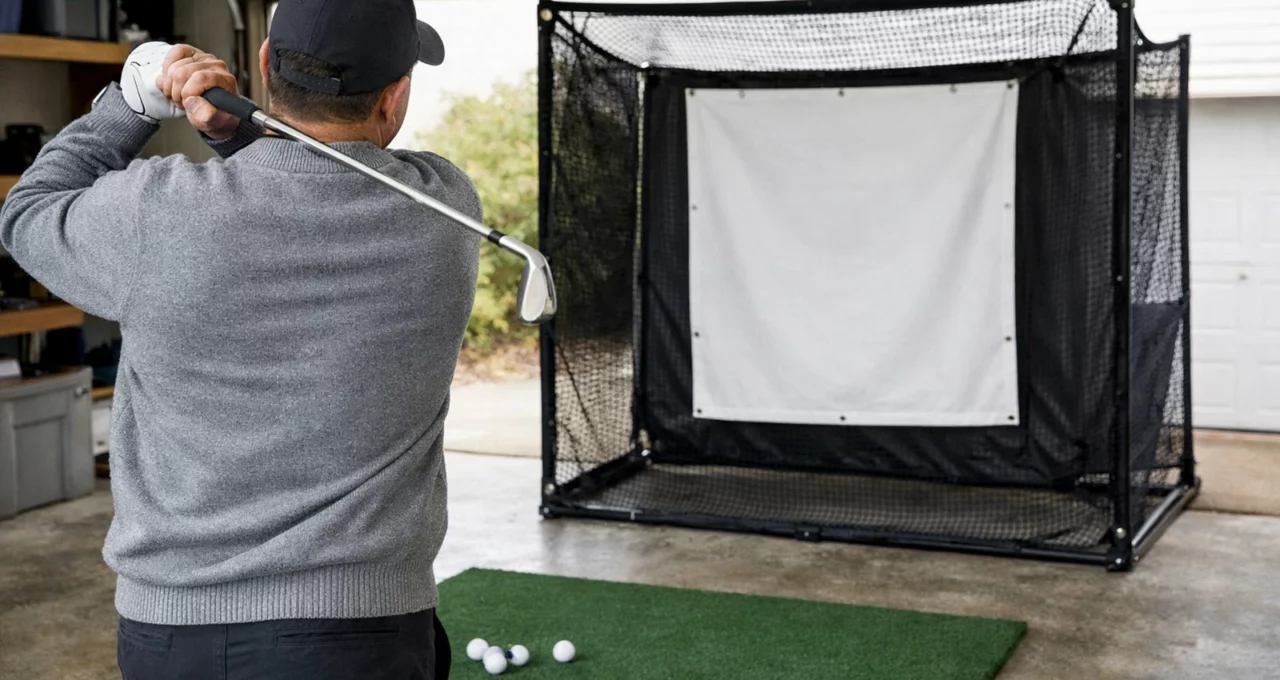
A home golf net looks like the simplest purchase in the sport. A frame, some mesh, a target in the middle, and you can hit balls in the garage every evening instead of driving to the range on Saturday. Then it arrives. The ball comes back off the mesh toward your shins, the first shank goes past the side of the frame and into the drywall, the driver clips the ceiling on the way back, and by March the poles have a crack in them. Read enough owner reviews and forum threads and a pattern appears: the regrets are remarkably consistent, and very few of them are about the net itself. They are about the room, the frame, the mat underneath and what golfers expected the net to do. This page looks at six nets Americans buy, at what they cost in October 2026, and at what owners say they wish they had known.
It is a presentation of products and a reading of public opinion, not a test. Nobody at Panxis Golf set up or hit balls into any of these nets for this page, and nothing here was measured by us.
What a net does, and what it cannot do
A net stops a golf ball moving at well over 100 miles an hour within a few feet. That is the whole job, and a decent net does it with every club in the bag. What it does not do is tell you where the ball would have gone. A slice and a pure draw both end up in the mesh, and a ball that left the face 15 degrees offline still lands in the target zone if you stand close enough. That is the first thing to understand before you spend anything: a net is a place to make swings, not a place to see shots.
Golfers who are happy with their net tend to use it for something specific. They groove a takeaway, work on contact with a towel behind the ball, keep their body moving through the winter, or warm up before an evening nine. Golfers who regret the purchase often bought it hoping to fix a slice, and found that the net hides exactly what they wanted to see. If ball flight is what you are after, the answer is a launch monitor in front of the net, which we covered in our look at home simulators under $1,000. The net is still the part that keeps the ball in the garage.
The second thing to understand is that the price of the net is rarely the price of the setup. Owners who spent $120 on the net routinely report spending as much again on a hitting mat, side barriers, a ceiling baffle or a replacement target. Count the whole corner of the garage, not the box.
IZZO Titan 7×7 and Titan Beast 12×10
IZZO’s Titan nets are the entry point many Americans start from: fiberglass poles on a steel base, a black net and a hanging target, at a price that does not hurt if the net turns out to be the wrong idea. The Titan 7×7 is the compact version for a single bay in a garage; the Titan Beast 12×10 is the wide version, built for golfers who want more room for mishits than a 7-foot frame allows.
- What the maker lists: a 7 by 7 foot hitting area on the Titan and 12 by 10 feet on the Beast; for the Titan, a hanging target, fiberglass poles on a steel base, setup and takedown in minutes, a nylon carry case and a one-year warranty. Dealer listings give the ball speed rating as 150 or 160 mph depending on the page, so check it on the box.
- Who it suits: a golfer who wants to find out whether home practice will stick before spending real money, or who has a wide space and wants coverage more than polish.
Price read in October 2026 at a U.S. golf retailer, where the 7×7 was shown out of stock: Titan 7×7 $119.99, Titan Beast 12×10 $169.99. The difference between the two is $50, and owners of the smaller model are among those who most often say they wish they had bought the wider one.
Spornia SPG-7 and SPG-5
Spornia built its name on a pop-up design: a frame that opens quickly and folds down into a carry bag, with an automatic ball return built into the net. The SPG-7 is the standard edition; the SPG-5 is a compact edition with what the maker calls a 5.5-foot footprint, aimed at patios and smaller garages.
- What the maker lists: automatic ball return toward the hitting area, an impact-absorbing target sheet meant to reduce noise, a pop-up frame that folds down, a carry bag, and use with every club from wedge to driver. Replacement roof poles and target sheets are sold separately, which tells you which parts wear.
- Who it suits: a golfer who cannot leave a net standing, in a shared garage or a yard where the net has to come down after each session.
Price on the maker’s U.S. store in October 2026: SPG-7 $349.99, SPG-5 $249.99, with bundles including a mat from $489.99. A $69.99 auto-return chipping net and a $39.99 side net extension are listed separately.
The Net Return Home Series V2 and Pro Series V2
The Net Return is the name most often cited in forums when the question is “which net lasts.” Its design is different from the others: the maker says its patented net absorbs the shot and sends the ball rolling back to the golfer’s feet, and owners describe netting that hangs loose in the frame instead of being stretched tight. The rolling return is also the feature owners praise most.
- What the maker lists: commercial-grade netting rated for ball speeds up to 225 mph, an automatic ball return built into the net’s shape, a 7 by 7 foot Home Series V2, an 8 by 7.5 foot Pro Series V2, and larger Pro 8, Pro 9, Pro 10 and Pro XL versions. Overhead protectors and side barriers are sold as options.
- Who it suits: a golfer who knows the net will stay up for years and wants to buy once.
Price read in October 2026 at a U.S. golf retailer: Home Series V2 $695, Pro Series V2 $795. With the overhead protector and side barriers, the Pro Series V2 package reaches $1,343. That last number is the honest one if you hit indoors, and the step owners most often say they skipped and then bought later.
Side by side
| Net | Hitting area listed | Frame type | Ball return | U.S. price, Oct. 2026 |
|---|---|---|---|---|
| IZZO Titan 7×7 | 7 x 7 ft | Fiberglass poles | No | $119.99 |
| IZZO Titan Beast 12×10 | 12 x 10 ft | Wide fixed frame | No | $169.99 |
| Spornia SPG-5 | Compact, 5.5 ft footprint | Pop-up | Yes | $249.99 |
| Spornia SPG-7 | Standard edition | Pop-up | Yes | $349.99 |
| The Net Return Home Series V2 | 7 x 7 ft | Fixed frame, loose net | Yes | $695 |
| The Net Return Pro Series V2 | 8 x 7.5 ft | Fixed frame, loose net | Yes | $795 |
Read the third and fourth columns before the last. The price gap between a $120 net and a $795 net is not about stopping the ball, which all of them do. It is about where the ball goes after it stops, how long the mesh lasts, and how much of the setup you will add later.
What golfers are saying
The same points come back in owner reviews, golf forums and the makers’ own help and replacement-part pages. Most of them are about what happened in the second month, not the first evening.
On the plus side:
- Fifteen minutes a day adds up. The most consistent praise, across price points: owners say the net changed how often they swing a club, not how well. A bucket in the garage after work beats a range session they never found time for.
- A ball that comes back on its own. Owners of loose-net designs describe the ball rolling back to the mat as the feature they would pay for again. It turns a session of thirty balls into one of a hundred without bending over.
- Quick setup on the better pop-ups. Golfers who have to put the net away every time praise the designs that open and fold in under a minute, and say the time saved is what keeps them using it.
On the minus side:
- The ball that bounces back. The regret that comes up most. A net stretched tight, a hard target sheet or a hitting position too close to the frame sends the ball back toward the golfer, sometimes at the face. Owners describe moving the mat back, loosening the net or hanging a second layer of mesh behind the target.
- A frame that is too small for the miss. Golfers who bought a 7-foot net for the garage describe the shank or the thin driver that missed the frame and found a wall, a water heater or the car. The fix they recommend is side barriers or a wider net, and the regret is not having bought it first.
- Mesh and poles that wear out. A hole worn through the middle of the target, netting that turns brittle after a summer left outside in the sun and rain, a fiberglass pole that cracks at a joint, a pop-up frame that will not fold back the way it came out of the bag. Owners of nets left outdoors all year report replacing them annually.
- The noise and the mat. Owners in attached garages and townhouses report complaints about the bang of the ball on the frame or target, especially early or late. And the cheap mat that came with the net, or was bought with it, is one of the most frequent second purchases: too hard on the wrists, too forgiving of a fat shot. That deserves its own page, and it is coming.
Nobody in these discussions is quoted by name here, nothing has been counted, and none of these impressions is a measurement. They are what comes back most often in public reviews and golf forums.
Where Americans set up a net, and what each space asks
In the United States, the net usually goes in one of three places, and each one decides which regret you are most likely to have.
- The two-car garage. The most common setup and the most forgiving on width: a standard two-car garage gives enough room for a wide net or side barriers. The limit is height. A garage ceiling around 8 or 9 feet is tight for a driver swing, and the garage door track and opener sit exactly where the club goes at the top. Many owners hit irons only indoors and take the driver outside. Check the swing with a club before you buy, slowly, in the exact spot where the mat will go.
- The basement. Popular in the Midwest and the Northeast because it is warm in January. Ceilings are often lower than in a garage, with ducts and joists in the way, and the noise carries through the house. Owners recommend an overhead baffle and a soft target, and some put the net in the basement only for short irons and wedges.
- The backyard. The most room, and the place where nets wear out fastest. Sun is the main enemy in the South and the West; wind topples light frames everywhere. Look at what is behind the net before the first swing: a neighbor’s window, a fence line, a pool. Some homeowner associations restrict structures that stay up in a yard, so read the rules before leaving a net standing all season.
Whatever the space, stand far enough from the net. Makers and coaches commonly suggest about 8 to 10 feet between the ball and the net, which cuts bounce-back and gives the mesh room to absorb the shot. And never hit indoors without something on either side of the frame: a shank does not care how good the net is.
As for where to buy, Americans have four options. A golf superstore lets you see the net assembled and ask about the warranty. A pro shop can sometimes order a model and set it up. Online, from a golf retailer or the maker’s own store, the range is widest and bundles with mats and barriers are easier to find. And the used market is busy every spring, but check the mesh at the center of the target and the pole joints before paying. Whatever the channel, ask what the warranty covers on the net and the frame separately, and whether replacement nets and targets are sold on their own.
How to choose before you buy
- Measure the room with a club. Ceiling height at the top of your driver swing, width at your shoulders plus the club, and 8 to 10 feet from ball to net. If the driver does not fit, buy for your irons.
- Buy for the miss, not the good shot. A wider frame or side barriers matter more indoors than any other feature. The $50 between a 7-foot and a 12-foot net is the cheapest insurance in this category.
- Decide if it stays up. A net that stays in place can be heavy and fixed; a net that comes down every evening has to fold in a minute, or you will stop using it.
- Check the replacement parts. A maker that sells replacement nets, targets and poles is telling you which parts wear, and that you will be able to fix them.
- Keep it out of the weather. If the net lives outside, cover it or take it down between uses. Sun and rain shorten the life of almost every mesh.
- Price the whole corner. Net, mat, barriers, a few dozen balls. That is the real cost, and the number to compare with a season of range buckets.
A home net earns its place when it is up, safe and easy to use on a Tuesday night. The golfers who say they would buy it again are the ones who sized it for their worst swing and their real room, not for the picture on the box.
How this page was put together
This is a presentation of products and a reading of public opinion, not a test. Nobody at Panxis Golf set up, hit balls into or measured any of these nets for this page. Features and dimensions come from the makers’ published descriptions: IZZO for the Titan nets, Spornia for the SPG-7 and SPG-5, and The Net Return for the Home Series V2 and Pro Series V2, as reproduced on their own stores and on dealer listings.
Prices were read on October 29, 2026, in U.S. dollars: at Carl’s Golfland for the IZZO Titan 7×7 and Titan Beast 12×10, on Spornia’s U.S. online store for the SPG-7, the SPG-5 and their accessories, and at PlayBetter for The Net Return Home Series V2, Pro Series V2 and the Pro Series V2 package with overhead protector and side barriers. The PGA TOUR Superstore website could not be read from our servers. Prices change with promotions, so the figure at checkout is the one that counts.
What golfers say was read in public owner reviews, golf forums such as The Sand Trap, MyGolfSpy and the Golf Monthly forum, and the makers’ replacement-part and help pages, some only through search excerpts. Nobody is quoted by name, nothing is counted, and no impression is presented as a statistic. The distance from ball to net is a common recommendation from makers and coaches, not a safety standard. There is no commercial link on this page, no affiliate arrangement and no commission of any kind. If content on this site is ever paid for by a brand, it will carry an advertising label at the top of the page, before the first line.