Home golf nets: what Canadian buyers regret in low basements, cold garages and a six-month winter
Most nets bought in October are not worn out by February; they are folded away. Here are four practice nets sold in Canada, from a C$150 cage to a C$999 aluminum frame, with what their makers publish, what they cost before tax and what buyers regret once a Canadian winter is under way in the basement or the garage.
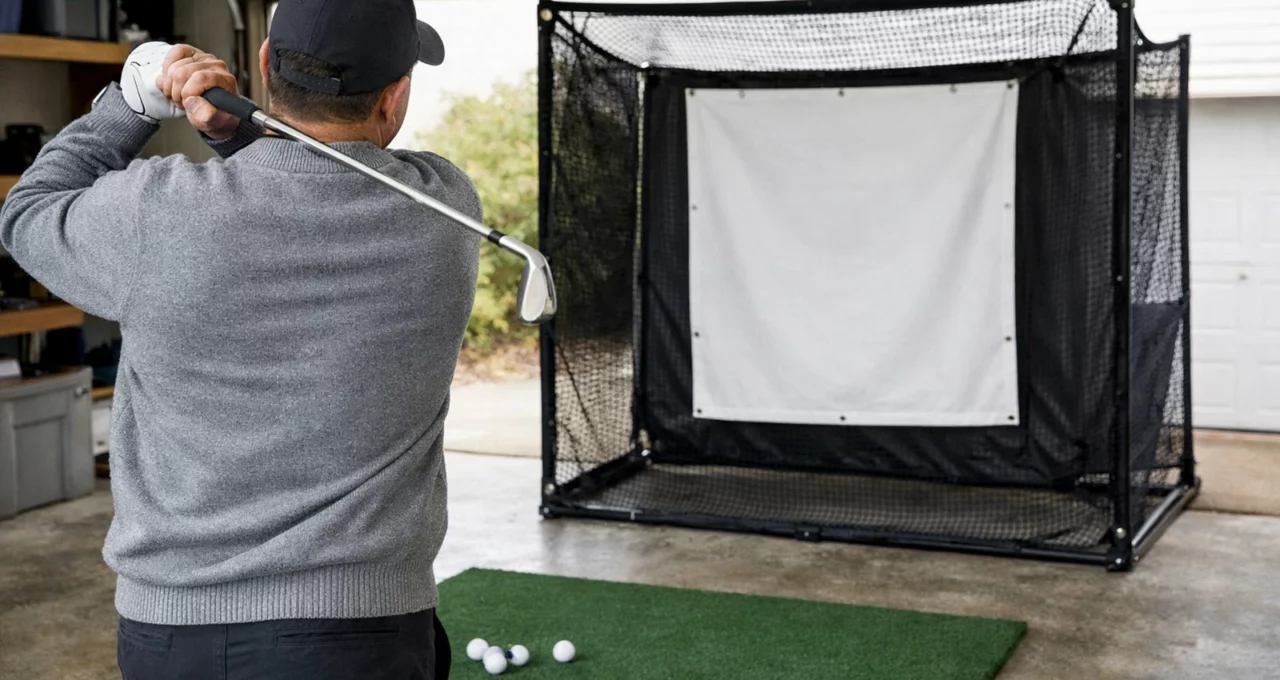
In brief
- Prices read in Canada in October 2026, before tax: GDF Deluxe Golf Practice Cage C$152.49, SKLZ Home Range C$264.99, Quick-Up Deluxe C$399.99, The Net Return Home Series C$999 (side barriers C$299).
- Buyers rarely blame the netting: the regrets are rebounds off tight nets, frames too narrow for shanks, worn targets and broken fibreglass poles, noise and ball return that fails on soft floors.
- Setup guides ask for 9 to 10 feet of clear height for a driver and 8 to 10 feet between you and the net, more than many finished Canadian basements offer.
- In an attached garage the car comes back with the snow: owners choose a net that folds in minutes or side barriers placed away from the windshield.
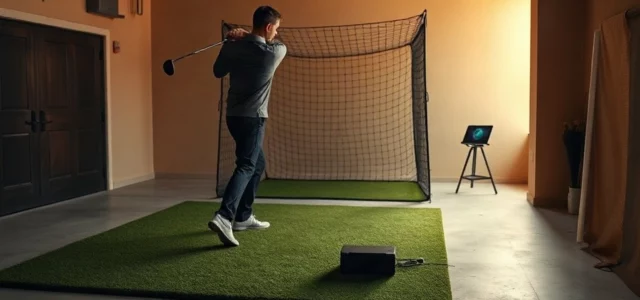
The net goes up in late October, usually in a hurry, usually after the last round of the year has been rained or frosted out. By February, a fair number of them are folded behind the furnace or listed for sale, and the reasons owners give are surprisingly consistent. Hardly anyone blames the netting. They blame the ceiling, the width of the garage, the car parked next to it, the hard floor, the ball that came back at their shins, or the fact that they never knew where the ball would have gone.
This page looks at four practice nets sold in Canada this fall, from a C$150 fibreglass cage to a C$999 aluminum frame, with their Canadian prices in October 2026 and what buyers say about them once the season indoors has started. Most regrets turn out to be about the room and the routine, so much of the page is about the Canadian house.
No net on this page was installed, hit into or measured by Panxis Golf. What follows is the makers’ published data, prices read at Canadian sellers and a summary of what buyers report in public reviews and forums.
Why a net, and why buyers change their minds
For most of the country, a net is the cheapest way to keep swinging between Thanksgiving and the spring opening. Buyers who keep using their net all winter tend to describe exactly that: short, frequent sessions, often fifteen minutes or less, that would never happen if they had to leave the house.
The buyers who give up describe a different winter. The net was too small, so every thin or heeled shot became a risk to the drywall. The ceiling was too low for the driver, so the club they most wanted to work on stayed in the bag. The ball came back too fast, or sat dead at the bottom of the net, so each session started with crawling around to collect it. None of this shows up on the box.
The Net Return Home Series
The Net Return is the name that comes up most often in home-practice threads, and its Home Series is the brand’s entry point for adults. The maker lists a frame 7 feet wide, 7 feet high and 3 feet 6 inches deep, built from 1.5-inch tubular aluminum that it says will not rust, with UV-treated commercial-grade polyester netting sleeved over the frame. Assembly uses stainless steel push buttons, without tools, and the brand says one person can set it up in under five minutes. The listed weight is 26 lb, the maximum ball speed is given as 225 mph, and the warranty is three years. A duffle bag is included.
The principle is what sets it apart from most cheap nets: the netting hangs with slack rather than stretched tight, so the ball loses its energy in the mesh and drops toward the bottom, from where it rolls back toward the hitting area.
The same frame comes in other sizes on the Canadian store: a Mini at 5 by 6 feet, aimed at juniors and shorter players, and a Pro at 8 feet wide and 7 feet 6 inches high, with larger Pro models above it. Side barriers are sold separately.
Read in October 2026 on the maker’s Canadian online store: C$999 for the Home, C$799 for the Mini, C$1,149 for the Pro and C$299 for a pair of side barriers, before tax.
SKLZ Home Range Golf Net
SKLZ takes a different route to ball return. Its Home Range uses two nets: a large back net on a frame the maker gives as 10 feet wide by 7 feet high, and a smaller front collection net of 6 feet 6 inches square that catches the ball and is meant to send it back toward you. SKLZ says that on soft surfaces, where the ball may not come back at the speed you want, you can throw the front net over the top of the frame and hit into the back net alone. A storage bag is included, and the Canadian listing gives a one-year warranty.
The appeal is the width: three feet more than the Net Return Home for roughly a quarter of the price, which matters when your slice keeps finding the garage door.
Read in October 2026 on the brand’s Canadian online store: C$264.99, before tax.
Quick-Up Deluxe Practice Net
Quick-Up builds pop-up nets: you pull a drawstring and the frame opens from a hub, which is what the brand means when it says one person can set it up in about two minutes. The Deluxe measures 5 feet deep, 10 feet wide and 7 feet high. The listing says it takes every club from driver to wedge with real balls, indoors or outdoors, and that it comes with a hitting screen, a practice target, a turf strip, tie-downs and a carrying case.
The selling point for a Canadian garage is the fold. A pop-up net that opens in two minutes can share a garage with a car, which a fixed frame usually cannot once the snow is on the driveway.
Read in October 2026 at a Canadian golf retailer: C$399.99 for the Deluxe; C$299.97 for the smaller model, shown down from C$328.99, before tax.
GDF Deluxe Golf Practice Cage
This is the budget cage. The listing gives approximate dimensions of 2.15 metres high, 4.44 metres wide and 1.7 metres deep, which is roughly 7 feet by 14 and a half feet by 5 and a half feet. The netting is knotless and UV-treated, the poles are shock-corded fibreglass, and a target and a carrying bag are included. No separate maker’s page with further specifications or a warranty could be found, so the figures here are those of the retail listing.
The cage design is the reason a cheap product like this sells: the sides and roof are part of the net, so off-line shots stay inside. The trade-off is the frame. Fibreglass poles are light and easy to pack, and they are the part of a budget cage that buyers most often report breaking.
Read in October 2026 at a Canadian golf retailer: C$152.49, before tax.
The four nets side by side
| Net | Size (W x H x D), per the maker or listing | Frame | Ball return | Warranty | Price in Canada, October 2026, before tax |
|---|---|---|---|---|---|
| The Net Return Home Series | 7 ft x 7 ft x 3 ft 6 in | Aluminum, push buttons | Slack net rolls the ball back | 3 years | C$999 (side barriers C$299) |
| SKLZ Home Range | 10 ft x 7 ft frame; 6 ft 6 in front net | Not specified in the listing | Front collection net | 1 year | C$264.99 |
| Quick-Up Deluxe | 10 ft x 7 ft x 5 ft | Pop-up hub | None stated | Not stated in the listing | C$399.99 |
| GDF Deluxe Cage | 4.44 m x 2.15 m x 1.7 m | Shock-corded fibreglass | None stated | Not stated in the listing | C$152.49 |
Two things stand out. The cheapest products on the page are also the widest, because they are built to contain the ball rather than return it. And the most expensive one is the narrowest unless you add side barriers, which raises its cost to around C$1,300 before tax. Sales tax then adds anywhere from 5% in Alberta to 15% in parts of Atlantic Canada.
What golfers are saying in Canada
The same points come back in buyer reviews on retail listings, in golf forum threads and in published reviews. Canadian comments add one theme: the net has to live with a long winter and a car.
What buyers like
- The habit. Owners who stick with a net talk less about any one feature than about the routine: a bucket of balls and fifteen minutes on weekday mornings, all winter, instead of one expensive bay session a month.
- A ball that comes back on its own. Net Return owners single out the slack net that drops the ball and rolls it toward the mat, and describe netting that holds up under heavy use. SKLZ buyers who get the return working describe the same pleasure in a cheaper package.
- Fast setup and takedown. Quick-Up and Net Return owners both lead with how quickly the net goes up. In a garage that has to hold a car from December to March, the pop-up design is often the reason it gets bought at all.
What buyers regret
- The ball that comes back at you. It is the most common safety complaint about tight nets and cheap cages. A net stretched taut, a hard target sheet or a mat set too close turns a solid strike into a rebound toward the hitter. Buyers of the SKLZ also describe the front net rolling up on impact and then dropping the ball at the base of the frame instead of returning it.
- Too narrow, and nothing on the sides. A 7-foot net with no barriers catches good shots and misses the ones you most need to practise. Shanks and thin shots end up in drywall, windows, water heaters and the side of the family car. Net Return owners often mention adding the side barriers after a first close call, and wishing they had been in the box. One published review of the Quick-Up notes that even the 10-foot Deluxe is not very wide and warns that indoor use may end with drywall repairs.
- Wear in the wrong places. Holes in the centre of the target, mesh that gets brittle when the net lives outside, and fibreglass poles that crack at the joints come back again and again with budget nets and cages. Some SKLZ buyers report a ball going through the net within days. Pop-up owners add a classic: a net that opens in two minutes and takes twenty to fold back into its bag.
- Noise and a ball return that depends on the floor. The crack of a ball hitting a target sheet carries through a house, a shared wall or a condo floor more than buyers expect. And ball return designed for one surface often fails on another: carpet, thick turf or a soft mat can leave the ball sitting at the bottom of the net, something SKLZ itself acknowledges for soft surfaces.
No one is quoted by name, nothing has been counted, and these are impressions gathered from public comments, not measurements.
Where Canadians actually put a net: low basements, cold garages and a six-month season
Outside the south coast of British Columbia, where some courses stay open most winters, the Canadian season runs roughly from May to October. A net here is not something you use on a rainy Sunday; it is how you keep swinging for five or six months. That is why the room matters more than the net.
The basement ceiling
Setup guides commonly ask for 9 to 10 feet of clear height to swing a driver (around 2.7 to 3 metres), and a great many Canadian basements do not have it once the drywall, bulkheads and ductwork are in. Before buying, take your driver down, stand where the mat will go and swing slowly to the top. Watch the follow-through too, which can reach as high as the backswing. If the clubhead meets a duct or a light, plan your winter around irons and wedges.
Basements also hide things behind the net that do not like golf balls: the furnace, the hot water tank, the electrical panel, the sump pit, a basement window at ground level. Check what sits behind and to each side of the frame before you choose a position, and keep the distance the makers and setup guides recommend between you and the net, roughly 8 to 10 feet. Closer than that, a rebound has less time to lose speed, and you have less margin when the ball comes off the toe.
The attached garage
A single or double garage usually has the depth and often more height than a basement, as long as the garage door opener rail and the open door are out of the swing path. The difficulty is everything else stored there. From December, the car comes back in out of the snow, and a fixed frame that was fine in October now sits a few feet from a windshield. Owners either pick a net that folds away in minutes or add side barriers placed so the car is never in line with a missed shot.
The cold also changes how you use the net. An unheated garage in Saskatoon, Winnipeg or Quebec City in January is a hard place to warm up, and cold balls fly shorter and feel harder off the face. Owners tend to keep the balls inside, bring a space heater for the hour they are out there, and accept that the garage is really a late-fall and early-spring range.
The condo, the townhouse and the shared wall
In a Toronto condo or a Vancouver strata, the problem is less the swing than the sound. A ball striking a tight target sheet, or a club hitting a hard mat on a concrete slab, travels through floors and shared walls. Read your condominium declaration or strata bylaws for anything about noise and use of common spaces before you set up, and talk to the neighbour on the other side of the wall. Many condo owners settle on a slack net, which is quieter, and limit themselves to wedges and short irons.
The backyard, for half the year
In spring and summer, the net goes outside, and the outdoor regrets start. A net left out through the season fades and gets brittle in the sun; one left out through the winter carries snow and ice. The Net Return sells an outdoor cover, and owners of every brand recommend taking the net down when you are not using it. Check what lies beyond the net, too: a neighbour’s fence, a window or a lane can be closer than they look when the shot comes off the hosel.
The shot you cannot see
A net stops the ball a few feet after impact. You feel the strike, you see the start line, and that is all. Buyers who stay motivated through the winter tend to add some form of feedback, whether a target with zones, a phone filming the swing, or a launch monitor. If you are thinking about the last option, our look at home simulators under C$1,000 for a Canadian winter covers room depth, prices and what owners report. Even without one, a carry chart in yards from your last outdoor rounds lets you link the feel of a strike to a real number.
And the mat
A cheap, hard mat is the regret that hides behind the net. It forgives heavy contact, which builds a habit you will discover on real turf in May, and on a concrete basement or garage floor it can be hard on the wrists and elbows. It gets its own page next.
How to choose a net for a Canadian winter
- Measure three things first. Clear height under a full driver swing, width of the space with a few feet to spare on each side, and depth from the back of the net to where you will stand, allowing 8 to 10 feet in front of the frame.
- Decide whether the net stays up. If it shares space with a car or has to disappear when guests come, a pop-up or a light cage will get used more than a sturdier frame that takes time to assemble.
- Buy width or buy barriers. A 7-foot net is fine for a skilled player. For everyone else, the side protection is not an accessory. Count it in the price from the start.
- Prefer slack to tension. A net that gives absorbs the ball, rebounds less and makes less noise. If yours is stretched tight, stand further back and avoid hard targets at the centre.
- Look at the parts that wear. Ask whether replacement netting, poles and target sheets are sold separately in Canada, and check the warranty period on the listing: on this page it ranges from one year to three, and two listings give none.
- Plan for feedback and a decent mat. Without them, a winter of reps can harden bad habits as easily as good ones.
Winter nets rarely break; they stop being used. Whether yours is still up in March depends less on the price than on whether the room lets you swing safely in a few minutes.
How this page was put together
This page presents products and summarizes public opinion; it is not a test. No net was set up, hit into or measured by Panxis Golf. Specifications come from the makers’ published material: The Net Return’s Canadian online store for the Home Series, Mini and Pro; SKLZ Canada’s product page for the Home Range Golf Net, including its one-year warranty; and the Quick-Up product descriptions as reproduced on a Canadian retail listing. For the GDF Deluxe Golf Practice Cage, no maker’s page could be found and the figures are those of the retailer’s listing. Distances to the net and ceiling heights come from setup guides and vary from one source to another.
Prices were read on October 29, 2026, in Canadian dollars and before tax. The Net Return Home Series: C$999, Mini C$799, Pro C$1,149, side barriers C$299, on The Net Return Canada (thenetreturn.ca). SKLZ Home Range Golf Net: C$264.99 on SKLZ Canada (sklz.ca). Quick-Up Deluxe Practice Net 5 x 10 x 7: C$399.99, and Quick-Up Practice Net 5 x 8 x 5: C$299.97, regular C$328.99, at Canadian Pro Shop Online. GDF Deluxe Golf Practice Cage: C$152.49 at Niagara Golf Warehouse. The pages of Golf Town and Golf Avenue refused automated reading that day, and no Canadian-dollar price could be read for the Spornia, IZZO and Rukket nets that are popular in the United States, so they are not on this page. No price was converted from another currency by Panxis Golf. Sales tax rates are those published by the Canada Revenue Agency and the provinces.
What buyers say was read in customer reviews on Canadian and U.S. retail listings, in golf simulator forum threads and in published reviews from GolfWRX and Plugged In Golf; some of it was read only through search excerpts, and some review sites also sell the nets they discuss. No Canadian forum thread with enough owner comments on these four nets was found. Nobody is quoted by name, nothing is counted, and no impression is presented as a statistic. There is no commercial link on this page, no affiliate arrangement and no commission of any kind. If content on this site is ever paid for by a brand, it will carry an advertising label at the top of the page, before the first line.