Home golf nets in Australia: buyer regrets, Colorbond fences, strata balconies and summer UV
Buyers of home golf nets rarely regret the net. They regret the rebound, the gap a shank finds, the poles, the mat and a summer in the sun. Here are five nets on sale in Australia this month, from A$185.95 to A$579.95, what owners praise and regret, and how the backyard, the fence and the UV change the choice.
In brief
- Australian prices read on 29 October 2026: GolfCraft nets A$185.95 and A$249.95, IZZO Catch All 12 x 10 ft A$189.99, Rukket Haack Pro A$359.99, Spornia SPG-7 A$579.95.
- Owners praise short daily sessions, ball returns on loosely hung nets and quick pop-up setups.
- They regret balls bouncing back, nets too narrow for a shank, snapped fibreglass poles, worn targets and nets that will not fold.
- In Australia, extreme summer UV, wind, Colorbond fences, lawns that stall ball returns and strata by-laws matter as much as the brand. Stand about 2.5 to 3 metres back.
Read enough reviews of home golf nets and a pattern shows up quickly. The net itself is rarely the villain. People regret the spot they put it in, the poles that hold it up, the mat they stood on, the fence behind it and the summer sun that sat on it for four months. A ball that comes back off the target at your shins, a shank that clips the neighbour’s Colorbond, a mesh that goes brittle on the back lawn by February: those are the stories that come back again and again, and most of them could have been avoided before the box was opened.
This is a good month to think it through. Spring evenings are long again in the south-east, the course is getting firmer, and a net bought now gets a full summer of use before the cooler months. This page looks at five nets on sale in Australia in October 2026, at prices from about A$186 to A$580, and at what buyers say they wish they had known.
Nobody at Panxis Golf put up these nets or hit a ball into them. What follows comes from the makers’ published specifications, Australian prices read this month and what owners say in public reviews and forums.
Why the net is usually not the problem
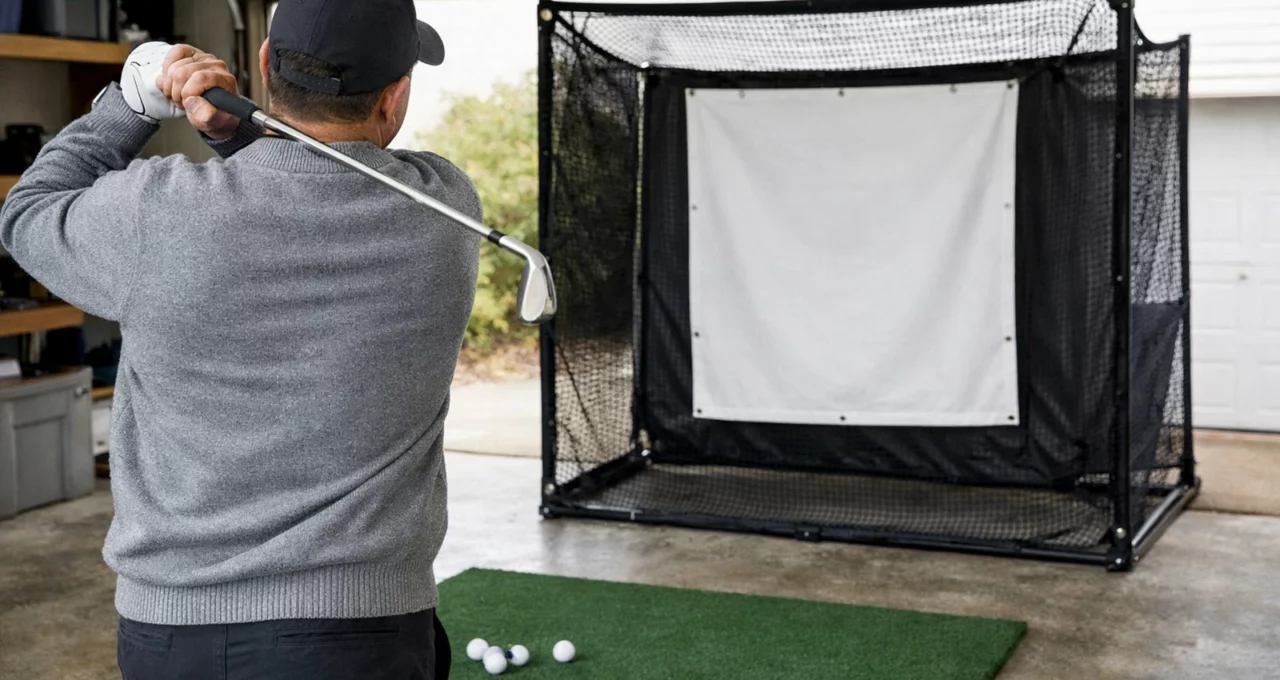
A practice net does one simple job: it stops a golf ball over a couple of metres. Even a cheap one usually manages that on a good strike. The trouble starts with everything around the good strike. A thinned iron, a heel shot, a driver that leaves the face at an odd angle: those are the balls that find the gap between the frame and the side panel, or skip off the frame and into the house. Buyers who are happy with their net tend to be the ones who planned for the bad shots, not the good ones.
The other theme is time. A net is often bought for a spell of practice, used hard for a few weeks and then left standing in the yard. That is when the sun, the wind and the weather do their work. In Australia, more than in most markets these nets were designed for, the weather is the thing that decides how long a net lasts.
Five nets on Australian shelves this month
The models below cover the range most buyers look at: two budget nets from GolfCraft, a big catch-all net from IZZO, a frame net with a ball return from Rukket and the pop-up Spornia, which sits at the top of the price range here. Specifications are the makers’ own. Where the maker gives a size in feet, it is converted to metres and rounded.
GolfCraft Extra Large 9×7′ Practice Net
The cheapest full-swing net in this group is GolfCraft’s semi-enclosed net, sold under a name that gives its size in feet: about 2.7 metres wide and 2.1 metres high.
- Frame: shock-corded fibreglass poles, the kind you clip together like a tent.
- Side protection: the listing says protective side panels stop wide shots.
- Target: an oversized removable target flag.
- Storage: a carry case is included, and the maker says it sets up and comes down quickly.
Read in October 2026 at an Australian retailer: A$185.95.
The maker does not publish a weight, a mesh rating or a ball speed limit for this model, so none is given here.
GolfCraft 9×7 Auto Return Net
The same footprint, about 2.7 by 2.1 metres, but with a ball return built in. GolfCraft describes it as semi-enclosed and designed for a backyard or a garage.
- Ball return: the net is shaped so balls roll back towards you after each shot.
- Impact net: the maker says the current version has an improved impact net for durability and energy absorption.
- Setup: designed to be assembled by one person.
Read in October 2026 at an Australian retailer: A$249.95.
The same retailer lists a plainer GolfCraft Freestanding Net, also about 2.7 by 2.1 metres, at A$159.95. Its listing gives the dimensions and little else.
IZZO Catch All Hitting Net
IZZO’s Catch All is the biggest net here for the money. It comes in two sizes: 12 by 10 feet, about 3.7 metres wide and 3 metres high, and 8 by 7 feet, about 2.4 by 2.1 metres.
- Design: the netting is cut so a ball drops into a basin at the bottom rather than rolling back out.
- Frame: fibreglass support poles, which IZZO says keep the net from folding over.
- Ball speed: the listing for the smaller size says the netting handles ball speeds up to 150 mph, about 240 km/h.
- Setup: up and down within minutes, according to the maker.
Read in October 2026 at an Australian retailer: A$189.99 for the 12 x 10 ft net, against a recommended price shown of A$329.99, and A$149.99 for the 8 x 7 ft size.
The catch-all design suits a driver swing, because the net is wide and tall. It does not send balls back to you, so you will be walking up to collect them.
Rukket Haack Pro Golf Hitting Net
Rukket’s Haack nets carry the name of Chris Haack, the University of Georgia golf coach who, according to the maker, developed and endorses them. The Pro version adds a cage shape at the front.
- Size: 9 by 7 by 3 feet, about 2.7 metres wide, 2.1 metres high and 0.9 metres deep.
- In the box: the net, a hitting target and a carry bag.
- Use: the maker says it takes wedges through to the driver and is built for thousands of balls.
Read in October 2026 at an Australian retailer: A$359.99, against a recommended price shown of A$449.99.
The same retailer lists the standard Haack net with a tri-turf hitting mat at A$343.99 (recommended A$429.99). Rukket gives that set as 3 metres wide, 2.1 metres high and 90 centimetres deep, with four-ply knotless netting, a ball return and a two-minute setup.
Spornia SPG-7 Golf Practice Net
The Spornia is the net that turns up in most overseas buying guides. It is a pop-up design: the frame springs open and folds back into a bag.
- Size: 2.1 metres wide, 2.1 metres deep and 2.1 metres high, with a flexible roof that adds about 150 millimetres.
- Ball return: the maker says the net catches the ball and lets it roll down to your feet without bouncing on the floor.
- Target sheet: included, meant to absorb impact and noise.
- Extras: a chipping basket comes with it; side net extensions are sold separately.
- Warranty: 12 months.
Read in October 2026 on the maker’s Australian online store: A$579.95. The compact SPG-5, 1.65 by 1.65 metres with a roof at 1.9 metres and a stated weight of 7 kilograms, is A$429.95. Side net extensions cost A$69 each for the SPG-7, and a water-resistant weather cover costs A$99.95.
Spornia’s own description of that cover is worth reading: it is sold to protect a net left outside from harsh sun, dust and weather, and the maker notes it is water-resistant, not waterproof. In other words, the brand itself expects a net left in the yard to suffer.
Side by side
| Net | Size (W x H) | Frame | Ball return | Australian price, Oct 2026 |
|---|---|---|---|---|
| GolfCraft Extra Large 9×7′ | about 2.7 x 2.1 m | Shock-corded fibreglass | No | A$185.95 |
| GolfCraft 9×7 Auto Return | about 2.7 x 2.1 m | Not specified | Yes | A$249.95 |
| IZZO Catch All 12 x 10 ft | about 3.7 x 3 m | Fibreglass poles | No, catch basin | A$189.99 (RRP A$329.99) |
| Rukket Haack Pro | about 2.7 x 2.1 m, 0.9 m deep | Cage frame | Not stated for the Pro | A$359.99 (RRP A$449.99) |
| Spornia SPG-7 | 2.1 x 2.1 m, 2.1 m deep | Pop-up | Yes | A$579.95 |
Two things stand out. The cheapest net with the biggest catching area is the IZZO, at its sale price this month. And the price gap between the budget GolfCraft and the Spornia, nearly A$400, buys mainly a smoother ball return, a fast setup and a tighter footprint, not a bigger net.
What golfers are saying
The opinions below come from published reviews, owner forums and retailer comments, most of them American or British. Australian owner reviews of these specific nets are scarce, but nothing in the complaints is tied to one country, and a few of them matter more here than they do overseas.
What owners like
- Fifteen minutes, most days. The praise that comes back for every net is that it turns practice into a habit. Owners describe hitting a bucket before work or after dinner, something the range never allowed, and say the regular reps matter more than the brand.
- A ball return that actually returns. Owners of the Spornia and the Rukket Haack single out the ball return as the feature they would not give up: the ball drops and rolls back, and the session keeps its rhythm. Reviewers link that to netting that hangs loose rather than stretched tight.
- Quick to put up, on the good ones. Spornia owners like that the net springs open in seconds, which means it gets used. Rukket owners say the same of the Haack once they have watched the folding video once or twice.
What owners regret
- The ball that comes back at you. This is the complaint that worries people most. It happens when the net is pulled too tight, when the target sheet is stiff, or when the player stands too close. A loose, deep net absorbs the ball; a flat, taut one can send it straight back.
- A net too small for the miss. Plenty of buyers find a net about 2 metres wide fine for a good swing and far too narrow for a shank or a top. Reviews of cheaper nets without side panels are full of balls that ended up in a wall, a window or a car. One piece of forum advice repeats often: buy the widest net you can fit, or add side nets.
- Poles and folding. On budget nets, reviewers report fibreglass rods that snap at the metal joints, poles that work loose because there is no lock, and frames that blow over in light wind. On cheap pop-up nets, the classic complaint is that the net will not fold back into the bag. Rukket owners mention a learning curve with the twist fold.
- Wear in the middle and in the sun. The target area takes every strike, and reviewers describe holes appearing there first, sometimes quickly on thin netting. Nets left outside are the ones that age fastest, which is exactly why Spornia sells a sun and weather cover.
A few smaller regrets come up too. Some buyers say the ball return only works on a hard, flat surface and stalls on grass. Others mention the noise: a ball hitting a target sheet in a garage makes a sharp crack that carries through a wall. And many say the mat they bought with the net was the weak link, too hard on the wrists and too kind to heavy shots. Mats are a big enough topic to deserve their own page, which is coming next.
The last regret is quieter: after a few weeks of hitting into a net, you have no idea where the ball would have gone. A target sheet helps a little. A launch monitor helps more, and our recent look at home simulators under A$1,000 covers what those numbers cost in Australia.
No one is quoted by name and nothing here has been counted. These are the points that recur in public reviews and forum threads, not measurements. Golf Monthly has published a review of the larger Spornia SPG-8 for readers who want an independent hands-on view.
Where Australians put a net: backyards, Colorbond, strata and the summer sun
Overseas reviews mostly assume a basement or a big garage. In Australia the net usually goes in the backyard, sometimes the garage, occasionally a balcony. Each spot brings its own regret.
- The backyard and the fence line. On a typical suburban block the back fence, often Colorbond steel, is only a few metres from the patio. A ball that slips past a net and hits a steel fence is loud and can dent it, and the neighbour’s side is a long way to walk to ask for it back. Face the net away from windows, the neighbour’s house and the Hills hoist, and leave the fence well behind it rather than right up against it.
- Grass, pavers and the ball return. Ball returns are designed for a flat floor. On a lawn, especially soft spring couch or kikuyu, balls stall in front of the net. If the return matters to you, set the net up on pavers, a concrete pad or a flat slab, with the mat in front.
- The summer sun. Across most of Australia the UV index reaches the extreme range on summer days, and a polyester net and target sheet left in that sun all season is the one that goes faded, brittle and holed. Buyers who are happy in their second year tend to take the net down or cover it between sessions, and to store it out of the sun over winter. That makes a quick-to-fold net, or a cover, worth more here than in a British or Canadian garden.
- Wind and storms. Afternoon sea breezes in coastal cities, such as Perth’s Fremantle Doctor, and spring and summer storms in Sydney and Brisbane will push over a light net or snap a pole. Peg it down properly, use sandbags on a hard surface, and take it in before a storm warning.
- The garage. A double garage gives you shelter, but height is the limit. Many project-home garages sit around 2.4 metres, so a full driver swing may clip the ceiling. Swing slowly with your arms up before you buy. A closed garage also gets very hot on a summer afternoon, so early mornings and evenings suit it better.
- Strata and apartments. Many strata schemes have by-laws on noise and on what can be kept on a balcony or on common property. A compact net such as the SPG-5 is marketed for patios and apartments, but check your by-laws, and think about the people below before you hit a ball off a hard balcony floor. Chipping into a small net is a lot quieter than full swings.
- Time of day. Daylight saving began on 4 October 2026 in New South Wales, Victoria, the ACT, South Australia and Tasmania. That gives the south-east light after work until autumn, but a ball cracking into a target sheet at 8 pm on a quiet street carries. Keep the full swings to reasonable hours.
How to set it up so it does not end in regret
- Stand back. Hit from about 2.5 to 3 metres in front of the net. Too close and the ball has less room to slow down, and a bad strike can still catch the frame.
- Check what is behind and beside it. Leave space behind the net so a full shot does not push it into a wall, a fence or a window. Indoors, never hit full shots without side protection.
- Do not over-tension. Leave the netting a little slack, the way the makers intend. A tight net is what sends the ball back.
- Look at the target first. Replace or patch a worn target area before it becomes a hole. Spornia sells replacement target sheets and poles in Australia, which is worth checking for any brand before you buy.
Choosing the right net
- Measure the space, then the miss. Width is what protects you from a shank. If you can only fit a net about 2 metres wide, plan for side nets.
- Decide where it lives. If it will stay out in the yard, budget for a cover or for taking it down. If it lives in a garage, check the ceiling first.
- Decide how much you care about the return. A catch-all net like the IZZO is cheaper per square metre but sends you walking. A ball return keeps the rhythm going but needs a flat surface.
- Look at spare parts. Poles and target sheets are the parts that wear. A net with parts sold in Australia lasts longer than one you have to replace whole.
- Know your rights. Beyond the maker’s warranty, the Australian Consumer Law gives you remedies if a product is not of acceptable quality. A pole that snaps in the first month is worth raising with the seller.
A net is one of the cheapest ways to keep a swing moving between rounds. The buyers who stay happy with theirs are the ones who thought about the fence, the sun and the bad shot before they thought about the brand.
How this page was put together
This page presents products and reports public opinion. It is not a test: nobody at Panxis Golf set up, used or hit balls into these nets. Specifications come from the makers’ published material, as reproduced on Australian listings: GolfCraft for its Extra Large 9×7′, 9×7 Auto Return and Freestanding nets, IZZO for the Catch All, Rukket Sports for the Haack Pro and the Haack net with mat, and Spornia for the SPG-7, SPG-5 and accessories. Sizes published in feet have been converted to metres and rounded; the 150 mph ball speed figure for the IZZO has been converted to kilometres per hour.
Prices were read on 29 October 2026, in Australian dollars including GST. Drummond Golf listed the GolfCraft Extra Large 9×7′ Practice Net at A$185.95, the GolfCraft 9×7 Auto Return Net at A$249.95 and the GolfCraft Freestanding Net at A$159.95. Golfbox listed the IZZO Catch All Hitting Net at A$189.99 for the 12 x 10 ft size (RRP shown A$329.99) and A$149.99 for the 8 x 7 ft, the Rukket Haack Pro at A$359.99 (RRP shown A$449.99) and the Rukket Haack net with hitting mat at A$343.99 (RRP shown A$429.99). Spornia’s Australian online store, spornia.com.au, listed the SPG-7 at A$579.95, the SPG-5 at A$429.95, the SPG-7 side net extension at A$69 and the weather cover at A$99.95. Drummond Golf did not list the Spornia, IZZO or Rukket nets on that date. Prices and stock change often, especially before Christmas.
What golfers say was read in published reviews and owner threads, including Golf Monthly, the MyGolfSpy and Practical Golf forums, a golf simulator forum and retailer customer reviews of these and similar nets. Some were read only through search excerpts, and several review sites also sell nets. We found few detailed Australian owner reviews to draw on. No one is quoted by name, nothing is counted, and no impression is presented as a statistic. There are no commercial links on this page, no affiliate arrangement and no commission of any kind. If content on this site is ever paid for by a brand, it will carry an advertising notice at the top of the page, before the first line.