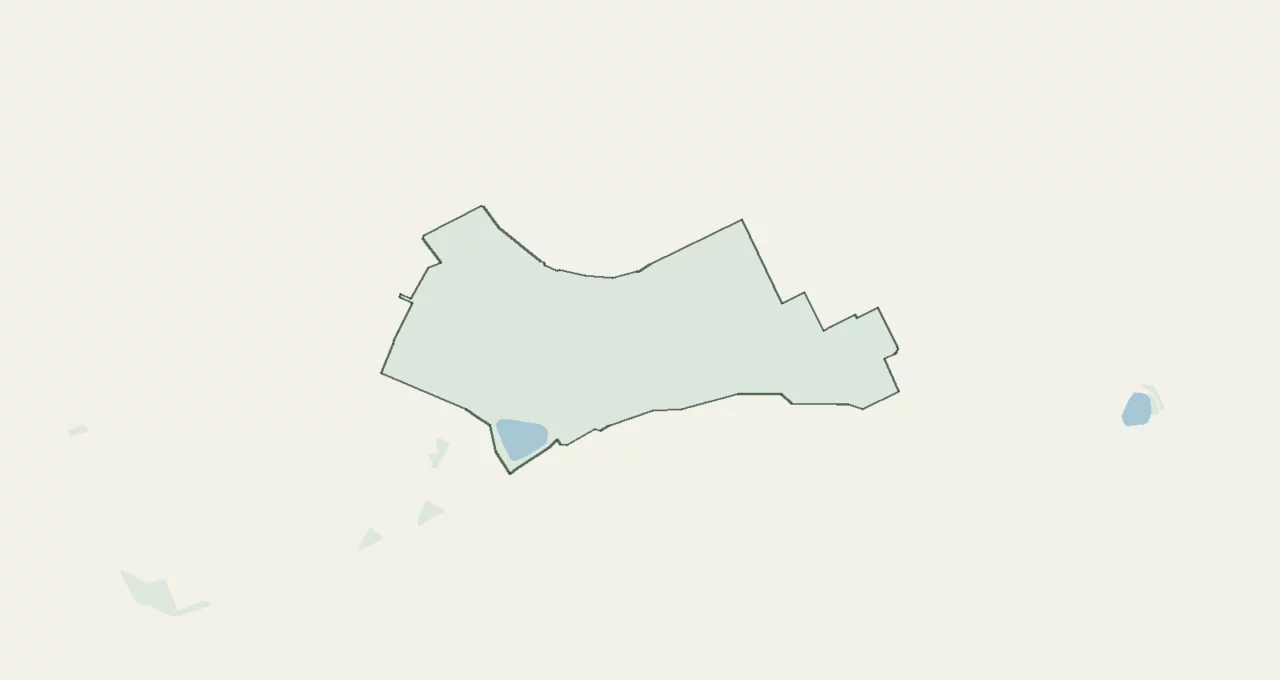
Layout of Canterbury Public Golf Course from OpenStreetMap survey data (ODbL licence).
Canterbury Public Golf Course
Holes
9
By
33 (one directory gives 34)
Length
About 2,100 metres for nine holes on the Hole19 and 18Birdies cards; 2,320 metres in one directory
Green fee
—
Best season
All year
Canterbury Public Golf Course is a nine-hole public course in Beverly Hills, in the City of Canterbury Bankstown, in south-western Sydney. It belongs to the council, which lists it among its own facilities, and it is run on the council’s behalf by a private golf management group. The council gives its address as 186/190 Moorefields Road, Beverly Hills NSW 2209; OpenStreetMap and several golf directories give 196 Moorefields Road. In a straight line the course lies about 13 kilometres south-west of Sydney Town Hall and about 8 kilometres west of Sydney Airport, and the club’s own site says it is three minutes from Roselands Shopping Centre, which is a little over a kilometre away.
It is a short, simple and unusually accessible place to play. There is no membership to join and nothing to book: the club’s site says the course is open every day except Christmas Day, from 6 am to dusk, and that golfers simply arrive, pay and play. Groups of 16 or more are asked to contact the shop first. The council describes the course as ideal for weekend golfers and beginners, and adds that most golfers enjoy it so much they play 18 holes at a time, which here means going round twice.
The name causes some confusion. The council calls it Canterbury Golf Course, the club’s website calls it Canterbury Public Golf Course, and OpenStreetMap carries both. It has nothing to do with Canterbury Golf Club in Ohio, a former US Open venue, or with Canterbury Golf Club in Kent, England, and searches for the name return all three. It is also distinct from the other public and club courses of the Canterbury and St George districts, such as Bexley, Bardwell Valley and Hurstville, which are all within a few kilometres.
The course in figures
The course has nine holes. On that the club, the council, OpenStreetMap and every directory we consulted agree. Some data sets list it as an eighteen-hole course, apparently because a round of eighteen means playing the loop twice, but there is only one set of nine holes on the ground.
The par is less certain. OpenStreetMap carries all nine holes with their pars, and they add up to 33: four par 3s (the 1st, 2nd, 3rd and 7th), four par 4s (the 4th, 6th, 8th and 9th) and one par 5 (the 5th). The hole-by-hole cards in two golf apps, Hole19 and 18Birdies, give the same par of 33 and the same split. The club’s own hole descriptions confirm that the 1st, 2nd, 3rd and 7th are par 3s, the 5th a par 5 and the 8th and 9th par 4s. Another golf directory, as it appears in search results, gives a par of 34 made up of three par 3s, five par 4s and one par 5, and a length of 2,320 metres. We were not able to open that page, and it disagrees with the club’s own description of four par 3s, so we treat par 33 as the more reliable figure.
Length depends on whom you ask. The club publishes the lengths of its four par 3s only: 168 metres for the 1st, 113 for the 2nd, 110 for the 3rd and 109 for the 7th. It gives no length for the other five holes and no total.
The Hole19 card gives a total of 2,106 for a single set of white tees, labelled in yards. We think those figures are in fact metres: the first three holes on that card (168, 113 and 110) are exactly the lengths the club gives in metres. Read that way, the card makes the 4th 245 metres, the 5th 443, the 6th 364, the 8th 285 and the 9th 283. It disagrees with the club only on the 7th, which it puts at 95 metres against the club’s 109.
The 18Birdies card gives 2,292 yards, which is about 2,096 metres, with hole lengths that convert to roughly 165 metres for the 1st, 102 for the 2nd, 110 for the 3rd, 259 for the 4th, 441 for the 5th, 355 for the 6th, 109 for the 7th, 297 for the 8th and 259 for the 9th. The two apps therefore agree on a total of about 2,100 metres, while differing by up to 25 metres on individual par 4s. The hole lines drawn on OpenStreetMap, which we measured, add up to about 2,030 metres, slightly shorter, as straight lines from tee to green usually are. The directory figure of 2,320 metres is the outlier.
On any of these figures, the 5th is the longest hole by far, at around 440 metres, and the 6th, at 355 to 365 metres, is the longest par 4. The 4th, 8th and 9th are short par 4s of roughly 245 to 300 metres. The par 3s run from a little over 100 metres to about 168.
The stroke index is where the sources disagree most. The club’s site says the 6th is regarded as the number one challenge on the course, and the Hole19 card agrees, ranking the 6th as index 1, the 9th as index 2 and the 8th as index 3. The 18Birdies card and OpenStreetMap instead make the 1st index 1, the 9th index 2 and the 4th index 3, and put the 6th down at index 7. Golfers who need the stroke index for a competition or a handicap round should check the card at the shop on the day.
The 18Birdies app gives a nine-hole course rating of 32.2 with a slope of 104 for men, and 33.4 with a slope of 106 for women. Golf Australia, which is the authority for course ratings in this country, does carry a listing for the course, but its site blocked our requests and we could not read it. We therefore report those ratings as one app’s figures only.
A council course in the suburbs
Canterbury is a suburban course in the full sense. It sits in a residential district between Beverly Hills, Kingsgrove and Roselands, with Moorefields Road running along one side, and its outline on OpenStreetMap covers about 17 hectares. That is a compact site even for nine holes, and it accounts for the tight, tree-lined character the club describes on several holes.
The ground is not flat. The club’s own hole notes describe an elevated green at the 1st, an uphill 3rd where a short shot can roll back down the slope, an elevated tee at the 4th, a par 5 played over a rise, a 6th played up a rise to an elevated green, and a 7th whose green is set into the hill. Elevation data for the site put it at roughly 25 to 40 metres above sea level, so the total relief is modest, but it is enough to matter on a short course where several greens sit above the player. The data also bear out the club’s description of the 3rd and the 6th as uphill holes.
OpenStreetMap shows a single pond within the course. The club’s hole notes mention fairway bunkers on the 5th and 8th, bunkers to the left of the 9th, and grass mounds on the 4th, 5th and 8th, as well as out of bounds to the right of the 4th. Bunkers have not been mapped on OpenStreetMap, so we cannot say how many there are.
Who runs it
Canterbury is a council course. The City of Canterbury Bankstown lists it among its facilities and links to the course website; the course website in turn links back to the council. OpenStreetMap gives the council as the operator.
Day-to-day management is in private hands. According to the club’s own site, the general manager is Geoff Scott, a life member of the PGA of Australia, whose company maintains the course on behalf of the council; the site says he has managed six public golf courses and three driving ranges over his career. The same page names a shop manager, a PGA professional who gives lessons, a member of the sales staff and a course superintendent who joined in 2024 after working at The Australian Golf Club and Kareela Golf Club. We name only the general manager here, as the person responsible for the course; the club’s site has the rest of the team.
We have found no public record of when the course was built, who designed it or how its layout has changed. Golf directories list the designer as unknown. Beyond the fact that it is a council-owned course on Moorefields Road, its history is not documented in any source we could find, and we do not guess at it.
What it asks of you
Canterbury is a short course, and length is not what makes it difficult. At about 2,100 metres for nine holes, it is roughly half the length of a full eighteen-hole course for a single loop. What it asks for is accuracy, a sound short game and some care on and around greens that, by the club’s own account, are often small, elevated or both.
The par 3s
The first three holes are all par 3s, which is an unusual way to begin a round. The club describes the 1st, at 168 metres, as a challenging opener played to an elevated green; for many club golfers that means a hybrid or long iron, struck before they have had much chance to warm up. The 2nd, at 113 metres, has what the club calls a small and narrow green, and the 3rd, at 110, is uphill: the club warns that a short shot can roll back down the slope and that a shot over the back leaves a difficult chip or putt on a very slick surface. The 7th, at 109 metres on the club’s figures, looks straightforward but has a green set into the hill. On all four, the distance is modest and the challenge is in judging the elevation and hitting the right part of the green.
The par 4s and the par 5
The 4th is played from an elevated tee, and the club advises a drive placed to avoid the mounding on the left and the out of bounds on the right, so as to open the angle into a green that sits to the left of the fairway. The 5th, the only par 5, runs straight over a rise. The club says the drive should finish right of centre to avoid a grass mound, the second shot must avoid a fairway bunker, and the approach is a chip to a small green.
The 6th is the hole the club itself rates as the hardest: a tee shot up a rise with a slight dogleg to the right, then a long second to a narrow, elevated green, from which a missed approach on either side leaves a difficult chip. The 8th is a dogleg left with trees, a grass mound and a fairway bunker to negotiate from the tee, after which the club promises an easier pitch to the green. The 9th, a tight dogleg right with dense trees on the right and bunkers on the left, is the closing hole and, on every card we found, one of the two hardest on the course.
What that means for your game
Treat the round as an exercise in placement. On the doglegs at the 8th and 9th, and on the 4th with out of bounds to the right, a hybrid or long iron to the right spot will often serve better than a driver. Expect to play several approach shots uphill, and allow an extra club where the green sits above you; at the 3rd, the club’s own advice is that short is worse than long. Spend time on chipping before you come: small and elevated greens mean many missed greens and many recovery shots from awkward lies. And because the course opens with three par 3s, it is worth hitting a few balls or at least some practice swings before you tee off.
For beginners, the short length makes Canterbury a realistic place to play complete holes rather than hacking along a long fairway, and the council pitches it that way. For better players it is short, but the elevated greens and the doglegs keep it from being a formality.
Practice and facilities
The pro shop is the course’s other attraction. The council says it is on Moorefields Road, about 50 metres from the course, and that it hires out clubs and buggies and sells snacks and drinks as well as golf equipment. The club’s site describes it as one of Sydney’s leading discount golf shops, carrying major brands of clubs, bags, buggies, shoes and men’s and women’s clothing, and offering club repairs and custom fitting. Motorised carts and pull buggies are for hire. The council also mentions barbecue facilities.
Lessons are available with a PGA of Australia professional, individually or in groups, and the club’s site gives the telephone numbers for booking them. Some golf directories and one app list a driving range and a chipping green, but neither the club’s site nor the council’s page mentions a range, and we have not been able to confirm one. One app review mentions a well-maintained putting green. We have found no mention of a restaurant or function rooms, and one directory, as indexed in search results, says there are none.
Dogs are not permitted on the course, according to the club’s site.
What golfers say
Public comment on Canterbury is mostly in the form of star ratings on golf apps, with a modest number of short written reviews. The points below summarise what recurs across them. These are other people’s opinions, not ours: we have not played the course, and we name and quote no one.
What comes up in its favour
- Value for money is the aspect that comes out best in the app ratings, ahead of every other category.
- Several reviewers describe the course as well maintained, and the council itself says it is kept in excellent condition.
- The variety of holes is praised, with par 3s, doglegs and a long par 5 packed into a short loop, and reviewers find that it suits golfers of all handicaps.
- The greens are described as challenging, which some players see as the course’s main test.
- Pace of play is rated fast, and reviewers describe it as a fun, short layout for a quick round.
- The pro shop is singled out for its range and its prices, a point the club itself also makes on its home page.
What comes up against
- Course condition is the weakest category in the app ratings, below value and overall impression, even though written reviews are mostly positive about it.
- Reviewers and apps rate the course easy, and better players find it short.
- One review notes that there are not many hazards, which suits beginners more than experienced golfers.
- Nine holes means playing the same holes twice for a full round.
- Facilities beyond the shop are basic: no confirmed range and no restaurant or function room.
Two practical points are not complaints but are worth knowing. Because the course takes no bookings, there is no way to secure a tee time in advance, and what you find at the first tee depends on who arrived before you. And because the stroke index differs between cards, scores entered in different apps may not match.
Who it suits
Canterbury suits beginners and improving golfers who want to play real holes without the length or formality of a full eighteen-hole club, golfers in southern and western Sydney who want a quick nine before or after work, and anyone who wants to try out a new club fitted at the shop. It suits families and juniors, and the council’s mention of barbecues suggests it also welcomes social groups. It is not a course for low handicappers looking for a full-length test, and those who want a range, a restaurant or a members’ competition structure should look at the larger clubs nearby.
Getting there and when to go
By public transport, the nearest railway stations are Beverly Hills, about 1.2 kilometres away in a straight line, Kingsgrove, at about 1.4 kilometres, and Narwee, at about 1.7 kilometres. Bus stops on Moorefields Road lie within about 300 metres of the course. Check current routes and timetables with Transport for NSW before you set out; we have not listed specific services.
By car, the course is on Moorefields Road between Beverly Hills and Roselands, which the club says is three minutes away. Note the difference in street numbers: the council gives 186/190 Moorefields Road and OpenStreetMap and several directories give 196. The council places the pro shop on Moorefields Road, about 50 metres from the course. One directory lists the postcode as 2193, but Beverly Hills is 2209, and that is the postcode the council uses.
There are no tee times. The club’s site says no booking is required, and golfers are welcome seven days a week from 6 am until dusk; the course is closed on Christmas Day only. Groups of 16 or more should contact the shop in advance, on (02) 9759 5444, the number given by the club, the council and OpenStreetMap. The club’s website also has a contact form. Current playing conditions and any group arrangements are best confirmed by phone.
Golf is played all year in Sydney. Spring and autumn usually bring the most comfortable conditions; summer afternoons can be hot and humid, and a short course like this one is a natural choice for an early round before the heat. In winter, daylight ends earlier, and with play running until dusk, the last practical start time is correspondingly earlier.
How this page was made
The factual frame comes from public sources, consulted on 30 October 2026. The club’s website provided the opening days and hours, the no-booking policy, the lengths of the four par 3s, the descriptions of all nine holes, the management arrangement with the council, the staff, the shop and the hire equipment. The City of Canterbury Bankstown’s page for the course provided its ownership, the address of 186/190 Moorefields Road, the location of the shop, the barbecues and the description of the course as suited to beginners and weekend golfers. OpenStreetMap provided the outline and area of the course, the pars and stroke indexes of the nine holes, the hole lines we measured, the pond, the operator, the address of 196 Moorefields Road and the coordinates from which we calculated straight-line distances to stations, bus stops, the city and the airport. Elevations come from the SRTM terrain model. The hole-by-hole cards come from the Hole19 and 18Birdies apps, and the course rating and slope from 18Birdies. Golf Australia’s listing could not be read, as its page blocked our requests.
Several sources disagree, and we have said so in the text. The par is 33 according to the club’s hole descriptions, OpenStreetMap and two apps, and 34 according to one directory as indexed in search results. Total length ranges from about 2,030 metres on the mapped hole lines to about 2,100 metres on the two app cards and 2,320 metres in that directory; the Hole19 card is labelled in yards, but its first three holes match the club’s metric figures exactly, so we read it as metres. The 7th measures 109 metres according to the club and 95 according to Hole19. The stroke index ranks the 6th as the hardest hole according to the club and Hole19, and the 1st according to 18Birdies and OpenStreetMap. The street number is 186/190 for the council and 196 for OpenStreetMap and the directories. Some listings describe the course as having eighteen holes; it has nine, played twice for a full round.
We left out what we could not confirm: the year the course opened, its designer and its history, a Golf Australia rating, the existence of a driving range, and any public transport route numbers. We give no prices; the club’s website publishes its current fees.
The opinion section summarises public reviews and ratings on golf apps and directories, read in October 2026; we report recurring themes rather than individual voices, we reproduce no quotations and we give no ratings or review counts. Most reviews are short, and the picture they give is necessarily partial.
We have not played this course, and this page is no substitute for a round. The course has not paid for this page, has not seen it before publication and has no say over its content. If you know the course and something here is wrong or out of date, write to us and we will correct it.
Other courses nearby
Closest to this one in our Australian directory:
- Barnwell Park Golf Club — 9 km
- Bankstown Golf Club — 9 km
- The Lakes Golf Club — 12 km
- The Australian Golf Club — 12 km