Slope lasers from A$595 to A$949: set it to metres, switch slope off and know what you can buy here
Four slope lasers on sale in Australia this spring all promise accuracy to within about a metre, but that figure only covers the straight-line distance to whatever the beam locked on. On 21 October 2026 the Tour V7 Shift and the Garmin Approach Z30 were both A$594.99, the Pro X3+ A$849.99, and the Nikon, dearer here than in the United States, A$949 and on back order.
In brief
- Prices read on 21 October 2026, including GST: Bushnell Tour V7 Shift and Garmin Approach Z30 A$594.99 each, Bushnell Pro X3+ A$849.99, Nikon Coolshot Pro III Stabilized A$949 on back order.
- The accuracy on the box, about ±0.9 m (±0.7 m for the Nikon), covers line distance only; locking the wrong target, a shaky hand and the slope formula add far more error.
- Owners praise the lock confirmation, the Nikon's steady image and a visible slope switch; complaints cover the Pro X3+'s weight and price, unverifiable slope figures, Garmin durability and too many modes.
- Rule 4.3a(1) allows distance-only devices in comps unless a club adopts Local Rule G-5: switch slope off, and check the laser reads metres before you leave the shop.
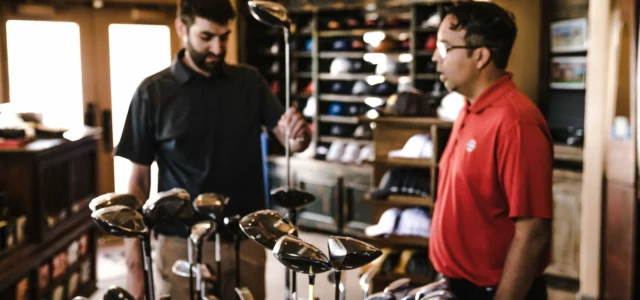
Daylight saving is back across the south-east, twilight comps are filling up, and the pro shop counter has a row of laser rangefinders under glass with price tags that start to hurt around A$600. Nearly every box promises the same thing: accurate to within about a metre, sometimes better. That promise is genuine, but it covers less than most of us assume. It tells you how well the laser times a beam to a target it has already found. It says nothing about whether it found the flag or the gum trees 20 metres behind it, and nothing at all about the slope-adjusted figure many owners end up playing to. Below you will find four slope lasers you can buy here this spring, the Bushnell Pro X3+, the Bushnell Tour V7 Shift, the Nikon Coolshot Pro III Stabilized and the Garmin Approach Z30, with what each maker claims, what independent reviewers report, Australian prices read on 21 October 2026 and what owners like and dislike. It is a reading of published specs and public opinion, not a test: nobody at Panxis Golf has pointed any of these units at a flag.
The short version, in Australian dollars and metres
Three of the four were listed by an Australian golf retailer on 21 October 2026, prices including GST, each marked about 15 percent below its recommended retail price. The Nikon was not on that retailer’s shelves; the only Australian price we could read for it came from a national electronics chain, at full price and on back order.
| Model | Claimed accuracy | Zoom | Weight | Price, 21 Oct 2026 | RRP |
|---|---|---|---|---|---|
| Bushnell Tour V7 Shift | about ±0.9 m | 6x | about 255 g | A$594.99 | A$699.99 |
| Garmin Approach Z30 | about ±0.9 m | 6x | about 210 g | A$594.99 | A$699.99 |
| Bushnell Pro X3+ | about ±0.9 m | 7x | about 340 g | A$849.99 | A$999.99 |
| Nikon Coolshot Pro III Stabilized | about ±0.7 m under about 640 m | 6x | about 205 g without battery | A$949 | not shown |
The order is worth a second look. In the United States the Nikon sits below the Pro X3+ on price. Here it is the dearest of the four, by about A$100, and the Bushnell and Garmin mid-range units are level at A$594.99. Makers publish their figures in American units; we have converted them to metres and rounded, so treat the accuracy column as approximate.
Three different things called “accurate”
A golf laser sends short pulses of infrared light and measures how long they take to come back. The tolerance on the box describes the error in that timing when the target returns a clean signal. When a golfer calls a rangefinder accurate, though, they are usually bundling three separate ideas together.
Did it measure the right thing? A flagstick is skinny, a couple of centimetres across, and the mound, bunker face or stand of trees behind the green sends back a much stronger echo. All four brands use first-target logic (Bushnell calls it PinSeeker, Nikon and Garmin use their own names) that keeps the nearest object and buzzes to confirm the lock. When it grabs the wrong object, you can be 20 or 30 metres out with a device that is, on paper, still accurate to under a metre. On an open green with little behind it, this matters less; on a tree-lined suburban course, it matters a lot.
Could you hold it still? At six or seven times magnification, a small wobble pushes the aiming circle off a flag at 140 metres. Hot hands, a gusty afternoon or a bit of age all make it worse. That is the problem Nikon set out to fix with its stabilised optics, and why reviewers spend so much time on how steady each image looks.
Is the slope figure right? This is the one people get wrong. The adjusted “plays as” number is not measured. The device measures the straight-line distance and the angle, then runs its own formula to suggest how far the shot effectively plays. Bushnell’s top model also folds in temperature and air pressure. We found no manufacturer that publishes a tolerance for that adjusted figure, so two premium lasers can disagree by a few metres on the same uphill approach and both be working exactly as designed.
The box only vouches for the first of those three.
What independent reviewers have actually measured
There is less hard accuracy testing out there than the marketing suggests. The biggest annual comparison, run by the American site MyGolfSpy, describes its accuracy score as a measure of consistency: the same target ranged several times, at several distances and against different backgrounds, to see whether the reading moves. Its 2024 round covered 28 lasers at distances of roughly 90, 140, 185 and 230 metres. It publishes composite scores rather than raw errors, so it tells you which units repeat themselves reliably, not how far any of them misses a surveyed distance.
Single-reviewer tests mostly compare one laser with another. Plugged In Golf found the Garmin Approach Z30 within about a metre of a Nikon unit almost every time, and the Coolshot Pro III Stabilized never more than about a metre away from other well-regarded lasers. Useful, but that is agreement between devices, not proof of the true distance.
Put it together and the picture is fairly clear. At the distances club golfers hit approach shots, the line-distance error of any current premium laser is smaller than the error you add yourself by locking on the wrong object, ranging with a shaky hand or playing a slope figure on faith. The real differences between these four live in those areas.
The four lasers, one by one
Bushnell Pro X3+
Bushnell’s flagship ranges from about 4.5 metres out to about 1,190 metres, with 7x zoom and a claimed accuracy of about ±0.9 metres. It is the heaviest here at about 340 grams, runs on a CR2 battery, carries an IPX7 waterproof rating and has a magnetic mount for the buggy bar. The display can switch between red and black, which helps when the low morning sun is behind the green. Its slope mode can be extended with what Bushnell calls Elements, which adds temperature and air pressure to the calculation, and you can enter your home course’s altitude. A locking Slope-Switch on the side physically turns slope off and shows it is off, and a flag lock is confirmed with a vibration and a flashing red ring.
For an Australian buyer the Elements feature is a mixed bag. Most of us play close to sea level, so the altitude setting does little unless you are in Canberra, at around 580 metres, or up on the New England tablelands near 1,000 metres. Temperature is a different story: the gap between a 10°C July medal and a 36°C January stableford is real, and Elements is the only system here that tries to account for it.
Bushnell Tour V7 Shift
The Tour V7 Shift arrived in February 2026 to replace the V6 Shift. It ranges out to about 1,190 metres with 6x zoom and the same claimed accuracy, weighs about 255 grams and is rated IPX6, one step below the Pro X3+. The headline change is what Bushnell calls Slope First: the adjusted figure is the big number on the two-colour OLED display, with the straight-line distance underneath. It also links to the Bushnell Golf app to suggest a club. Slope switches off for competition. At A$594.99 it was A$255 cheaper than the Pro X3+ on the day.
Nikon Coolshot Pro III Stabilized
Nikon launched it in January 2025 to replace the Pro II. It ranges from about 7 to about 1,100 metres with 6x zoom and weighs about 205 grams without its CR2 battery, which Nikon rates at roughly 2,700 measurements. The specification sheet reproduced by retailers gives the tightest tolerance here: about ±0.7 metres below roughly 640 metres, wider beyond. Nikon quotes a measuring time of 0.1 seconds, against 0.3 for the old model, and the main selling point is optical stabilisation that damps hand shake. In its default golf mode it gives the adjusted distance; a green light on the front shows when slope is off. It is waterproof to one metre for ten minutes and Nikon offers a five-year warranty. There is no magnet, deliberately, because it would upset the stabiliser.
The local catch is supply. On the day, the golf retailer we used for the other three did not list it, other golf-shop listings we found showed it on back order, and the one Australian price we could read came from an electronics chain, at A$949, also on back order. If you want this one for the Christmas comps, ask about delivery dates before you pay.
Garmin Approach Z30
Garmin’s laser came out in 2024. It locks a flag out to about 365 metres, with 6x zoom and the usual claimed accuracy, weighs about 210 grams, is rated IPX7, has a magnet and uses a CR2 battery that Garmin says lasts up to a year. Its slope function is called PlaysLike, and a blue light in a small window on the side shows when it is off. What sets it apart is Range Relay: paired with a compatible Garmin watch or the Garmin Golf app, it sends the ranged distance to your wrist, where the watch adds front, centre and back of the green from GPS. Some of those extras need a paid Garmin Golf membership, so check the current Australian subscription price in the app before counting on them. At A$594.99 it matched the Tour V7 Shift exactly.
What golfers are saying about these four
We found no Australian forum discussion detailed enough to use for these particular models, so the impressions below come mainly from British and American published reviews, the comments under them and retailer customer reviews. They are recurring themes, not counts, and nobody is quoted.
What owners like
- Knowing what you hit. The buzz on a flag lock, plus the flashing ring on the Bushnells, is the feature owners bring up most. It is what turns a precise laser into one you trust, because it tells you which object was measured.
- A rock-steady picture on the Nikon. Reviewers describe an image that stays put in wind or with tired arms, and a reading that comes back almost instantly. Golfers who struggled to hold an older laser on a distant pin say this alone justifies it.
- A slope switch you can see from the next tee box. Pro X3+ owners in particular like that a playing partner can tell at a glance that slope is off, which heads off an awkward conversation in a comp.
What owners grumble about
- Weight and price on the Pro X3+. It is the heaviest of the four, and reviewers of the Pro X3 line keep naming the price as the main hurdle.
- Slope figures nobody can check. Golfers regularly ask why two expensive lasers give different adjusted numbers for the same uphill shot. Each brand uses its own formula, and none publishes how far that number can drift.
- Durability questions on the Garmin. Under Plugged In Golf’s review, several owners report a unit that died within a year, and one says the warranty claim was refused. They are individual stories, but they turn up in more than one place. Reviewers also disagree on its magnet: one found it weak, another strong.
- Too many modes. Golfalot calls the club suggestions and new display options on the Tour V7 Shift more than most golfers need, several of them unusable in competition. Nikon owners find switching between its four modes fiddlier than it should be, and miss having a magnet for the buggy.
The Rules: what you can use in a Saturday comp
Golf Australia plays to the Rules of Golf, and Rule 4.3a(1) lets you use a device to measure straight-line distance during a round unless the committee has banned them with Model Local Rule G-5. What you cannot use is anything that measures elevation change. Leave slope on in a counting round and the general penalty applies: loss of hole in match play, two strokes in stroke play, and disqualification if you do it again.
So a slope laser is fine in your Saturday stableford or medal, as long as the slope function is off. That is why every maker puts a light, a switch or a window on the outside, and why some playing partners will glance at it on the first tee. On-screen club suggestions are a separate issue; reviewers of the Tour V7 Shift suggest checking each feature before using it in a round that goes to your GA Handicap. Pennant and open events run under their own conditions of competition, set by state associations and host clubs, so read them before you pack the laser.
Where Australian golfers buy a laser, and how to set it to metres
The first thing to check on any laser bought here is the unit setting. Course planners, tee markers and scorecards in Australia all work in metres, and plenty of lasers arrive from the factory set to American units. The switch is usually in a menu or behind a held-down button; ask the shop to show you it reads “M” before you walk out, and check the app setting too if the laser pairs with one, or the watch and the laser may disagree.
Beyond that, each type of outlet lets you check something different.
- Your club pro shop. The big advantage is a real flag at a real distance, with real trees behind it. Ask to range the practice green pin and something on the course from the clubhouse balcony. Many pros will also order a model they do not stock and can tell you which ones members have sent back.
- Specialist golf stores. The national chains and bigger independents usually have demo units, which tells you about image quality and nothing about flag lock in the open. Ask about the return window and whether it covers a laser you have taken onto a course.
- Online. Prices are often sharpest, and spring sales are common. Check that the seller is an authorised Australian stockist, so the manufacturer’s warranty applies here, and be wary of grey imports. Buying from a business also gives you the protection of Australian Consumer Law.
- Second-hand. A used laser can be a smart buy if the lens is clean and the lock works. Ask the seller to range a known target, such as a 100-metre marker, and walk away from any battery compartment with corrosion. A private sale gives you none of the consumer law protection a business sale does.
Two more things for our conditions. Most of these units run on CR2 batteries, and a tired battery slows the lock before the display warns you, so keep a spare in the bag, but not on the dashboard of a car parked in 40°C heat. And on bright summer afternoons, try the display outdoors before you buy: a red readout that looks great inside can wash out against a sunlit fairway, which is one reason the Pro X3+’s red or black option has fans.
Do you need slope at all?
If your home course is flat, and a lot of Australian courses are, a laser without slope does almost everything these four do, and the money saved buys a few lessons. Slope earns its keep on hilly layouts, say in the Adelaide Hills, the Dandenongs or the Gold Coast hinterland, where an uphill approach can play a club longer than the straight-line figure. Even there, the adjusted number is a suggestion, not a measurement. The best use of it is in practice rounds: learn how your own ball reacts to elevation in our heat and wind, then rely on that knowledge in comps, where slope has to be off.
Among these four, it comes down to priorities. The Pro X3+ adds temperature to the slope sum and has the clearest competition switch, for about A$255 more. The Tour V7 Shift gives you the same core laser for A$594.99. The Nikon offers the steadiest image and the tightest stated tolerance, but costs the most here and is harder to get hold of this spring. The Garmin makes the most sense if there is already a Garmin watch on your wrist.
How this page was put together
This page presents products and reports public opinion. It is not a test, and nobody at Panxis Golf has used any of these rangefinders. Specifications come from the manufacturers’ published material: Bushnell’s specifications for the Pro X3+ and the Tour V7 Shift as reproduced by authorised retailers, Nikon’s product information and its January 2025 launch announcement (the accuracy tolerances are those of Nikon’s specification sheet as reproduced by retailers), and Garmin’s Approach Z30 specifications as reproduced by retailers. The makers publish in American units; Panxis Golf converted distances and weights to metres and grams and rounded them. Independent accuracy findings come from Plugged In Golf’s Z30 review, its Coolshot Pro III review and MyGolfSpy’s description of its rangefinder testing; Panxis Golf did not reproduce them.
Prices were read on 21 October 2026, in Australian dollars including GST. The Bushnell and Garmin prices, and the recommended retail prices shown beside them, come from the rangefinder listings of GolfBox, an Australian golf retailer. GolfBox did not list the Nikon, so its price comes from JB Hi-Fi’s product page, where it was shown on back order. Drummond Golf, our usual reference, refused access to its pages that day, as did House of Golf and The Golf Clearance Outlet, so none of them was used. Prices and stock change often.
What golfers say was read in reviews published by Plugged In Golf, Golfalot, Golf Monthly, Tom’s Guide and Today’s Golfer, in the comments under those reviews and in retailer customer reviews. We looked for Australian forum discussion of these four models and found none specific enough to use. Nobody is quoted by name, nothing is counted, and no impression is presented as a statistic. There are no commercial links on this page, no affiliate arrangement and no commission of any kind. If content on this site is ever paid for by a brand, it will carry an advertising notice at the top of the page, before the first line.