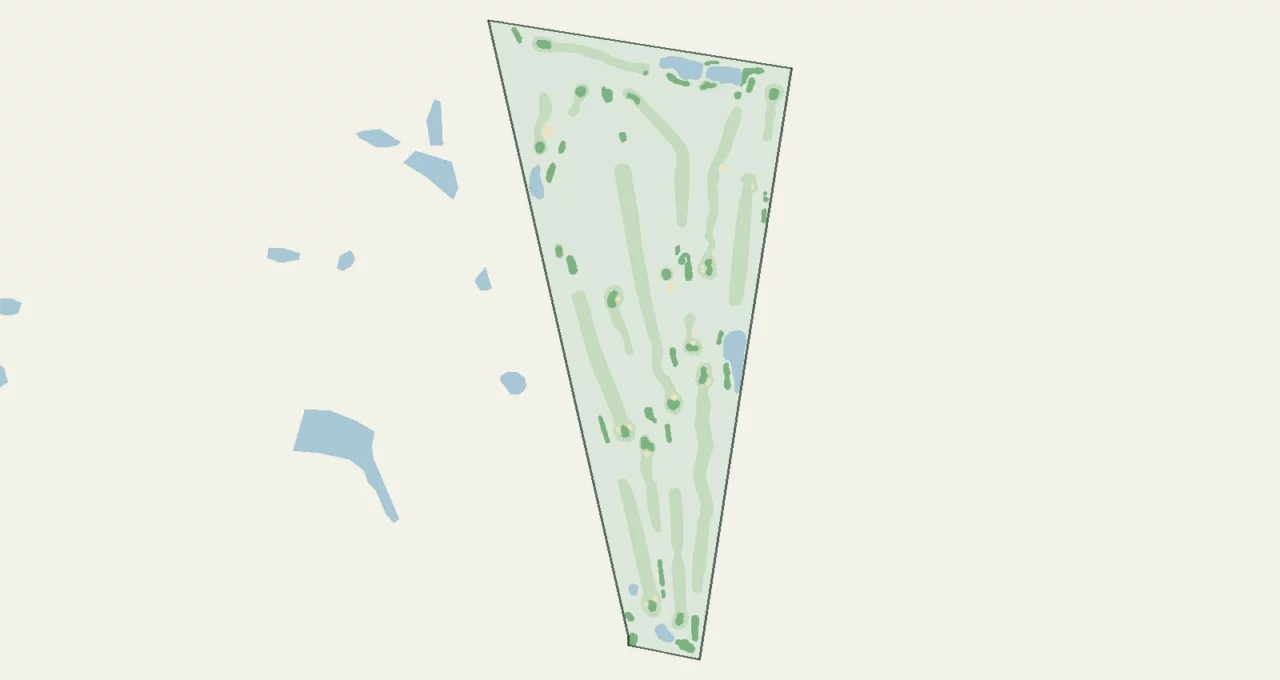
Layout of Boomerang Public Golf Course from OpenStreetMap survey data (ODbL licence).
Boomerang Public Golf Course
Holes
18
By
67
Length
About 4,380 to 4,430 metres from the back tees and 3,600 to 3,790 metres from the forward tees, depending on the source
Green fee
—
Best season
—
Boomerang Public Golf Course is an eighteen-hole course on the plateau above the northern Illawarra, in the City of Wollongong, New South Wales. The club gives its address as 167 Old Princes Highway, Maddens Plains, NSW 2508, and describes the course as lying less than 60 minutes’ drive south of the Sydney CBD. In a straight line, the course is about 49 kilometres south-south-west of central Sydney and about 20 kilometres north of Wollongong station. The coast, with the villages of Scarborough, Wombarra and Coalcliff, lies two to three kilometres to the east, but several hundred metres lower down: the course sits on top of the Illawarra escarpment, not beside the sea.
It is a short course of par 67, open to the public seven days a week. On its own site the club dates itself to 1963. It describes the layout as a country-style course perched high on the escarpment, with ocean and city views, bent and poa greens and kikuyu fairways, and presents it as a challenge for novices and accomplished players alike. Golf Australia’s directory, as it appears in search results, describes the course as privately owned and open to the public every day, and says members of the public, social clubs and family groups are welcome to use the barbecues, the kiosk and the course itself. We were not able to open that page directly, so we report that description as it is indexed rather than as we read it.
The course is compact. Its outline on OpenStreetMap covers about 27 hectares, roughly a kilometre from north to south and under half a kilometre from east to west, and it sits a short distance west of the Princes Highway. That is a small area for eighteen holes, and it explains much of the character of the course: short holes, parallel fairways and a routing that runs up and down the length of the property.
The course in figures
All the sources we found agree on a par of 67, split 33 on the front nine and 34 on the back. OpenStreetMap carries all eighteen holes with their pars, and they add up to the same total. There are seven par 3s (the 3rd, 6th, 7th, 9th, 10th, 14th and 18th), nine par 4s and two par 5s (the 4th and the 15th).
Length is less straightforward, because the club itself does not publish a scorecard and the listings disagree on both the figure and the unit. The GolfFinder directory gives 4,382 metres from the blue tees and 3,790 metres from the red. Another directory gives 4,434 metres from the white tees, and a third simply says the course covers about 4,400 metres. The 18Birdies app gives a total that converts to almost exactly 4,382 metres, the same as GolfFinder’s blue tees.
The hole-by-hole card published in two golf apps, Hole19 and AllSquare, gives a total of 4,395 from the back tees and 3,597 from the forward tees, labelled in imperial units. We think those figures are in fact metres. The total is within a few metres of the metric totals above, and the individual holes match the lengths of the hole lines drawn on OpenStreetMap, which we measured in metres, to within a few per cent on most holes. Read as metres, the card gives a front nine of 2,135 and a back nine of 2,260. We give the hole lengths below on that basis, but they should be treated as approximate: the figures are rounded, the unit is labelled inconsistently and the club has not confirmed any of them.
On that card, the longest hole is the 15th, a par 5 of 495 metres, and the other par 5, the 4th, measures 400. The par 4s are short: the 5th, at 330 metres, is the longest, followed by the 2nd, 8th and 16th at 300 each, while the 13th, at 190, and the 17th, at 230, are par 4s that a long hitter could reach or nearly reach from the tee. The par 3s cover a wide spread. The 7th, at 90 metres, and the 3rd, at 100, are little more than pitches; the 9th, 10th and 14th sit between 140 and 145; and the 6th, at 195, and the 18th, at 205, are long par 3s by any standard.
The same card ranks the holes for stroke index, and it puts the difficulty where the length is. The 15th is index 1, the closing par 3 is index 2, the 12th, a par 4 of 275 metres, is index 3, and the long par 3 6th is index 4. The 14th and the 13th are rated the easiest holes on the course.
The 18Birdies app gives a course rating of 63.7 and a slope of 112, without saying which tees they apply to. We have not been able to confirm those figures with Golf Australia, whose rating information we could not read, so we report them as one app’s figures only. Golf Australia remains the authority for ratings in this country, and any golfer who needs an exact figure for handicap purposes should check there.
On top of the escarpment
The setting is what sets Boomerang apart from most public courses in the Illawarra. The Illawarra escarpment, officially the Illawarra Range, is the long sandstone wall that separates the narrow coastal strip from the plateau inland. Along the northern Illawarra the coastal villages and the South Coast railway line sit at its foot, and the Princes Highway runs along its top. The course is on that upper side. Elevation data for the site put it at roughly 380 to 400 metres above sea level, with a fall of about 20 metres across the property, which squares with directory descriptions of the terrain as flat.
The height has practical consequences. It explains the views the club advertises, out over the ocean and, on clear days, towards the city. It also means the course is more exposed than the coastal courses below it, and that it will usually be a few degrees cooler than the beach a couple of kilometres away. A golfer coming up from the coast on a warm day may find the plateau noticeably fresher, and on a still day down below there can be a breeze on top.
Much of the escarpment is protected within the Illawarra Escarpment State Conservation Area. The course is therefore surrounded by bush rather than houses, and directories describe its fairways as tree-lined.
One point of geography causes confusion in the listings. Several directories place the course at Darkes Forest, the neighbouring locality to the west, while the club and others give Maddens Plains. The club’s own address, on the Old Princes Highway at Maddens Plains, is the one to use. A golf course of a similar name, Boomerang Farm, is on the Gold Coast hinterland in Queensland and has nothing to do with this one; it is easy to land on the wrong page when searching.
The club and its neighbour
Little of Boomerang’s history is on public record. The club’s founding date of 1963 appears on its own site and nowhere else that we could find, and we have found no name for the designer of the course, no account of how it came to be built and no record of changes to the layout. The name “Public Golf Course” and Golf Australia’s description of it as privately owned suggest a course run as a business open to all, rather than a members’ club, but we have not been able to establish who owns or manages it today.
The plateau once had a second course. The former Illawarra Golf and Country Club stood on about 40 hectares at 87 Princes Highway, Maddens Plains, and a golf directory describes Boomerang as lying across the road from the closed Illawarra course. According to a golf industry report from October 2014, that course had not been used for golf since the early 2000s. A Japanese investor bought the property in the 1980s and obtained a rezoning for a resort that was never built, Sydney investors bought it in 2002, and in 2014 the land was being sold on behalf of a receiver. We do not know what has become of the site since. Boomerang is, as far as we can tell, the only course still operating on this stretch of the escarpment.
The club keeps a low profile online. Its current website is a single page with a booking number, a list of rates and a contact page. An older web address, the one recorded on OpenStreetMap, has been a parked domain since at least 2018 and should be ignored.
What it asks of you
At about 4,400 metres for a par of 67, Boomerang is not a test of length. Its challenge lies in the variety of its holes and in the accuracy they demand on a tight site. On a property less than half a kilometre wide carrying eighteen holes, fairways run side by side, and a drive that drifts too far left or right can easily end up near the next hole, or in the trees that line many of them.
The par 4s are the scoring chances. With most of them between 275 and 330 metres on the card, many golfers will be hitting a short or mid iron into the green, and some will prefer a fairway wood or a hybrid off the tee to keep the ball in play. The 13th and the 17th, the two shortest par 4s, invite an attacking drive, but the card ranks them among the easiest holes precisely because the reward is limited if the drive goes astray.
The par 3s are where the card shows the most contrast. The two short holes, the 3rd and the 7th, call for a wedge or even a lob, and their difficulty depends almost entirely on where the hole is cut and how firm the green is. The 6th and the 18th, both close to 200 metres, are a long iron, hybrid or wood for most club golfers, and the card rates them the second and fourth hardest holes on the course. Finishing with a long par 3 is unusual, and it means the round can turn on the last tee shot.
The 15th is the hole most golfers will remember. At 495 metres on the card, and drawn on OpenStreetMap running almost the full north-to-south length of the property, it is the longest hole by a distance and the stroke index 1. The 4th, the other par 5 at 400 metres, is reachable in two for longer hitters.
Water and sand are present but not dominant. OpenStreetMap shows several ponds within the course, five of them mapped as water hazards, and GolfFinder lists water hazards among the course’s features along with between ten and twenty bunkers, which it calls moderate. The fairways are watered, according to the same directory.
Greens and fairways
The club describes its greens as bent and poa and its fairways as kikuyu. Kikuyu is a warm-season grass, vigorous in summer and slower to grow in winter, and it tends to hold the ball up rather than let it run. Bent and poa greens, the traditional mix on cooler sites, can be quick and true when well kept, but poa in particular is sensitive to heat and wear. That may explain why opinions on the putting surfaces vary so much, as the next section shows.
What that means for your game
Leave the driver in the bag more often than you would on a longer course. On holes of 275 to 300 metres between rows of trees, the safest approach is often a long iron or hybrid to the widest part of the fairway, leaving a wedge in. Expect the kikuyu fairways to give little roll, especially in cooler months. Take time on the long par 3s, the 6th and the 18th: the card says they are among the hardest holes, and a par there is worth more than a birdie chance missed on a short hole. Check the wind before each tee shot, because an exposed plateau can play differently from the shelter of the trees. And spend a few minutes on the putting green before the round, since green speed is the point on which visitors disagree most.
For beginners and juniors, the short length and flat ground make Boomerang an approachable full eighteen holes. For a group of social golfers, it can be played comfortably in a morning. Strong players will find it short, but the long par 3s and the 15th give them something to think about.
Practice and facilities
Facilities are modest. GolfFinder lists a putting green and light snacks at the clubhouse, and the Golf Australia listing, as indexed, mentions a kiosk and barbecues for visitors and family groups. The club’s own site lists golf carts, pull buggies and hire clubs. We have found no mention of a driving range, a practice fairway or a resident professional, and we do not know the clubhouse’s opening hours. One visitor’s review mentions a seat at every hole and well-kept gardens.
What golfers say
Public comment on Boomerang is fairly plentiful in the form of star ratings on golf apps, but thin in written reviews, so most of what can be learned comes from short remarks and from the balance of the ratings. The points below summarise what recurs. These are other people’s opinions, not ours: we have not played the course, and we name and quote no one.
What comes up in its favour
- Value for money is the aspect that comes out best in the app ratings, and one reviewer calls the rates very reasonable.
- The atmosphere is described as friendly, relaxed and uncrowded, and pace of play is rated quick.
- The setting, with gardens, bush and a park-like feel, is singled out, and the club’s own description stresses the views from the escarpment.
- Walkers appreciate the flat ground and the seats placed around the course.
- Several comments see it as a good, low-key public course for a casual round.
What comes up against
- Course condition is the weakest point in the app ratings, and it scores below value, pace and overall impression.
- The greens divide opinion. One app rates their speed as fast, while at least one recent review is sharply critical of their state.
- A review from 2025 reports a hole closed without explanation, which suggests that visitors should not count on the full eighteen holes on every day.
- The facilities are basic, and those looking for a full clubhouse, range or pro shop will not find them.
- At around 4,400 metres and par 67, it is short for strong players.
Who it suits
Boomerang suits golfers who want an inexpensive, relaxed eighteen holes without a long drive from southern Sydney or the northern Illawarra, beginners and improving players who are not yet ready for a full-length course, families, and social groups who want to combine golf with a barbecue. It is also an option for golfers travelling the Princes Highway who want a quick round with a view. Low handicappers looking for a demanding test will find it short, and those who care most about the quality of the greens should look at recent reviews before they go.
Getting there and when to go
The course is reached by road. It sits just west of the Princes Highway between Helensburgh and Bulli Tops, and the club gives its address as 167 Old Princes Highway; OpenStreetMap and some directories write simply Princes Highway. From Sydney, the club puts the drive at under an hour. The nearest railway stations, Scarborough, Wombarra and Coalcliff on the South Coast line, are two to three kilometres away in a straight line, but they are on the coastal strip at the foot of the escarpment, several hundred metres lower, and are no practical way of reaching the course on foot. We have not confirmed any bus service and do not give one.
Social golf is available seven days a week, according to GolfFinder, and booking is required. The club takes bookings by telephone on 0407 646 121, the number on its own site; older directory listings and OpenStreetMap give a landline number, 02 4294 3434, which may no longer be current. The club also gives an email address on its contact page. We have found no online booking system and no published opening hours.
Golf is played all year in this part of New South Wales. Spring and autumn usually bring the most comfortable conditions. In winter, the kikuyu fairways slow down and the plateau can be cool and damp; in high summer, the height of the course usually takes the edge off the heat of the coast. Because the course sits high and exposed, it is worth checking the weather on the escarpment rather than in Wollongong before setting out.
How this page was made
The factual frame comes from public sources. The club’s website provided the address, the 1963 founding date, the description of the setting, the grasses, the hire equipment and the booking number, read in its archived form of February 2026 because the site did not respond when we consulted it. OpenStreetMap provided the outline and area of the course, the pars of each hole, the hole lines we measured, the ponds and water hazards, and the coordinates from which we calculated straight-line distances. Elevations come from the SRTM terrain model. The GolfFinder directory gave the lengths of the blue and red tees, the terrain, bunkers, watering and facilities. The hole-by-hole card and stroke index come from the Hole19 and AllSquare apps, and the course rating and slope from 18Birdies. Golf Australia’s description of the course was read in search results only, as its page blocked our requests. The history of the former Illawarra Golf and Country Club comes from a Golf Industry Central report of 27 October 2014.
Several sources disagree, and we have said so in the text. Lengths range from about 4,380 to 4,434 metres for the back tees and from about 3,600 to 3,790 metres for the forward tees; the hole-by-hole card is labelled in imperial units, but its figures match metric totals and the mapped hole lengths, so we read them as metres. The course is placed at Maddens Plains by the club and at Darkes Forest by some directories. The club’s telephone number and email address differ from those on older listings, and the web address recorded on OpenStreetMap is a parked domain. We found no designer, no history beyond the founding year, no confirmed rating from Golf Australia and no opening hours, so none is given.
The opinion section summarises public reviews and ratings on golf apps and local directories, read in October 2026; we report recurring themes rather than individual voices, we reproduce no quotations and we give no ratings or review counts. Few reviews contain written comments, and the picture they give is necessarily partial.
We have not played this course, and this page is no substitute for a round. The course has not paid for this page, has not seen it before publication and has no say over its content. If you know the course and something here is wrong or out of date, write to us and we will correct it.
Other courses nearby
Closest to this one in our Australian directory:
- Antill Park Country Golf Club — 31 km
- Bankstown Golf Club — 36 km
- Canterbury Public Golf Course — 37 km
- New South Wales Golf Club — 40 km