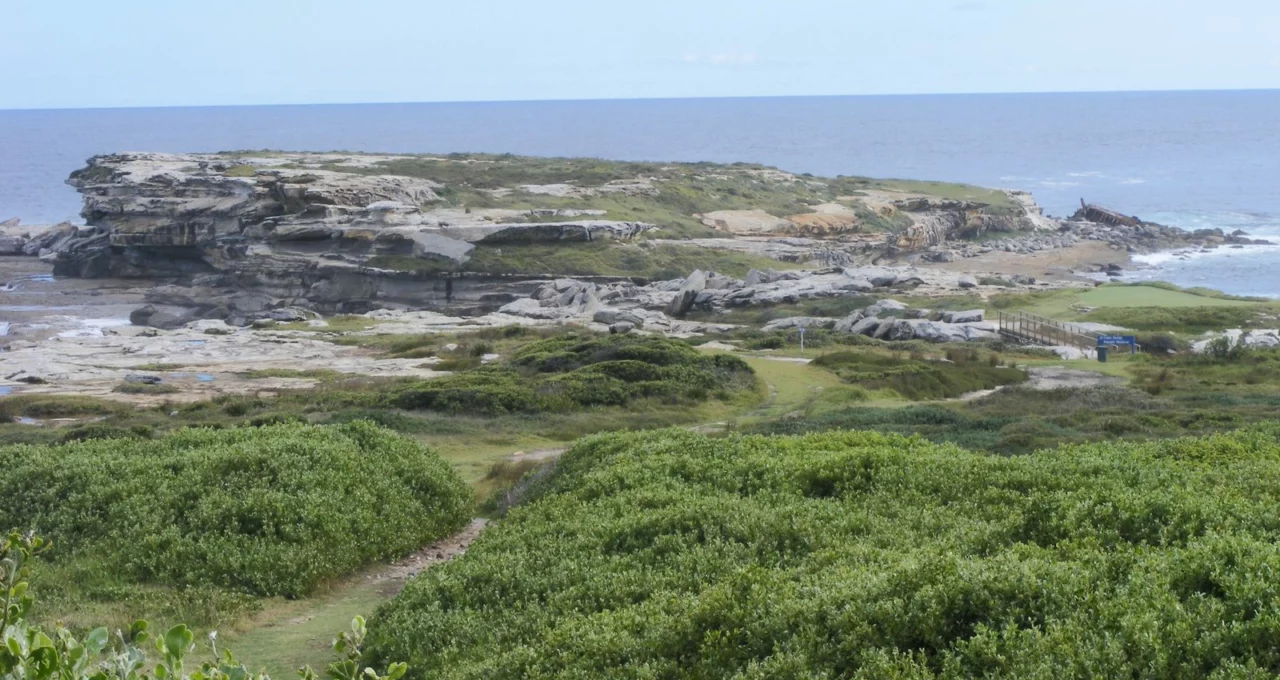
New South Wales Golf Club — Photo Adam.J.W.C. / Wikimedia Commons, CC BY-SA 3.0
New South Wales Golf Club
Holes
18
By
72
Length
—
Green fee
—
Best season
All year
MacKenzie saw the headland at La Perouse on his 1926 Australian tour and was, by every account, delighted with it: cliffs, dunes, exposed rock and the entrance to Botany Bay on three sides. The course opened in 1928 to his routing.
The hole that made it famous, however, is not his. The par three over the ocean inlet at the sixth was the work of Eric Apperly, an Australian amateur and architect whose name is far less known than the photograph of his hole.
What it asks of you
A par 72 on the most exposed piece of golfing ground in Sydney. The wind is not an occasional factor here, it is the course. All four short holes face different directions, and so do the par fives, which means that in a single round the wind hits from every angle, exactly as it does on the best British links.
The fifth and sixth together are regularly called one of the finest back-to-back pairs anywhere. The walk across the bridge to the sixth tee is part of the experience, and the shot itself is close to 180 metres over open water to a green that will not accept a ball played tentatively.
The ground is rugged, the elevation change is real, and the greens are fast. It is a physically and mentally demanding round, and reviewers who arrived expecting a scenic stroll say so afterwards.
What players say about it
Visitor times are limited and must be booked well in advance, so the review record is smaller than for a resort course but is genuine. The notes below summarise recurring themes across specialist golf sites, traveller review pages and player discussion threads. They are other people’s opinions, not ours: we have not played the course, and we do not name or quote individual reviewers.
What comes up in its favour
- The setting is unmatched in Sydney and reviewers say so without qualification: ocean on three sides, cliffs, and Botany Bay below.
- The fifth and sixth are praised as one of the best consecutive pairs in world golf, and the bridge walk to the sixth tee is mentioned in almost every account.
- Conditioning is described as excellent, and the greens draw particular praise for speed and quality.
- The variety created by facing the short holes in four different directions is admired by people who write about architecture.
What comes up against
- It is very hard. Rugged ground and fast greens make it a demanding round, and several accounts say a first-time visitor should expect the sixth to beat them.
- The wind can render the course close to unplayable for a mid-handicapper on a bad day.
- Visitor access is limited and has to be arranged a long way ahead.
- The walk is strenuous over the headland, and the exposure means there is nowhere to shelter.
Getting there and when to go
The club is at La Perouse, on the northern headland at the entrance to Botany Bay, around half an hour from central Sydney and fifteen minutes from the airport, which makes it an unusually easy course to fit into a trip.
The course plays all year on sandy ground that drains. Spring and autumn give the most reliable weather and the least severe wind. Visitor tee times are limited and should be booked well in advance.
Green fees
Rates and visitor times are set by the club. See the club’s own site.
How this page was made
The factual frame comes from public sources: OpenStreetMap for the location, Wikipedia and published architecture coverage for the history and the design credits, and the club’s own site for access. The opinion section summarises public reviews and player discussions read in September 2026; we report recurring themes rather than individual voices, and we do not reproduce or attribute quotes.
We have not played this course, and nothing here is a substitute for that. The club has not paid for this page, has not seen it before publication and has no say in what it says. If you know the course and something here is wrong or out of date, write to us and we will correct it.