Garden golf nets: what British buyers regret, from narrow garages to the fence next door
Almost nobody who regrets a home golf net regrets the mesh. They regret the bounce-back, the shank that found next door's fence, the garage that was too narrow and the pop-up left out in a gale. Here are five nets sold in Britain, from £69.99 to £828 in October 2026, what owners say about them, and what a British garden or garage asks of a net.
In brief
- Prices read at British retailers in October 2026: FORB Pro Pop-Up £69.99 to £84.99, FORB ProFlex cage £279.99, SimSpace Deluxe 10ft £399, The Net Return Home £720 and Pro £828.
- The recurring regrets are bounce-back from tight nets, mishits escaping a net without sides, low ceilings with a driver, weather damage, and no feedback on ball flight.
- Stand about 2.5 to 3 metres back, let the net hang slack, and walk the arc of a shank before deciding whether you need side netting or a cage.
- The Net Return asks for 9 to 10ft of width; many British single garages are about 2.5 metres wide, so measure width and height before the net.
Read enough British forum threads about garden golf nets and a pattern appears. The posts rarely start with the net. They start with a fence panel split down the middle, a ball rolling off a conservatory roof into next door’s garden, or a drive that went straight through a cheap net. The net itself turns out to be the least of it. What buyers regret is almost always the space around it, the frame that holds it, the mat under their feet, or the way they used it.
Worth knowing before you spend anything between about £70 and £830. Below are five nets sold in Britain this autumn, with their makers’ specifications and October 2026 prices, what owners say, and a section on where British golfers actually put a net: a garden with a neighbour on each side, a single garage built for a smaller car, a patio that is dark before five.
None of these nets was set up or hit into by anyone at Panxis Golf. This is a presentation of products and a summary of published opinion, not a test.
Five regrets that have nothing to do with the mesh
The short version of what goes wrong, decided before you pick a model.
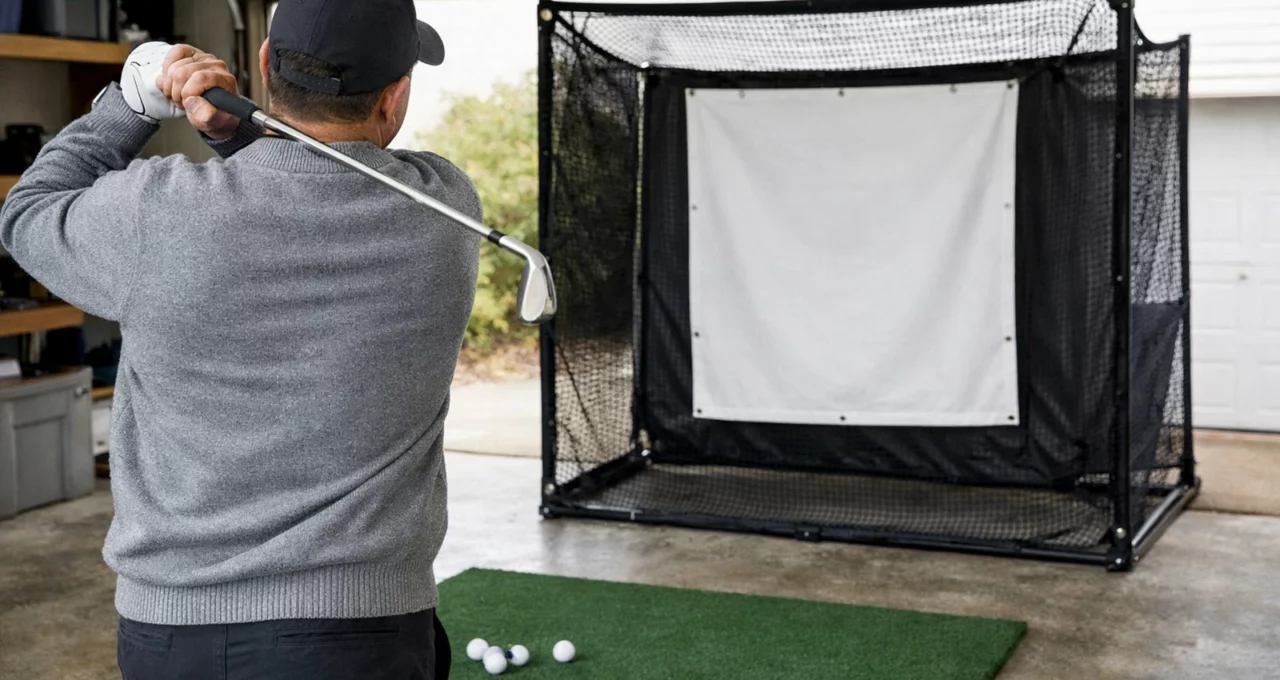
- The ball comes back at you. A net pulled tight like a trampoline, or a hard target sheet in the centre, sends the ball straight back towards the hitter, and the closer you stand, the faster it arrives. A net that hangs slack absorbs the ball instead. Stand roughly 8 to 10 feet away, about 2.5 to 3 metres, and watch what the first few shots do before swinging properly.
- The net was the right size for good shots only. A 7ft by 7ft net, around 2.1 metres square, catches a struck shot comfortably. It does not catch a shank, a thin one off the heel or a top that skips under the frame. Without side netting, those are the shots that find the fence, the window, the car or the shed.
- The ceiling or the roof line was too low. Indoors, an iron swing fits more rooms than people expect. A driver does not. Garage owners learn this from the sound of a club meeting a beam, a strip light or the up-and-over door mechanism.
- It was left out. British weather finishes cheap nets faster than golf balls do. Wind works at the seams, rain and sunlight weaken polyester, fibreglass poles crack, and a pop-up net left standing in a gale becomes a sail.
- Nothing told them where the ball went. A net stops the ball a few feet after impact, so a push that would have finished 30 yards right looks the same as a draw. Hundreds of swings with no feedback can groove a fault as easily as cure one.
Two more, briefly: the cheap mat bundled with many nets jars the wrists and hides a heavy contact (mats deserve their own page), and an automatic ball return can stop short on a sloping lawn or a thick mat.
FORB Pro Pop-Up: the cheapest way to find out
FORB is a British brand of training equipment; on some of its listings the same net carries the FORZA name, and the maker notes that branding may vary between sizes. The Pro Pop-Up is a square net on a steel and fibreglass frame, sold in two sizes, and it is the kind of net most first-time buyers in Britain end up with.
- What the maker lists: 8ft by 8ft (2.4 m by 2.4 m) or 10ft by 7ft (3 m by 2.1 m). The 8ft version weighs 5 kg, with steel tubes of 22 and 25 mm and 14 mm fibreglass poles; the 10ft version weighs 7.1 kg, with 25 mm steel tubing and 12.7 mm poles. Netting is three-ply, one-inch knotless polyester with 420D fabric. No bottom bar, so balls drop flat rather than deflecting. Set up in under 90 seconds, carry bag included. No ball speed rating and no warranty period are stated on the listing.
- Price: read at a British retailer in October 2026: £69.99 for the 8ft by 8ft and £84.99 for the 10ft by 7ft, against previous prices shown as £139.99 and £179.99.
A review of the 8ft version in Golf Monthly found it stable in strong wind and easy to put up, and pointed out the obvious limitation: there are no side or roof panels. At this price that is the trade.
FORB ProFlex Golf Cage: a box rather than a wall
The ProFlex is the same brand’s answer to the side-panel problem. Instead of a single face, it is a cube: back, sides and roof, so a shank or a ballooned wedge stays inside.
- What the maker lists: 8ft by 8ft by 8ft (2.4 m each way), 19 kg. Base frame of 25 mm by 25 mm by 1.5 mm steel tube, 14 mm fibreglass flexi poles, outer net of three-ply knotless polyester with one-inch mesh and 600D Oxford fabric banding, plus a separate impact panel on the back wall to protect the outer net. Patented pre-attached frame, no tools, assembled or taken down in under three minutes. Guy ropes included, and a wheeled 900D carry bag.
- One line worth reading twice: the maker says the cage is suitable for outdoor use but must be taken down and stored inside when not in use. It is a garden net, not a garden fixture.
- Price: read at a British retailer in October 2026: £279.99, against a previous price of £299.99.
Three minutes is quick, but it is three minutes every session, plus a 19 kg bag to keep indoors.
SimSpace Deluxe 10ft: side netting built in
The SimSpace Deluxe sits between the pop-ups and the premium frame nets. It is a steel-framed net with shank netting either side and a ball return, sold in a 10ft width and a smaller 7.5ft version.
- What the maker lists: 10ft model 3 m wide by 2.5 m high, powder-coated steel frame in black satin, high-tenacity nylon netting, protective side netting for shanks, a ball return feature, push-button assembly with setup and takedown in under five minutes, indoor and outdoor use. The listing shows a one-year manufacturer warranty. No weight or ball speed rating is given.
- Price: read at a British retailer in October 2026: £399 for the 10ft model, against an MRRP of £399.99. The 7.5ft version was listed at £299.95.
At 3 metres wide, the 10ft model is close to the full width of many British single garages, which matters more than it sounds: see the section on where nets go, below.
The Net Return Home Series: the slack net
The Net Return, an American maker, built its name on a net that hangs loose in a curved sleeve, so the ball loses its energy, drops and rolls back to the hitter. It is the brand that comes up whenever bounce-back is the complaint.
- What the maker lists: 7ft wide by 7ft high, 3ft 6in deep, 26 lb. Powder-coated aluminium frame with stainless steel push buttons and colour-coded connections, no tools. Heavy-duty, UV-protected polyester netting for indoor and outdoor use. Rated for ball speeds up to 225 mph. A three-year net warranty, terms applying. Minimum room for a full swing: 9ft wide, 8ft high and 14ft long.
- Price: read at a British retailer in October 2026: £720 for the net alone. Side barriers, turf and a carry bag are sold separately or in bundles.
The price buys the frame and the return, not width: the Home is narrower than a 10ft pop-up costing a tenth as much.
The Net Return Pro Series: more height, same idea
The Pro is the next size up in the same range: the same construction, a foot wider and six inches taller.
- What the maker lists: 8ft wide by 7ft 6in high, 3ft 6in deep, 28 lb. Same aluminium frame, UV-protected polyester netting, automatic ball return, 225 mph rating and three-year net warranty. Minimum room: 10ft wide, 8ft 6in high, 14ft long.
- Price: read at a British retailer in October 2026: £828 for the net alone.
Larger sizes exist, up to 10ft wide; for most British garages the Pro is already at the limit.
The five nets side by side
| Net | Size (W x H) | Frame | Sides | Ball return | Warranty listed | UK price, Oct 2026 |
|---|---|---|---|---|---|---|
| FORB Pro Pop-Up | 8ft x 8ft or 10ft x 7ft | Steel and fibreglass | None | No | Not stated | £69.99 / £84.99 |
| FORB ProFlex Golf Cage | 8ft x 8ft, 8ft deep | Steel and fibreglass | Enclosed, with roof | No | Not stated | £279.99 |
| SimSpace Deluxe 10ft | 3 m x 2.5 m | Powder-coated steel | Shank netting | Yes | 1 year | £399 |
| The Net Return Home | 7ft x 7ft | Aluminium | Sold separately | Yes | 3 years (net) | £720 |
| The Net Return Pro | 8ft x 7ft 6in | Aluminium | Sold separately | Yes | 3 years (net) | £828 |
Price does not follow width: the dearest nets pay for the frame, the ball return and the warranty.
What golfers are saying
Across British and American forums, retailer reviews and review sites, the same points keep returning.
What owners like:
- Fifteen minutes is enough. The most common praise is not about any feature. It is that a net in the garden turns an evening into a short, regular session, something a trip to the range rarely allows on a weekday in winter.
- A slack net that actually returns the ball. Net Return owners in retailer reviews and on the MyGolfSpy forum single out the return: the ball drops and rolls back almost every time, which keeps a session moving without walking after balls. The price is the usual reservation, described as high but worth it.
- Fast setup on the better pop-ups. Golf Monthly’s review of the FORB Pro Pop-Up praised its stability in wind and how quickly it goes up, and owners of push-button frames describe setup as a non-event after the first few times.
What owners complain about:
- Bounce-back on tight nets. On The Sand Trap, a garage owner’s account of balls coming back hard drew the standard reply from experienced users: the net must hang loose enough not to act as a trampoline. The fix is usually slack and distance, not a new net.
- Mishits that escape. Threads on the Golf Monthly forum are full of shanks, slices and sky shots that went past a pop-up net towards a neighbour’s house or car, and of a drive that went straight through a cheap net into the next garden. Workarounds include archery-style netting around the sides and foam balls, at the cost of almost all feedback.
- Weather and wind. Owners on the same forum say cheap pop-up nets do not weather well and that wind strains the seams unless the net comes down after every session. The independent MyGolfSpy forum review of the Net Return Home, which rated its durability highly over three months, made the same point in reverse: the one way it could see durability becoming a problem was leaving the net outside in harsh conditions for long periods.
- Height and width on the premium nets. The same review flagged the Home’s 7ft height as its main limitation and the side barriers as an extra cost on top of the net. For a full-swing driver, owners lean towards the larger sizes, which costs more and needs a bigger room.
Nobody is quoted by name, nothing has been counted, and none of this is presented as a measurement. These are the points that recur in public discussion.
Where British golfers put a net, and what each space asks
Most buying guides assume an American house: a double garage, a basement, no one within shouting distance. A British net goes into a narrower, busier space.
The back garden, with a neighbour on each side
For most British owners the net goes on the lawn of a semi-detached or terraced house, which means a fence on two sides and a neighbour behind each one. Point the net so that a miss goes towards your own house wall or a solid boundary rather than towards a window, a car on the drive or a neighbour’s patio. Forum owners report fence panels broken by nets placed too close to them: leave a gap behind the net so a ball that stretches it does not hit the boards. A conservatory, a greenhouse or a shed window within the arc of a shank is a reason for side netting or a cage, not a reason to swing more carefully.
A lawn is also softer and less level than it looks, and ground stakes hold differently in wet clay in January than in dry ground in July.
The single garage
Garage specialists put a typical British single garage somewhere between about 2.5 by 4.8 metres and 3.5 by 6 metres, with newer houses at the narrow end. Compare that with the published minimum rooms above. The Net Return Home asks for 9ft of width, about 2.7 metres; the Pro asks for 10ft, about 3 metres, and 14ft of length. In a 2.5-metre-wide garage neither fits as the maker intends, and the SimSpace’s 3-metre frame will barely go through the space between the walls. The length is usually there; the width and the height are not.
Height is the other test. Many garages in Britain are a little over 2.5 metres to the ceiling, less under the door mechanism, a strip light or a joist. Stand where the ball would be, take a driver slowly to the top and through, and see what you touch. If the answer is anything, the garage is an iron and wedge room, and that is still worth having. Concrete in a British winter is cold and sweats; a damp mat is a slippery one.
The patio, the side return and the small garden
On a patio, the hard surface matters. A topped ball skips on paving and finds the gap under the net; a pop-up with no bottom bar helps here, as does a mat large enough to stand on as well as hit from. A side return between a house and its neighbour is often long enough for a net but rarely wide enough for side protection, and both walls are close. Wedges into a net there, yes; a driver, think twice.
Noise, light and the season
A ball into a net is quieter than a ball off a wall, but the strike itself is not silent, and a metal frame can rattle. Through the shared wall of a semi or a terrace, a run of drivers at seven in the morning will be heard. Keep the long clubs for weekend middays and the evenings for wedges. Since the clocks went back, most of the evening is dark. A net in a garden after five needs light, and an outside light pointed at the hitting area is also pointed at the neighbours’ windows.
Wind is the British factor American guides skip. A pop-up net is a sail; even with guy ropes and stakes, owners take them down in a gale. The ProFlex maker’s instruction to store the cage indoors after use is not a formality. And if a ball does end up in a car windscreen or a neighbour’s greenhouse, do not assume you know how your home insurance will treat it. Ask your insurer before you need to.
How to choose before you buy
- Measure the space first, the net second. Width at the hitting position, height at the top of your driver swing, depth from where you stand to the back of the net plus the gap behind it. Hold those against the maker’s minimum room figures, not the net’s size.
- Decide what a miss hits. Walk the arc of a shank and a top from where you will stand. If it reaches glass, a car, paintwork or a neighbour, budget for side netting or a cage. A narrow net with side barriers is safer than a wide net without them.
- Choose slack over tension. Whatever you buy, set it up so the net gives. Then stand about 2.5 to 3 metres back and hit a few soft wedges to see where the ball goes before anything longer.
- Plan for storage, not just use. If it must come down after each session, will you really put it up again on a cold Tuesday?
- Do not let the net be the only feedback. Add a target, a camera on your phone or a launch monitor if the budget allows. Yesterday’s page on home simulators under £1,000 covers the room each unit needs; most of them pair with a net like those above.
- Ask about warranty and parts. Whether you buy from a club pro shop, a golf retailer or online, ask how long the warranty runs, whether it covers the net or only the frame, and whether replacement nets and poles are sold separately. A broken fibreglass pole should not mean a new net.
A garden net is often found folded behind the lawnmower by spring. Bought for the space you actually have, with the neighbours in mind, it is still in use when the clocks go forward.
How this page was put together
This is a presentation of products and a reading of published opinion, not a test. Nobody at Panxis Golf set up, used or hit a ball into any of these nets. Specifications come from the manufacturers’ published material: FORB and FORZA product pages for the Pro Pop-Up and the ProFlex Golf Cage, the product description for the SimSpace Deluxe, and The Net Return’s own site (thenetreturn.com) for the Home and Pro, including the frame, netting, 225 mph rating and three-year net warranty. The minimum room dimensions for the Net Return nets are those reproduced on the British retailer’s listing. Garage sizes come from British garage specialists, as cited on our home simulator page. Feet are given first because British retailers list nets in feet; metric equivalents are approximate.
Prices were read in October 2026, in pounds sterling: FORB Pro Pop-Up £69.99 (8ft by 8ft) and £84.99 (10ft by 7ft), and FORB ProFlex Golf Cage £279.99, at Net World Sports, which also owns the FORB brand; SimSpace Deluxe 10ft £399 (MRRP £399.99) and 7.5ft £299.95 at GolfOnline; The Net Return Home £720 and The Net Return Pro £828 at GolfBays. Prices change often, especially in the weeks before Christmas.
What golfers say was read in Golf Monthly’s review of the FORB Pro Pop-Up, in threads on the Golf Monthly forum about garden and pop-up nets, in a thread on The Sand Trap about bounce-back, in an independent owner review of the Net Return Home on the MyGolfSpy forum, and in retailer customer reviews of the Net Return. Some were read only through search excerpts. Nobody is quoted by name, nothing is counted, and no impression is presented as a statistic. There is no commercial link on this page, no affiliate arrangement and no commission of any kind. If content on this site is ever paid for by a brand, it will carry an advertising notice at the top of the page, before the first line.