Golf simulators under £1,000: four launch monitors for a British garage, box room or garden room
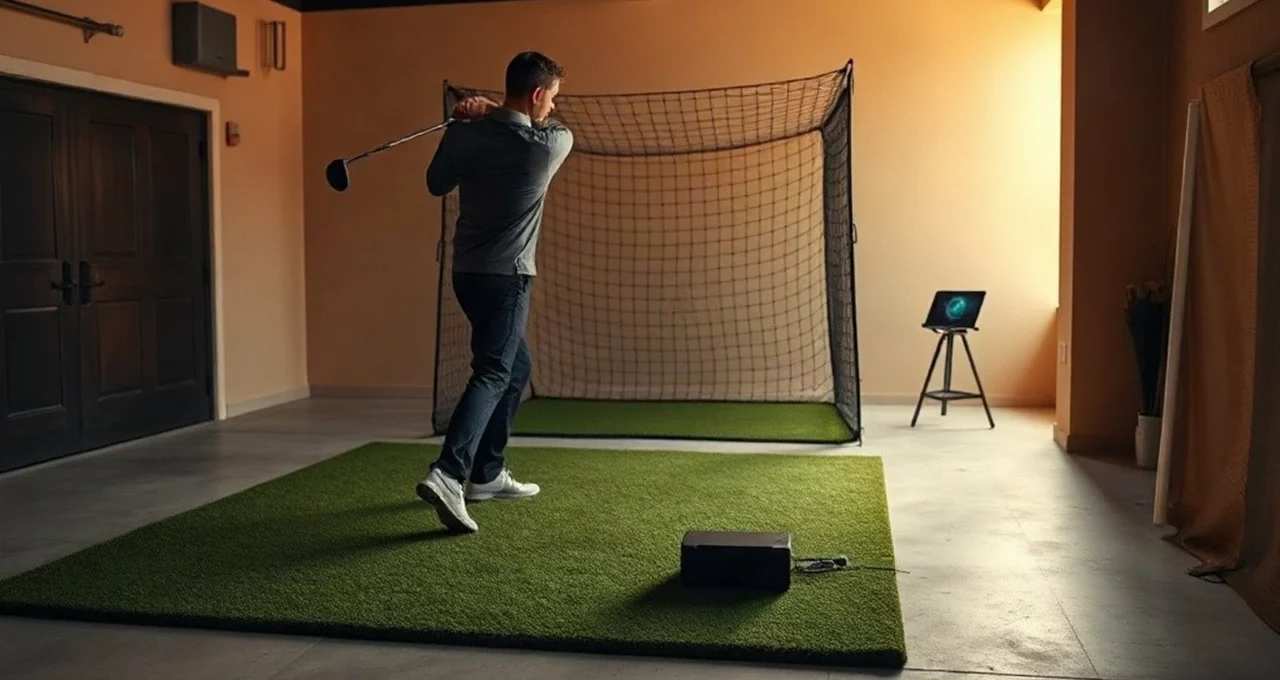
With the clocks back and the evenings dark, a launch monitor in the garage is tempting. Four units sold in Britain cost between £449 and £685 in October 2026. Which one suits you depends less on the spec sheet than on the room: a radar behind the ball wants about 5 metres, a camera beside it far less, and a garden room near the fence may be capped at 2.5 metres high.
In brief
- The four units: Garmin Approach R10 (£449), Voice Caddie SC4 Pro (£549), Rapsodo MLM2PRO (£549) and Square Golf (£685), UK prices read on 27 October 2026.
- The three radars sit behind the ball and want a room of roughly 4.5 to 5 metres; the Square's cameras sit beside the ball and suit a box room or a short garden room if the ceiling allows a driver.
- Software after the trial: Garmin Golf at £89.99 a year for course play, Rapsodo Core at £159.99 for 12 months after a 21-day trial; the SC4 Pro and the Square have no subscription.
- Owners praise ball speed, launch and winter yardage work; the recurring complaints are indoor spin, rooms that are too small, memberships and, for the Square, a very small hitting zone.
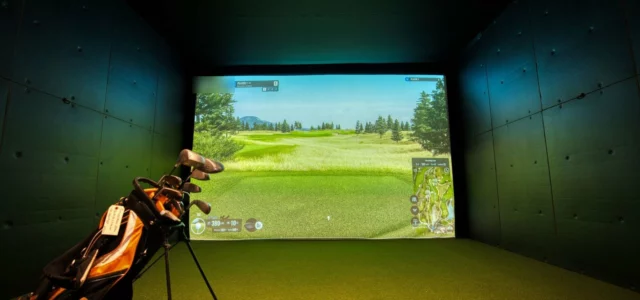
The clocks went back on Sunday. From now until March, most club golfers in Britain will get one weekend round in, if the course is open and the greens are not on temporaries, and spend the rest of the week getting home in the dark. That is the moment a home simulator starts to look sensible. Not a £20,000 room with a projector and a hitting bay, but a small launch monitor, a net and a mat in whatever space the house can spare.
Under £1,000 there are now several of those units, and four of them come up again and again when British golfers ask for advice: the Garmin Approach R10, the Voice Caddie SC4 Pro, the Rapsodo MLM2PRO and the Square Golf launch monitor. All four sat between £449 and £685 at British retailers in late October 2026. The harder question is not which is best on paper but which one your garage, spare bedroom or garden room can actually accommodate, and what it costs once the free software runs out.
This page presents the four units from their makers’ own specifications and summarises what owners and reviewers have published about them. It is not a hands-on review: nobody at Panxis Golf set one up or swung a club in front of it.
Where a simulator fits in a British home
American buyers’ guides tend to assume a double garage or a basement. Most British houses offer neither, so the room decides the purchase long before the spec sheet does. A widely used British room guide from a simulator-enclosure supplier puts the comfortable minimum at 2.8 metres of ceiling height, ideally 3 metres, about 3 metres of width, and a depth of roughly 5 metres for a radar unit or 4 to 4.5 metres for a camera unit. Hold those figures against the rooms most of us have.
- The single garage. The most common choice, and often the only room with enough length. Garage specialists put a typical British single garage at anywhere from about 2.5 by 4.8 metres to 3.5 by 6 metres, with newer builds at the smaller end, so the width is usually fine for the ball flight but tight for a full swing if you stand off-centre. Length is the strong point: 4.8 metres or more gives a radar unit most of what it wants. The weak points are the ceiling, and threads on British golf forums are full of garages only a little over 2.5 metres high, and the cold.
- The spare bedroom or box room. A standard British room sits at around 2.4 metres floor to ceiling, which is low for a driver. Many owners settle for wedges and irons upstairs, and a box room in a terrace or semi is rarely deep enough for a radar placed behind the ball. This is where a unit that sits beside the ball, rather than behind you, earns its place.
- The through-lounge. In a Victorian or Edwardian terrace, knocking two reception rooms together often produces the longest straight run in the house. It is also the room everyone else wants in the evening, so the setup has to be fast to put up and take down: a pop-up net, a roll-up mat, a unit that pairs with a phone in a minute.
- The loft conversion. Plenty of length, almost never the height. Under a pitched roof, only the strip beneath the ridge is tall enough for a full swing, and that strip is usually where the stairs arrive. Putting and short chips, yes; a driver, rarely.
- The garden room. The route that keen golfers increasingly take, and the one with a planning catch. In England, an outbuilding under permitted development that stands within 2 metres of a boundary may not exceed 2.5 metres in overall height, which leaves an internal ceiling well short of a driver swing once the floor and roof are built. Set further back from the fence, a dual-pitched roof can rise to 4 metres overall with eaves at 2.5 metres. Rules differ in Wales, Scotland and Northern Ireland, and listed buildings and designated land need permission anyway, so check with your local planning authority before you order the timber.
The weather is the other British factor. An unheated garage in January is cold enough to make a phone or tablet battery drop quickly and to put condensation on a cold concrete floor, and a damp mat is a slippery one. Owners who use their garage all winter talk about a sheet of insulation board on the floor under the mat, a dehumidifier and a small heater as part of the budget, not as extras.
Finally, try one before you buy one. Many driving ranges in Britain now have Toptracer or similar tracking in their bays, which gives a taste of hitting at a virtual target, and a growing number of clubs and high-street venues hire out simulator bays by the hour, often with a camera-based system far above this price bracket. An hour in one shows you how much you actually enjoy virtual golf, and how much of it is practice rather than play.
Radar or camera: what each unit asks of the room
Three of the four units here are radars that sit behind the ball and track it as it flies towards the net. They need depth: space behind you for the unit, and space in front for the ball to travel far enough to be read. The fourth, the Square, photographs the ball at impact from beside it, which frees up the space behind but asks for a precise ball position. In metres, using the setup distances quoted in the manufacturers’ documentation and retailers’ setup guides:
- Garmin Approach R10: about 1.8 to 2.4 metres from the unit to the ball, and at least 2.4 metres of ball flight to the net. Roughly 4.5 to 5 metres of room in total.
- Rapsodo MLM2PRO: about 2.1 to 2.4 metres behind the ball and around 2.4 metres from ball to net. Again close to 5 metres.
- Voice Caddie SC4 Pro: also behind the ball; published setups vary, so take the distance from the manual for your unit rather than from a forum.
- Square Golf: beside the ball, so the room is set by your swing and the gap to the net, not by a unit behind you. A spare room of 4 metres can work if the ceiling allows.
Before you spend anything, stand where the ball would be, take your driver to the top slowly and see what you hit. Then measure from the back wall to where a net would stand.
Garmin Approach R10: the cheapest way in
The R10 is the unit most British owners started with, and it remains the least expensive here. It is a small Doppler radar that sits behind the golfer and pairs with a phone or tablet through the Garmin Golf app.
- What Garmin lists: ball speed, launch angle and direction, spin rate and spin axis, carry and total distance, plus club head speed, club path, face angle and smash factor. A battery rated for around 10 hours.
- Software: the free app gives a virtual range and session data. Full rounds on Garmin’s Home Tee Hero courses need a Garmin Golf membership, listed in the UK App Store at £8.99 a month or £89.99 a year in October 2026. The R10 also connects to third-party simulation software, some of which is sold separately.
- Price: £449 at a British golf retailer on 27 October 2026, against an RRP of £529. A second British retailer listed it at £479 the same day.
Voice Caddie SC4 Pro: numbers without a phone
Voice Caddie, whose units have also been sold under the Swing Caddie name, made its name with portable radars for the range. The SC4 Pro is the latest version of its best-known model and the only unit here that shows your numbers on its own screen, and calls out the distance after each shot.
- What Voice Caddie lists: carry and total distance, swing speed, ball speed, smash factor, launch angle, apex, backspin, spin axis, side spin, dispersion and deviation, with speed-training modes and a remote control in the box.
- Software: no subscription. The Voice Caddie app gives a 3D driving range. In the United States the brand bundles access to E6 Connect simulation; the British listing read for this page speaks only of compatibility with external simulation software, so ask what is included in the UK box before you buy.
- Price: £549 at a British golf retailer on 27 October 2026, against an RRP of £649.
Rapsodo MLM2PRO: the one that films you
Rapsodo pairs a radar with two cameras. One reads the ball, the other films your swing from behind and lays a shot tracer over the clip, which is why golfers who mainly want to practise, rather than play virtual rounds, tend to shortlist it.
- What Rapsodo lists: carry and total distance, ball speed, launch angle and direction, club speed, smash factor, apex and descent angle. Measured spin rate and spin axis need Rapsodo’s RPT balls, Titleist or Callaway balls with a printed pattern the camera can read; a sleeve of three comes in the box.
- Software, and a change worth knowing about: Rapsodo’s UK site now lists three tiers for the MLM2PRO. The free tier keeps basic practice data; Core, at £159.99 for 12 months, adds the full data set, swing video features, around 30,000 simulated courses and third-party software connections; Studios costs £349.99 for 12 months. The UK product page says a 21-day Core trial is included with purchase, a far shorter introduction than the year of membership that came with the unit at launch. Older reviews that talk about a free first year no longer describe what you get.
- Price: £549 at a British simulator retailer on 27 October 2026, with Titleist or Callaway RPT balls. Rapsodo’s own UK store listed it at £549.99.
Square Golf: the one that sits beside the ball
Square is the exception in this group: a camera unit placed next to the ball, designed for indoor use only. It is the obvious candidate for a box room or a garden room that is wide enough but not long. Square also makes the Omni, which works outdoors too, but it costs well over £1,000 and falls outside this page.
- What Square lists: high-speed camera capture of ball speed, launch angle and direction, spin and carry, with club data. Square sells marked balls for the most reliable spin readings.
- Software: no subscription. Practice modes are free; rounds on Square’s own courses use credits, and 1,000 welcome credits come with the unit. Further credit packs are sold in the app; the UK App Store listed 1,000 credits at £19.99 in October 2026. Reviewers report connections to outside software such as GSPro and E6, which carry their own fees.
- Price: £685 at a British golf retailer on 27 October 2026, against an RRP of £689. The dearest of the four.
If £449 is still more than you want to spend, there is a cheaper route. Shot Scope, the Edinburgh brand better known for GPS devices, sells the LM1 launch monitor, which appeared at £199 at a British retailer in October 2026. It is not covered in detail here.
The cost over three winters
| Unit | Sits | Spin | Software after the trial | UK price, 27 Oct 2026 |
|---|---|---|---|---|
| Garmin Approach R10 | Behind the ball | Radar estimate | Garmin Golf membership for course play, £89.99 a year | £449 |
| Voice Caddie SC4 Pro | Behind the ball | Radar estimate | No subscription | £549 |
| Rapsodo MLM2PRO | Behind the ball | Measured with RPT balls | Core £159.99 for 12 months for full features and courses | £549 |
| Square Golf | Beside the ball | Camera, best with marked balls | No subscription, credits for rounds | £685 |
Add three years of the relevant membership and the order shifts. An R10 with three years of Garmin Golf comes to about £719; an MLM2PRO with three years of Core to about £1,029, past the threshold this page set itself. The SC4 Pro and the Square stay at their purchase price, apart from any balls or credit packs you buy. None of that includes the net, the mat and the heater, which together can easily cost as much as the cheapest unit.
What golfers are saying
Across British and American reviews, the brands’ own owner forums and retailer comments, the same handful of points keeps returning. Most of them concern indoor use, which is exactly where a British owner will use the unit from November to March.
What owners like:
- Ball speed and launch you can trust. Whatever their reservations elsewhere, reviewers and owners agree that the core ball numbers are close enough to far dearer systems to practise with. A review of the Square found spin within a few hundred rpm and carry within a couple of yards of a reference unit in its sessions.
- A reason to keep swinging in winter. Owners value less the virtual rounds than the carry numbers for each club, kept up through the dark months, so the first round in April does not start from scratch. Building a yardage chart in the garage is the use that comes up most often.
- Specific strengths by unit. MLM2PRO owners single out the impact video with its shot tracer; SC4 Pro owners like reading the number on the unit without unlocking a phone; Square owners like that it works in a room where a radar cannot.
What owners complain about:
- Short distances indoors, usually traced to spin. On Garmin’s R10 forum and in a Titleist owners’ thread, golfers describe indoor carries noticeably shorter than outdoors, and estimated backspin that looks too high, with marked balls and firmware updates helping some more than others. SC4 Pro reviewers also name spin as the figure most often off.
- Rooms that are just too small. Radar owners who squeeze the distance behind the ball or to the net report missed shots or strange readings, and threads on British forums are full of garage ceilings around 2.5 metres and plans to dig the floor down or move a joist. Square owners have the opposite problem: a hitting zone of roughly 15 centimetres square, with no warning when the ball is slightly out of place.
- The software bill. Rapsodo owners object most to the membership, and some note that third-party simulators will not connect without it; R10 owners make the same point about Garmin Golf for course play.
- Apps and consumables. The Voice Caddie app draws the sharpest criticism of the four, and MLM2PRO owners find three RPT balls too few for a proper session; a box of Titleist RPT balls was £69.99 on Rapsodo’s UK store in October 2026.
Nobody is quoted by name, nothing here has been counted, and none of these impressions is a measurement. They are the points that recur in public reviews and owner discussions.
Before you order
- Measure three things: depth from back wall to net, width either side of your stance, and the height your driver reaches at the top of a slow swing.
- Pick the technology from the room. Under about 4.5 metres of depth, a radar behind the ball will struggle; look at a camera unit beside it.
- Price three winters. Purchase price plus any membership, plus the net, mat and whatever keeps the garage dry and above freezing.
- Treat spin as a trend. At this price, trust ball speed and launch indoors, and use spin to compare sessions rather than to fit a club.
- Ask the right questions at the till. Whether you buy from a club pro, a golf shop with a hitting bay or online, ask what is in the UK box, how long any software trial lasts, whether the membership transfers if you sell the unit, and how a sensor fault is handled under the UK warranty. The second-hand market is busy each spring, when owners upgrade; check the membership status of any used unit before paying.
Under £1,000, a home simulator in Britain is above all a way of keeping your swing and your yardages alive until the clocks go forward. Bought with that in mind, and fitted to the room you actually have, it will still be in use in March.
How this page was put together
This is a presentation of products and a reading of published opinion, not a test. Nobody at Panxis Golf set up, used or measured these units, and no club was swung in front of them. Specifications come from the manufacturers’ published material, as shown on the brands’ product pages and on British retailers’ listings: Garmin for the Approach R10, Voice Caddie for the SC4 Pro, Rapsodo for the MLM2PRO and its UK membership tiers (rapsodo.co.uk, read on 27 October 2026), and Square Golf for its launch monitor. Room dimensions come from the room-size guide published by GolfBays, a British simulator retailer, and from setup distances quoted in manufacturers’ documentation and retailer guides, converted to metres; they vary by source. Planning limits for garden rooms come from the Planning Portal’s guidance on outbuildings in England.
Prices were read on 27 October 2026, in pounds sterling: Garmin Approach R10 £449 (RRP £529) and Square Golf launch monitor £685 (RRP £689) at The Golf Shop Online; Voice Caddie SC4 Pro £549 (RRP £649) at Click Golf; Rapsodo MLM2PRO £549 at GolfBays, where The Golf Shop Online showed it as out of stock. The R10 was also listed at £479 at Clubhouse Golf, and the MLM2PRO at £549.99 on Rapsodo’s UK store, where a box of Titleist RPT balls was £69.99. The Shot Scope LM1 figure of £199 was read at The Golf Shop Online. Membership and credit prices come from the UK App Store (Garmin Golf, Square Golf) and from Rapsodo’s UK site. Prices change often, especially in the run-up to Christmas.
What golfers say was read in published reviews from National Club Golfer and Golf Insider UK in Britain, and from Plugged In Golf, MyGolfSpy, PlayBetter, Golfer’s Authority, Golfer Geeks and Breaking Eighty, in owner threads on Garmin’s Approach R10 forum, a Titleist owners’ forum thread on the R10, the Golf Monthly forum, and in retailer customer reviews. Some were read only through search excerpts, several of the review sites also sell these units, and some reviews predate Rapsodo’s change of membership tiers. Nobody is quoted by name, nothing is counted, and no impression is presented as a statistic. There is no commercial link on this page, no affiliate arrangement and no commission of any kind. If content on this site is ever paid for by a brand, it will carry an advertising notice at the top of the page, before the first line.