Home golf simulators under $1,000: four launch monitors and what owners say after a winter
Under $1,000, a home simulator starts with a compact launch monitor and ends with a net, a mat and a small screen. Here are four units from $499.99 to $699, what they need in the room, what they cost after the first year and what owners say about using them indoors all winter.
In brief
- The four units: Garmin Approach R10 ($499.99), Rapsodo MLM2PRO ($549.99), Voice Caddie SC4 Pro ($599.99) and Square Golf Home Edition ($699), U.S. prices read in October 2026.
- The radars sit behind the ball and want a room about 16 feet deep; the Square's cameras sit beside the ball.
- The two cheapest need a paid membership for course play (Rapsodo's Premium has been listed at $199.99 a year); the Voice Caddie and the Square have no subscription.
- Owners praise ball speed, launch and winter practice; the recurring complaints are indoor spin, room size, memberships and special balls.
A thousand dollars is the number most golfers have in mind when they start pricing a simulator for the garage or the basement. It is also roughly where the market splits. Above it, you find camera units that cost as much as a used car. Below it, a handful of compact launch monitors promise ball data, a virtual driving range and, with the right software, full rounds on famous courses, for about the price of a new driver and a fairway wood. This page looks at four of them, at what they need around them to become a real home simulator, and at what golfers who own one actually say after a winter of hitting into a net.
It is a presentation of products and a reading of public opinion, not a physical test. Nobody at Panxis Golf set up these units or hit a ball in front of them, and nothing on this page was measured by us.
What “under $1,000” really buys
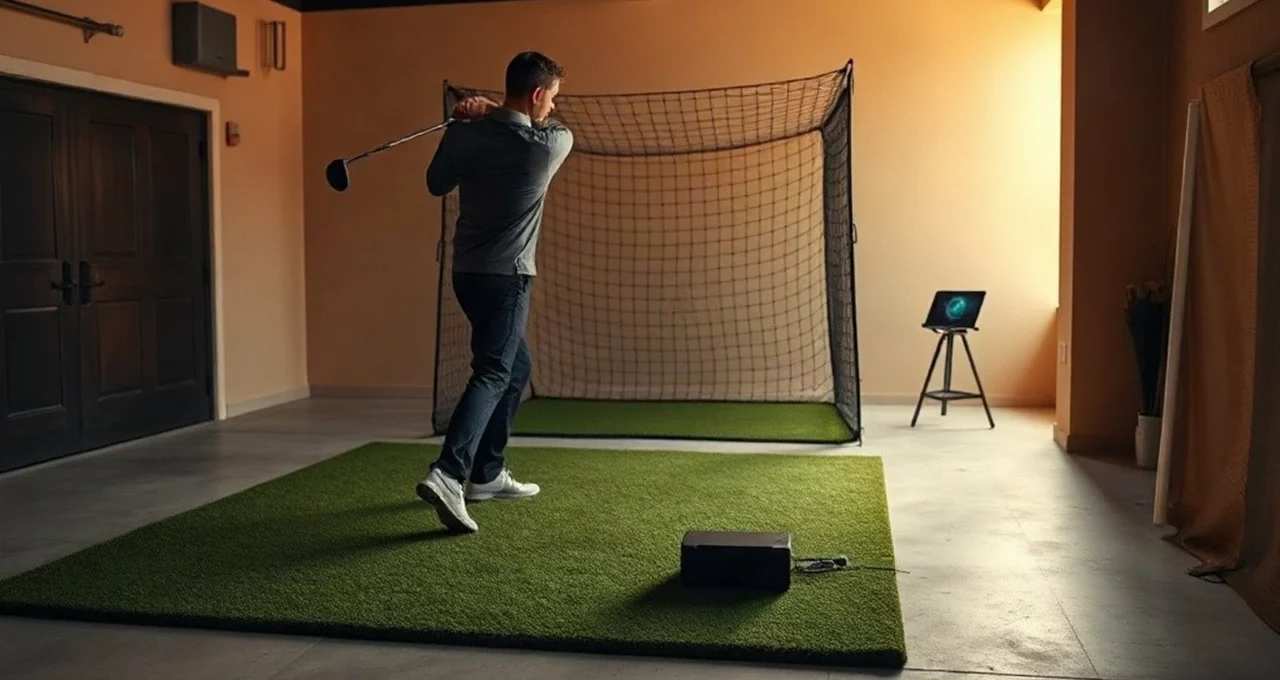
The launch monitor is only one part of a home simulator. To hit a real ball indoors you need four things.
- The launch monitor itself, which reads the ball, and sometimes the club, and turns that into numbers and a virtual shot.
- A net or an impact screen to stop the ball safely, with enough distance in front of it for the unit to see the ball fly.
- A hitting mat that will not punish your wrists or your elbows on a fat shot.
- A screen: a phone, a tablet, a laptop or a TV for most owners in this price range, a projector for the few who go further.
With a monitor at $500 to $700, the rest of a $1,000 budget goes on the net and the mat. A projector and an impact screen push the total well beyond it. That is the honest shape of a sub-$1,000 simulator: a good practice station with a small screen, and a full simulator once you add to it over time.
The second thing the sticker does not show is the software. Some of these units include course play for life, others need a yearly membership once the first year is over. Over three or four winters, that difference matters as much as the purchase price.
Garmin Approach R10
The R10 is the unit that made home launch monitors a mainstream purchase when it arrived. It is a small Doppler radar that sits behind the ball and pairs with a phone or tablet.
- Technology: radar, placed behind the golfer, looking down the target line.
- Data: ball speed, launch angle, launch direction, spin rate and spin axis, carry and total distance, plus club head speed, club path, face angle and smash factor, as listed by Garmin.
- Space: setup guides based on Garmin’s documentation place the unit about 6 to 8 feet behind the ball, with at least 8 feet of ball flight in front, so a room of roughly 16 feet deep at the very least.
- Software: the Garmin Golf app gives a virtual range and session data. Playing virtual rounds on Garmin’s Home Tee Hero courses requires a paid Garmin Golf membership. The R10 also works with third-party simulation software, some of it sold separately.
Price in the United States, read in October 2026 at a U.S. golf retailer: $499.99. It is the least expensive of the four.
Rapsodo MLM2PRO
Rapsodo’s unit combines a radar with two cameras, one of which films your swing and lays a shot tracer over it. It is the most practice-oriented of the four.
- Technology: radar plus a dual camera system, placed behind the ball. Your phone mounts on the unit.
- Data: ball speed, launch angle, launch direction, carry and total distance, club speed and smash factor. Spin rate and spin axis are measured with Rapsodo’s RPT balls, Titleist balls with a printed pattern the cameras can read.
- Space: retailer setup guides call for about 7 to 8 feet between the unit and the ball and roughly 8 feet from the ball to the net, so a room of about 15 to 16 feet deep.
- Software: what comes in the box depends on the seller and the period, from a 45-day Premium trial to a full year of membership, and Rapsodo has been reorganizing its plans around new Core and Studios tiers. The Premium membership has been listed at $199.99 a year in the United States. Simulation, course play and third-party software connections depend on a paid plan, so check what is included before you pay.
Price in the United States, read in October 2026 at a U.S. golf retailer: $549.99, sold with Titleist RPT balls.
Voice Caddie SC4 Pro
Voice Caddie, also sold under its Swing Caddie name, built its reputation on portable radar units for the range. The SC4 Pro is the newest version of its best-known model, with a screen on the unit itself.
- Technology: radar, behind the ball, with a built-in display so you can read numbers without a phone.
- Data: carry and total distance, ball speed, club speed, smash factor, launch angle and spin. Voice Caddie says the Pro adds spin axis, sidespin, backspin and dispersion, which the original SC4 did not show.
- Space: the unit goes behind the ball; check the manual for the exact distance, as reviews describe different setups.
- Software: no subscription. Access to E6 Connect simulation is included with the purchase, with a 3D range in Voice Caddie’s own app.
Price in the United States, read in October 2026 at a U.S. golf retailer: $599.99.
Square Golf Home Edition
The odd one out. Square is a camera unit, not a radar, and it is made for indoor use only. Its newer Omni edition also works outdoors but sits well above this page’s budget, at $1,599 on Square’s own store.
- Technology: cameras that photograph the ball at impact, in a compact unit placed beside the ball rather than behind you.
- Data: ball speed, launch angle, launch direction, spin and carry. Square sells marked balls for the most reliable spin readings, and club data relies on stickers.
- Space: because the unit sits next to the ball, it does not need the 6 to 8 feet behind the golfer that the radars want. You still need enough room to swing and a safe distance to the net or screen.
- Software: no subscription fee, and 1,000 credits included. Practice is free; rounds on Square’s own courses are paid with credits. Reviewers report connections to E6 and GSPro without extra fees from Square, though those programs have their own prices.
Price in the United States, read in October 2026: $699. It is the most expensive of the four, and the only one not carried at the retailer where the other three were read.
Side by side
| Unit | Technology | Placement | Spin | After year one | U.S. price, Oct. 2026 |
|---|---|---|---|---|---|
| Garmin Approach R10 | Radar | Behind the ball | Radar reading | Course play needs a Garmin Golf membership | $499.99 |
| Rapsodo MLM2PRO | Radar and cameras | Behind the ball | With RPT balls | Paid plan (Premium listed at $199.99 a year) | $549.99 |
| Voice Caddie SC4 Pro | Radar | Behind the ball | Radar reading | No subscription | $599.99 |
| Square Golf Home Edition | Cameras | Beside the ball | Best with marked balls | No subscription, credits for rounds | $699 |
Read the last two columns together and the ranking turns around. The two cheapest units are the ones that need a paid membership for course play. The two dearest are the ones you pay for once.
What golfers are saying
The same points come back in published reviews, the manufacturers’ own owner forums and retailer comments. Most of them are about indoor use, which is where these units are hardest to get right.
On the plus side:
- Ball speed and launch feel right for the money. This is the most consistent praise across all four. Reviewers who compared the SC4 Pro with a far more expensive camera unit found most numbers close, and the Plugged In Golf review of the Square reports spin within a few hundred rpm and carry within a couple of yards.
- Winter practice that counts. Owners describe the value less in the virtual rounds than in having numbers for every swing through the cold months: a carry chart for each club, a target to aim at, a reason to go to the garage three times a week.
- The swing video on the Rapsodo. MLM2PRO owners single out the impact camera and shot tracer as the feature that sets it apart. It turns a net session into a lesson you can watch back.
- No fees on the Voice Caddie and the Square. Owners who chose them often say so first: what they paid is what it costs.
On the minus side:
- Spin indoors is the weak point. It is the complaint that comes up most, for every unit. On Garmin’s own R10 forum, owners describe indoor carry distances one or two clubs shorter than on the course and spin that seems too high, with firmware updates helping some of them more than others. SC4 Pro reviewers name spin as the one figure that is sometimes clearly off. Rapsodo and Square ask for special balls to read it properly.
- The room is never quite big enough. The radars need distance behind the ball and in front of it, and owners with short garages report missed or odd readings once they cut that distance. The Square avoids the problem behind you, but asks for precise ball placement in a small hitting zone.
- Subscriptions add up. Rapsodo owners mention the yearly membership most often, and some note that third-party simulation will not connect without it. R10 owners make the same point about Garmin’s membership for course play.
- Consumables and connections. MLM2PRO reviewers find the three RPT balls in the box too few for a real session and say they wear quickly. Rapsodo’s own help pages deal with dropped phone connections, and owners of the radars mention odd readings on tops and shanks.
Nobody in these discussions is quoted by name here, nothing has been counted, and none of these impressions is a measurement. They are what comes back most often in public reviews and owner forums.
Where Americans put a home simulator
In the United States, the home simulator is mostly a garage or basement project, and the house decides more than the budget does.
- The garage. The most common choice, and the one that suits radar units best, because a garage is usually deep enough for the distance behind the ball and in front of it. The limit is the ceiling: measure it, then swing your driver slowly with your arms up before you buy anything. In the northern states, it is also a cold room from December to March, and a phone or tablet battery drains faster there.
- The basement. Common in the Midwest and the Northeast, warmer in winter, often too low for a full driver swing. Golfers with a low ceiling tend to stop at irons and wedges, which is where indoor numbers are most reliable anyway.
- The spare room. Rarely deep enough for a radar. This is where a side-mounted camera unit like the Square makes its case.
- The off-season. In the Sun Belt, many owners use the same radar unit outdoors on the range for most of the year. In the snow states, the unit spends five months indoors, and spin and room size matter much more.
To buy, the same few kinds of outlet carry these units. Golf stores with a hitting bay sometimes let you see a monitor work before you pay; online golf retailers and the brands’ own stores have bundles with a net and a mat, often cheaper than buying the parts separately; and the used market is busy every spring, when owners upgrade. Whichever you choose, ask what happens to the membership if you resell the unit, and how a sensor fault is handled under warranty.
How to choose before you spend
- Measure the room first. Depth from the wall behind you to the net, and ceiling height under a full swing. If the depth is short, a radar will struggle; look at a side-mounted camera unit.
- Price three winters, not one. Add any yearly membership to the purchase price before you compare.
- Decide what the screen is for. If you want practice numbers and swing video, a phone or tablet is enough. If you want to play full rounds on a big screen, budget for a projector and an impact screen on top.
- Accept the limits on spin. At this price, ball speed and launch are the numbers to trust indoors. Use spin as a trend, not as a fitting tool.
Under $1,000, a home simulator is a practice station first and a game second. Owners who bought it that way are the ones who still use it in March.
How this page was put together
This is a presentation of products and a reading of public opinion, not a test. Nobody at Panxis Golf set up, used or measured these units. Specifications come from the manufacturers’ published material, as shown on the brands’ product pages and reproduced on authorized U.S. retailers’ listings: Garmin for the Approach R10, Rapsodo for the MLM2PRO and its membership prices, Voice Caddie for the SC4 Pro and Square Golf for the Home and Omni editions. Space figures come from retailer setup guides based on the manufacturers’ documentation, and they vary by source.
Membership prices come from Rapsodo’s published U.S. plans and app store listings; Rapsodo’s plan names and trial lengths were changing when this page was written. Prices were read on October 27, 2026, in U.S. dollars, at Carl’s Golfland for the Garmin, Rapsodo and Voice Caddie units, and on Square Golf’s own U.S. store for the Square, which Carl’s did not list. PGA TOUR Superstore’s product pages could not be read when the prices were collected. Prices change often, especially before the holidays.
What golfers say was read in published reviews from Plugged In Golf, PlayBetter, Golfer’s Authority, Golfer Geeks, National Club Golfer and Golf Insider UK, in owner threads on Garmin’s Approach R10 forum, in Rapsodo’s help pages and in retailer customer reviews. Some of these were read only through search excerpts, and several of the review sites also sell these units. Nobody is quoted by name, nothing is counted, and no impression is presented as a statistic. There is no commercial link on this page, no affiliate arrangement and no commission of any kind. If content on this site is ever paid for by a brand, it will carry an advertising label at the top of the page, before the first line.