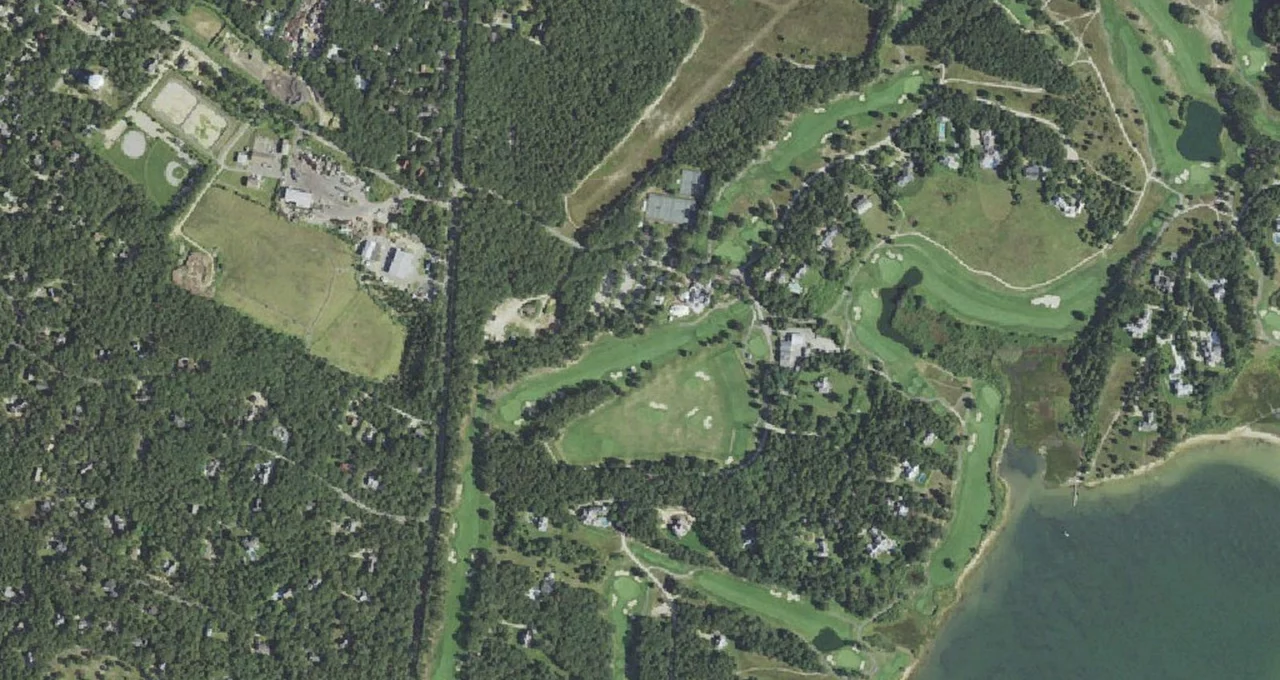
Farm Neck Golf Club from the air. Aerial imagery USGS, domaine public.
Farm Neck Golf Club
Holes
18
By
72
Length
6,741 yards from the Gold tees on the scorecard posted by the club (Blue 6,205, White 5,729, Green 4,954, Red 4,730); directories still list an older 6,815-yard Gold card rated 72.8 with a slope of 135 (GolfNow, Golfify)
Green fee
—
Best season
April 17 to November 29 in 2026, per the club's hours page; GolfNow lists April 10 to December 25; the club closes in winter
Farm Neck Golf Club is a semi-private 18-hole golf club in Oak Bluffs, on the north shore of Martha’s Vineyard, the island just south of Cape Cod in Massachusetts. OpenStreetMap and the club give its address as 1 Farm Neck Way, Oak Bluffs, MA 02557. The course sits beside Sengekontacket Pond, on what the club calls a peninsula, or “Neck,” of farmland “on the eastern edge of the Island abutting Vineyard Sound.” Golf Course Architecture and the American Society of Golf Course Architects put the property at about 425 acres. On the scorecard the club posts today, the course is a par 72 of 6,741 yards from the Gold tees.
Three things set Farm Neck apart. It was born out of a land-use fight in the 1970s, when a large housing development planned for the same ground was stopped, and its founders describe it as an attempt to save that corner of the island. It is semi-private but has kept public tee times, which made it, in the words of a 2004 Vineyard Gazette article, “the only public golf course on Martha’s Vineyard” at that time. And it is best known outside golf as the course where Presidents Bill Clinton and Barack Obama played during their island vacations. Between autumn 2023 and May 2025 it went through an 18-hole renovation by the architect Mark Mungeam, so many older descriptions of the course no longer match what is on the ground.
This page is a portrait built from public sources. It is not a review of a round, and nobody from Panxis has played the course.
From a blocked subdivision to a golf club
Golf on this part of the island predates Farm Neck by almost a century, although the sources do not tell exactly the same story. A 1949 history in the Vineyard Gazette by Henry Beetle Hough dates golf in Oak Bluffs to 1897, when amateurs laid out a nine-hole course with sand greens on a local farm; the course was later enlarged to 18 holes and renamed the Martha’s Vineyard Country Club. That article does not say whether it stood on today’s Farm Neck land. Two 2026 articles, one from the American Society of Golf Course Architects (reprinted from Golf Course Trades) and one on the regional site New England dot Golf, say that a Cottage City Country Club took shape at the north end of the present property in the late 19th century, when Oak Bluffs was a Victorian summer community, that the Scottish architect Alexander Finley formalized its layout in 1900, and that the club changed names and owners several times before fading in the late 1960s.
The modern story begins with a development plan. According to the Gazette’s 2004 history of the club, the brothers Moses and Alvin Strock bought more than 2,000 acres in 1967 and formed a company called Island Properties; the land was known as Waterview Farms. In the 1970s their company, by then called Strock Enterprises, proposed a golf course surrounded by 867 half-acre house lots, and the Oak Bluffs planning board approved the plan in 1974. After objections from islanders, the Martha’s Vineyard Commission, the regional planning body, froze the project. Four years of litigation followed, and in 1977 the Massachusetts Supreme Judicial Court upheld the commission. The company went bankrupt and the bank foreclosed. Wikipedia tells the same story in less detail.
In October 1978, a group of investors organized as Farm Neck Associates bought the land from the bank, the Gazette reports, and turned the project into a subdivision of 51 lots and an 18-hole course. The paper credits three men with creating the club: Charles Harff, Bob Fullem and Douglass Mabee, who was its president until 1983. Harff and Fullem were both lawyers and neighbors on Sengekontacket Pond. The club’s own “Our Beginning” page sums up the founders’ aim as saving “a pristine corner of Martha’s Vineyard from over-development” and creating “a first class, non-exclusive golf setting for all to enjoy.” Conservation was part of the deal: the Gazette says 85 acres were donated to the Felix Neck sanctuary, about 1.5 miles south of the course in a straight line, in 1979, and that the Felix Neck Wildlife Trust oversees about 260 acres of conservation easements around the course.
When the course opened, and who designed it, are the points on which sources disagree the most. Wikipedia says construction began in 1979 and that the course opened on July 3, 1980, and it credits Geoffrey Cornish, the prolific New England architect. The Gazette’s 2004 article also gives July 3, 1980 as the day members first teed off, on a course it describes as “far from finished,” but credits the design to Pat Mulligan, helped by Tony Paganis, who the paper says had built the original nine holes for Island Properties. The club’s About Us page calls the design “a collaboration of three architects, Geoffrey Cornish, Bill Robinson and Patrick Mulligan,” and its home page says “Since 1979.” Golf Course Architecture wrote in April 2025 that the course opened in 1980 as a nine-hole layout by Cornish and Robinson, with Mulligan adding a second nine; in September 2025 the same magazine dated the Cornish and Robinson nine to 1976 and Mulligan’s nine to 1980. The 2026 articles from the architects’ society and New England dot Golf say the Cornish nine debuted in 1976 along the pond and a second nine, by a “Patrick Milligan,” opened three years later. OpenStreetMap records a start date of December 19, 1979. Our reading is that a first nine existed before the club was formed and that the full 18 opened in 1980, but we cannot confirm it from a single reliable source, and the spelling of Mulligan’s name varies.
The club grew slowly at first. The Gazette counted 150 charter members in 1986 and, in 2004, 284 full members, 136 Island members and more than 850 names on a waiting list. It also reported that Tim Sweet had been general manager since the course was created; he is still quoted as general manager in the 2026 articles. Since 1986 the club has hosted a charity tournament for Martha’s Vineyard Hospital, and the Farm Neck Foundation raises money for island charities.
Presidents, recognition and a long renovation
Farm Neck’s fame beyond the island comes from its presidential visitors. Wikipedia says Bill Clinton played the course several times in the 1990s and that Barack Obama played it on August 24, 2009, citing an official White House photo caption. Wikipedia also says Boston Magazine named Farm Neck the top public course in Massachusetts in 2003, and the club states that Golf Digest’s “Places to Play” guide has consistently rated it four and a half stars out of five.
The course has been reworked in stages. Golf Course Architecture reports that Cornish and Brian Silva served as consulting architects until the early 2000s, that Silva renovated many bunkers in the 1990s, and that Mark Mungeam, Cornish’s former partner and protégé, was then appointed. The Gazette’s 2004 article mentions a driving range and yardage markers added in later work, some of them on the sites of original holes. Between 2011 and 2014 the club rebuilt all its greens to USGA specifications, according to Golf Course Architecture; the architects’ society dates Mungeam’s greens work and a first round of tree removal to 2013.
The latest project is the largest. Golf Course Architecture says a master plan was drawn up in 2022, the front nine was rebuilt from autumn 2023 to spring 2024 and the back nine from October 2024 to May 2025, with MAS Golf Construction of Hopkinton, Massachusetts, as contractor. Mungeam told the magazine that “many players complained that the front and back nines were too dissimilar in character and difficulty,” and that the goal was a more cohesive course that made better use of the site. The work, as described by the magazine and the architects’ society:
- Tees were renovated on every hole.
- Hundreds of small “cape” pines were removed, opening playing width and views of the Atlantic, especially from the third tee.
- The course’s 91 bunkers were reduced by roughly a third, and wooded areas and little-used rough were converted to native grass and waste sand.
- Native fescues, sedges and bluestems were transplanted from elsewhere on the property to frame all 18 fairway corridors, replacing a parkland look with the island’s sandplain grassland.
- About 10 acres of fairway were added, using bentgrass salvaged from the tee rebuilds.
- On the 14th, a fairway bunker was removed and the approach widened; on the 15th, the green was rebuilt and recontoured and a greenside bunker on the left removed.
- The area between the 3rd and 5th holes, a former borrow pit grown over with pitch pines, was reshaped with about 120 yards of informal bunkering and native vegetation.
The architects’ society reports that Golf Inc. listed the project among its 2026 Renovations of the Year.
What the course asks of you
Farm Neck is a full-length par 72 with ten par 4s, four par 5s and four par 3s: the front nine holds three of the par 3s, the back nine only one. The scorecard posted on the club’s website gives these totals: 6,741 yards from the Gold tees, 6,205 from the Blue, 5,729 from the White, 4,954 from the Green and 4,730 from the Red, with combination tees between them. The front nine is a par 35 and the back nine a par 37, and the back nine is the longer of the two by more than 500 yards from the Gold tees. Hole by hole from the Gold tees, the club’s card reads:
- Front nine: 1st, par 4, 396 yards; 2nd, par 5, 537; 3rd, par 4, 362; 4th, par 3, 173; 5th, par 4, 351; 6th, par 3, 197; 7th, par 4, 385; 8th, par 5, 512; 9th, par 3, 200. Out: 3,113 yards, par 35.
- Back nine: 10th, par 4, 426; 11th, par 5, 551; 12th, par 4, 404; 13th, par 4, 365; 14th, par 4, 348; 15th, par 3, 179; 16th, par 4, 412; 17th, par 4, 403; 18th, par 5, 540. In: 3,628 yards, par 37.
The club’s card carries no course rating or slope. The ratings published by golf directories (GolfNow, Golfify and Stymie) belong to an older card of 6,815 yards from the Gold tees, rated 72.8 with a slope of 135 for men, and 6,301 yards from the Blue tees, rated 70.5 with a slope of 133. Several of that card’s holes are longer or shorter than on the club’s current one: the 18th is 552 yards there against 540, and the 17th 418 against 403. We assume the club’s card reflects the renovated course, but we could not confirm when it was issued or whether the course has been rerated.
The setting shapes the round. The club describes holes that move through woodland, open meadow and salt marsh to overlooks and “intimate brushes with the ocean’s edge,” and its golf page says water and marshes come into play on many holes. The 2026 articles say the Atlantic is visible from 10 holes. The front nine, the original Cornish nine according to those articles, runs along Sengekontacket Pond on the south side of the property, while the second nine was built on and around the old Cottage City ground; only the 14th follows the historic routing. Wind off the water is a recurring factor in golfer reviews. The fairways and greens are bentgrass, which Mungeam says firms up in the fall for hard, fast conditions. A few holes stand out:
- The 3rd, a par 4 of 362 yards from the Gold tees, is the hole every source mentions for its view. The Gazette’s 2004 article cites its sweeping view of Sengekontacket Pond, Golf Course Architecture says the tree removal opened Atlantic views especially from its tee, and a 2023 Gazette column wrote, “It’s hard to beat a view from the third tee at Farm Neck Golf Club.”
- The 7th, a par 4 of 385 yards, is stroke index 2 on the club’s card, the hardest hole on the front nine.
- The 12th, a par 4 of 404 yards, is the number one stroke-index hole for men on the club’s card.
- The 13th and 14th run along Beach Road: a local rule on the club’s site says the bike path beside the road marks out of bounds on the left of both holes. The 14th, a par 4 of 348 yards, is the one hole that follows the old Cottage City routing, and its approach was widened in the renovation.
- The 15th, a par 3 of 179 yards, has a green rebuilt and recontoured in 2025, with its left greenside bunker removed.
- The 18th, a par 5 of 540 yards, closes a back nine that ends with three holes of 400 yards or more.
The local rules have one island touch: any ball moved or stolen by seagulls is to be replaced or played from its original lie.
What golfers say
Public reviews of Farm Neck are fewer than for a busy mainland course, and many of the pages that collect them refused our requests. What follows summarizes recurring themes from what we could read in October 2026: the summary of 88 reviews (average 4.5 out of 5) shown by the travel site Airial, which does not name its source; excerpts of reviews on Tripadvisor, GolfPass and Golf Digest’s panel shown in search results, since those sites blocked us; and the 2023 Vineyard Gazette column, written by a non-member. Most of these reviews predate the 2023 to 2025 renovation or are undated, so some comments may describe a course that has since changed. These are other people’s opinions, not ours, we name no reviewer, and nobody from Panxis has played the course.
What comes up in its favor
- The views: by far the most frequent praise, especially of the pond and the ocean from the front nine and from the 3rd, 4th and 14th holes.
- Course condition: reviewers repeatedly describe the course as well kept and the greens as fast and true, and a Golf Digest panelist noted after the renovation that it played firm and fast with more open views.
- The layout: seen as strategic and demanding but fair, with ocean-side holes that play into changing winds.
- The staff and the setting: friendly service from the pro shop, carts and café, and, in the Gazette’s words, a place that is “charming, classy, intimate.”
- Pace of play: several reviewers report rounds of about four hours, helped, one summary says, by staggered tee times.
What comes up against
- Cost: the most frequent complaint. Even reviewers who liked the course call it expensive, and some find it overrated for the price.
- Access in summer: non-members say peak-season tee times are hard to get, a point Wikipedia and the Gazette also make, and that the range is open to them only before a booked round.
- Rangers: some visitors felt pushed on pace even when they were keeping up, and one wrote not to expect a “member for the day” experience.
- Bunkers: a recurring complaint in reviews written before the renovation reduced their number.
- Wind, which can make the waterside holes much harder, and crows that raid unattended food.
Getting there and playing
Farm Neck describes itself as a semi-private club. Its membership page says all membership categories (full, Island and junior) were full when we read it, with waiting lists; Island membership is reserved for year-round residents of ten years or more who are registered voters in one of the island’s six towns. Public play remains open: the club’s booking page says public tee times can be reserved three days in advance online, or by calling the golf shop, which also handles single players, and it runs a virtual waitlist for times already taken. New England dot Golf says members dominate the tee sheet in July and August, and the general manager says the club prices its golf in spring and fall to attract public play. We do not report green fees, which vary by season and time of day; the club publishes them on its site.
According to the club’s 2026 fee schedule, electric carts and range balls are included in all green fees. The club’s rules allow no more than two players per cart and keep carts on paths, fairways and maintained rough, never in the native grass or woods. We found no clear statement from the club on walking; the Stymie directory lists walking as permitted. Practice facilities include a driving range and putting, pitching and chipping greens, but the range is open to public players only to warm up before a tee time on the day of play. The club expects proper golf attire, with no denim, aims for “four hour golf,” and offers lessons, club rental, a café and tennis courts. GolfNow lists metal spikes as not allowed.
The season is long for New England but not year-round. The club’s 2026 hours page runs from April 17 to a final day on November 29, with greens aeration days in June and September when all play is nine holes; GolfNow lists an April 10 to December 25 season, and the general manager notes that the club closes for winter. The 2026 articles describe September and October as the most temperate months on the island.
Martha’s Vineyard can be reached only by boat or by air. Measured on the map in a straight line, the course is about 1.5 miles from the Steamship Authority ferry terminal in Oak Bluffs, about 2.2 miles from the terminal in Vineyard Haven, about 4 miles from Martha’s Vineyard Airport and about 8 miles from the ferry dock at Woods Hole on Cape Cod. The center of Edgartown is about 4.2 miles away. These are straight-line distances, not road distances. The general manager recommends a rideshare from the ferry or the airport and a rented bike during the stay rather than bringing a car.
How we built this page
The factual frame comes from public sources: OpenStreetMap and Wikidata for the location, address and identifiers; the club’s website, farmneck.net, for its About Us, golf, membership, booking, hours and etiquette pages, its 2026 fee schedule (used only for what is included, not for amounts) and the scorecard PDF it posts; Wikipedia’s article on the club; the Vineyard Gazette for its 2004 history of the club, its 1949 history of island golf and its 2023 column on island courses; Golf Course Architecture for its April and September 2025 articles on the renovation; the American Society of Golf Course Architects and New England dot Golf for their 2026 articles; GolfNow, Golfify, Stymie and Hole19 for directory data; and Airial, Tripadvisor, GolfPass and Golf Digest for reviews. GolfPass, Golf Digest and Tripadvisor refused our requests, so we used only the review excerpts shown in search results, and we could not read their full pages.
Where sources disagree, we say so. The opening is dated 1976 (a first nine), 1979 or July 3, 1980 depending on the source, and OpenStreetMap records December 19, 1979. The design is credited to Geoffrey Cornish alone by Wikipedia, to Pat Mulligan with Tony Paganis by the Gazette in 2004, to Cornish, Bill Robinson and Patrick Mulligan by the club, and to Cornish and a “Patrick Milligan” by the 2026 articles. The length is 6,741 yards from the Gold tees on the club’s card, 6,815 yards in Wikipedia and the directories, 6,807 yards in GolfNow’s summary and “6,800 yards” in a Golf Digest quotation on the club’s site; GolfNow’s summary rating of 72.1 and slope of 129 do not match its own tee table. Hole19 shows a 5,761-yard card that matches no other source. The date of the 85-acre gift to Felix Neck is 1979 in the Gazette and “shortly after the course was completed” in Wikipedia. The link between the 19th-century Oak Bluffs course and today’s property rests on the 2026 articles alone.
Some details will age: the reviews, most of them written before the renovation; the ratings, which may change if the renovated course is rerated; the season dates and booking rules, which the club revises each year; and the membership waiting lists. The opinion section reports recurring themes rather than individual voices. Nobody from Panxis has played or visited this course, and this page is no substitute for a round.
The club has not paid for this page, has not seen it before publication and has no say over its content. This page contains no commercial link and earns us no commission. If you know the club and something here is wrong or out of date, write to us and we will correct it. The club’s golf page links to its current scorecard, and its booking page sets out the rules for public tee times.
Other courses nearby
Closest to this one in our United States directory:
- The Bay Club at Mattapoisett — 21 mi
- TPC Boston — 51 mi
- Blue Hill Country Club — 59 mi
- Brae Burn Country Club — 71 mi
The hole to know
A par 4 of 362 yards from the Gold tees, the hole every source cites for its view: over Sengekontacket Pond according to the Vineyard Gazette, and toward the Atlantic since the 2023 to 2025 tree removal, according to Golf Course Architecture.