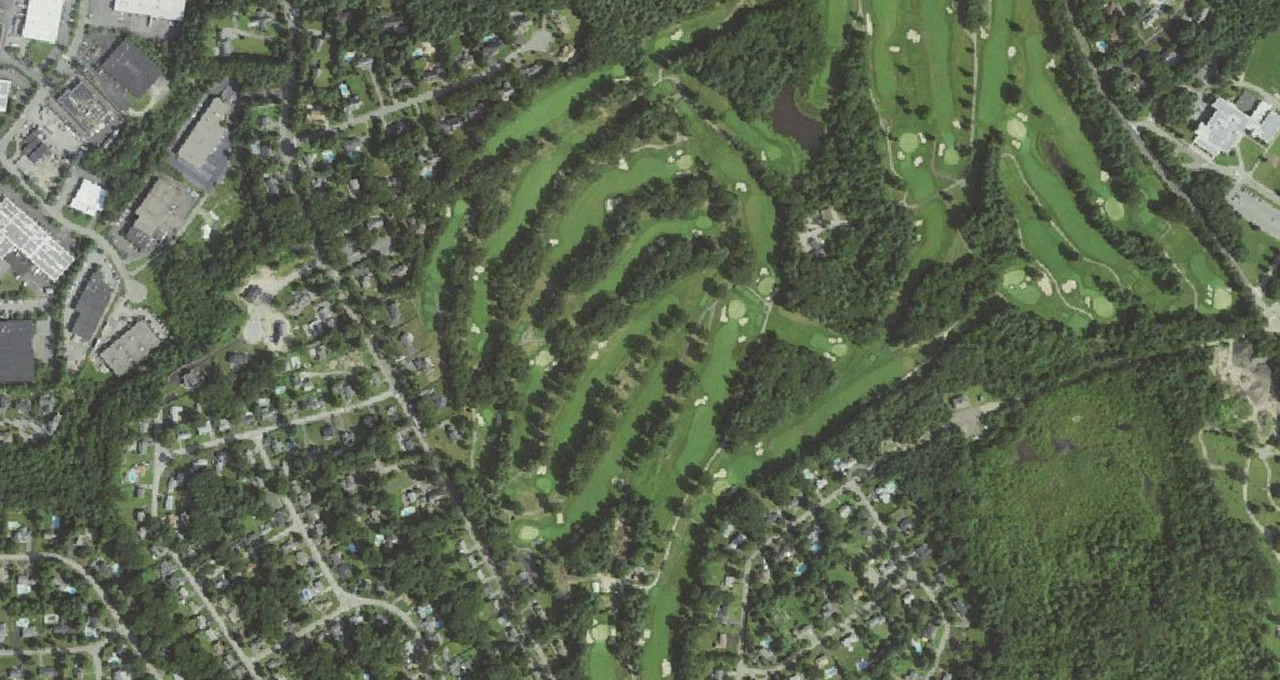
Blue Hill Country Club from the air. Aerial imagery USGS, domaine public.
Blue Hill Country Club
Holes
18
By
72
Length
6,646 yards from the Black tees on the club's hole-by-hole card (rating 73.0, slope 130 according to directories); some directories give 6,563 yards. Plus the nine-hole Challenger Course, par 34, 2,697 yards on the club's card
Green fee
—
Best season
—
Blue Hill Country Club is a private club at 23 Pecunit Street in Canton, Massachusetts, a town in Norfolk County south of Boston. It has 27 holes: the 18-hole Championship Course, laid out in 1925 by Eugene “Skip” Wogan, and the nine-hole Challenger Course, built in 1961 by his son Phil. The club takes its name from Great Blue Hill, the high point of the Blue Hills range just to the north, which the club says owes its name to the bluish tint of its exposed granite.
The Championship Course is a par 72. On the hole-by-hole card the club publishes, it measures 6,646 yards from the Black tees and 5,388 yards from the forward Red tees. Golf directories give it a course rating of 73.0 and a slope of 130 from the Black tees. Its main claim to fame is a single week in July 1956, when it hosted the PGA Championship, the only time that championship has been played in Massachusetts. It was also an LPGA Tour stop from 1991 to 1997. The details, and the points on which the sources do not agree, follow.
A 1925 course by a Donald Ross protégé
Skip Wogan is not a famous name outside New England, but his career is well documented by the New England PGA, which inducted him into its Hall of Fame in 1999. According to that citation, he started caddying at Oakley Country Club in Watertown at the age of twelve, where Donald Ross was the head professional. Ross made him his personal caddie and later his assistant, took him along when he moved to Essex County Club in Manchester in 1910, and recommended him as his successor when he left for Pinehurst three years later. Wogan stayed at Essex as head professional and greenkeeper until his death in 1957, after forty-seven years there.
Alongside that job, he designed courses. The Hall of Fame citation lists “Blue Hills” among them, with Bellevue, Sankaty Head and Webhannet, and he was one of the founders and the first president of the organization that became the New England section of the PGA of America. The section’s player of the year award carries his name. Course directories and the club’s own pages date the Blue Hill design to 1925, which is also the year local press gives for the club’s arrival in Canton.
His son Phil Wogan (1918 to 2010) took over at Essex after his father died and continued the family design firm, E.F. Wogan and Sons, until 2004. The American Society of Golf Course Architects, which elected him a Fellow in 1989, credits him as the primary architect of more than 40 New England layouts. At Blue Hill he built the nine-hole Challenger Course in 1961, on land next to his father’s eighteen. The club describes him as having learned the trade working side by side with his father.
Restoration, money troubles and a sale
The modern history of the course begins with Ron Prichard, an architect known for restoring Donald Ross courses. The club says he restored the Championship Course in 2003; Wikipedia says both courses. A 2004 regional golf newsletter, which we could only read in excerpts, quotes a club representative explaining that work began in November 2002 and that the first winter was very difficult. In that account, three greens were rebuilt, the bunkers around every green were rebuilt so that the putting surface became the highest point of each green complex, and the new bunkers were meant to undo a 1984 bunker job that was out of character with the course. While the work was going on, the club kept 18 holes in play by using the Challenger nine. A reviewer writing in 2025 adds that the club completed an irrigation and course improvement project in 2003 and 2004.
The following decade was harder. For about 90 years the club was owned by its members through a company called Blue Hill Associates, according to the Boston Globe. In February 2013 the Canton Citizen reported that Troon had been chosen to manage the club, then still member-owned. In July 2015 the Globe reported that the 210-acre property was on the market through a golf course brokerage, and that a clubhouse of about 45,000 square feet, dating from 1956, stood on it. Around the time of the sale, the Canton Citizen described long-running debates among members over how to fund repairs, and reported that several prospective buyers had wanted to develop the land.
The buyer was Concert Golf Partners, a company based in Newport Beach, California, that owns private clubs across the United States. The deal was announced in 2015 and closed in the winter of 2015 to 2016, according to the Canton Citizen. Under it, the club’s debts were paid off, dues were lowered by 30 percent, future assessments on members were ruled out, and the new owner agreed in writing to keep all 27 holes, including the Challenger nine that developers had eyed for housing. The club is still listed as an affiliate of Concert Golf Partners on its website today.
The new owner expanded the driving range and the short-game area, created a members’ lounge and renovated a third-floor banquet room with views toward the Boston skyline, according to local press and a 2025 review. The Challenger Course also changed. A reviewer writing in 2020 reports that four of its holes were altered and some land was sold to help finance the purchase, and that its first hole was turned into a par 3 to make room for the range. That is why older and newer sources give different figures for the nine, as explained below.
The 1956 PGA Championship and the LPGA years
The 1956 PGA Championship was played at Blue Hill from July 20 to 24, according to Wikipedia, as a match-play event with a field of 128 professionals. The course was set up as a par 71 of 6,634 yards. Jack Burke Jr., who had won the Masters in April, beat Ted Kroll 3 and 2 in the 36-hole final. Burke was three down after 19 holes, won five of the next seven, and the match ended on the 34th hole when Kroll made bogey on a par 3. In the semifinals Burke needed an extra hole to get past Ed Furgol, while Kroll beat Bill Johnston 10 and 8; in the quarterfinals Kroll had eliminated Sam Snead. Burke became the second player, after Snead in 1949, to win the Masters and the PGA Championship in the same year. Wikipedia notes that Blue Hill was not highly regarded as a championship venue at the time. It was the second-to-last PGA Championship played at match play, before the switch to stroke play in 1958.
From 1991 to 1997 the club hosted the LPGA Tour event that later became known as the PING/Welch’s Championship, after it moved from Ferncroft Country Club in Danvers. According to the event’s Wikipedia page and other tournament records, the winners at Blue Hill were Juli Inkster (1991), Dottie Pepper (1992), Missie Berteotti (1993, after a five-hole playoff against Pepper, then playing as Dottie Mochrie), Helen Alfredsson (1994), Beth Daniel (1995), Emilee Klein (1996) and Liselotte Neumann (1997). Beth Daniel’s winning total of 271, seventeen under par, was the lowest of those seven editions. The Boston Globe adds that the club hosted a U.S. Women’s Open qualifying round in 1998.
The club continues to host competitions. Its own pages mention many Massachusetts Golf Association qualifiers and championships. In June 2025 it was a site for U.S. Amateur local qualifying, where, according to the Massachusetts Golf Association, two players shared the medal with 68 and nine advanced to final qualifying. The club has also hosted a Golfweek junior invitational (2012) and the Boston College women’s intercollegiate tournament.
What it asks of you
The Championship Course is a parkland layout on rolling ground, with tree-lined fairways, many bunkers and very little water. The club’s hole notes mention only a pond on the 3rd that long hitters can reach and water to the right on the 5th, which the club calls the only water on the course. Several greens sit on high ground, so short approaches roll back. Around the time of the sale, the club president of the time told the Canton Citizen that the first four holes are among the toughest opening stretches he knows, and that the greens run fast and true.
The card bears him out. The 1st, 2nd and 3rd are all par 4s of more than 430 yards from the Black tees, and the 2nd is the men’s number one stroke index. After that the course offers chances: two short par 4s, the 6th (299 yards) and the 15th (357 yards), a 132-yard par 3 at the 7th, and two par 5s under 500 yards, the 9th and the 18th. The back nine has the longest par 5, the uphill 12th at 533 yards, and the longest par 3, the 13th at 229 yards. Reviewers note that fairway bunkers line the par 5s, which is how the course defends itself against long hitters despite its modest length.
The club publishes the following pars and Black tee yardages, with the men’s stroke index in brackets. The front nine measures 3,290 yards and the back nine 3,356.
- 1st: par 4, 434 yards (5). A wide fairway sloping left to right, with bunkers on both sides and a small green guarded by two bunkers. The club calls it deceptively easy.
- 2nd: par 4, 431 yards (1). A large elevated green that falls away on all sides; according to the club, a short approach rolls back 20 to 30 yards.
- 3rd: par 4, 432 yards (7). A slight dogleg with a pond in the distance, and a long iron or hybrid to a large green.
- 4th: par 3, 198 yards (15). A large green sloping off at the front and the back right.
- 5th: par 4, 389 yards (9). Straight, to an elevated green, with water to the right.
- 6th: par 4, 299 yards (13). Drivable for long hitters; three bunkers and a turtleback green.
- 7th: par 3, 132 yards (17). A shallow green with three pot bunkers in front.
- 8th: par 5, 517 yards (3). Out of bounds left, a cross bunker on the second shot, and a very small green sloping sharply from back to front.
- 9th: par 5, 458 yards (11). Short and well bunkered; the club calls it a birdie or eagle chance.
- 10th: par 4, 410 yards (4). Out of bounds left and a green with sharp slopes all around; the club calls par an accomplishment.
- 11th: par 4, 418 yards (8). Played from an elevated tee.
- 12th: par 5, 533 yards (2). A three-shot hole uphill all the way to a small green.
- 13th: par 3, 229 yards (14). Usually into the wind, with a spine across the green.
- 14th: par 4, 407 yards (6). An elevated tee with a view of Blue Hill, and a small green with three bunkers.
- 15th: par 4, 357 yards (12). A short hole with a small green surrounded by bunkers; front pins can send balls off the green.
- 16th: par 3, 182 yards (18). Downhill to a very small green that slopes from back to front.
- 17th: par 4, 338 yards (16). A well-placed drive leaves 120 to 150 yards to a large, fairly flat green.
- 18th: par 5, 482 yards (10). Bunkers left and right off the tee, a deep bunker front right and a steep collection area to the left of a small green.
The card lists five sets of tees. Adding up the club’s hole-by-hole figures gives 6,646 yards from Black, 6,376 from Gold, 6,138 from White, 5,621 from Blue and 5,388 from Red. The club does not print ratings on its online card. Directories give 73.0 and 130 from the Black tees, and a 2020 reviewer gives 71.5 and 126 from the Gold tees. For women, the club lists the 1st and the 9th as par 5s and the 8th as a par 4, so the women’s par is also 72. On two holes, the 9th and the 12th, the card shows the Red tee as long as or longer than the Blue tee.
The Challenger nine
The club calls the Challenger Course harder than the main eighteen. Its current card, on the club’s website and in the 18Birdies app, shows a par 34 of 2,697 yards from the Black tees, with four par 3s, including an uphill opener of 175 yards, a 196-yard par 3 at the 6th with a green that slopes hard from back to front, and a 9th played over water to a narrow fairway. According to the club, its 4th hole was the 12th hole of the Championship Course back in 1965. The 2nd, a par 5 of 506 yards with three deep bunkers about 100 yards from the green, is the hardest hole on the nine.
What golfers are saying
As a private club, Blue Hill has few public reviews of its main course. The most detailed come from four reviewers on the Top100GolfCourses site between 2020 and 2025, which ranks it 48th in Massachusetts; short comments from the Golf Digest panel and from GolfPass users, which we could only read in search summaries because both sites refused our requests; and app ratings for the Challenger nine, which has about fifty reviews on 18Birdies with an average close to the maximum. We report recurring themes rather than individual voices.
What they like
The land comes first. Reviewers describe rolling terrain, good soil, little water, tees and greens set on high points and a varied mix of long and short holes. One calls it under-rated, the kind of course that would be among the top ten in many states but gets less attention in a state as rich in golf as Massachusetts. The greens draw praise for their movement on holes like the 8th, 10th and 12th, and app users describe the greens as fast. Another reviewer, writing in 2025, finds the course mature and more picturesque than ever. Several mention the strong openings on both nines, the fairway bunkering that makes the short par 5s harder than they look, and the porch of the clubhouse overlooking the 18th, a good spot after a round. Staff friendliness also comes up.
What they like less
The most common criticism is trees. Two reviewers writing in 2020 argue that too many trees now crowd several holes, limit the shots players can play and hide the original design, and call for a planned removal program. The same reviewers find the bunkering repetitive in shape and placement, some bunkers too large for their purpose, and the green surrounds lacking closely mown chipping areas. The par 5s are seen as too short for good players; one reviewer suggests turning two of them into par 4s. Others mention high rough, a routing whose quality varies from stretch to stretch, a layout that a Golf Digest panelist found somewhat basic, and greens that one GolfPass user found slow on the day. Several conclude that the course is below its potential. On the Challenger nine, app users in 2025 and 2026 mention damaged or temporary tee boxes during repair work.
Nobody from Panxis has played the course. This section is a summary of what others have written, not our own judgment.
Who can play
Blue Hill is a private club: golf is for members and their guests, and there are no public tee times. The club lists three categories on its membership page. Full golf membership covers both courses, the practice facilities, the pool and dining, club tournaments, and reciprocal access to other Concert Golf Partners clubs and the Links2Golf network. Challenger membership covers only the nine-hole course, practice facilities, pool and dining. Social membership covers the pool, open from Memorial Day to Labor Day, and dining, with no golf. All categories extend to a spouse or partner and children aged 24 and under. Optional packages include a limited number of guest passes each year. Prospective members can ask for a tour through the membership office.
Outside membership, the main way onto the course is an event. Wikipedia says the course is available for private and charity outings on Mondays from May through October, and the club hosts weddings, meetings and other events in its clubhouse. Directories list a driving range, a putting green, a chipping green and a practice bunker, motorized and pull carts, club rental, club fitting and lessons; one lists caddie service. The golf professionals run programs for men, women, seniors, juniors and couples. Other facilities include a heated pool, a fitness center, a members’ lounge with golf simulators, and summer camps and junior clinics. The club does not publish its season dates.
Getting there
The club is at 23 Pecunit Street, Canton, MA 02021, and its main switchboard, listed on its contact page, also reaches the golf shop. Measured in a straight line from the middle of the course, the summit of Great Blue Hill is a little over two miles to the northeast, the Canton Junction commuter rail station about a mile and a half to the southwest, and Route 128 station, served by Amtrak and commuter rail, about two miles to the north. The Massachusetts State House in downtown Boston is about 13 miles to the north-northeast, which matches the club’s “15 minutes outside of Boston” in light traffic. Boston Logan International Airport is about 14 miles away and Providence about 28 miles to the southwest. These distances are measured on the map and not by road.
Green fees
Blue Hill does not sell rounds to the public and publishes no green fees, so none are given here. Guest play is arranged through a member, and membership costs are given by the club’s membership office on request. For rates and anything else, start with the club’s own website.
How this page was made
The factual frame comes from public sources: OpenStreetMap for the location and the outline of the course; Wikidata (Q4929228) and Wikipedia for the entity record, the course figures and the outing policy; the club’s website for the hole-by-hole cards and hole descriptions of both courses, the golf, membership, contact and “About Us” pages; the New England PGA’s 1999 Hall of Fame citation for Skip Wogan; the American Society of Golf Course Architects for Phil Wogan; Wikipedia for the 1956 PGA Championship and the LPGA event; the Boston Globe (July 2015) for the sale, the acreage and the clubhouse; the Canton Citizen (2012 to 2016) for local history, management and the sale; the Massachusetts Golf Association for the 2025 qualifier; a 2025 review on GolfGuide.com and four reviews on Top100GolfCourses for the course and recent changes; excerpts of a 2004 newsletter archived by Michigan State University’s library for the restoration; and the 18Birdies, Hole19, GolfPass, GolfNow, Foretee, privateIQ and Golf Digest listings for directory data and reviews. The GolfPass, Golf Digest and Yelp pages refused our requests, and the full text of the 2004 newsletter was not available to us.
Where sources disagree, we say so. The Championship Course measures 6,646 yards on the club’s card, in Wikipedia, in the Canton Citizen and in most directories; Foretee and another directory give 6,563 yards with a rating of 72 and a slope of 128, which probably reflects an older card; 1956 records give 6,634 yards at par 71; one 2020 reviewer writes “par 70 or 72”. The Challenger Course is a par 35 of 2,954 yards in Wikipedia, GolfPass and a 2025 review, while the club’s current card and 18Birdies show a par 34 of 2,697 yards; a Canton Citizen profile from the time of the sale describes a 453-yard par-4 6th that no longer appears on the card. The 2020 review explaining the alterations accounts for that gap. The 18Birdies listing for the Challenger nine also shows an 18-hole card made of the nine played twice. Prichard’s 2003 work concerned the Championship Course according to the club and both courses according to Wikipedia and a 2013 article. The sale is dated 2015 by most sources and early 2016 by the Canton Citizen, which reflects the gap between announcement and closing. The club’s hole notes give the 13th as 220 yards and the 3rd as a slight dogleg left, while its card says 229 yards and one reviewer describes the 3rd as a dogleg right; the club calls the water on the 5th the only water on the course, while its notes on the 3rd mention a pond. One reviewer lists the 9th as a par 4 for men, against par 5 on the club’s card, which we follow. Wikidata places the club about seven tenths of a mile north of the course outline in OpenStreetMap; we use the OpenStreetMap position. Directory phone numbers differ from the club’s own, which we use. One directory lists the club as founded in 1961 in Fitchburg, which we consider a mix-up with the Challenger Course; another still lists it as member-owned.
Some details will age: the owner, the membership categories and their privileges, the staff, the review counts and scores, the directory ratings and the facilities are those published up to October 2026, when we read them. The opinion section summarizes reviews read in October 2026. Nobody from Panxis has played or visited this course, and this page is no substitute for a round.
The club has not paid for this page, has not seen it before publication and has no say over its content. This page contains no commercial link and earns us no commission. If you know the club and something here is wrong or out of date, write to us and we will correct it.
Other courses nearby
Closest to this one in our United States directory:
- Brae Burn Country Club — 11 mi
- TPC Boston — 15 mi
- The Bay Club at Mattapoisett — 39 mi
- Abenaqui Country Club — 58 mi
The hole to know
The men's hardest hole on the card: a par 4 of 431 yards from the Black tees to a large elevated green that falls away on all sides. According to the club, an approach left short rolls back 20 to 30 yards down the slope.