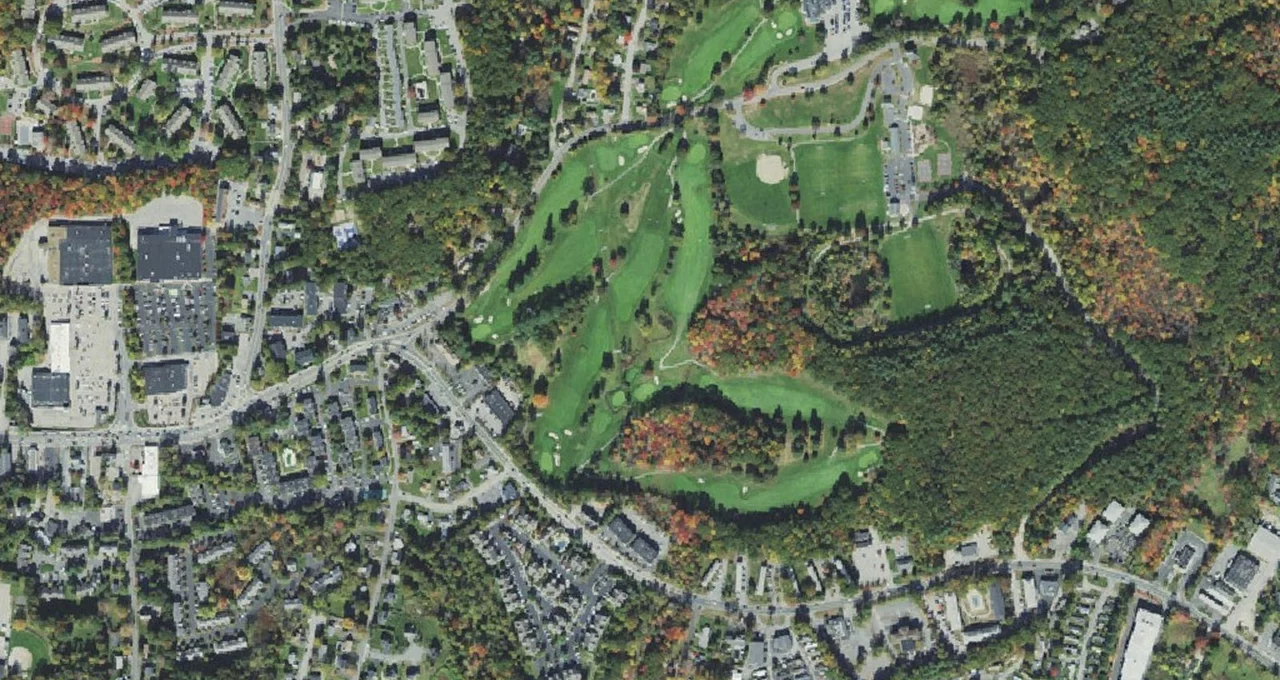
Marlborough Country Club from the air. Aerial imagery USGS, domaine public.
Marlborough Country Club
Holes
18
By
71 for men, 72 for women (the 2nd is a par 4 for men and a par 5 for women), according to the club's scorecard
Length
6,505 yards from the Black tees (rating 72.4, slope 138) on the club's scorecard and 18Birdies; GolfNow gives 6,494 yards (72.7, slope 131), GolfLink and Foretee 6,464 yards (71.0, slope 126). Other tees: Blue 6,122, White about 5,640, Red/White 5,299, Red 4,991
Green fee
—
Best season
Not stated by the club; GolfNow lists April 15 to November 15. Course open 7:30 a.m. to dusk (club)
Marlborough Country Club is an 18-hole golf club on Concord Road in Marlborough, Massachusetts, a city in the MetroWest region between Boston and Worcester. The club describes itself as a private golf course that accommodates public play on Mondays and Tuesdays, and it states on its about page that it is owned and managed by its membership. Its golf is a combination of two eras: a back nine laid out by Wayne E. Stiles and opened in 1922, and a front nine added by Geoffrey Cornish and William G. Robinson around 1970. From 1981 to 1983 the club hosted a Senior PGA Tour event, won in turn by Bob Goalby, Arnold Palmer and Don January.
The clubhouse complex includes the Eastside Grille, a restaurant the club says is open to the public and overlooks the 10th and 18th holes, along with function rooms used for weddings, meetings and golf outings. This page is about the golf course.
History: a poor farm, a speakeasy and two architects
The club’s own history page, which draws on newspaper archives, is the most detailed source we found, and most of what follows comes from it. The original clubhouse was a house built in 1770 for Joab Stowe. In 1921 a group called the Black and White Club, named after the white house with black shutters, occupied it. The land for the first nine holes was bought by the Black and White Club from the city of Marlborough and included the city “poor farm.” MCC, Incorporated was organized on March 18, 1921, according to the club.
The course was formally opened on Saturday, June 3, 1922, as announced in the Boston Evening Globe on May 20, 1922. The club reports that the mayors of Boston and Marlborough, James M. Curley and Edward T. Simoneau, attended, and that the feature match was a four-ball in which Francis Ouimet, the 1913 U.S. Open champion, and Larry Paton beat Ed Childs and Parker Schofield 2 and 1, with Ouimet shooting 78. Wikipedia gives the same opening date and the same match.
The decades that followed were unsettled. According to the club, a new clubhouse was completed in May 1923, while the old Black and White Club building became a restaurant that it calls a popular “speakeasy.” That newer clubhouse, on the site of today’s pro shop, burned on April 19, 1933. Ownership changed several times after the death of the owner in 1933, and in 1952 the Marlborough Realty Company bought the property and MCC, Incorporated took over its management, financed by the sale of shares. The club writes that in the early 1950s members did much of the maintenance themselves, painting and planting trees. A partial fire in 1977 led to the addition of the Marlborough Room and the lounges.
The architecture is credited consistently, with small variations in spelling and dates. The club’s history page says the current back nine was designed by Wayne E. Stiles in 1921 and completed in 1922, and notes that Stiles and his partner John Van Kleek designed nearly 100 courses in 14 states, more than thirty of them in Massachusetts and New Hampshire. The club’s golf page, Wikipedia, Foretee and Hole19 spell the name “Styles”; the architect’s usual spelling is Stiles. Wikipedia dates the Stiles nine to 1921 and Foretee says it first opened for play in 1922, which fits the club’s account of design in one year and opening in the next.
The front nine is the work of Geoffrey Cornish and William G. Robinson. The club dates its construction from 1968 to 1970, Wikipedia gives 1968 as the year of design, and Foretee and the club’s golf page say the new nine opened in 1970. The club also records that this nine was originally planned as the back nine. It lists later changes in some detail: in 1980 the 2nd hole was changed from a par 5 to a par 4, with Cornish’s agreement; the 1st was lengthened from 330 to 354 yards and the 2nd shortened from 486 to 441; the 7th, planned at 181 yards, was reduced to 165; and in 1991 Cornish returned to add bunkers on the 7th and 8th. The yardages on today’s card are slightly different again, which suggests further adjustments to the tees since then.
The Senior Tour years
The club’s website carries a 2005 column by Bob Kane, who was then the city’s director of community development and one of the organizers, telling how a Senior PGA Tour event came to Marlborough. According to that account, a local businessman backed the purse, the club agreed to lease its course, and Digital Equipment Corporation joined as a sponsor and became the main sponsor in the third year. The column says the tournament lost money in its first two years and broke even in the third.
Wikipedia’s article on the tournament calls it the Marlboro Classic, while the club calls it the Marlborough Classic. Both agree on the winners: Bob Goalby in 1981, Arnold Palmer in 1982 and Don January in 1983. According to Kane, the Tour then asked for facility upgrades, such as paved cart paths and a locker room, that the club could not afford, and the event moved to Nashawtuc Country Club in Concord, where it continued under a series of sponsor names until 2008. Kane writes that the Tour’s agronomist advised the club’s superintendent during those years and that the course improved considerably, and that Palmer’s win brought a wave of membership applications and outing requests.
The club’s history page adds a few records: an unofficial 63 by Don January during the 1983 senior event, played on less than the full course, and an official course record of 65 set at Mass. Open qualifying on May 30, 1995, which the club says is shared at club level by two other players. We have not been able to check these records against an independent source.
The card
The club publishes a scorecard with five sets of tees. From the Black tees the course measures 6,505 yards, with the front nine at 3,246 and the back nine at 3,259. The Blue tees measure 6,122 yards, the White tees about 5,640, the Red and White hybrid tees 5,299 and the Red tees 4,991. Par is 71 for men and 72 for women, the difference coming from the 2nd hole, which the card marks as a par 4 or 5: par 4 for men, par 5 for women. The front nine is a par 35 for men and the back nine a par 36.
The club’s card gives the following ratings and slopes:
| Tees | Yards | Men (rating / slope) | Women (rating / slope) |
|---|---|---|---|
| Black | 6,505 | 72.4 / 138 | 78.8 / 145 |
| Blue | 6,122 | 70.2 / 137 | 76.5 / 140 |
| White | about 5,640 | 68.5 / 135 | 73.8 / 134 |
| Red / White hybrid | 5,299 | 67.0 / 130 | 72.2 / 132 |
| Red | 4,991 | 65.2 / 126 | 70.2 / 127 |
A men’s slope of 138 on a course of 6,505 yards is high, and it says more about the course than the length does: by the rating system’s own logic, this is a course that plays much harder for a higher handicapper than for a scratch player.
The figures need two caveats. First, the club’s card prints a front-nine total of 2,635 yards for the White tees, the same figure as for the hybrid tees, while the White hole yardages it lists add up to 2,846; the 18Birdies app gives the White tees 5,637 yards and a men’s rating of 68.6. Second, other sources give other numbers. GolfNow’s tee chart shows Black at 6,494 yards (rating 72.7, slope 131), Blue at 6,171, White at 5,660 and Red at 5,172. GolfNow’s quick facts, GolfLink and Foretee give 6,464 yards with a rating of 71.0 and a slope of 126, Foretee attaching those numbers to a Blue tee. A 2018 article on New England Golf describes a 6,171-yard course. The club’s own golf page simply says about 6,500 yards from the championship tees and 5,000 from the forward tees. We follow the club’s scorecard, which matches the 18Birdies listing, and treat the other figures as older ratings.
The shape of the round from the Black tees is as follows. The front nine opens with a 361-yard par 4, then the 443-yard 2nd, the former par 5 that is now the longest par 4 on the card. The 5th is a par 3 of 236 yards, the longest one-shot hole on the course, and the 7th a par 3 of 162. The 8th is the only par 5 on the front nine, at 538 yards. The back nine has a different rhythm: a short 325-yard par 4 at the 10th, a 541-yard par 5 at the 11th, the 170-yard par 3 12th, and a 464-yard par 5 at the 13th, short enough to be reached in two by a long hitter. A run of par 4s between 378 and 413 yards follows, and the round ends on a par 3, the 183-yard 18th, played toward the clubhouse. In total there are four par 3s, three par 5s and eleven par 4s for men.
The club’s card does not give a handicap stroke index. The Hole19 app shows a card with a stroke index, but its yardages and par belong to an older forward tee and do not match the current card, so we do not rely on it for hole rankings.
What it asks of the golfer
The descriptions we could read agree on three points: rolling ground, fast greens and a rough that punishes.
The terrain is the first. The 2018 New England Golf article describes mild rolling rises and slopes, a mix of uphill and downhill tee shots, a few approach shots that are close to blind because they climb to the green, some straightforward level holes and occasional mild doglegs. The club’s history page quotes Billy Casper calling it a fun course with tricky greens and rolling terrain. On a course of this length, the challenge is less about distance than about judging uphill and downhill shots and the lie on sloping fairways.
The greens are the second. The club describes its greens as fast and challenging, and the outside sources say the same: the 18Birdies community rates green speed as “very fast” and the course as hard, a GolfPass reviewer, read in a search excerpt, describes undulating fast greens on which putting is where the round is decided, and the New England Golf writer found that downhill putts were especially hard to read and that misreads left long putts coming back. Directories list bentgrass greens. Approaching from below the hole is the obvious way to protect a score.
The rough is the third. In the GolfPass reviews we could read in excerpts, one reviewer describes it as thick and penalizing, a hazard in its own right. Combined with fast greens, it means that a missed fairway often leads to an approach that cannot be stopped close to the hole.
The two nines also differ in character. The back nine is the 1920s layout, with the short par 4 10th, two par 5s and the 12th, the par 3 that Bob Goalby, according to the club, named among the best holes he had played; in 1992, again according to the club, six central Massachusetts golf professionals chose the 12th, 14th and 16th among the region’s most outstanding holes. The front nine is the Cornish nine from around 1970, with the long par 3 5th and the long par 4 2nd. We found no hole-by-hole description from the club itself, so the comparison stops at what the card and the history page show.
One hole: the 8th
The 8th is the hole the club’s history describes most concretely. It is the only par 5 on the front nine, 538 yards from the Black tees, 497 from the Blue and 478 from the White. Its defining feature, according to the club, is an oak tree in the center of the fairway, growing on a ledge, which Geoffrey Cornish chose to leave in place to make the hole more interesting. In 1991 Cornish returned to add bunkers on the 7th and the 8th.
A tree in the middle of a fairway changes the way a par 5 is played. The tee shot has to be placed on one side of it or the other, and the second shot has to be planned around it as well, so the hole rewards a player who decides on a line before hitting rather than simply swinging for distance. For most golfers it is a three-shot hole, and the realistic aim is to leave a comfortable distance for the third into a green that, if it is like the others on the course, will be fast. The Hole19 card, which belongs to an older forward tee, lists the 8th as the hardest hole on the course; the club’s card gives no stroke index, so we cannot confirm that ranking.
The 12th deserves a mention as the other notable hole: a par 3 of 170 yards from the Black tees and 156 from the Blue, on the Stiles nine, singled out by Goalby and by the 1992 panel of local professionals.
What golfers say
Written reviews of Marlborough Country Club are scarce, which is not surprising for a mostly private club. The 18Birdies app shows an average of 4.7 out of 5 from 75 ratings, with course condition rated 4.8 and value 4.6, but almost no written comments. Hole19 shows nine dated reviews without readable text, GolfPass two reviews that we could read only in search excerpts, and GolfNow, Golfshake and Golf Digest’s reader section no reviews or none we could read. The themes below therefore rest on a small base and should be read as indications.
On the plus side. Condition comes first: the GolfPass excerpts describe tees, fairways, rough and especially greens in excellent shape, the 18Birdies community gives its highest mark to course condition, and the club’s own description, which is of course not independent, speaks of manicured fairways and greens. The greens are praised for their speed and for being challenging but fair. The rolling terrain and the variety of uphill and downhill shots are welcomed by the 2018 New England Golf writer. The pace of play is rated fast on 18Birdies, and the New England Golf writer found that groups moved steadily on a weekday afternoon. The history and the Senior Tour connection are part of the appeal in most descriptions.
On the minus side. The most consistent warning is difficulty: the course is rated hard on 18Birdies, the slope is high, the rough is described as thick and penalizing, and the greens, fast and sloped, leave little room for error on downhill putts. A few near-blind approaches uphill may frustrate a first-time visitor. Access is the other limit: public play is restricted to Mondays and Tuesdays, subject to availability, so a visitor cannot simply pick a day. Several ratings on 18Birdies from 2020 and 2021 show no stars and no text, and we cannot tell what they mean. We did not find recurring complaints about staff, conditions or pace in the material we could read, but the sample is too small to say that there are none.
How to play it
Marlborough Country Club is a private club with membership categories that include full, family, corporate, young professional (ages 23 to 35) and junior (ages 12 to 22), according to its membership page. Non-members can play on public days: the club’s golf and pro shop pages say that public tee times may be offered on select Mondays and Tuesdays, subject to availability, and that they can be booked by calling the pro shop at (508) 481-5340, up to five days in advance. Foretee also mentions booking through the TeeMeUp app. The course opens at 7:30 a.m. and closes at dusk, according to the club. The club also hosts golf outings. For rates, see the club’s own pages or call the pro shop; we do not publish prices.
The season is not stated by the club. GolfNow lists the course as open from April 15 to November 15, while the pro shop’s published hours run from March to December. In New England, opening and closing dates depend on the weather, so it is worth calling ahead early and late in the year.
On equipment and facilities, GolfNow lists carts, caddies, a driving range, a chipping area, a putting green and a teaching professional, with no rental clubs and no metal spikes. Golfshake, by contrast, does not list a driving range, so we could not confirm the practice facilities. The club names Tyler Corder as its head PGA professional and offers lessons for all ages, club repair open to the public and custom fittings. We found no published walking policy or dress code; ask the pro shop.
The Eastside Grille is open to the public according to the club, which makes it possible to eat at the club without a tee time. Hole19 lists its opening hours, but they may have changed.
Getting there
The club’s address is 200 Concord Road, Marlborough, MA 01752. The New England Golf article places it close to the center of Marlborough, just off Route 20, with ample parking. Marlborough is reached from Interstate 495 and Interstate 290, and Route 20 runs through the city center. The OpenStreetMap outline used for the map on this page places the course just north of the center.
How this page was made
This page is based on the club’s own website, read on November 2, 2026: its home and about pages, its history page, its golf, pro shop, membership and facilities pages, its scorecard page, and the 2005 column by Bob Kane on the Senior Tour event that the club republishes. We also used Wikipedia’s articles on Marlborough Country Club and on the Bank of America Championship, Wikidata (item Q6771663), the course listings of GolfNow, Foretee, Golfshake, Hole19, 18Birdies and Wander, the 2018 article by John Ingoldsby on New England Golf, and search excerpts of the GolfPass listing and its reviews. The OpenStreetMap outline of the course gives the map position.
Several sources could not be read in full. GolfPass, Golf Digest and GolfLink refused our automated requests, so we used search excerpts of GolfPass and GolfLink and nothing from Golf Digest. The 18Birdies and Hole19 pages showed ratings and dates but no review text. We found no local newspaper article on the club’s centennial in 2022, and no independent record of the course records or of the changes to the holes after 1991.
Where sources disagree, we say so above: on the length and ratings of each tee (6,505, 6,494 or 6,464 yards from the back, slope 138, 131 or 126); on the White front-nine total on the club’s own card; on the spelling of the architect’s name (Stiles or Styles) and the year of his design (1921 or 1922); on the date of the Cornish nine (1968 or 1970); on the name of the senior event (Marlboro or Marlborough Classic); on the club’s status, called private by the club and Wander and semi-private by Wikipedia, Foretee and Hole19; on the season; and on the practice facilities. Several directories still give older phone numbers or a former golf professional; we use the club’s own contact details. The current card shows yardages that differ slightly from the changes recorded on the history page, and we have not tried to reconcile them.
Some details will age: the membership categories, the public days, the staff, the review counts and the directory ratings are those published when we read them in November 2026. Nobody from Panxis has played or visited this course, and this page is no substitute for a round.
Marlborough Country Club has not paid for this page, has not seen it before publication and has no say over its content. This page contains no commercial link and earns us no commission. If you know the club and something here is wrong or out of date, write to us and we will correct it.
Other courses nearby
Closest to this one in our United States directory:
- Brae Burn Country Club — 15 mi
- George Wright Golf Course — 21 mi
- Blue Hill Country Club — 23 mi
- TPC Boston — 30 mi
The hole to know
The only par 5 on the front nine, 538 yards from the Black tees, with an oak tree growing on a ledge in the middle of the fairway that, according to the club, Geoffrey Cornish chose to keep; he added bunkers on the hole in 1991.