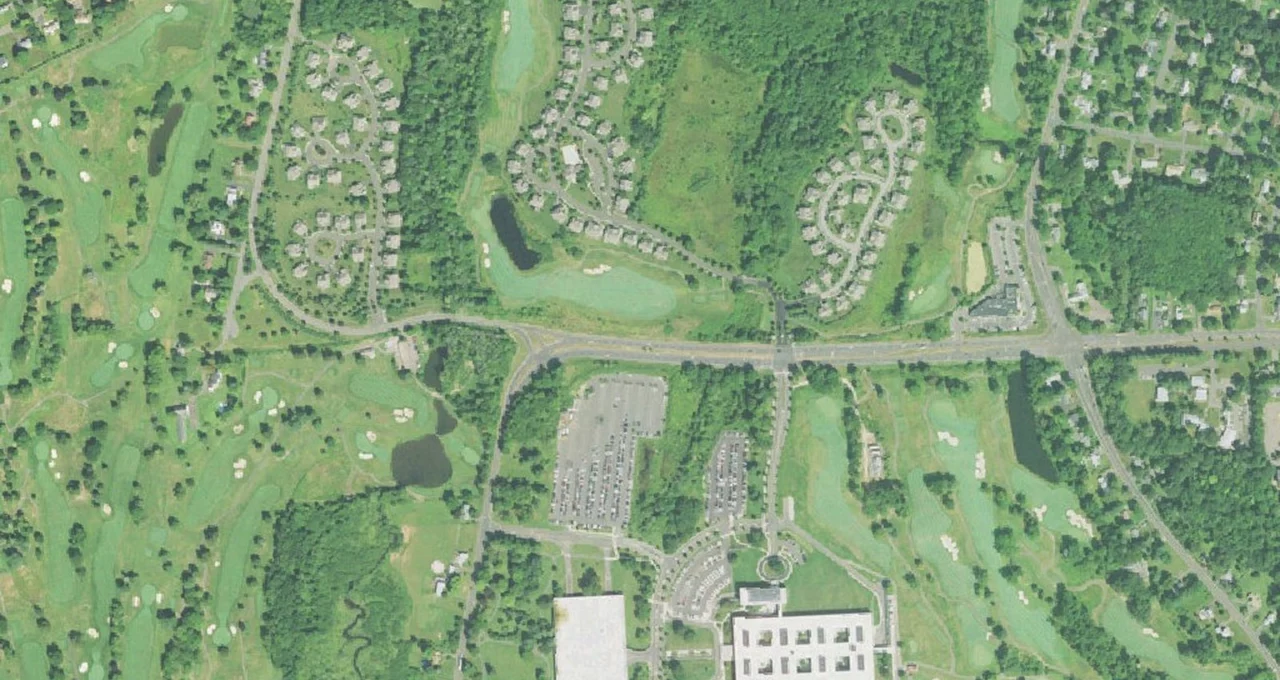
Gillette Ridge Golf Club from the air. Aerial imagery USGS, domaine public.
Gillette Ridge Golf Club
Holes
18
By
72
Length
7,191 yards from the Black tees (rating 74.5, slope 140); five tee sets down to 4,847 yards from the Green tees
Green fee
—
Best season
—
Gillette Ridge Golf Club is an 18-hole, par 72 public course at 1360 Hall Boulevard in Bloomfield, Connecticut, a suburban town on the edge of Hartford. The club presents it as the only Arnold Palmer design in the state, credited on its website to Palmer Course Design Company and billed as an Arnold Palmer Signature Design. From the back tees it measures 7,191 yards, with a course rating of 74.5 and a slope of 140, and one course directory places that slope above roughly nine in ten rated courses in Connecticut. The course opened to the public on July 30, 2004, according to Wikipedia, and it takes its name from Francis Gillette, the nineteenth-century Bloomfield farmer, antislavery politician and briefly United States senator whose house, the club says, still stands on the property.
The club describes a layout built around the features of the site: streams, lakes, changes in elevation and mature trees. Its own layout page counts 45 bunkers and multiple water hazards, and its hole notes return again and again to wetlands, ponds, a stream and a ravine. The course is run today by Century Golf Partners, the company that holds the Arnold Palmer Golf Management brand: the club’s contact addresses are on the Century Golf domain, and the National Golf Foundation lists Century Golf Partners and Arnold Palmer Golf Management as one company. Wikipedia, which names Arnold Palmer Golf Management as the operator, also says Cigna owns the land; we could not confirm the current ownership from a second source.
From a corporate campus to a public course
Gillette Ridge was carved out of the land around the Bloomfield headquarters campus of Cigna, known earlier as the headquarters of Connecticut General Life Insurance. That headquarters, a modernist office complex designed by Gordon Bunshaft of Skidmore, Owings and Merrill and built between 1954 and 1957, is listed on the National Register of Historic Places. According to Wikipedia, the original campus covered about 280 acres on the south side of Cottage Grove Road in southwestern Bloomfield; the present headquarters complex occupies about 30 of them, and the golf club is listed among the former elements of the campus.
Wikipedia dates the project to September 27, 1999, when Cigna announced plans to develop land at its Bloomfield headquarters with a golf course, a conference center, a hotel, office buildings and housing. The development received the name Gillette Ridge in December 2001, and the course opened on July 30, 2004. Most course directories, Wikipedia and the club agree on 2004. A few low-quality listings give a later opening year, which we treat as an error.
The design credit varies by source. The club and several directories credit Arnold Palmer through Palmer Course Design Company. The Top 100 Golf Courses website credits Ed Seay together with Palmer, and a booking site’s listing names Palmer, Ed Seay and Harrison Minchew. This page follows the club and calls it a Palmer design.
The man behind the name
Francis Gillette was born in 1807 in what was then Old Windsor and is now part of Bloomfield, according to Wikipedia. After graduating from Yale in 1829, poor health turned him from law to farming in Bloomfield. He sat in the Connecticut House of Representatives in the 1830s, ran for governor on antislavery tickets, and won a seat in the United States Senate as a Free Soiler in 1854 to fill a vacancy, serving until March 1855. He later helped found the Connecticut Republican Party, lectured on agriculture and temperance, and with his brother-in-law John Hooker developed the Nook Farm neighborhood of Hartford. He was the father of the actor and playwright William Gillette. His fieldstone house in Bloomfield, built in 1833, has been on the National Register of Historic Places since 1982, and Wikipedia’s article on the house notes documentation that he sheltered people escaping slavery there. The club’s hole notes point out the house to the left of the fairway on the 15th.
Tournaments and recognition
For four years the course was a stop on the women’s developmental tour, then called the Futures Tour. Wikipedia’s history of the event lists it as the CIGNA Golf Classic from 2005 to 2008, played each year at Gillette Ridge. The winners were Virada Nirapathpongporn of Thailand in 2005, in an event shortened to 36 holes by rain; Song-Hee Kim of South Korea in 2006; Taylor Leon of the United States in 2007, after a sudden-death playoff; and Vicky Hurst of the United States in 2008. A contemporary report carried by NBC Sports says Hurst, then an 18-year-old rookie, won by eight shots at seven under par, her fourth win of that season.
The club also lists qualifying events for the PGA Tour’s Travelers Championship. Its course information page and the Top 100 Golf Courses website give the years as 2010 to 2012, while the club’s home page says 2011 to 2012. This page follows the course information page. The club’s home page lists a string of state rankings and awards, among them a Travel and Leisure listing of the best new public and resort courses in 2004, a first place among Connecticut public courses from Northeast Golf in 2018, a Golfweek Best Courses You Can Play state-by-state listing in 2020 and a Links magazine best public golf in Connecticut citation in 2021.
The Top 100 Golf Courses website adds a chapter we could not confirm elsewhere: it says the course closed and deteriorated for about 18 months after the tournament years, then reopened in the summer of 2017 with new greens, refurbished bunkers and additional forward tees. More recently, the club has been rebuilding its bunkers in stages. A job listing indexed by search engines says the front nine bunkers were finished in early June 2025 and the back nine bunkers were due to be rebuilt in 2026, and the club’s daily course report of October 22, 2026, said only the front nine was open, with the back nine closed for the rest of the season during bunker restoration. Check the club’s course report before planning a full round late in the year.
What it asks of you
Gillette Ridge is a course of carries. The club’s own notes mention wetlands, ponds or a stream on most holes, and reviewers often say the wetlands come into play on close to half of them. Distance matters, too: the back tees run past 600 yards on two of the four par 5s, and the 18th, the hardest hole on the card, is a 478-yard par 4 that ends at a green almost surrounded by water. The card has four par 3s, ten par 4s and four par 5s, with each nine at par 36.
The scorecard used here comes from a course directory that reproduces the club’s card, and its stroke index matches the one on the club’s layout page. The club’s own scorecard is published only as an image, which we could not read. The tee sets, with the men’s ratings shown in that directory, are Black at 7,191 yards (74.5 and 140), Blue at 6,569 yards (71.3 and 133), a combination Blue/White at 6,047 yards (68.9 and 128), White at 5,695 yards (67.3 and 123) and Green at 4,847 yards (63.5 and 113). For women, the same directory gives White at 74.6 and 138 and Green at 69.8 and 130. Sources do not all agree: one booking site gives 72.1 and 135 for the Blue tees, and another directory lists a different stroke index altogether. We could not reach the USGA course rating database to settle these points, so this page follows the directory that matches the club’s stroke index and treats the Black tee figures, on which every source agrees, as the most reliable.
The club’s layout page says the course has a grass driving range, a full pitching and chipping complex and two putting greens. Course directories list bentgrass greens and fairways.
The front nine
Yardages below are from the Black tees, with the Blue tees in brackets, and the descriptions follow the club’s hole notes. The 1st, a par 4 of 426 yards (379), is a slight dogleg right and the only hole on the course without a bunker; the club suggests favoring the left side off the tee to stay clear of trees on the right, and warns that a miss short and left of the green leaves a hard recovery. It is the easiest hole on the club’s stroke index.
The 2nd is the hole most sources single out. A short par 5 of 505 yards (500), it opens with a view of the Heublein Tower, visible in the distance, and the club notes that its fairway, 72 yards across, is the widest on the course. Long hitters can reach the green in two, but a pond sits in front of it, and the club’s safe line is a layup to the left. The Top 100 Golf Courses website calls it the signature hole.
The 3rd, a par 4 of 431 yards (380), bends around wetlands and a pond on the inside of the dogleg, with out of bounds on the right; the club advises favoring the right off the tee, and the green has water on the left and a bunker on the right. The 4th is a par 3 of 182 yards (168) that asks for a carry over a bunker short left to a two-tier green; the club’s safe miss is short right. The 5th, a short par 4 of 364 yards (325), has bunkers on both sides of the landing area and an approach over a stream and ravine to a shallow, bunkered green.
The 6th, a par 4 of 387 yards (359), runs down a tight fairway lined with trees; the club suggests the left side off the tee for the best angle and the right side of the green to avoid a deep bunker front left. The 7th is the longest hole on the course, a par 5 of 612 yards (556) that the club calls a true three-shot hole, with the approach to an L-shaped green crossing a stream and ravine and a deep bunker guarding the front left. It is second on the stroke index. The 8th, a par 3 of 187 yards (159), is all carry over wetlands to a diagonal green with deep bunkers on the right and a bailout area to the left. The 9th, a par 4 of 447 yards (424), is a slight dogleg left with a deep bunker on the left and mounding on the right; it finishes at the largest green on the course, which slopes generally from right to left.
The back nine
The 10th, a par 4 of 430 yards (407), turns left around water that must be carried from the tee, with a large bunker on the left of a wide fairway. Long hitters can cut the corner or carry the trees and leave a short iron into a long, narrow green. The 11th is a par 3 of 214 yards (186) with a pond right of the green and bunkers left and long; the club’s advice is simply that any miss must be left.
The 12th, a par 5 of 609 yards (567), is the second hole over 600 yards from the back tees and, in the club’s words, rewards placement over length. It bends slightly right, and a bunker that appears to sit beside the green is in fact 62 yards short of it. The 13th, at 294 yards (273), is a short par 4 that long hitters can drive, with bunkers left of the green and another short right. The 14th, a par 4 of 430 yards (397), calls for a straight drive between the trees and away from a fairway bunker on the left; the club warns against going long with the approach and recommends missing left of a bunker on the right of the green.
The 15th is a par 3 of 187 yards (173) with deep bunkers short and left and trees to the right and long, and the club recommends taking an extra club. Francis Gillette’s house is visible on the left. The 16th, a par 4 of 431 yards (409), plays slightly downhill from the tee to a fairway that has to be hit; the club suggests leaving about 150 yards for a level lie, since the second shot crosses wetlands.
The closing pair includes the hardest hole on the card. The 17th, a par 5 of 577 yards (502), third on the stroke index, finishes at a green that the club says was partly built on an existing bridge over wetlands; the second shot should be played up the left side, with hazards short right and long and a large collection area short left. The 18th, a par 4 of 478 yards (405), is the longest par 4 on the course and first on the stroke index: the drive must carry wetlands and avoid fairway bunkers on both sides, and the approach crosses a pond and a bunker to a peninsula green. Here again, the club’s only advice for a miss is to the left.
What golfers are saying
The material behind this section is the user reviews on two golf review and booking sites, partly as shown in search results, and a third site with a handful of written reviews. The points below are other people’s opinions, not ours; nobody from Panxis has played the course, and we quote no one by name.
What comes up in its favor
- The challenge: reviewers describe a tough, well-designed layout that rewards accurate play and punishes misses into the wetlands.
- The setting, a landscape of natural wetlands and woods that many reviewers find attractive.
- Conditioning, with several reviews praising the fairways, the greens and the recently refreshed bunkers.
- The staff, from the golf shop to the starter and rangers, described as friendly and good at communicating about maintenance work.
What comes up against
- Pace of play: slow rounds on busy days, with some reviewers describing tee sheets they found overbooked and little action from the course to speed things up.
- Difficulty: some reviewers find the course punishing, and one complaint concerns pin positions judged too severe for everyday play early in the season.
- Uneven upkeep at times: some reviews describe weedy tees, rocky bunkers or greens that seemed to need aeration, and say the course was better kept in the past. The club has since been rebuilding its bunkers.
How to play it
Gillette Ridge is a public, daily-fee course. Tee times are booked online through the club’s website or through the golf shop, which also books lessons with the professional staff. The club offers a membership program, the Players Club, with its own rates, and it runs leagues, hosts tournaments and outings, and rents space for private events. The rates published by the club include a cart. The club’s website does not set out a walking policy; a course directory lists walking as permitted, which we could not confirm with the club. The club’s daily course report says when carts must avoid soft areas.
The club’s rates page sets out different blocks for mornings, afternoons and late play, with weekday and weekend pricing. This page lists no green fee; current rates and tee times are on the club’s website.
The facilities
Beyond the course, the club lists a golf shop, a restaurant called Ridge Kitchen, private event hosting and gift cards. Its practice area includes a grass driving range, a full chipping area and two putting greens. The club does not describe other sports facilities, and this page does not list any.
Getting there and when to go
The course is at 1360 Hall Boulevard, Bloomfield, CT 06002, in the southwestern part of the town, close to the Cigna headquarters on Cottage Grove Road. The golf shop’s phone number is 860-726-1430. Season dates vary by source: one directory gives April to November, another May to October, and a booking site says year round. The club itself publishes only winter hours, Monday to Friday from 9 a.m. to 4 p.m., and a daily course report that says which holes and practice areas are open. In late October 2026, only the front nine was open while the back nine bunkers were being rebuilt, so check the club’s course report before you go.
How this page was made
The factual frame comes from public sources consulted in October 2026: OpenStreetMap and Wikidata for the location; the club’s website for the address, phone number, designer credit, hole descriptions, stroke index, bunker count, practice facilities, services, tournaments, awards, rate structure and course status; Wikipedia for the opening date, the Cigna project, the campus history, Francis Gillette and his house, and the Futures Tour winners; NBC Sports for the 2008 result; the National Golf Foundation for the operating company; the Top 100 Golf Courses website for the Ed Seay credit, the 2017 reopening and the signature 2nd; course directories and booking sites for the tee-by-tee yardages, ratings and slopes, the grasses and the walking policy. Where sources disagree, as they do on the design credit, the Travelers qualifier years, the ratings of the forward tees, the stroke index, the season and the bunker count, which a directory gives as 42 where the club says 45, we say so and name the source we follow.
Several sources could not be read directly: the USGA course rating database, the main golf review site that carries most user reviews, a golf superintendents’ job board, and the scorecard image on the club’s website. For those, we relied on the excerpts shown by search engines and say so above. We could not confirm the current ownership of the land, the 18-month closure and 2017 reopening, or the walking policy with a second source. The opinion section summarizes public reviews; we report recurring themes rather than individual voices, and we reproduce no quotations. Nobody from Panxis has played or visited this course, and this page is no substitute for a round.
The club has not paid for this page, has not seen it before publication and has no say over its content. This page contains no commercial link and earns us no commission. If you know the course and something here is wrong or out of date, write to us and we will correct it.
Other courses nearby
Closest to this one in our United States directory:
- Keney Park Golf Course — 4 mi
- TPC River Highlands — 14 mi
- Fishers Island Club — 55 mi
- Dinsmore Golf Course — 61 mi
The hole to know
A par 4 of 478 yards from the Black tees, the longest par 4 on the course and first on the stroke index: the drive carries wetlands between fairway bunkers, and the approach crosses a pond to a peninsula green.