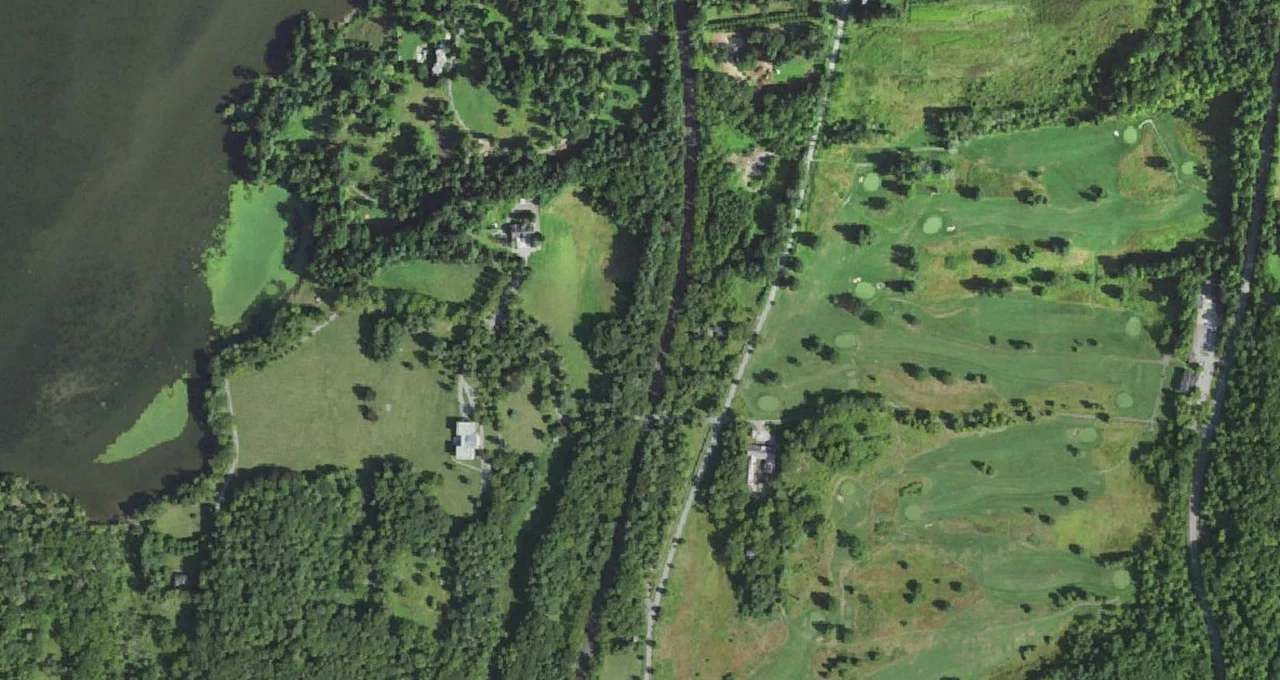
Dinsmore Golf Course from the air. Aerial imagery USGS, domaine public.
Dinsmore Golf Course
Holes
18
By
70
Length
5,759 yards from the Regulation tees on the New York State Parks page (rating 65.7, slope 106); hole-by-hole cards add up to 5,719 yards; Forward tees 4,567 yards (rating 64.2, slope 103)
Green fee
—
Best season
April to October, weather permitting, according to New York State Parks (call for the year's dates); GolfPass lists April 1 to November 10
Dinsmore Golf Course is a public, state-owned 18-hole course in Staatsburg, a hamlet of Dutchess County, New York, on the east bank of the Hudson River between Hyde Park and Rhinebeck. It lies inside Ogden Mills & Ruth Livingston Mills Memorial State Park, part of the larger area known as Mills-Norrie State Park, and is run by the New York State Office of Parks, Recreation and Historic Preservation. The state gives its address as 5371 Albany Post Rd., Staatsburg, NY 12580. It is a par 70 that measures 5,759 yards from the Regulation tees on the state’s course page, with a rating of 65.7 and a slope of 106.
Its reputation rests on two things: age and a view. The state describes it as one of the oldest golf courses in the country, built as a private nine-hole course in the 1890s for the estates of the Dinsmore, Hoyt and Mills families, and says it offers a panoramic view of the Hudson River and the Catskill Mountains. Both points deserve a closer look, because the history in particular is told in several different versions. This page sets out what the public record says, where the sources agree and where they do not.
A Gilded Age club on the Hudson
The course takes its name from William B. Dinsmore, whose family owned an estate in Staatsburg in the nineteenth century. The most detailed account of its origins is a history published in May 2016 on the blog of the neighboring Staatsburgh State Historic Site by Tom Buggy, a Hudson Valley golfer and author of a book on the golf courses of Dutchess County. According to Buggy, the Staatsburgh Golf Club was formed in 1893 by wealthy river families, among them the Dinsmores, the Mills, the Hoyts, the Rogers and the Astors. William B. Dinsmore II was its first president, and Ogden Mills and Archibald Rogers sat on its executive committee. Construction began in 1893 and the course opened in 1894. There was no clubhouse at first: members gathered at the Mills estate and in other family homes.
The Mills estate is the Beaux-Arts mansion now preserved as Staatsburgh State Historic Site, less than half a mile from the course. Wikipedia describes it as a 65-room house designed by McKim, Mead and White and built between 1895 and 1896 for the Mills family. The golf club, in other words, is almost exactly contemporary with the mansion, and both belong to the same world of Hudson River country estates.
Buggy’s reconstruction of the first course is precise. The original nine holes measured 2,591 yards for a par of 34. The greens were rigid rectangles, several streams were crossed by bridges, and bunkers were faced with earth-covered stone and stood only about two feet high. The 2nd, 3rd and 4th holes crossed valleys; the 3rd was a par 3 of 192 yards played from one high point to another, to a very small green with steep falloffs. Golfers used hickory shafts and gutta-percha balls, sheep helped keep the grass down, and the club employed a “golf keeper” with three assistants. In a tournament held in 1896, he writes, scores of 48 to 60 for nine holes were normal. Autumn was the main season, with tennis tournaments and dances on the same weekends.
Two club members had a modest national profile. Buggy notes that Archibald Rogers reached the quarterfinals of the first U.S. Amateur in 1895, and that Robert P. Huntington, a tennis champion, played in the 1896 U.S. Amateur without reaching match play. Huntington matters here because several sources credit him with designing the original course; the question of who laid it out is one of the open points discussed below.
From private estate to state park
Buggy’s history, built largely from local newspaper archives, follows the course through the twentieth century. It stayed private through the 1930s. A 1940 article reported that the Dinsmore estate was to be divided and sold, possibly including the course. In 1941, Mrs. Lytle Hull, a granddaughter of William B. Dinsmore II, inherited the property, and the course closed during the Second World War. A new Staatsburg Golf Club reopened it on a semi-private basis in 1946; two years later there was still no golf professional, and non-members paid on the honor system. By 1950 the course was being used as sheep pasture, and the Taconic State Park Commission was considering buying it.
According to Buggy, Mrs. Hull donated the course and adjoining land to the Taconic Commission in 1951 on two conditions: that it remain a public course and that it be named Dinsmore Golf Course. It opened under that name on June 1, 1952. The state’s own page says simply that the land was donated by Helen Hull. An older local account gives a different year: an article by Helene Meserve on the Dinsmore estate, published in March 1983 in a Hyde Park local history series and reproduced online, says the course was given to Taconic State Parks by Helen Huntington Hull in 1963, and also records that she stipulated the Dinsmore name.
The 18-hole course that golfers play today dates from the 1960s. The state says the original course, “which is now the south nine,” was expanded to 18 holes in 1962. Buggy is more specific: the North Nine, today’s holes 1 to 9, opened in 1962, and the South Nine, holes 10 to 18, opened in 1964, replacing the original nine on the same ground. He names Hal Purdy as the recognized designer of the present layout, a credit GolfPass also gives, and adds that Purdy probably had help. He cites a 1960 newspaper report that Gene Sarazen, who owned a farm in Germantown, New York, offered to direct the conversion to 18 holes free of charge, often joined by Ray Billows, a local amateur who finished runner-up in the U.S. Amateur three times.
Traces of the 1890s course survive. Buggy places today’s 10th tee near the site of the original first tee and the forward tee of today’s 12th on the site of the original 3rd green. He identifies remnants of the stone-faced bunkers along the left side of the 12th hole and a ring of three earth-faced bunkers, now grassed over, in front of the original 6th green, along the left side of today’s 15th. The environmental group Scenic Hudson, which promotes the course as a cross-country skiing area in winter, also notes that its southern half covers the site of the original nine.
What the course asks of you
On paper, Dinsmore is short. The state lists two sets of tees: Regulation at 5,759 yards (rating 65.7, slope 106) and Forward at 4,567 yards (rating 64.2, slope 103, for women). The hole-by-hole card published by GolfPass, OpenGolfAPI and the 18Birdies app adds a Gold tee of about 4,400 yards. A slope of 106 places it in the gentler half of the scale for most players. The card itself is unusual: six par 3s, eight par 4s and four par 5s. The front nine is a par 34, the back nine a par 36. On the card reproduced by most directories, the longest set reads as follows:
- Front nine: 1st, par 5, 460 yards; 2nd, par 3, 137; 3rd, par 4, 369; 4th, par 3, 120; 5th, par 4, 301; 6th, par 3, 90; 7th, par 5, 460; 8th, par 3, 181; 9th, par 4, 371. Out: 2,489 yards, par 34.
- Back nine: 10th, par 4, 401; 11th, par 4, 354; 12th, par 5, 539; 13th, par 4, 325; 14th, par 3, 120; 15th, par 4, 422; 16th, par 5, 548; 17th, par 3, 198; 18th, par 4, 323. In: 3,230 yards, par 36.
The two nines are different courses in character. The front is compact, with four par 3s and two par 5s of only 460 yards each, while the back is about 740 yards longer and carries the two longest par 5s, the longest par 3 and the two hardest holes on the stroke index, the 15th (index 2) and the 17th (index 4). The 9th, a par 4 of 371 yards, is the number one index hole. Golfers who post reviews regularly make the same observation: one, writing on GolfReview in 2005, noted that the back nine is much longer than the front, and that the course “doesn’t play like a course that short.”
The reason is the ground. Dinsmore sits on the slope between Route 9 and the river, and every description dwells on elevation. Scenic Hudson calls the terrain hilly and open. The 2005 GolfReview reviewer wrote that the shorter par 4s are “basically all up hill”; an earlier one, in 2001, warned of high greens and uneven lies and said the walk provides serious exercise. A 2022 roundup of Hudson Valley courses in the weekly Hudson Valley One spoke of “mighty elevation changes,” rough that can punish a loose tee shot, and little shade. Buggy, for his part, describes generous fairways, modest rough and few hazards, with the South Nine running mainly up and down valleys.
Two holes have names, according to a July 2025 article on the New York State Parks blog:
- The 6th, “Cardiac Hill”, a short par 3 with such a steep climb from tee to green that players cannot see where the ball lands. It is the 17th index hole, and the number on the card (90 or 130 yards, see below) understates the effort.
- The 14th, “The Crow’s Nest”, a par 3 of about 120 yards played from a high tee, where, in the words of a golfer quoted by the state, “you can look right down into that target.” The same slope serves as a sledding hill for children in winter.
Other holes come up in reviews. The 2005 GolfReview reviewer singled out the view of the mountains across the river from the 7th tee, a par 5 of 460 yards. The 12th and 16th, at 539 and 548 yards, are the only par 5s that play long, and the 17th, a par 3 of 198 yards, is the longest one-shotter. Water is a minor factor: Wikipedia, citing an archived Golf.com profile, says the course has no water hazards, while OpenGolfAPI counts three water hazards and 13 bunkers, and the 2001 reviewer mentioned wet ground to contend with. The streams of the 1890s course, Buggy writes, are gone.
The state’s July 2025 article also reports recent work on the course: an upgraded irrigation system and more paved paths for golf carts.
What golfers say
Public opinion on Dinsmore is spread thinly over many sites. The material summarized here comes from the 18Birdies app, which showed an average of 4.2 out of 5 from 145 ratings when we checked in October 2026 (with value rated 4.5, course condition 3.9 and pace of play described as fast); a single review on GolfPass for a round played in September 2019; two older reviews on GolfReview from 2001 and 2005; a review on the Hole19 app from October 2024; the Hudson Valley One roundup of May 2022; and comments from golfers interviewed by the state for its July 2025 blog article, which, coming from the operator, should be read as such. These are other people’s opinions, not ours. Nobody from Panxis has played the course, and we name no reviewer.
What comes up in its favor
- The view: the panorama of the Hudson and the Catskills from the clubhouse and the parking lot is the most consistent theme, from the 2001 review, which called it worth the trip by itself, to the 2019 and 2022 reviews.
- Value: every source that rates value rates it high, and golfers quoted by the state call the course reasonably priced and easy to get on.
- Condition: the 2019 GolfPass reviewer called it one of the best-maintained courses in the Mid-Hudson Valley; the 2022 roundup said the greens and grounds are immaculately maintained; golfers quoted in 2025 praised the greens and the improvements of the past decade.
- Character: hilly holes and long par 3s that make a short course play longer than its yardage, and a course described as fair to players of every level.
What comes up against
- Course condition rates lowest among the categories on 18Birdies, below value, which suggests that opinions on upkeep vary from season to season.
- Some of the par 5s are short, as the 2024 Hole19 reviewer noted; the two front-nine par 5s measure 460 yards.
- Older reviews mention slow play on busy days, too many par 3s for some tastes, and wet ground on parts of the course.
- Amenities are basic: the GolfPass reviewer rated them average, and the course has no driving range according to GolfPass.
- Little shade and a demanding walk, according to the 2022 roundup and the 2001 review.
Getting there and playing
Dinsmore is open to the public, and the state requires a tee time for every golfer. Its course page says tee times are made by calling the pro shop at (845) 889-4071, that same-day tee times are possible depending on availability, and that tee times are spaced ten minutes apart and strictly enforced. It also links to an online booking page. Earlier versions of the state page, archived in 2023 and 2024, said walk-ups were not accepted and that state park courses had gone cashless; check the current rules before you go.
The state gives the season as April to October, weather permitting, and asks golfers to call for the exact opening and closing dates each year; GolfPass lists April 1 to November 10. In season, the course opens at 8 a.m. on weekdays and 7 a.m. on weekends and holidays, and closes at 6 p.m., with the last cart times varying through the season. Electric carts are double-rider, single-rider carts are available at extra cost, and pull carts and rental clubs are offered. GolfPass lists walking as allowed and metal spikes as not allowed. A café on site, the Fairway Café, serves golfers; the state lists it as open seven days a week during the season.
The course is off U.S. Route 9 in Staatsburg. Measured on the map, in a straight line, it is about 5 miles south of the village of Rhinebeck and of the Rhinecliff station on Amtrak’s Empire Service line, about 10 miles north of the Poughkeepsie station, terminus of Metro-North’s Hudson Line, and about 76 miles north of Midtown Manhattan; those are not road distances. The surrounding parks make it easy to combine golf with other visits: the Staatsburgh mansion, hiking trails and carriage roads along the river, and, at neighboring Margaret Lewis Norrie State Park, a marina, a kayak operator, an environmental center, camping and cabins, according to the state. In winter, Scenic Hudson describes the course as open ground for cross-country skiing.
We do not report green fees. The state publishes its rates, with weekday senior and junior rates for New York residents, on its course page at parks.ny.gov; the booking page shows the price of each tee time.
How we built this page
The factual frame comes from public sources: OpenStreetMap and Wikidata for the location and identifiers; the New York State Parks page for the course, read through its archived copies of 2011, 2024 and July 2026 because the live page refused our automated requests, for the address, the tee data, the history in brief, the season, hours, carts and booking rules; the New York State Parks blog article of July 3, 2025, for the named holes, the recent work and golfers’ comments; Tom Buggy’s history of the course on the Staatsburgh State Historic Site blog, May 2016, for the founding, the original layout, the state acquisition and the 1960s redesign; Helene Meserve’s 1983 article on the Dinsmore estate; Wikipedia for the course and for the Staatsburgh mansion and the state park; GolfPass, GolfNow, OpenGolfAPI, 18Birdies and Hole19 for scorecards and ratings; GolfReview, Hudson Valley One and Scenic Hudson for descriptions and opinions.
Where sources disagree, we say so. The opening date is 1893 on the state blog and in the state’s 2011 page, which called Dinsmore “the 3rd oldest golf course in the country”; Buggy writes that the club was formed in 1893 and the course opened in 1894, calls the third-oldest claim incorrect while placing the course among the first fifty in the country, and mentions an unconfirmed story of three holes in 1887 or 1888; Meserve reports a sketch of the early course dated 1887 hanging in the clubhouse. GolfPass, GolfNow and OpenGolfAPI give 1957 as the year built, a date that no historical source explains. The original designer is Robert Huntington in Wikipedia, Robert P. Huntington in Buggy and in the reference book he cites, Richard Huntington, a local architect related to the Dinsmores, in Meserve, and William Dinsmore Jr. assisted by Willie Davis in an 1896 New York Evening Post article quoted by Buggy. The gift to the state is dated 1951 by Buggy and 1963 by Meserve. The full 18 holes date from 1962 for the state and from 1964 for Buggy, who splits the work between the two nines.
The length is 5,759 yards on the state page and in GolfPass, but the hole-by-hole cards of OpenGolfAPI and 18Birdies, and the state’s own 2025 blog, add up to 5,719 yards; the difference comes from the 6th hole, given as 90 yards on most cards and 130 yards on GolfPass’s white card. Ratings also vary: 65.7 and 106 on the state page, 67.2 and 113 on GolfPass’s white card, 67.6 and 117 in 18Birdies, 68.0 and 107 on GolfNow. We follow the state. Directories also use a second address, 199 Old Post Rd.; we use the one given by the state.
Some details will age: the ratings, the reviews read in October 2026, the season and opening hours, and the booking rules, which have already changed in recent years. The opinion section reports recurring themes rather than individual voices. Nobody from Panxis has played or visited this course, and this page is no substitute for a round.
The course has not paid for this page, has not seen it before publication and has no say over its content. This page contains no commercial link and earns us no commission. If you know the course and something here is wrong or out of date, write to us and we will correct it. Tom Buggy’s history of the course is the fullest account of its first seventy years, and the state’s 2025 article describes the course as it is today.
Other courses nearby
Closest to this one in our United States directory:
- Trump National Golf Club Westchester — 50 mi
- Keney Park Golf Course — 65 mi
- TPC River Highlands — 68 mi
- Village Club of Sands Point — 71 mi
The hole to know
"Cardiac Hill", a short par 3 (90 yards on most cards) with a climb so steep that players cannot see where the ball lands, according to New York State Parks.