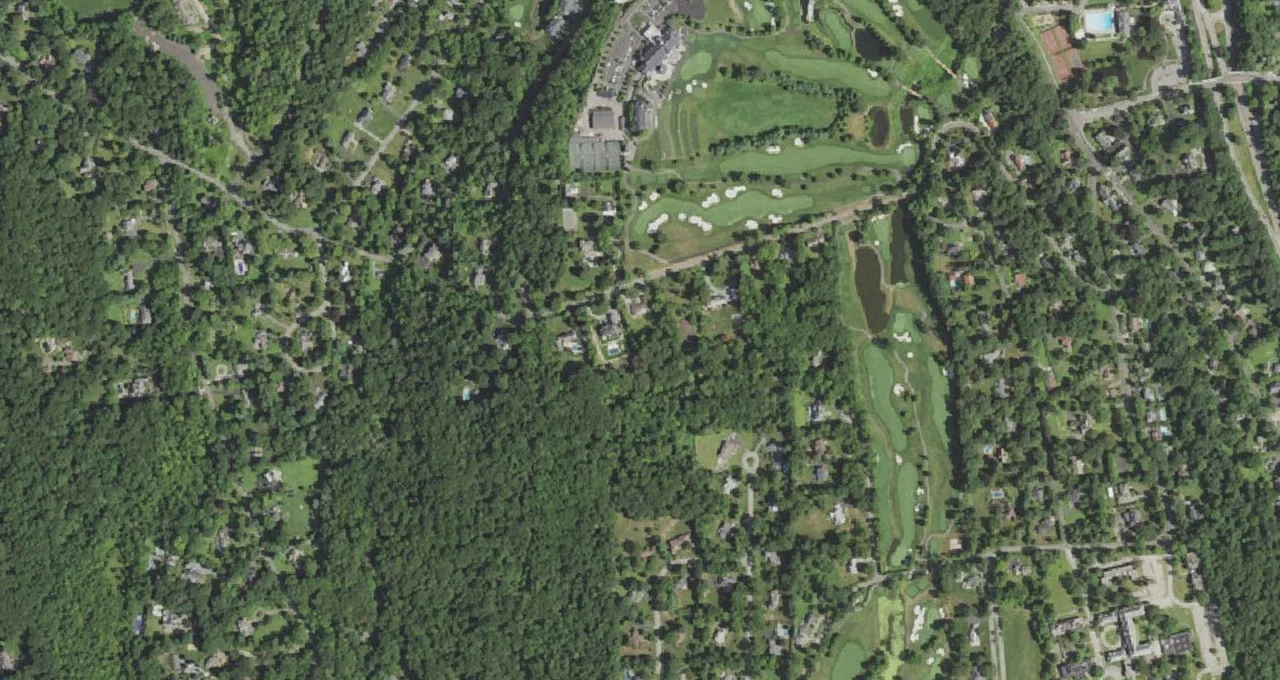
Trump National Golf Club Westchester from the air. Aerial imagery USGS, domaine public.
Trump National Golf Club Westchester
Holes
18
By
72
Length
7,361 yards from the Black tees on published scorecards (rating 76.7, slope 151); the club gives 7,300 yards
Green fee
—
Best season
Roughly April to November (Westchester County season)
Trump National Golf Club Westchester is a private club in Briarcliff Manor, New York, in Westchester County, north of New York City. Its address is 100 Shadow Tree Lane. The club is owned and operated by the Trump Organization, the family company of Donald Trump, which bought the property in 1996 and rebuilt the course completely before reopening it in 2002. The present course was designed by Jim Fazio, the architect of the Trump International Golf Club in West Palm Beach, Florida.
The course is an 18-hole par 72, with 36 on each nine. Its length varies with the source. The club gives 7,300 yards and says it has five sets of tees; encyclopedic entries give 7,200 yards. The yardages of the club’s own hole-by-hole course tour add up to 7,361 yards, which is also the figure on a scorecard published on a golf app for the Black tees, with a course rating of 76.7 and a slope of 151. A specialist ranking site gives a different rating for the back tees, 77.8 with a slope of 153, and 74.7 with 149 from the Blue tees. Whatever the exact figure, every source puts the slope from the back above 150, near the top of the scale. The golf app’s scorecard lists the Blue tees at 6,755 yards (73.9 and 145), the White at 6,262 (71.7 and 137), the Yellow at 5,713 (68.9 and 133) and the Red at 5,286 yards.
The club says the course has rolling ground, ponds, winding streams, stone bridges and a waterfall of 101 feet behind the green of its signature hole, the 13th. The clubhouse measures about 75,000 square feet.
A club with a century of history
Golf on this ground is much older than the current course. According to encyclopedic entries, it began around 1895 with a private nine-hole course on the estate of Walter W. Law, the founder of Briarcliff Manor. In 1922 the architect Devereux Emmet laid out an 18-hole course across the street, and Briarcliff Country Club was founded that year. The club became Briar Hills Country Club in 1927 and opened a new clubhouse in May 1929; the architect A. W. Tillinghast redesigned the course in 1936. In 1948 it became Briar Hall Golf and Country Club. The Metropolitan Open, a regional professional championship, was played at Briar Hall in 1964 and won by Jack Patroni.
The club later went into foreclosure. Encyclopedic entries report that Donald Trump bought it out of foreclosure in December 1996 for $7.5 million; at the time, it had a course of 6,313 yards and a clubhouse of about 78,782 square feet. Trump closed the club in 1999 and hired Jim Fazio to build a new course. According to the same entries, some three million cubic yards of earth were moved, which was described as the largest excavation project in the county’s history, and the cost was put at $30 million or $40 million, depending on the account. The first nine holes opened on April 15, 2002, and the second nine on June 29, 2002. The club took the name of its county, Westchester.
The club has also been a subject of local tax disputes. Encyclopedic entries report that every year since 2015, the Trump Organization has challenged the local tax assessment of the property. In 2015 the club asked for the assessed value to be cut from $13.5 million to $1.4 million, while Donald Trump’s financial disclosure of 2017 valued the club at more than $50 million; a compromise reached in July 2021 reduced the assessed value by 30 percent. On June 7, 2016, Trump gave a speech at the clubhouse marking his victory in the Republican presidential primaries.
What it asks of you
The slope says it first: above 150 from the back and 145 from the Blue tees, the course is very hard for a mid-handicap player. The reasons are consistent across the club’s hole notes and public reviews: water, elevation and narrow landing areas. A reviewer on a specialist ranking site counts only three or four holes without water, and the club’s own course tour mentions ponds, streams or a ravine on most holes.
The second demand is the ground. Fazio’s earthmoving created a course with large changes of elevation, elevated tees and uphill finishes; the 9th and the 18th climb to their greens, and on the 18th the putting surface cannot be seen in full from the fairway. The third demand is accuracy off the tee: fairways are framed by woods, water or out of bounds on many holes, and reviewers say that the combination of tight driving areas and hazards leaves little room for recovery.
The card is balanced: four par 3s, four par 5s and ten par 4s. The par 3s are long, from 188 to 231 yards from the back tees, and all four involve water. The par 5s range from 525 to 625 yards, and the par 4s from 390 to 485 yards; there is no genuinely short par 4.
The front nine
The 1st, a par 4 of 438 yards, plays downhill to a shallow, oblong green with water behind it. The 2nd, a par 5 of 533 yards, has a creek along its right side and a double fairway that allows several lines of attack. The 3rd, a par 4 of 485 yards with water down the whole left side, is ranked as the hardest hole on the card. The 4th, at 390 yards, is the shortest par 4, with woods on the right and water on the left. The 5th, a par 5 of 525 yards, is the club’s risk-and-reward hole, with water left, out of bounds right, a creek beside the green and a two-tiered putting surface.
The 6th, a par 3 of 188 yards, is lined with trees and requires a carry over water; the club says a crosswind often pushes shots into a large bunker on the left. The 7th, 402 yards, bends slightly left toward a green tucked beside a pond. The 8th, the longest par 3 at 231 yards, crosses a diagonal water hazard with a pond short of the green. The 9th, a long uphill par 4 of 446 yards, is framed by ten bunkers and ends on a large green with a ridge in the middle, for a front nine of 3,638 yards.
The back nine
The 10th, 401 yards, starts from an elevated tee and asks for an approach over a ravine with a stone dam system; the club says Westchester Magazine ranked it number one. The 11th, 393 yards, begins what the club calls the difficult stretch: the drive crosses a ravine out of a chute of trees, with water on the left, to a narrow two-tiered green guarded by a nest of bunkers. The 12th is the longest hole, a par 5 of 625 yards that requires three shots, the last over a ravine about 100 feet deep to a small green.
The 13th is the signature hole: a par 3 of 218 yards to a green with the 101-foot waterfall behind it and a pond and a smaller waterfall in front. The club puts the cost of the feature at seven million dollars, and encyclopedic entries say the black granite waterfall pumps 5,000 gallons a minute. The 14th, 432 yards, is a dogleg left from an elevated tee. The 15th, a downhill par 3 of 193 yards, carries a large pond. The 16th, a par 5 of 561 yards, is long and straight, with a pond in front of the green. The 17th, 435 yards, has a wide fairway and a green that climbs from front to back, and the 18th, an uphill par 4 of 465 yards, finishes on an undulating green, for a back nine of 3,723 yards.
What golfers are saying
This is a private club, and the public record is limited: a few entries on course-ranking sites, ratings on a golf app from guests and members, and occasional mentions in local press. The points below summarize what recurs in that material. They are other people’s opinions, not ours; nobody from Panxis has played the course, and we name and quote no one.
What comes up in its favor
- Conditioning is the most frequent compliment: pure fairways and fast greens, described as well kept despite heavy play.
- The setting is praised as beautiful, and the waterfall on the 13th is the most memorable feature for most visitors.
- Reviewers like the bunkering around the par 5 greens, which they see as protecting the scoring holes well.
- The clubhouse and the amenities are rated very highly.
What comes up against
- The most frequent criticism is the difficulty itself: rating sites classify the course as very hard, and reviewers find that narrow fairways, out of bounds and water on almost every hole make it punishing, with few chances to recover from a mistake.
- Some reviewers find that the front and back nines feel disconnected in character.
- The steep slopes and changes of elevation make the course a physical test.
- On rating sites, the course scores lower for value than for conditions, and without a member or an organized outing there is no way to play.
How to play it
Trump National Golf Club Westchester is a private club and sells no public tee times. The club lists full golf, junior (under 40), corporate and social memberships; social members use the clubhouse but not the course. Members also have access to the other clubs of the Trump Golf portfolio. Encyclopedic entries report an initiation fee of $75,000 and annual dues of $28,400 in 2024; the club publishes no figures. Guests play with a member, under the club’s rules.
The club also hosts golf outings for companies and charities, with the course, the clubhouse and catering, arranged in advance with its staff; an outing is one of the few ways onto the course without a member. It also hosts weddings and private events.
The facilities
The club lists a full driving range, a short-game area and a putting green, a team of PGA teaching professionals and an indoor golf simulator. The 75,000-square-foot clubhouse has a ballroom, a grill and overnight guest suites for members and their guests. Outside golf, there are four Har-Tru tennis courts, a pool complex that the club describes as the largest in Westchester County, a fitness center and a children’s playground.
Getting there and when to go
The club is at 100 Shadow Tree Lane in Briarcliff Manor, in the Hudson Valley north of New York City. The golf season in Westchester County runs roughly from April to November, with the course at its best from late spring to early fall; winter closures and the club calendar are the club’s call.
Green fees
Trump National Golf Club Westchester is a private club and publishes no public green fees. Guest and outing conditions are set by the club. See the club’s own site.
How this page was made
The factual frame comes from public sources: OpenStreetMap for the location; the club’s website for the address, the architect, the par, the stated length, the number of tee sets, the hole-by-hole descriptions, the waterfall and its cost, the membership categories, the outings and the facilities; encyclopedic entries for the history of the site from 1895, the Emmet and Tillinghast courses, the 1964 Metropolitan Open, the 1996 purchase, the reconstruction and its reopening dates, the tax dispute, the 2016 speech and the fees; a golf app’s published scorecard for the tee yardages, ratings and slopes; and a specialist ranking site for the alternative rating and slope. Where sources disagree, as they do on the length and the rating, we say so.
The opinion section summarizes ranking sites and guest ratings read in September 2026. We report recurring themes rather than individual voices, and we reproduce no quotations. Nobody from Panxis has played or visited this course, and this page is no substitute for a round.
The club has not paid for this page, has not seen it before publication and has no say over its content. This page contains no commercial link and earns us no commission. If you know the course and something here is wrong or out of date, write to us and we will correct it.
Other courses nearby
Closest to this one in our United States directory:
- Village Club of Sands Point — 22 mi
- North Hempstead Country Club — 24 mi
- TPC River Highlands — 70 mi
- Keney Park Golf Course — 76 mi
The hole to know
The signature hole, a par 3 of 218 yards from the back tee, with a pond and a small waterfall in front of the green and a black granite waterfall of 101 feet behind it, which the club says cost seven million dollars.