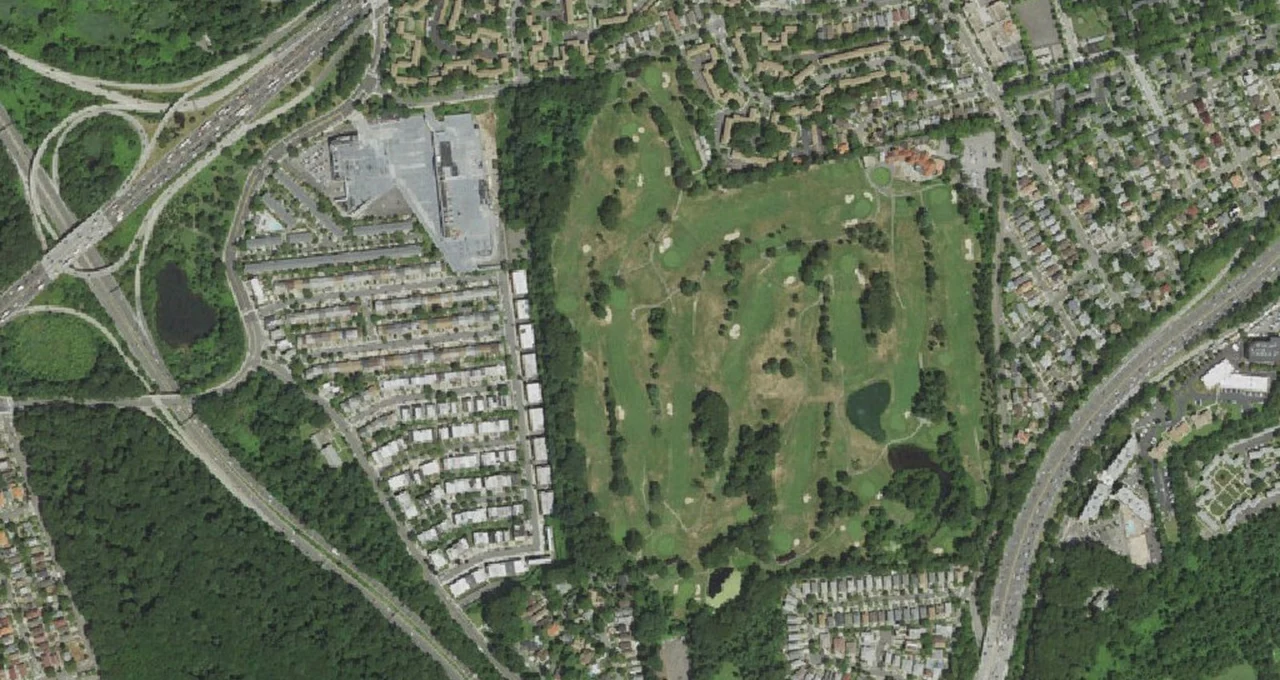
Douglaston Golf Course from the air. Aerial imagery USGS, domaine public.
Douglaston Golf Course
Holes
18
By
67
Length
5,469 yards from the Black tees (rating 65.5, slope 110, per GolfPass and OpenGolfAPI; 18Birdies gives 65.9 and 114); TeeOff gives 5,585 yards; 5,071 yards from the Blue tees and 4,413 from the Red
Green fee
—
Best season
Open year-round except in snow or ice, sunup to sundown, according to the general manager in 2010 (Patch); OpenGolfAPI lists March to November
Douglaston Golf Course is a public, city-owned 18-hole course in the far northeast corner of Queens, New York City, close to the city’s border with Nassau County. OpenStreetMap and NYC Tourism give its address as 63-20 Marathon Parkway, Douglaston, NY 11363. The land belongs to NYC Parks, the city’s parks department, which lists the property as Douglaston Park Golf Course; a private concessionaire runs the golf day to day. The course is a par 67 of about 5,500 yards: 5,469 yards from the Black tees on the scorecard published by GolfPass, OpenGolfAPI and 18Birdies, with a course rating of 65.5 and a slope of 110 according to GolfPass and OpenGolfAPI.
Two facts define the place. The first is its history: it opened on Labor Day 1927 as the private North Hills Golf Club, later North Hills Country Club, and only became a municipal course in the early 1960s, when the club left New York City for Long Island. The second is its setting. The operator describes the course as sitting at the highest point in the Borough of Queens, with views of the Manhattan skyline, a claim repeated by NYC Tourism and LINKS Magazine. A local Patch article from 2010 is a little more cautious and speaks of “some of the highest ground in Queens or Long Island.” Either way, the course is hilly by New York City standards, and that topography shapes almost everything golfers say about it.
This page is a portrait built from public sources. It is not a review of a round, and nobody from Panxis has played the course.
From North Hills to Douglaston Park
The NYC Parks Department’s history of the site says that in 1927 a group of members of the Belleclaire Country Club in Bayside founded the North Hills Golf Club and chose this rolling ground in Douglaston for its course. According to the same history, the 18 holes were laid out by a father-and-son team, Willie Tucker Sr. and Jr., and the course opened on Labor Day 1927. Most golf directories simply credit “Willie Tucker” or “William H. Tucker” with the 1927 design. The current North Hills Country Club, which still exists in Manhasset, gives the same founding year on its own website and adds that many former members of the Clearview Golf and Yacht Club in Whitestone joined North Hills after the city bought Clearview during the Great Depression.
The clubhouse is the other surviving piece of the 1920s. The NYC Parks history describes it as a Spanish Mission style building that many consider the finest work of the architect Clifford C. Wendehack, and Wikipedia’s article on Douglaston Park calls it “an elaborate Spanish/Mission revival structure.” Wendehack, who died in 1948, was one of the busiest clubhouse architects of his era; Wikipedia credits him with the clubhouses at Winged Foot in Mamaroneck, Ridgewood in New Jersey and Bethpage State Park on Long Island, among others. Today the building operates as Douglaston Manor, a catering and banquet hall, which is how Wikipedia and the city’s 2024 concession notice both refer to it.
The club’s finances were never easy. NYC Parks writes that North Hills failed to make a profit during the Depression and was repossessed by its bank, and that the members bought the property back after the Second World War. The final blow was local taxation. In an April 1963 article in Golfdom, the golf trade magazine, the Long Island Daily Press golf writer John M. Brennan explained that the view of Manhattan from the club’s “Skyline Terrace” had become expensive: the club’s city tax bill had roughly tripled within a decade. According to Brennan, the members accepted an offer from a New York construction company to buy the club around 1960, and a smaller group of members decided to rebuild North Hills outside the city, about five miles away on Long Island’s North Shore. The new course was designed by Robert Trent Jones; Wikipedia dates the relocation to 1961, while the club’s own timeline has Jones describing the finished layout to members in a letter of March 30, 1961 and the new course opening in the mid-1960s.
The city then stepped in. NYC Parks says the City of New York bought a 50-acre parcel of the former club on September 7, 1962 and a second parcel of 54.6 acres on March 13, 1963, and that Parks Commissioner Newbold Morris named the property Douglaston Park Golf Course in April 1963. Patch, writing in 2010, also gives 1963 as the year the course reopened under its new name. How the construction company’s purchase described by Golfdom fits with the city’s acquisition is not explained in any source we found, so we report both without trying to reconcile them.
The modern chapter begins in 2004. The operator’s description, repeated by NYC Tourism, LINKS Magazine and several directories, says the course underwent a major renovation that year by the architect Stephen Kay, and that the clubhouse was completely redesigned and now includes a catering facility. The same text says the work moved Douglaston up to second place in popularity among New York City’s courses, and NYC Tourism calls it “the second busiest golf course in the five boroughs.” We found no independent account of what Kay changed on the ground, hole by hole, so we do not describe the scope of the renovation.
The latest change is contractual. In March 2023 NYC Parks issued a request for proposals for a new 20-year concession at Douglaston, and Patch reported that the city wanted the next operator to improve drainage, repave cart paths, expand tee boxes and replace the clubhouse’s internal plumbing, among other works, with the existing license agreements set to expire in January 2024. The City Record published the award on June 26, 2024: a 20-year permit agreement for the renovation, operation and maintenance of the golf course and clubhouse went to Douglaston GC LLC, of Woodhaven, Queens. We could not confirm which of the requested works have been completed so far.
What the course asks of you
By the numbers, Douglaston is short. Par is 67, and the back-tee total of about 5,500 yards is well below a typical modern 18-hole course. LINKS Magazine, which in a 2024 article listed it among notable regulation courses in the United States with a par under 70, describes it as a tree-lined par 67 that “tips out at about 5,500 yards.” The par comes from an unusual mix: the scorecard has seven par 3s, nine par 4s and only two par 5s. The front nine is a par 34 and the back nine a par 33.
The card published by GolfPass, OpenGolfAPI and 18Birdies lists the Black tees hole by hole as follows:
- Front nine: 1st, par 4, 385 yards; 2nd, par 3, 163; 3rd, par 4, 369; 4th, par 4, 431; 5th, par 3, 140; 6th, par 4, 420; 7th, par 5, 470; 8th, par 4, 380; 9th, par 3, 202. Out: 2,960 yards, par 34.
- Back nine: 10th, par 4, 324; 11th, par 4, 297; 12th, par 3, 163; 13th, par 4, 370; 14th, par 4, 347; 15th, par 3, 181; 16th, par 3, 169; 17th, par 3, 125; 18th, par 5, 533. In: 2,509 yards, par 33.
Shorter sets of tees are listed at 5,071 yards (Blue) and 4,413 yards (Red). The ratings vary from one directory to the next. GolfPass and TeeOff give the Black tees 65.5 and 110, the Blue tees 63.7 and 108, and the Red tees 62.1 and 106. A second table on GolfPass and the 18Birdies listing give higher figures, 65.9 and 114 for the Black tees and 64.1 and 112 for the Blue tees for men, and 68.6 and 116 for women from the Blue tees. NYC Parks itself describes the course as designed for beginner to intermediate players.
Short does not mean flat or open. Every source that describes the ground mentions the hills. A detailed 2014 account on Legitimate Golf, a blog that reviewed New York City’s municipal courses one by one, found the holes “mostly narrow and tree-lined” and packed tightly together, but credited “a lot of elevation changes, rolling topography” and a strong design with keeping it from feeling like a corridor of parallel fairways. The same writer noted a few blind shots, only one par 4 under 300 yards and two genuine driver holes, and concluded that the course does not play as short as its card suggests. Patch’s 2010 article mentions water hazards, rolling terrain and well-bunkered greens; OpenGolfAPI counts 31 bunkers and three water hazards.
A few holes stand out on the card itself:
- The 4th, a par 4 of 431 yards from the Black tees, is the longest par 4 on the course and the number one stroke-index hole on the published scorecard.
- The 6th, a par 4 of 420 yards, is the stroke-index 3 hole, so the front nine holds two of the three hardest holes on the card.
- The 9th, at 202 yards, is the longest of the seven par 3s and closes the front nine.
- The 11th, at 297 yards, is the only par 4 under 300 yards, the kind of hole where longer hitters will be tempted to go for the green.
- The 15th, 16th and 17th are three par 3s in a row, of 181, 169 and 125 yards. The 2014 blog called a finish with three par 3s in the last four holes “an odd way to finish a round,” and a 2025 review on 18Birdies blamed the back-nine par 3s for slowing play.
- The 18th, a par 5 of 533 yards and stroke index 2, is the longest hole on the course and the last chance to make up shots.
Low scores are possible for very good players. Wikipedia’s article on Douglaston Park lists a course record of 58, set by Greg Mazerolle at the Quinnie Cup on May 19, 2019. We found no second source for that figure.
What golfers say
Douglaston is one of the busiest public courses in the city, so there is no shortage of opinions. What follows summarizes recurring themes from the reviews we could read in October 2026: written reviews on 18Birdies from 2019, 2025 and 2026 (the app showed an average of 4.1 out of 5 from 845 ratings, with value and course condition each at 3.9), the summary of Google reviews shown by the travel site Wanderlog (4.1 out of 5 from 485 reviews), reviews collected by the golf app Hole19, and the 2014 Legitimate Golf account. The review pages on GolfPass could not be opened when we prepared this page, so we have not used them. These are other people’s opinions, not ours, and we name no reviewer.
What comes up in its favor
- The greens: the most consistent praise. Reviewers on 18Birdies in 2025 and 2026 describe them as well maintained or in excellent condition for a public course, and Wanderlog’s summary mentions recent improvements such as faster greens. The 2014 blog thought Douglaston might have the best turf and greens in the city.
- The terrain: the hills and elevation changes, which make a short course more interesting, and the views from the high ground.
- The layout, which several reviewers find visually interesting and demanding of most clubs in the bag, with challenging par 3s.
- Accessibility: for city residents, a classic layout reachable without leaving the five boroughs, and playable early in the morning before work.
- Friendly staff, mentioned on 18Birdies in 2026 and in Wanderlog’s summary.
What comes up against
- Pace of play: the most frequent complaint. Reviews on 18Birdies from 2019 and 2025 mention rounds of four and a half hours or more, slow groups and many beginners on busy days, and the 2014 blog noted little marshalling on the course. Wanderlog’s tips suggest weekdays or off-peak times.
- Conditions away from the greens: 2025 reviews mention bumpy fairways, bare patches and tee boxes in poor shape, and a 2026 review complained of greens full of sand.
- Blind shots on hilly holes, which make yardages hard to judge and, according to one Hole19 reviewer, make it hard to tell when it is safe to hit.
- Value: a 2025 review considered the course overpriced for what it offers, and value is among the lower sub-scores on 18Birdies.
- Limited practice: there is no driving range, as TeeOff’s listing and a 2025 review both note, only a putting green.
- The short card and par 67, which some golfers see as a drawback compared with full-length courses.
Getting there and playing
Douglaston is a public course. NYC Parks offers a resident rate to golfers who hold a valid NYC Resident Golfer’s Permit, with proof of residency, and charges non-residents an additional fee. NYC Parks lists Douglaston on its online golf reservation page. Rates depend on residency, age and time of play, and we do not report them. The operator’s website, golfnyc.com, is the place to check current green fees, permits and booking rules.
On the course, TeeOff and GolfNow list walking as allowed, motor carts and pull carts available, club rental, and metal spikes not allowed. 18Birdies adds a pro shop, lessons, a restaurant and a changing room. In 2010, the general manager told Patch that the course was open 365 days a year unless there was snow or ice, from sunup to sundown, seven days a week; OpenGolfAPI gives a March to November season. Winter play therefore depends on the weather and on the operator’s current policy.
NYC Tourism points drivers to the Long Island Expressway (Interstate 495) and the Grand Central Parkway. The entrance and the only parking lot are at the north end of Commonwealth Boulevard, where it meets Marathon Parkway, according to Wikipedia. NYC Parks puts the course about 17 miles from Midtown Manhattan, a figure that matches a drive more than a straight line: measured on the map, the distance is about 13 miles as the crow flies. The nearest rail stations are Douglaston and Little Neck on the Long Island Rail Road’s Port Washington Branch, about 1.4 and 1.6 miles north of the course in a straight line. LaGuardia Airport is about 7.5 miles away in a straight line. These are map measurements, not road or walking distances; check the transit authority’s trip planner before you go.
How we built this page
The factual frame comes from public sources: OpenStreetMap and Wikidata for the location, address and identifiers; the NYC Parks history of the property, which we could read only through search-engine excerpts because the city’s site refused our requests, for the 1927 founding, the Tuckers, the Wendehack clubhouse and the city’s purchase; Wikipedia’s articles on Douglaston Park, on North Hills Country Club and on Clifford C. Wendehack; the North Hills Country Club’s own history page; John M. Brennan’s April 1963 article in Golfdom, held in the Michigan State University turfgrass archive; Patch’s 2010 profile of the course and its 2023 article on the concession; the City Record notice of June 26, 2024; NYC Tourism and LINKS Magazine; and GolfPass, OpenGolfAPI, 18Birdies, TeeOff, Hole19 and Wanderlog for the scorecard, ratings and reviews. The operator’s site, golfnyc.com, also refused our requests, so its descriptions are quoted as they appear in the listings that reproduce them.
Where sources disagree, we say so. The back-tee length is 5,469 yards on GolfPass, OpenGolfAPI, 18Birdies and Wikipedia, 5,585 yards as the headline figure on TeeOff, 5,439 yards in the 2014 blog and 5,343 yards on another directory; Patch gave 4,602 to 5,585 yards in 2010 and called the 18th a 550-yard par 5, against 533 yards on today’s card. Ratings and slopes differ between directories, as described above. The 1927 design is credited to Willie Tucker Sr. and Jr. by NYC Parks and to Willie or William H. Tucker by others; OpenGolfAPI credits Stephen Kay and dates his design to 1927, which confuses the original layout with the 2004 renovation, and TeeOff adds a Doug Smith whose role we could not identify. NYC Parks dates the city’s purchase to 1962 and 1963, while Golfdom places the club’s sale around 1960. The relocation of North Hills is dated 1961 by Wikipedia and the mid-1960s by the club. Hole19 lists a back-tee length of 4,995 yards that no other source supports. NYC Parks and the operator list different telephone numbers.
Some details will age: the reviews read in October 2026, the tee ratings, which are revised periodically, the season and opening hours, and above all the works expected under the 2024 concession, which may change tees, drainage and cart paths. The opinion section reports recurring themes rather than individual voices. Nobody from Panxis has played or visited this course, and this page is no substitute for a round.
The course and its operator have not paid for this page, have not seen it before publication and have no say over its content. This page contains no commercial link and earns us no commission. If you know the course and something here is wrong or out of date, write to us and we will correct it. Wikipedia’s article on Douglaston Park summarizes the site and its clubhouse, and the City Record notice sets out the current concession.
Other courses nearby
Closest to this one in our United States directory:
- North Hempstead Country Club — 5 mi
- Village Club of Sands Point — 7 mi
- Dyker Beach Golf Course — 18 mi
- Trump National Golf Club Westchester — 27 mi
The hole to know
A par 4 of 431 yards from the Black tees, the longest par 4 on the course and the number one stroke-index hole on the published scorecard.