The six weeks before your first round
Putting and chipping survive a winter lay-off; the full swing does not. Six weeks that respect that order start the season two shots ahead, and everything booked in February costs less than the same thing booked in June.

In brief
- Weeks 1 and 2: mobility and half swings only. Cold drivers into a net cost you April.
- Weeks 3 and 4: short game, because it is the part that survived the lay-off.
- Weeks 5 and 6: a carry chart in carry, not total, and a full bag audit.
- Cold air and soft ground together cost close to a full club in spring.
- Book the lesson block in February, when the teaching diary is empty.
Most golfers start the season with the round they should have used to warm up. Six weeks of unglamorous work before the first tee time turns March into a head start instead of a month of finding out what stopped working over the winter.
The premise is worth stating plainly, because it is the reason the plan works. After a lay-off, the parts of your game decay at very different rates. Putting and chipping hold up well, because they are slow, short motions with no speed component. The full swing decays fastest, and specifically the sequencing and the mobility that make it repeatable. A preparation that treats all three the same wastes most of the six weeks.
What follows assumes a northern season opening in late March or April. In the transition states the same plan runs three or four weeks earlier, and in the South, where the season never truly closes, the equivalent window is the six weeks before your club’s spring competitions rather than before your first round.
Weeks one and two: movement before speed
The first sessions are about getting the body turning again, not about ball flight. Short irons, half swings, twenty balls at a time, and stop before anything hurts.
The failure mode here is well documented and entirely avoidable. Golfers who spend February hitting drivers into a net, cold, after four months without a swing, produce the classic early-season back complaint and lose the first month of the season to it. Speed is the last thing to reintroduce, not the first.
Two or three sessions a week is plenty, and each one should start with five minutes of movement: trunk rotations, hip openers, shoulder circles. If you are going to do any strength work in the winter, rotational mobility and single-leg balance are the two that carry directly into a golf swing. Anything that hurts is a matter for a health professional rather than an article.
Weeks three and four: the short game nobody practices
This is the part of the plan that pays and the part everyone skips.
The logic is the decay curve above. Chipping and putting hold up better than the full swing over a lay-off, which means two weeks spent there arrives on the course as scoring rather than as a swing that still needs another month. You are not rebuilding a skill; you are sharpening one that survived.
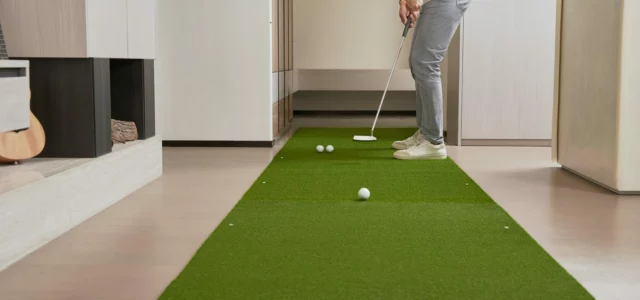
At home, a putting mat and ten minutes a day is enough to restore the stroke and, more importantly, the start line. Twenty low running chips a week off a mat or a patch of lawn keeps the strike. If your club’s short-game area opens before the course does, which it often does, that is the most valuable ground on the property in March.
Focus the putting on two things: three-footers, which are the shots that decide whether early-season rounds feel good or awful, and long-putt speed, which you will have to recalibrate on real greens anyway but which you can keep the feel of indoors.
Weeks five and six: distances and the bag
Two range sessions with your own balls and a rangefinder, or one hour in an indoor bay on a launch monitor, produces a carry chart. Carry, not total, and the number that recurs rather than the best one.
This matters more in spring than at any other time of year, because early-season conditions cost you distance from two directions at once. Cold air is denser, which costs a few yards on its own, and soft ground removes the run entirely. A golfer using August numbers in April is short on every approach for a month and blames their swing.
Then audit the bag. Grips that have gone shiny, a wedge whose grooves are finished, the gap under the pitching wedge you meant to fill last year. All three are cheaper and quicker to fix in February than in June, when every workshop in the country has a two-week queue.
The equipment jobs to do before the first round
- Regrip anything that has gone shiny or hard. It is the cheapest improvement in golf and it changes how you hold the club without you deciding to.
- Replace the spikes if the tips have rounded off. Slipping in a wet spring is both a scoring problem and an injury one.
- Empty the bag completely. Everyone finds three balls, a glove that has gone hard, and a rules card from four seasons ago.
- Check the loft and lie on irons you have played for several seasons. Both move over time, and a set that has drifted two degrees flat will start every shot right of your aim.
- Check the grooves on your most-used wedge. A wedge with no grooves left does not spin, and no technique fixes that.
Book the lesson now, not in June
A swing change needs two to three weeks to stop feeling wrong, and making that change in April costs you nothing because you are not scoring yet. Making it in July costs you the summer.
Teaching diaries are also emptier in early spring, which means better times, better attention and often better rates. A block of three or four lessons booked in February gets you a coach who is not fitting you between two members on a Saturday.
Go with a question rather than a request. Not “fix my slice” but “here is my miss and here is what I have already tried”. A coach given a clear symptom in March can build a plan that lasts the season.
The first round is not a test
Play it from a tee forward of your usual one, in a fourball you enjoy, without a card. The point is to move around a golf course for four hours, not to find out whether your handicap survived the winter.
Everybody who treats the first round as an examination shoots eight over their average and spends the following week annoyed about it, which is a poor return on six weeks of preparation. Post the score if you play it under the rules, but do not organize the day around it.
Where to do the work in the U.S.
For the winter half of the plan, indoor bays and simulator centers have spread through northern cities in the past few years and are typically booked by the hour, which is enough for a carry chart in one session. Heated ranges and domes attached to municipal facilities are the cheaper version and are open through the cold in most northern markets.
For the equipment work, the large U.S. golf and sporting-goods chains all run a repair bench that handles regripping, groove checks and loft and lie adjustment, and their quietest weeks are exactly the ones you should be using. Your own club’s pro shop often does the same work, and in February they will have time to do it properly.
For a fitting, the chains publish their studio rates and the independent fitters and premium studios have empty diaries between November and February. If you are replacing anything, the previous model year is discounted in exactly this window, and used-club specialists take trade-ins at their best value before the new models land.
For lessons, the PGA of America’s coach directory lists teaching professionals by location, and your own club’s professional knows your course, which for this particular purpose is worth a great deal. Panxis Golf has no commercial relationship with any of these companies and earns no commission.
The six-week plan, in one list
- Weeks 1 to 2: mobility and half swings, short irons only, twenty balls at a time.
- Weeks 3 to 4: chipping and putting, three short sessions a week, three-footers and long-putt speed.
- Weeks 5 to 6: carry distances measured in carry, bag audit, regrips, spike check.
- Any week: book a block of lessons while the diary is still open.
- First round: forward tee, no card, four hours of walking around a golf course.
None of it is difficult and all of it is boring, which is precisely why the golfers who do it start the season two shots ahead of the ones who do not.