Winter practice in twenty square feet: a putting mat, an alignment stick and a mirror
Three objects, twenty square feet and twenty minutes three evenings a week: what a putting mat, an alignment stick and a mirror each teach, the session that fits between dinner and bed, and where winter really closes the course in the U.S.
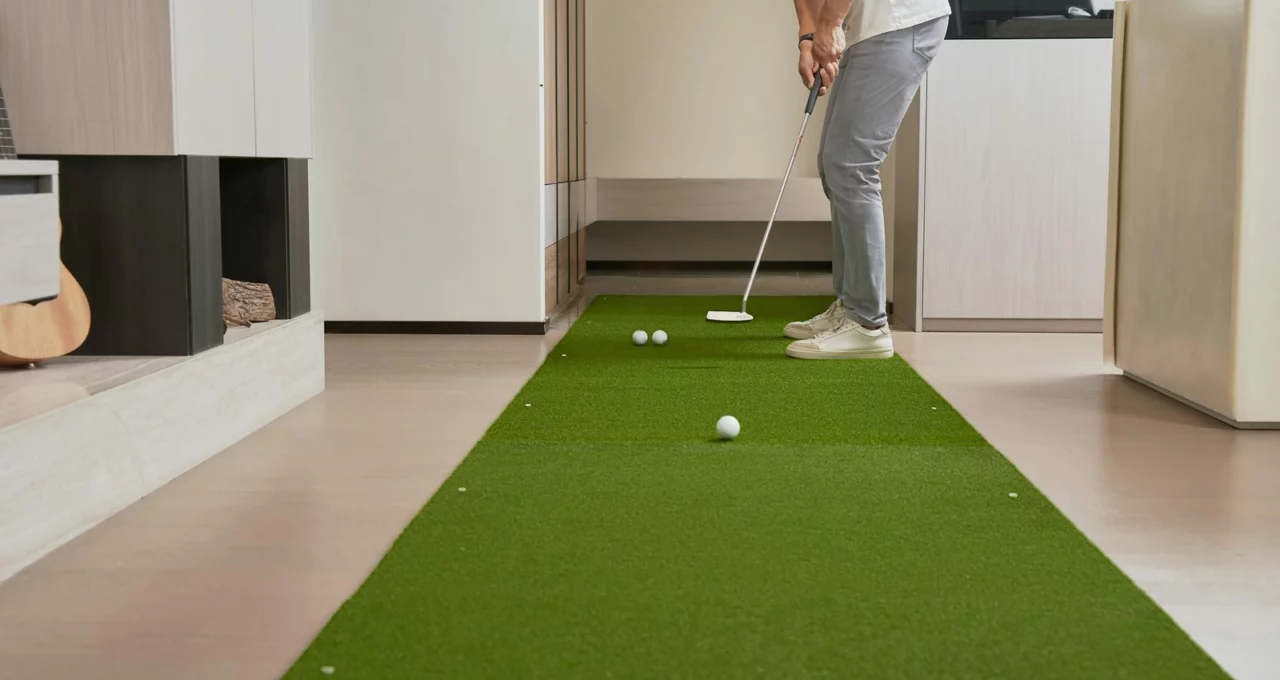
The first frost delay of the year is not the end of your golf season. It is the start of the only part of the year when your game can improve without a tee time. Most golfers waste it: the clubs go into the garage in November and come out in April, and the first round of spring is spent relearning what the last round of fall already knew. The alternative does not need a basement simulator or a heated range bay. It needs three objects, about twenty square feet of floor, and twenty minutes a few evenings a week. Here is what the three objects are, what each one teaches, and how to put them together into a routine that survives January.
Why twenty square feet beat an occasional trip to the dome
Winter golf in most of the northern United States happens indoors, and the usual answer is a trip to a simulator or a heated bay: a bucket of balls, a screen, and an hour of full swings. There is nothing wrong with that, except the frequency. A simulator hour once every three weeks is a treat, not a practice plan. What moves a handicap is the small, repeated work on the parts of the game that cost the most strokes, and for almost every amateur those parts are the setup, the putter and the start line of the ball.
None of those need a ball to fly. That is the point of practicing at home: you give up distance and ball flight, which you cannot measure in a living room anyway, and you keep everything that can be measured without them. Did the putt start on line? Were the shoulders square at address? Did the eyes sit over the ball? Those questions have yes-or-no answers, and three cheap objects give you the answers every evening instead of once a month.
Object one: a putting mat, or a strip of carpet and a cup
A putting mat is the one purchase in this plan that is close to essential, and it does not have to be elaborate. The useful features are a flat surface that rolls true, a length of at least six feet, and a target the size of a real hole, 4.25 inches across. A mat with a slight ramp into the hole is fine. A mat with marked distances is better, because the drills below depend on knowing how far away you are. If you already have a stretch of low-pile carpet, a plastic cup on its side does most of the same job; just accept that the roll will be slower than any green you play.
Two drills cover most of what the mat is for. The first is pure repetition from three feet: ten putts in a row, restart the count on the first miss, stop at ten. Three-footers are where rounds are lost in spring, when the greens are bumpy and the nerves are rusty, and the mat is the only place you will ever hit three hundred of them in a month. The second drill is the gate: two tees, or two coins, set just wider than the putter head, a foot in front of the ball. If the putter passes through without touching, the face was square and the path was reasonable. If it clips a tee, you have found the thing to work on, and you found it without a coach.
What the mat will not teach you is speed. Carpet and synthetic turf do not behave like bentgrass in April, and no amount of lag putting on a mat transfers directly to the course. Use it for the start line and the short ones, and leave distance control for the first week the practice green opens.
Object two: an alignment stick
An alignment stick is a fiberglass rod, about 46 inches long, sold in pairs at any pro shop. It is the cheapest piece of golf equipment that genuinely changes a game, because the fault it fixes is the most common one in amateur golf: aiming somewhere other than where you think you are aiming. Set the stick on the floor along your toe line, step into your setup to an imaginary target across the room, and look down. Most golfers find their feet pointing well right or left of where they believed. A few weeks of stepping into a stance against a stick retrains that picture.
The second use is as a swing plane reference. Push the stick into the ground outside, or lean it against a wall indoors at the angle of your shaft at address, and make slow half swings beside it. The feedback is not about hitting a ball; it is about whether the club goes back and comes down on roughly the same line, which is something a mirror or a phone camera would show you too, but the stick gives it to you in real time, in your peripheral vision, with no screen to check.
One warning that matters more indoors than out. Under Rule 10.2b(3) of the Rules of Golf, you cannot set down an object such as an alignment rod to help you take your stance during a round. The stick is a practice tool, and the habit it builds has to survive without it: practice stepping in against the stick, then practice stepping in without it and checking afterward. Otherwise you have trained a routine you are not allowed to use.
Object three: a mirror
The third object is the one most golfers already own. A full-length mirror, or a mirror leaned against a wall where you can take your setup in front of it, turns twenty square feet into a lesson room. Face it from the side first and check three things: the spine tilt, which for most players should be a forward lean from the hips rather than a slump from the shoulders; the arms hanging roughly under the shoulders; and the knees flexed enough that you could jump. Then face it head-on and check the ball position for each club, the shoulder line, and how much the lead shoulder sits higher than the trail one with a driver.
For putting, a small putting mirror sold for the purpose does the same job on the floor: it shows whether your eyes sit over the ball or inside it, and whether the putter face is square at address. If you prefer not to buy one, a hand mirror laid flat under the ball works for the eye line, and the gate drill on the mat already checks the face.
The mirror’s real value is not the checklist but the comparison. Set up as you normally would, look, and adjust. Then close your eyes, set up again by feel, open them, and see how far you drifted. The gap between what you feel and what you see is what the winter is for. By March it should be small.
The twenty-minute session
Three objects and twenty minutes break down naturally into three blocks, and the order matters: setup first, because everything else depends on it.
- Minutes 1 to 5, mirror and stick: five setups with a mid-iron, five with the driver, each one checked from the side and from the front. Close your eyes for the last two of each and compare.
- Minutes 6 to 15, mat: the three-foot ladder, ten in a row, then the gate drill for twenty putts. If the gate is clean, move the tees closer together.
- Minutes 16 to 20, slow swings: half swings beside the stick or in front of the mirror, no ball, feeling the club stay on the line you set up to. If you have a towel, fold it under your trail arm for the last few to keep the arm connected to the body.
Three sessions a week is the honest target. The research on motor learning is consistent on one point: shorter, more frequent practice beats one long session, because the skill is rebuilt a little each time rather than crammed once and forgotten. Twenty minutes, three evenings, from Thanksgiving to the start of the season, is about forty hours of work on the three things that cost you the most strokes. No range session in the spring comes close.
What not to try at home
Full swings indoors are where winter practice goes wrong. A ceiling of eight feet is a club’s length plus a swing arc above a six-foot golfer, which means the top of the backswing and the follow-through pass within inches of plaster, light fixtures and people. If you want to hit balls at home, foam practice balls into a hanging blanket or a net are the safe version, and even then the ceiling height is the first thing to measure. A garage with the door open is a better room than a living room with the furniture pushed back.
Resist the urge to rebuild your swing from videos in the dark months. The mirror and stick are for setup and alignment, which you can see and correct yourself. Plane and sequencing changes need a coach and, preferably, a ball flight to confirm them. A winter spent changing a grip on your own often produces a spring spent changing it back.
Where winter actually closes the course in the U.S., and what that leaves you
The clearest signal that your season is over is not the weather but the handicap calendar. The USGA lets state and regional golf associations declare an inactive season, during which scores played at home do not count toward a Handicap Index because frozen ground, temporary greens and winter rules distort them. The published schedules for recent seasons run from November 1 to March 31 in Minnesota, Wisconsin and Michigan, from November 15 to March 31 across the New York metropolitan area, Massachusetts and most of New England, and from mid-November in Colorado. Check your own association’s dates each fall, because they are reviewed, and remember that a round played in Florida or Arizona during your inactive season still has to be posted: it is the course’s season that counts, not yours.
That calendar explains why off-course golf has grown so fast. The National Golf Foundation counted more than 29 million Americans playing on a course in 2025, and about 48 million once ranges, simulators and entertainment venues are included. Much of that off-course play happens between November and March, in simulator studios that rent bays by the hour, heated range stalls that stay open through the winter in cities from Chicago to Boston, and the inflatable domes that appear over driving ranges across the upper Midwest each fall. Those are good places to hit a ball in January, and a monthly visit tells you whether the work at home is transferring. They are not a substitute for the work at home, for the reason above: frequency.
Two things make the indoor hour worth more. First, bring the alignment stick: most simulator bays have room for it, and the number that matters on the screen in winter is the start direction, not the carry. Second, if your club or a local course keeps its putting green open on snow-free days, use it. A February afternoon on a cold, slow, real green is worth a week on a mat for the one skill the mat cannot teach, which is speed.
The winter practice checklist
- Space: about twenty square feet of flat floor, a ceiling you have measured before any swing, and nothing fragile within a club’s length.
- Objects: a putting mat at least six feet long with a regulation hole, one alignment stick, and a mirror you can take your setup in front of.
- Schedule: twenty minutes, three evenings a week, in the same order every time: setup, putting, slow swings.
- Measures: ten three-footers in a row, a clean gate, and a setup that looks the same with your eyes closed as it does with them open.
- Outside the room: one simulator or heated-bay session a month to check the start line, and the real putting green whenever it is open.
- Leave alone: full swings indoors without a net and a measured ceiling, and any rebuild of grip or plane without a coach.
Spring golf in the northern states always starts with the same complaint: the first three rounds are lost to rust. The golfer who spent the winter in front of a mirror with a putting mat and a stick does not make that complaint. The swing may not be longer in April, but the setup is right, the three-footers go in, and the ball starts where it was aimed. On a cold course in early spring, that is most of what a score is made of.
How this page was put together: the hole size and the alignment rule come from the Rules of Golf (Rule 10.2b(3)) and the USGA equipment rules, the inactive-season schedules from the USGA and the state golf associations’ published calendars, and the participation figures from the National Golf Foundation’s 2025 reports, all read in October 2026. The drills are standard coaching practice and are presented as such; nobody at Panxis Golf measured them. Panxis Golf has no commercial relationship with any product or facility mentioned here, and no retailer is named. If a page is ever paid for by a brand, it will say so above its first line.