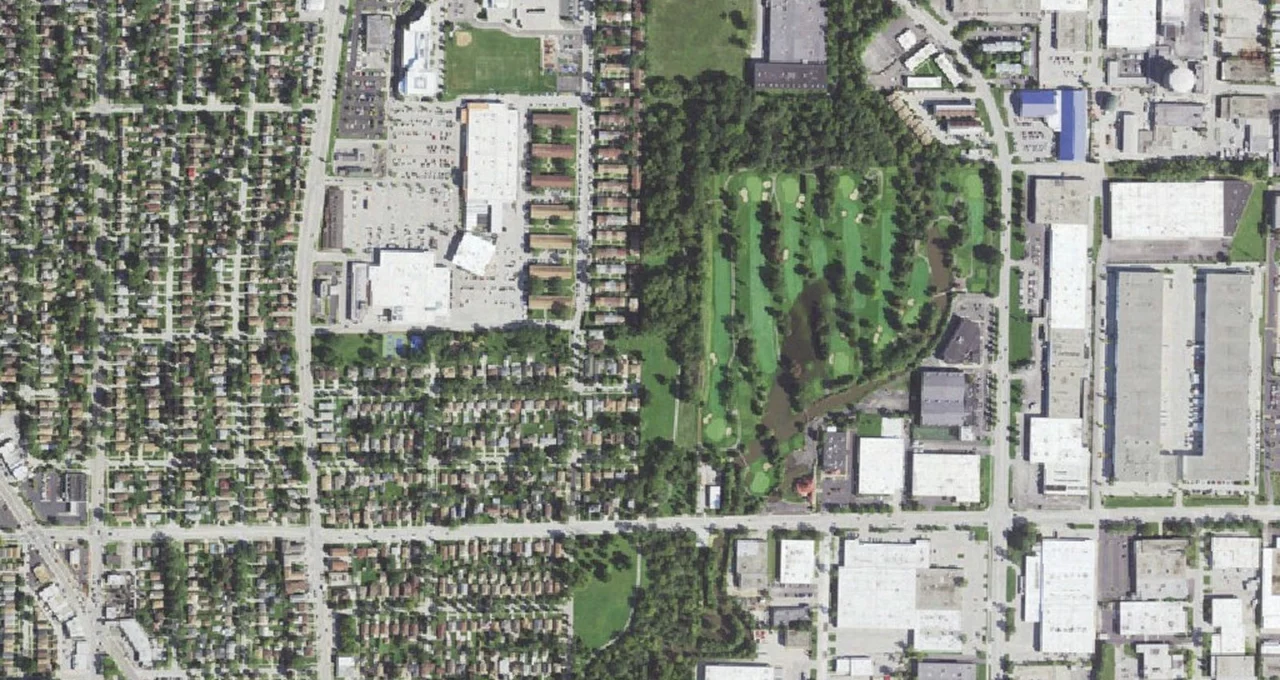
Tam O'Shanter Golf Course from the air. Aerial imagery USGS, domaine public.
Tam O’Shanter Golf Course
Holes
9
By
33
Length
2,440 yards from the Blue tees
Green fee
—
Best season
April to mid-December, weather and river permitting
Tam O’Shanter Golf Course is a public nine-hole course in Niles, Illinois, a suburb on the northwest edge of Chicago, owned and run by the Niles Park District. The North Branch of the Chicago River runs through the property. The address is 6700 Howard Street, Niles. Today it is a short, flat par 33 popular with beginners, juniors and families; from the 1940s to the 1960s, on a larger 18-hole course on the same ground, it was one of the most famous tournament sites in American golf.
The layout has six par 4s and three par 3s. Published lengths vary slightly from one source to another: booking listings give 2,440 yards from the Blue tees, 2,235 from the White and 1,905 from the Red, a regional course guide gives 2,440 yards with a longest hole of 408, and a press feature on the course’s recent upgrades gives 2,457 yards from the tips, with the 1st, at 404 yards, as the longest hole. Third-party listings also carry course ratings for nine holes of about 31 to 32 and slopes of 106 to 107, but they do not agree with each other and we could not check them against the rating authority, so this page gives no official figure.
The story behind the name
The original Tam O’Shanter Country Club was a private 18-hole club, laid out in 1925 by C. D. Wagstaff and opened in 1926. It did not prosper: a fire destroyed the clubhouse in 1936 and a flood damaged the course in 1938. George S. May, a Chicago businessman who had joined the club when it opened, took control in those years, rebuilt the clubhouse and remodeled the course, and turned it into the stage for his own tournaments.
May was a promoter first. He launched the Tam O’Shanter Open in 1941 with the largest purse in professional golf at the time, then the All American Open, and from 1946 the World Championship of Golf, whose first prize was for years several times larger than any other on the tour. Women’s versions of both events followed; Babe Didrikson Zaharias won eight times at Tam O’Shanter. May is credited with a long list of firsts for spectator golf: numbers on players’ backs from 1942, grandstands, scoreboards fed by short-wave radio, and carts at a club. He also opened his fields to Black professionals in the early 1940s, when almost every other tournament excluded them; Ted Rhodes, Howard Wheeler and Charlie Sifford played Tam O’Shanter events, as did the boxer Joe Louis.
The most famous day came in 1953. May paid ABC to broadcast the final hour of the World Championship of Golf, the first golf tournament shown live on national television in the United States, with a single camera behind the 18th green. Estimates of the audience range from one to two million viewers. Chandler Harper was in the clubhouse as the apparent winner when Lew Worsham, the 1947 U.S. Open champion, holed a wedge from 104 yards on the par 4 18th for an eagle 2 and won by one stroke.
The winners’ list of the World Championship tells the rest: Sam Snead in 1946, Ben Hogan in 1947 and 1951, Lloyd Mangrum in 1948, Julius Boros in 1952 and 1955, Worsham in 1953, Bob Toski in 1954, and Dick Mayer in 1957, the last edition, after May fell out with the PGA and walked away. The tour came back for the Western Open in 1964, won by Chi Chi Rodriguez, and in 1965, won by Billy Casper.
May died in 1962. According to a golf-history feature, his family sold the club in 1965 to developers who turned most of the land into an industrial park. In 1973 the Niles Park District bought the part of the property that is now the course, and reopened it as a public nine in 1974 on a design by William J. Spear. According to the press feature on its upgrades, only two holes survive from the championship course: the 1st, a par 4, and the 6th, a par 3 that was once the 16th.
What it asks of you
Next to that history, the current course is modest, and it does not pretend otherwise. It is short, flat and open to the public, and the holes run straight and mostly parallel across a lightly tree-lined parkland site. What it asks of a player is not length but control of the short and middle irons, a sound wedge game, and nerve over water on the two river holes.
The par 4s are the heart of the round. With a longest hole of about 400 yards and most of the others well short of that, the average golfer will reach several greens with a mid-iron or less, and a strong player can think about driving some of them. The risk is in the precision: with nine holes and a par of 33, a couple of loose approaches weigh heavily on the score, and the course guides describe greens that are more demanding than the yardage suggests.
The river is the course’s signature. The North Branch of the Chicago River crosses the property, and the 6th and the 9th, both par 3s, ask for a carry over it. For a beginner, those two shots are the real test of the round; for everyone else, they decide whether the card ends near par.
The river is also the course’s permanent problem. Much of the property lies below the 10-year and 100-year floodplains, and before 2018 high water regularly put tees and greens under water; severe storms in September 2008 caused heavy damage. The Park District commissioned a master plan from the Illinois firm Lohmann Quitno Golf Course Architects, whose main goal was to lift tees and greens out of the 10-year floodplain and improve drainage. Planning began in the spring of 2017, construction in the fall, and the course reopened for the summer of 2018 with new tees, reworked bunkers, new cart paths and new signage. The engineering firm on the project says the work reduced maintenance problems and increased the number of days the course can open. Floods have not disappeared entirely, and a flooded river can still close the course.
What golfers are saying
As a public course with a long history, Tam O’Shanter has a real trail of reviews on rating sites, booking platforms and local golf media. The points below summarize what recurs. They are other people’s opinions, not ours; nobody from Panxis has played the course, and we name and quote no one.
What comes up in its favor
- Condition is the most frequent compliment: reviewers describe well-kept fairways and greens, and attractive landscaping for a municipal nine.
- The staff are often described as friendly and helpful.
- Many see it as an ideal course for beginners, juniors and families, with forward tees for children and a relaxed atmosphere.
- The history is part of the appeal: players like standing on the ground where the first televised tournament was decided, and the history wall by the 1st tee.
- National and local outlets have rated it among the best short courses in the country and among the best nine-hole courses in the Chicago area.
What comes up against
- There is no driving range; practice is limited to a small putting green and a few hitting nets.
- The pro shop is small, with little stock.
- Flooding from the river remains an issue at times, even after the 2018 work.
- It is only nine holes, which some reviewers list as its main limit, and the course is busy with beginners.
How to play it
Tam O’Shanter is a public course: anyone can book a tee time, through the course’s website or a booking platform, or walk on when there is space. Tee times are spaced ten minutes apart, according to a regional course guide. Walking is allowed, and motorized carts and push carts are available; booking listings also mention club rentals, a putting green and a teaching professional, and they note that metal spikes are not allowed. The Park District sets the rates and the rules.
The facilities
The old clubhouse is long gone. A sports bar and restaurant adjoins the pro shop. The course’s Golf Learning Center, set up on the site of a driving range that did not succeed, runs lessons and junior programs, and the press feature on the upgrades reported that it served about a thousand young pupils a year. Photographs and memorabilia from George S. May’s tournaments are displayed near the 1st tee.
Getting there and when to go
The course is on Howard Street in Niles, in the northwest suburbs of Chicago, at 6700 Howard Street. The season follows the Chicago climate; booking listings give an opening period from April 1 to December 15, subject to weather and to the river. After heavy rain, it is wise to check that the course is open before setting out.
Green fees
Rates are set by the Niles Park District and are published by the course. See the course’s own site.
How this page was made
The factual frame comes from public sources: OpenStreetMap for the location; encyclopedic entries for the ownership, the reduction to nine holes and the list of tournaments; the Niles Park District and local press for the recognitions; a regional course directory for the original architect, the 1974 architect and the Park District purchase; a press feature on the course’s upgrades for the surviving holes, the length from the tips, the learning center and the history wall; the engineering firm’s project page for the 2018 renovation; and golf-history references for George S. May, the 1953 broadcast and the tournament winners. Where sources disagree, as they do on the length and the rating, we say so and give no single figure.
The opinion section summarizes rating sites, booking platforms, course guides and local media read in September 2026. We report recurring themes rather than individual voices, and we reproduce no quotations. Nobody from Panxis has played or visited this course, and this page is no substitute for a round. The course’s own website could not be read when this page was prepared.
The Park District has not paid for this page, has not seen it before publication and has no say over its content. This page contains no commercial link and earns us no commission. If you know the course and something here is wrong or out of date, write to us and we will correct it.
Other courses nearby
Closest to this one in our United States directory:
- Sunset Ridge Country Club — 6 mi
- Rolling Green Country Club — 9 mi
- Riverside Golf Club — 12 mi
- Onwentsia Club — 16 mi
The hole to know
A par 3 over the North Branch of the Chicago River, and one of only two holes that survive from the championship course of George S. May's tournaments, where it was the 16th.