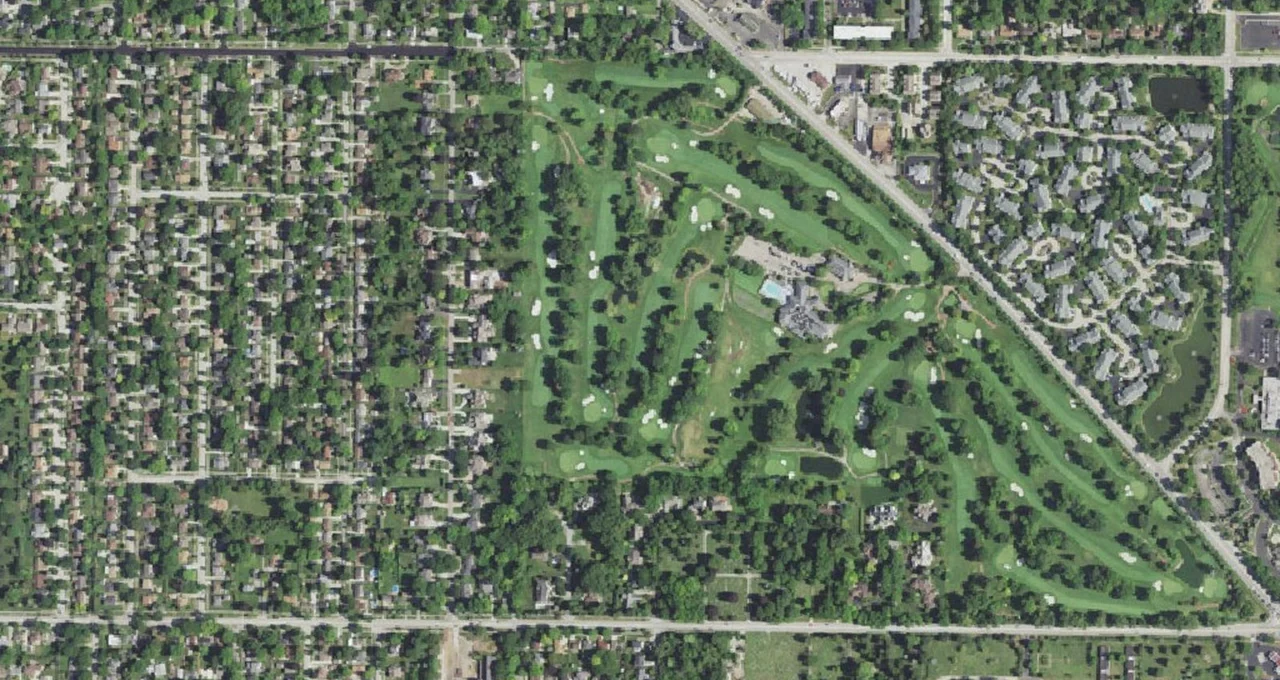
Rolling Green Country Club from the air. Aerial imagery USGS, domaine public.
Rolling Green Country Club
Holes
18
By
72
Length
6,642 yards (blue tees, club's hole-by-hole card)
Green fee
—
Best season
Roughly March to November
Rolling Green Country Club sits on the northeast side of Arlington Heights, in Chicago’s northwest suburbs, at 2525 East Rand Road. The property covers about 105 acres, bounded by Rand Road, Euclid Avenue, Forrest Avenue and Oakton Street. It is a private club, and it has been one since it was formed on June 24, 1924.
The land was a farm owned by Dr. Charles Oughton. According to the Daily Herald’s account of the club’s centennial, Oughton and his friend H.B. Wheelock had already built a first nine-hole course, which ended up as part of Old Orchard across Rand Road. When Oughton’s health declined, Wheelock and a small group of North Shore businessmen formed a trust to buy his 160-acre farm, and Rolling Green was born, named for the roll of the ground. The club’s encyclopedia entry adds a story it does not source: Donald Ross was first commissioned to design the course, before Oughton decided to oversee construction himself. Treat that as club lore rather than established fact.
The course played today is the work of William H. Diddel, the Indiana architect, and his 18 holes were finished in 1927. The original nine then became a course for women, and men could only play it with a woman in the group. The club still presents that women’s nine as a point of pride. Ray Kroc and his wife Ethel were members. Local accounts say Kroc, then a milkshake machine salesman, persuaded fellow members to invest in his early hamburger business here, a scene the 2016 film The Founder recreated at a golf club in Atlanta; the club has a boardroom named after him.
The course has also served competitive golf. The club lists the 1965 CDGA Senior Championship among the events it has hosted, it held Western Open qualifying rounds through the 1970s, and it still hosts Illinois PGA tournaments.
In January 2015 the members, with about 90 percent voting in favor according to local press at the time, sold the club to ClubCorp, the Dallas company now known as Invited. Rolling Green is run as part of that network, and its website sits on the Invited domain.
The card is a par 72, 36 out and 36 back, with four par 3s, four par 5s and ten par 4s. The club’s own hole-by-hole card adds up to 6,642 yards from the blue tees, 6,351 from the white, 5,914 from the silver, 5,491 from the gold and 5,379 from the green. The same card gives a slope of 137 from the blue, 134 from the white, 129 from the silver, 125 from the gold and 130 from the green. Other published figures do not agree with this card, and we come back to that at the end of the page.
What it asks of you
This is a tree-lined parkland course with no houses inside the property; homes line the edges instead. The corridors are defined by mature trees, and the club notes that ponds come into play on nine of the eighteen holes. Tees are often raised, which gives a good view of the hole, and the club’s own advice on the 1st is to look at the flag beside the tee to judge the wind before the first swing.
Three things decide the round. The first is the left side. Out of bounds runs down the left of the 6th for its whole length, down the left of the 8th, down the whole left of the 10th, along the first 150 yards of the 13th and down the entire left of the 17th. A pull or a hook is the expensive miss here, and the club’s professional keeps steering players toward the middle and the right.
The second is the wind. It comes up in the pro’s notes on the 1st, the 5th, the 7th, the 9th and the 11th, and the advice is always the same: know your carry number, check the flags, take one more club when unsure. On a course of modest length, the wind is what turns a short hole into a long one.
The third is the greens. Several are elevated, several slope hard, and the pro’s warnings are about which side of the hole to leave the ball on: below the hole on the 3rd, where a downhill putt is described as treacherous; below the hole on the 16th, where anything above it makes for a tough two-putt; middle-left on the 17th, a green that falls from left to right. The 5th has a spine running across the green, so front and back pins need a tee shot that lands on the correct side of it.
The front nine
The 1st is a par 4 of 431 yards from the blue, described as tight, with a fade toward the right edge of the bunkers on the left as the preferred shape. The 2nd, a par 5 of 489, hides water on the left that cannot be seen from the tee, with a large willow waiting to complicate the second shot. The 3rd is only 375 yards but carries the number 3 stroke index for men: trees right, water left, and an elevated green where the approach can take one or two extra clubs.
The 4th, at 353, is the second of the two tightest holes on the course, and the pro suggests taking a line on a chimney in the distance. The 5th is the longest par 3 on the card at 213. The 6th, a par 5 of 536, is the number 1 stroke index for men, the one hole where the pro invites players to let the driver go, and still a three-shot hole for most. The 7th is a short par 3 of 157 to a raised green, the 8th a short par 4 of 328 squeezed between out of bounds and heavy rough, and the 9th a par 4 of 446 whose large, receptive green rewards an aggressive approach once the wind has been read.
The back nine
The 10th, a par 4 of 423, offers a narrow landing area: out of bounds all the way on the left, trees all the way on the right, and rough that cuts in from the left. The 11th is a par 3 of 156 where the wind, in the pro’s words, is always an influence. The 12th, 375 yards, hides the right side of the green from the tee. The 13th, 393 yards, has a pear-shaped green that narrows toward its upper right.
The 14th and 15th are back-to-back par 5s, the first of 552 yards and the second of 486. The 16th is a short par 4 of 324 where the advice is to lay up at 180 to 200 yards, using a windmill as the line. The 17th is a par 3 of 191 with out of bounds all down the left and a green that should not be overshot. The 18th, a par 4 of 414 to an elevated green, is the number 6 stroke index, and the club’s own notes say there is no shame in playing it as a three-shot hole.
What players say about it
Public material on this course is thin. It is a private club, and most reviews available online are about weddings and events at the clubhouse rather than about the golf. The golf opinions below come from a small number of player reviews on course directories, plus local coverage. The points below summarize what recurs. These are other people’s opinions, not ours: we have not played the course, and we name and quote no one.
What comes up in its favor
- Conditioning is the most frequent compliment: players describe well-kept fairways, greens and practice areas, and the club itself claims tournament conditions every day.
- The greens are singled out as complex, and together with demanding pin positions they lead some players to call the course underrated.
- The traditional layout, with big trees along the fairways and no houses inside the course, is appreciated.
- Event guests praise the grounds, the views over the course and the staff.
What comes up against
- Access is closed: members and their guests only.
- From the back tees the course is said to play long, with little roll, and a missed fairway usually costs a shot.
- Food and events are described by some as expensive.
- The volume of public material is small, and any summary, including this one, rests on a narrow base.
The facilities
The practice setup includes a driving range and practice areas, and the teaching staff uses TrackMan for lessons and club fitting. Programs include a youth series, PGA Junior League and a course for adult beginners. There is a golf shop.
Rolling Green runs a caddie program, which lets members and guests walk the course. Caddies must be at least 14 to apply, and the club supports the Evans Scholars Foundation, the scholarship fund for caddies. Carts are also available. Loopers Golf Lounge, an indoor room with golf simulators, keeps the club in golf through the winter.
Away from golf, the club has a pool with a water slide and a children’s pool with a splash pad, a fitness center, a restaurant and bar, and event rooms. In winter it grooms cross-country ski and snowshoe trails that start on the back nine, builds an ice rink, and opens a skeet range on the west side of the property on weekends from November to March.
Getting there and when to go
The club is on Rand Road, US Route 12, on the northeast side of Arlington Heights. O’Hare International Airport is about eight miles to the south as the crow flies, and the Chicago Loop about twenty-two miles to the southeast. The nearest Metra station is Arlington Heights, on the Union Pacific Northwest line, about two miles away.
Course listings give the season as roughly March 1 to November 1. This is the Chicago area, so early spring can be cold and wet, and once the season ends the club turns to its simulators, ski trails, ice rink and skeet range. Play is for members and their guests.
Green fees
There is no public green fee: the club says it is open only to members and their guests. Members of other Invited clubs may have access depending on their membership category, and companies or charities can book the course for a golf outing through the club. See the club’s own site.
How this page was made
The factual frame comes from public sources: OpenStreetMap and Wikidata for the location; the club’s pages on the Invited website for the architect, the hole-by-hole card (yardages, par, stroke index, slope and the professional’s notes), the facilities, the winter activities and the access rules; the Daily Herald and a Christian Science Monitor piece for the founding, the women’s nine and Ray Kroc; the club’s own history page for the tournaments it has hosted; local press from 2015 for the sale to ClubCorp and the acreage; the Midwest Association of Golf Course Superintendents for the architect and founding year; and the club’s Wikipedia entry, used with caution, for its early history and the skeet range. The opinion section summarizes public player reviews and event reviews read in September 2026; we report recurring themes rather than individual voices, and we reproduce no quotations.
Published figures disagree. The club’s golf page advertises 7,036 yards with a rating of 74.2 and a slope of 140, and its outings page a rating of 71.5 and a slope of 132, while its own hole-by-hole card adds up to 6,642 yards from the blue with a slope of 137. Older directory listings give 6,536 yards from the blue. We use the hole-by-hole card, which is the most detailed source, and we have not been able to check the official rating directly.
We have not played this course, and this page is no substitute for a round. The club has not paid for this page, has not seen it before publication and has no say over its content. There is no affiliate link or commission on this page; if a brand ever pays for content on Panxis Golf, that page will carry an advertising notice at the top. If you know the course and something here is wrong or out of date, write to us and we will correct it.
Other courses nearby
Closest to this one in our United States directory:
- Sunset Ridge Country Club — 8 mi
- Kemper Lakes Golf Club — 9 mi
- Tam O’Shanter Golf Course — 9 mi
- Onwentsia Club — 12 mi
The hole to know
The longest hole on the card, a par 5 of 552 yards from the blue, and the number 2 stroke index for men (number 1 for women). Water runs along the whole left side of the green complex and cannot be seen from the fairway, so the club's professional advises favoring the right from tee to green.