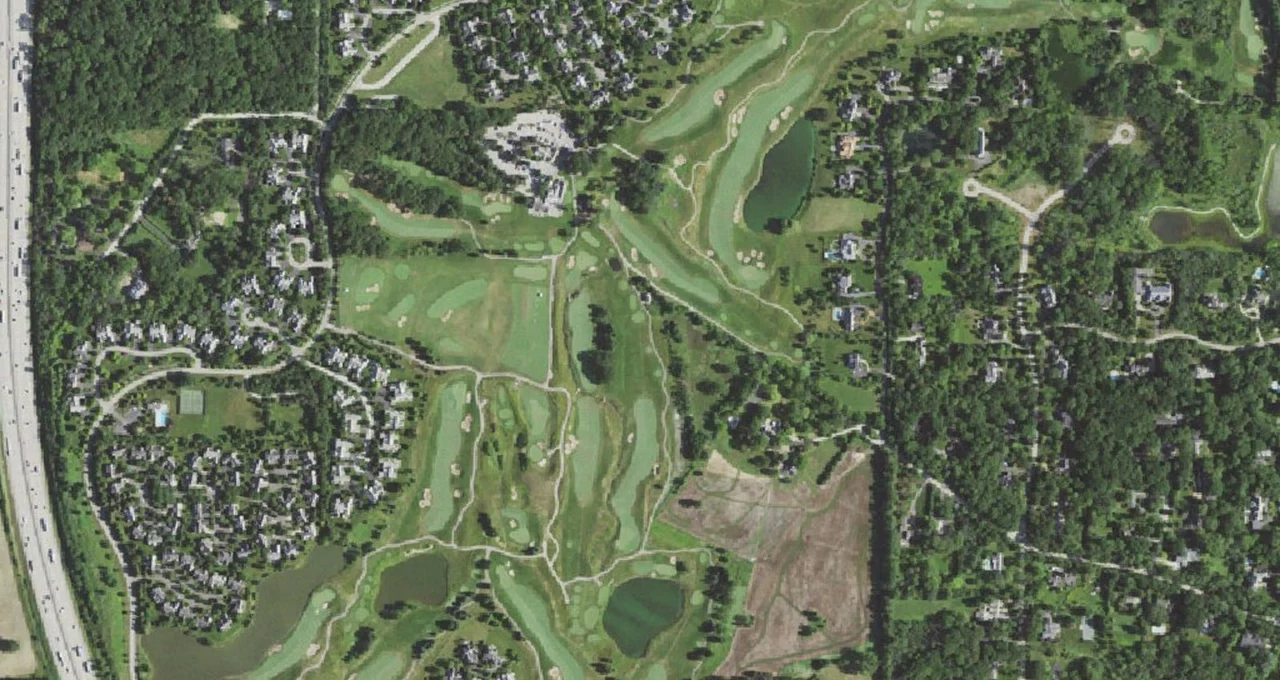
Conway Farms Golf Club from the air. Aerial imagery USGS, domaine public.
Conway Farms Golf Club
Holes
18
By
71
Length
7,233 yards from the back tees (rating 76.3, slope 152), according to Wikipedia and OpenGolfAPI; other directories give 6,946 or 6,733 yards; 7,216 yards for the 2013 BMW Championship
Green fee
—
Best season
—
Conway Farms Golf Club is a private golf club on the west side of Lake Forest, Illinois, a North Shore suburb in Lake County, roughly 28 miles north of downtown Chicago in a straight line. The club gives its address as 425 S. Conway Farms Drive, Lake Forest, IL 60045. Its single 18-hole course was designed by Tom Fazio, opened for play on August 3, 1991, and sits on 209 acres, according to the club. Several course directories also credit Andy Banfield, a longtime associate in Fazio’s firm, as co-designer. The club describes itself as an Illinois not-for-profit corporation whose membership is by invitation only.
The course is a par 71. The scorecard reproduced on Wikipedia gives it 7,233 yards from the back tees, with a course rating of 76.3 and a slope of 152, figures that make it one of the stiffer tests in the Chicago area on paper. Other directories give different totals, as we explain further down, partly because the course was renovated between 2021 and 2022. For a club that is barely 35 years old, Conway Farms has an unusually full championship record: the 1998 U.S. Junior Amateur, the 2009 Western Amateur, the 2012 U.S. Mid-Amateur and three editions of the PGA Tour’s BMW Championship, in 2013, 2015 and 2017. It was during the first of those that Jim Furyk shot 59, the sixth sub-60 round in PGA Tour history.
The club puts its emphasis squarely on golf. Its own mission statement lists walking the course among the traditions it intends to keep, and a recent reviewer on a ranking site notes that there is no pool and no tennis. This page is a portrait built from public sources; because the club is private, most readers will only ever see the course on television or as a member’s guest.
From a farm on Conway Road to a 1991 opening
The club’s history page traces its origins to three Lake Forest families who, in 1956, bought a farm straddling a stretch of old Conway Road. That farm gave the club its name, although the history page adds that it was at one point going to be called “Twin Silos,” after the silos that stood on the property. Thirty-five years passed between that purchase and the opening. In the club’s description, the site was then cornfields, other crops and horse trails, with no road linking Route 60 to Everett Road and none of the houses or ponds that surround the course today.
The club opened on August 3, 1991. Its account of the day is specific: a ribbon was stretched between two trees and cut by one of the founders, Margaret Hart; a bagpiper led the first fifty members onto the course; the land was blessed, and sand imported from Scotland was poured to mark the link with the birthplace of the game. The club says the course was designed around Scottish links traditions, and IllinoisGolf.com, a regional directory, writes that its founders drew inspiration from the Old Course at St Andrews and from Shinnecock Hills. Construction photographs on the club’s history page show Fazio on site with founders Gus Hart and Bob Stuart, and with a group that includes Dennis Wise, who would return as Fazio’s on-site architect more than twenty years later. One caption shows Fazio explaining how to play out of the sod-wall bunker on the 15th; another shows the founding governors looking over a newly built sod-wall bunker on the 8th. The original farmhouse served as the first golf shop.
The course was developed together with a residential neighborhood, and the club itself now describes a mature housing development of cul-de-sacs and tree-lined streets around the holes. That context matters for players: one reviewer on Top100GolfCourses.com complains of out of bounds on nearly every hole, which is a common side effect of a course threaded through a housing development.
An amateur championship venue
The club says it is dedicated to “the strong support of amateur golf,” and its tournament page bears that out. It lists the 1995 Women’s Western Junior, won by Candy Hannemann over Cristie Kerr; the 1997 NCAA Division I men’s championship; and the 1998 U.S. Junior Amateur, in which James Oh beat Aaron Baddeley 1 up in the final. Baddeley was also the stroke-play medalist, at 135, and the USGA received 4,088 entries that year, according to the club’s page, which reproduces the USGA’s record. The American Junior Golf Association’s Canon Cup, an East against West team match for top juniors, was played at the club in 2002 and 2006, and the Big Ten championship came in 2006. The club also lists U.S. Open qualifying in 2007 and 2008.
In 2009 the Western Amateur, which the club calls one of the toughest tests in amateur golf, came to Conway Farms; the club names John Hahn as the winner. A Daily Herald article on the event noted that the Western Amateur had last been played in the Chicago area in 1952, at Exmoor Country Club. Three years later the USGA held the 2012 U.S. Mid-Amateur at the club. Nathan Smith won it, becoming the first player to win that championship four times, as the USGA itself noted in a later release.
Three BMW Championships and a 59
The Western Golf Association’s professional event, the BMW Championship (formerly the Western Open), is the second-to-last event of the PGA Tour’s FedExCup playoffs. Conway Farms hosted it three times in five years. According to Wikipedia’s tournament records, the results were as follows:
- 2013: Zach Johnson, 268 (16 under par), two strokes ahead of Nick Watney.
- 2015: Jason Day, 262 (22 under), six strokes ahead of Daniel Berger.
- 2017: Marc Leishman, 261 (23 under), five strokes ahead of Justin Rose and Rickie Fowler.
Those totals confirm that the course was played as a par 71 for the professionals. The Chicago golf writer Len Ziehm reported that the 2013 setup measured 7,216 yards, that attendance was about 130,000 for the week, and that the final round was delayed by rain and finished on Monday. The club’s tournament page notes that the PGA Tour named the BMW Championship its tournament of the year in 2012, 2013 and 2014.
The 2013 edition produced the round the course is best known for. On Friday, September 13, in the second round, Jim Furyk shot 59, 12 under par, becoming the sixth player to break 60 on the PGA Tour, after Al Geiberger, Chip Beck, David Duval, Paul Goydos and Stuart Appleby, according to CBS News and the Associated Press. Wikipedia’s reproduction of his card shows that he started on the 10th, holed out for an eagle 2 at the par-4 15th, and finished on the 9th; reports agree that he needed a birdie on that last hole and hit a wedge to just over three feet. The round gave him a share of the halfway lead, and Ziehm records that he finished third. Wikipedia says the previous course record, a 61, had belonged for almost five years to Luke Donald, the former world No. 1, whom Wikipedia and Ziehm both identify as a member; Donald tied for fourth that week. The same week, Hunter Mahan made a hole-in-one at the 17th, and Tiger Woods was given a two-stroke penalty after a PGA Tour videographer’s footage showed his ball moving as he cleared a twig near it behind the 1st green, a ruling Woods disputed, according to Golf Channel and other reports at the time.
Before the 2015 return, the club closed the course in August 2014 for work by Fazio and Dennis Wise, reopening at the end of May 2015. Ziehm reported that all the greens were renovated and that other changes, described by the general manager as minor, included new tees and bunker adjustments; the practice range was also rebuilt and enlarged. Day then opened the 2015 championship with a 61 and a 63, a 36-hole total of 124 that, according to the Associated Press and ABC 7 Chicago, tied the PGA Tour record of 18 under par for two rounds; he finished it with a long eagle putt on the 18th. His six-stroke win made him world No. 1 for the first time, as reported by Al Jazeera and Reuters. In 2017 Leishman led from start to finish with rounds of 62, 64, 68 and 67, according to the BMW Group’s release and Golf Digest; the BMW release says his 23 under par tied the tournament record.
The Jackson Kahn renovation
The course that members play today is not quite the one seen on television in 2013. According to Golf Course Architecture magazine, the club asked Tim Jackson of Jackson Kahn Golf Design for a master plan in late 2017, and construction was approved for August 2021. Wadsworth Golf Construction rebuilt the front nine by December 2021 and the back nine by December 2022, with some grassing finished in spring 2023. The magazine lists the main elements:
- A rebuilt 1st green, moved to get more sun and a better angle of approach, after earlier re-sodding had left layered soil and trees had shaded it; several trees were removed around it.
- Redesigned greens and green complexes at the 7th and 15th, the two short par 4s.
- Redesigned creeks on the 10th and 18th.
- Bunkers moved and reshaped, from an open “clamshell” style to edges with more shadow and definition, and rebuilt with modern liners.
- Wider fairways that follow the movement of the land, longer and more angled championship tees, and repositioned forward tees.
- A new irrigation system replacing the original one from the club’s founding.
Jackson told the magazine that the course “had tremendous bones” but that its strategy had been overtaken by modern equipment, and he credited Fazio’s original work. Several recent reviewers on Top100GolfCourses.com describe the new bunkering as the most visible change, with white sand and native grasses around the edges.
What the course asks of you
The site is gently rolling rather than flat, which sets it apart from much of the Chicago area. Top100GolfCourses.com describes 209 acres of “gently undulating land” where four lakes come into play, and reviewers mention marshland, wetland crossings, mature trees and more open stretches. A creek and ravine run along the 10th and return on the 18th. The card is built around a par 35 front nine with a single par 5, the 8th, and a par 36 back nine with par 5s at the 14th and 18th. There are four par 3s, at the 2nd, 6th, 11th and 17th, which one reviewer notes play in different directions and so react differently to the wind.
Hole lengths vary with the source and the date. The card on Wikipedia, which we could not date, gives the following yardages from the back tees:
- Front nine: 1st, par 4, 360 yards; 2nd, par 3, 196; 3rd, par 4, 405; 4th, par 4, 505; 5th, par 4, 470; 6th, par 3, 218; 7th, par 4, 345; 8th, par 5, 600; 9th, par 4, 405. Out: 3,504 yards, par 35.
- Back nine: 10th, par 4, 458; 11th, par 3, 177; 12th, par 4, 419; 13th, par 4, 465; 14th, par 5, 585; 15th, par 4, 334; 16th, par 4, 466; 17th, par 3, 230; 18th, par 5, 595. In: 3,729 yards, par 36.
OpenGolfAPI, an open course directory, lists eight sets of tees from 5,146 to 7,233 yards, but its own hole-by-hole card adds up to 6,946 yards, with, for example, 155 yards at the 11th and 560 at the 18th, figures that match those quoted by recent reviewers. Treat individual hole lengths as approximate.
Some holes come up again and again in published descriptions and reviews:
- The 5th, a long par 4 rated the hardest hole on the stroke index in OpenGolfAPI’s card. Reviewers describe a forced carry over marshy ground from the tee, out of bounds on the left, trees and bunkers to the right as the hole bends, and a green that slopes from back to front. Top100GolfCourses.com’s own description calls it a short par 4, one of several small inconsistencies between sources.
- The 7th, a short par 4 that the renovation reshaped. Reviewers describe a long, narrow green with a false front, deep bunkers and runoffs, reachable from the tee for long hitters; several list it among their favorite holes because every option, from driver to a layup, carries a similar risk.
- The 8th, the only par 5 on the front nine, which the club’s own construction photos show with a sod-wall bunker. It swings left around a large pond and climbs to an elevated green guarded by deep bunkers well below the putting surface. Top100GolfCourses.com calls it the signature hole, and one reviewer calls it possibly the best on the property.
- The 11th, a short par 3 over water to a well-bunkered green. A member who reviewed the course says it was one of the holes most changed by the renovation, and another reviewer recalls it playing as one of the hardest holes during the BMW Championship.
- The 15th, a short par 4 bending left around a lake to a narrow green beside the water, where Furyk holed out for his eagle in 2013. It was reworked in 2014 and again by Jackson Kahn.
- The 17th, a downhill par 3 that reviewers single out for its bunkering and its strongly contoured green.
- The 18th, a par 5 crossed twice by the creek, which forces a decision on the second shot and protects the front right of the green.
For club golfers, the many forward tees bring the course within reach, but the ratings published by directories still describe a difficult course. Reviewers also mention fescue and native grass that can make balls hard to find, and out of bounds on many holes.
What golfers say
Because Conway Farms is private, public opinion is thin. Booking sites and golf apps, the usual source of reviews for public courses, have little or nothing to offer. The material summarized here comes from the six reviews posted on Top100GolfCourses.com when we read them in October 2026 (individual scores from 3 to 5 out of 5, an average of 4.0), dated between 2019 and September 2026, and from the descriptions on that site and on IllinoisGolf.com. One reviewer says he is a member and declares his bias; another says he plays the course several times a season. These are other people’s opinions, not ours. Nobody from Panxis has played the course, and we name no reviewer.
What comes up in its favor
- Strategic variety: reviewers praise the mix of short, risk-and-reward par 4s and long, demanding holes, and holes that offer several reasonable lines of play.
- The renovation: several reviewers say the new bunkering looks and plays better, and the member reviewer writes that it took the course “from good to the border of great.”
- The routing and terrain: reviewers note more elevation change than on most Chicago-area courses and a round that visits every corner of the property, with varied scenery.
- The finishing stretch from the 15th to the 18th, and individual holes such as the 7th, 8th and 17th.
- Conditioning, described as excellent or pristine in most recent reviews, and a club culture focused on golf, walking and caddies.
What comes up against
- The oldest review, from 2019 and so before the renovation, is harsh: out of bounds on nearly every hole, fescue that is “out of control,” and “boring” green complexes.
- One recent reviewer finds the opening two holes the weakest and spatially tight, the 1st especially.
- Another finds several of the redesigned greens and closing holes overly penal or out of character with the rest of the course.
- The member reviewer finds the greens “always a bit slow” for his taste and says conditions often look better than they play.
- One reviewer admits arriving skeptical after watching the BMW Championship on television, which he did not find impressive, before changing his mind.
Getting there and playing
Conway Farms is a private club, and the club says its membership is by invitation only. There is no public tee-time booking. Its website has a guest page for those who play with a member. Guests are asked to drive up to the bag drop by the golf shop, the white building on the left, and to identify their host so their bags can be tagged. The page sets out the club’s customs: tipping club employees is not an accepted practice; traditional golf attire is expected, with tucked-in collared shirts, appropriate shorts or slacks and soft-spike shoes, and gentlemen remove their hats in the clubhouse; mobile phones must stay silent and out of sight, with calls allowed only in the clubhouse phone booth or in your car; and a round is expected to take four hours. Lockers, a driving range, a chipping green and a putting green are available to guests.
The club encourages walking, and one recent reviewer describes it as walking only, with caddies. Directories disagree on carts: IllinoisGolf.com lists carts as unavailable and caddies as available, while Stymie’s directory says carts are available. Guests should ask their host. The club does not publish a season. Like every course in northern Illinois it is exposed to winter weather, so play depends on conditions and on the club’s decisions.
The club sits in west Lake Forest, near Illinois Route 60. In a straight line, it lies about 17 miles north of O’Hare International Airport and about 28 miles north of the Loop; those distances are measured on the map, not by road. The club’s neighbors include other well-known North Shore clubs such as Knollwood, Onwentsia and Old Elm. As a private club, Conway Farms publishes no green fees or membership rates, and we do not report any.
How we built this page
The factual frame comes from public sources: OpenStreetMap for the location; the club’s website, conwayfarmsgolfclub.org, for its history, its address, its mission, its list of tournaments and its guest rules; Wikipedia for the scorecard, the course rating and slope, the BMW Championship results, the record of Luke Donald and Furyk’s card; Wikidata for the identifiers; Golf Course Architecture magazine for the Jackson Kahn renovation; Len Ziehm’s reporting for the 2014 to 2015 work and the 2013 setup; CBS News, the Associated Press, Golf Channel, ABC 7 Chicago, Al Jazeera, Reuters, the BMW Group and Golf Digest for the championship details; the USGA for the Mid-Amateur; the Daily Herald for the Western Amateur; and IllinoisGolf.com, OpenGolfAPI, Stymie and Top100GolfCourses.com for the course data, ratings and reviews.
Where sources disagree, we say so. The club’s address is 425 S. Conway Farms Drive on its own site, but 405 S. Conway Farms Road in IllinoisGolf.com and Stymie. Wikipedia gives a back-tee length of 7,233 yards with a rating of 76.3 and a slope of 152; OpenGolfAPI repeats 7,233 yards for the Black tees but its hole card adds up to 6,946; Stymie lists 6,946 yards at par 70 with 74.2 and 143, apparently built from a doubled front nine; and IllinoisGolf.com gives 6,733 yards and a slope of 138. The 2013 tournament setup was 7,216 yards according to Ziehm. The yardage of the 15th is 334 in Wikipedia, 332 in OpenGolfAPI and in a review, and 342 in Top100GolfCourses.com’s description. Fazio is the architect in every source; IllinoisGolf.com and other directories add Andy Banfield, and OpenGolfAPI adds Dennis Wise. Top100GolfCourses.com ranks the course eighth in Illinois, and IllinoisGolf.com says Golf Digest ranked it ninth in the state in 2006; we could not open Golf Digest’s current state list.
Some details will age: the review count and scores read in October 2026, the rankings, the tee ratings, which are revised periodically, and the guest rules. The opinion section reports recurring themes rather than individual voices. Nobody from Panxis has played or visited this course, and this page is no substitute for a round.
The club has not paid for this page, has not seen it before publication and has no say over its content. This page contains no commercial link and earns us no commission. If you know the club and something here is wrong or out of date, write to us and we will correct it. The club’s own history page has photographs of the course under construction in 1991, and its tournament page lists the championships it has hosted.
Other courses nearby
Closest to this one in our United States directory:
- Onwentsia Club — 2 mi
- Chevy Chase Country Club (Traditions at Chevy Chase) — 5 mi
- Kemper Lakes Golf Club — 8 mi
- Sunset Ridge Country Club — 9 mi
The hole to know
A short par 4 of about 332 to 342 yards, depending on the source, bending left around a lake to a narrow green beside the water. Jim Furyk holed out here for an eagle during his 59 in 2013; the hole was reworked in 2014 and again by Jackson Kahn in 2022.