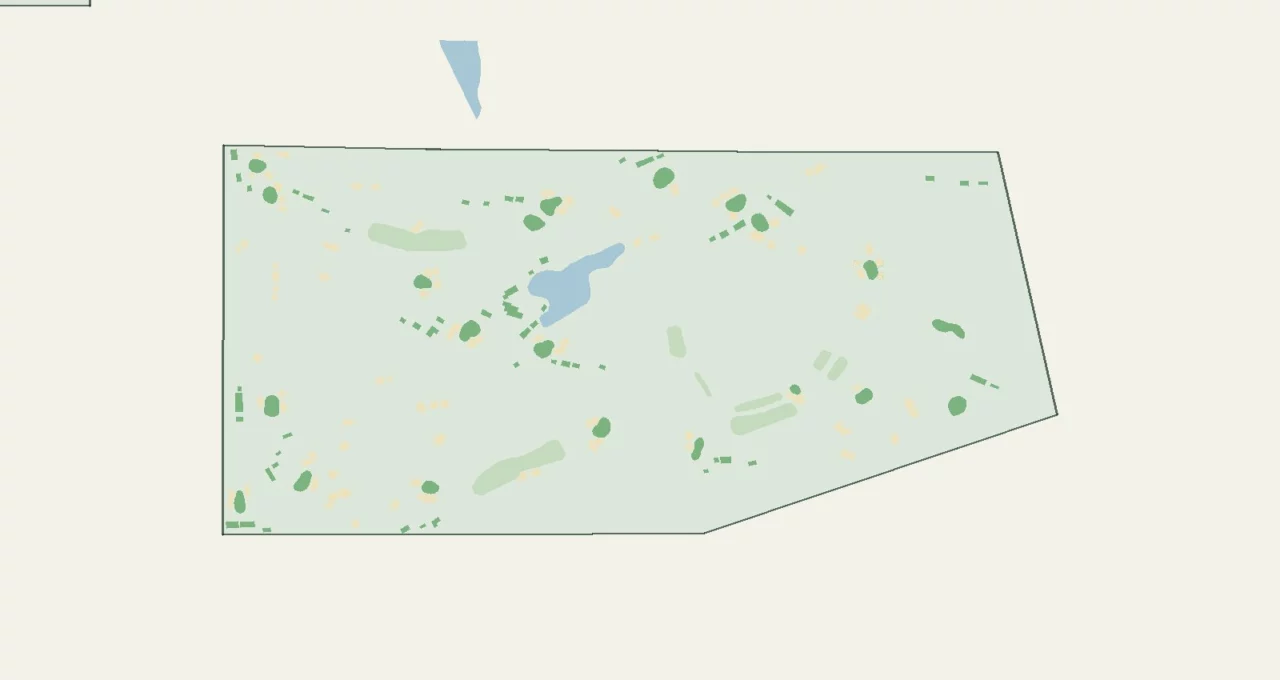
Layout of Onwentsia Club from OpenStreetMap survey data (ODbL licence).
Onwentsia Club
Holes
18
By
71
Length
6,645 yards (back tees)
Green fee
—
Best season
Roughly April to October
Onwentsia began in 1893 as seven holes on the lawn of Senator Charles B. Farwell in Lake Forest, laid out between the flower beds and the trees, with tomato cans sunk for holes. The club moved to its present ground in 1895, and Charles Blair Macdonald designed the first nine there; Herbert J. Tweedie and the brothers James and Robert Foulis added the second in 1898. Tom Doak has since worked on the course.
It staged the U.S. Open in 1906, over 6,107 yards, when Alex Smith won the first of his two titles seven strokes clear of his younger brother Willie. Today it is a par 71 of 6,645 yards from the back, rated 72.8 with a slope of 134.
What it asks of you
This is nineteenth-century American golf on ground that was never moved much, and it plays like it. The greens are small by modern standards and sit on natural rises, and the bunkering is close in rather than pushed out to catch a drive.
At 6,645 yards there is no defence by length, so the course defends with position: the angle into a small green from the wrong side of the fairway is the difference between a birdie putt and a bogey. That is the oldest idea in golf architecture and it survives here because nobody stretched the holes to hide it.
Macdonald’s nine matters historically. He went on to build the National Golf Links and to import the template holes that shaped American design, and Onwentsia is among his earliest work, before the ideas hardened.
What players say about it
This is a private club, so the public record comes from guest accounts, architecture writing and championship history. The points below summarise what recurs. These are other people’s opinions, not ours: we have not played the course, and we name and quote no one.
What comes up in its favor
- The lineage is the draw: an early Macdonald nine, a U.S. Open, and a club that has been in continuous play since 1895.
- The small greens and close bunkering are praised as an intact example of how the game was defended before length existed.
- The Lake Forest setting, with mature trees and old estate ground, is consistently admired.
- Conditioning is reported as excellent.
What comes up against
- Access is closed: private club, play by invitation.
- The course is short by modern measures and a long hitter will find it undemanding from the tee.
- A century of tree growth has narrowed corridors that were open when the holes were drawn, a criticism common to clubs of this age.
- Public material is scarce, and any summary, including this one, rests on a narrow base.
Getting there and when to go
The club is in Lake Forest, on the North Shore, about forty-five minutes north of downtown Chicago and reachable by Metra.
The season runs roughly from April to October. June and September give the best conditions. Play is by invitation of a member.
Green fees
Guest conditions are set by the club. See the club’s own site.
How this page was made
The factual frame comes from public sources: OpenStreetMap for the location, encyclopaedic entries and the club’s published history for the founding, the architects and the move of 1895, championship records for the 1906 U.S. Open, and public course records for par, length, rating and slope. The opinion section summarises public reviews and guest accounts read in September 2026; we report recurring themes rather than individual voices, and we reproduce no quotations.
We have not played this course, and this page is no substitute for a round. The club has not paid for this page, has not seen it before publication and has no say over its content. If you know the course and something here is wrong or out of date, write to us and we will correct it.