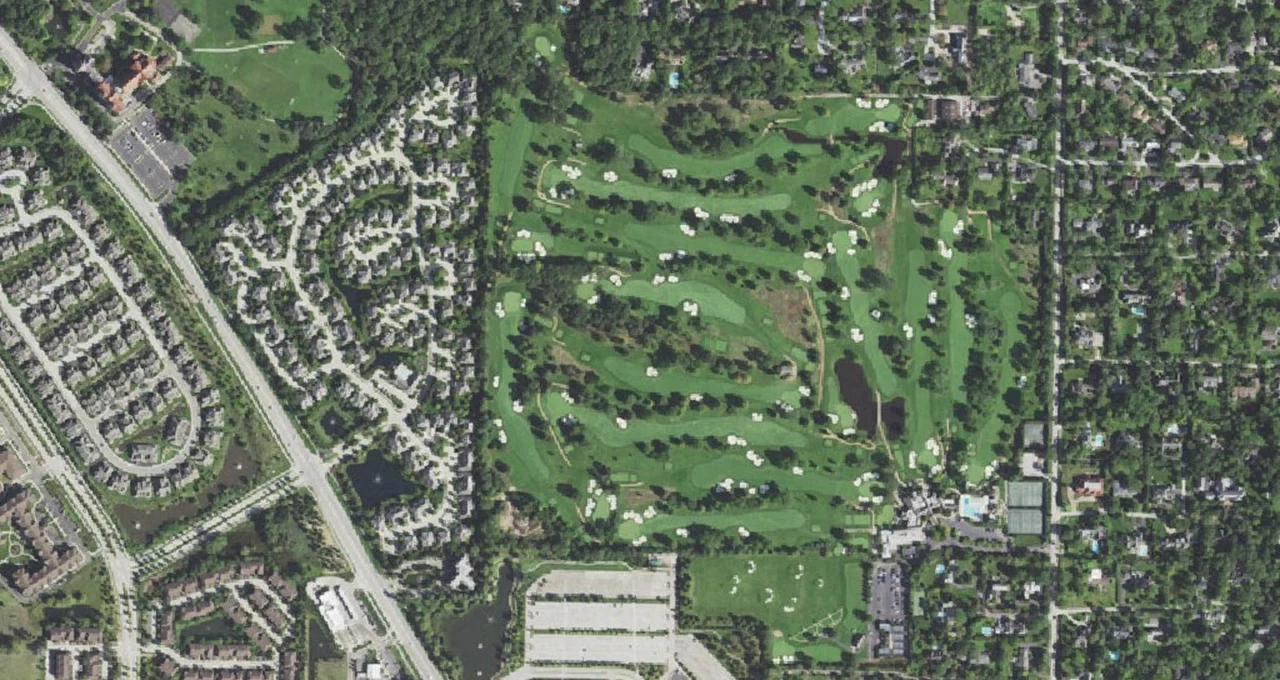
Sunset Ridge Country Club from the air. Aerial imagery USGS, domaine public.
Sunset Ridge Country Club
Holes
18
By
71 (72 for women)
Length
6,754 yards from the blue tees (rating 73.1, slope 137)
Green fee
—
Best season
Club open February through December
Sunset Ridge Country Club is a private club in Northfield, on Chicago’s North Shore, at 2100 Sunset Ridge Road. It began, in the club’s own telling, as an idea shared by ten young men in 1922, who wanted a great golf course with room for other sports, a fellowship of families, and a place where business and politics stayed at the door. The property sale closed in May 1923, William Diddel was hired to design and build the course, and construction started on May 7 of that year.
The club opened with an inaugural dinner on July 3, 1924. The next day the first foursome teed off: the club’s president, its vice president, the first club professional, Bob Pirie, and Diddel himself. Membership was capped at 250 at the start and sold out. Today the club counts about 650 member families and runs from February through December.
Diddel, born in Indianapolis, was a five-time Indiana Amateur champion and a charter member of the American Society of Golf Course Architects; the Western golf associations also describe him as a mentor to Pete Dye. He drew a par 71 that the club still plays. A renovation announcement from 2005 adds that Charles Wagstaff reworked the course a short time after it opened. The modern version is the work of Rick Jacobson, a Libertyville architect, whose renovation took ten months and reopened the course on May 28, 2005. Golf Inc. magazine named it its private-club renovation of the year, an honor the club lists as its 2006 award.
From the blue tees the course measures 6,754 yards. The Chicago District Golf Association lists a course rating of 73.1 and a slope of 137 from there for men; the white tees play 6,409 yards and the gold tees 6,095. For women the course is a par 72, because the 9th is scored as a par 5, and the red tees measure 5,371 yards. The front nine is a par 35 of 3,309 yards and the back nine a par 36 of 3,445.
What it asks of you
The numbers make the first point. At 6,754 yards and par 71, Sunset Ridge is not long by modern championship standards, and the par is built from eleven par 4s, four par 3s and three par 5s. What protects it is placement: tree-lined corridors, bunkers that Jacobson restored to Diddel’s scale, and greens that tournament previews describe as fast and sloping from back to front. Leaving the ball below the hole is the recurring piece of advice.
The trees have their own history. In 1953 Dutch elm disease killed 150 of them, and the superintendent of the day, Dominic Grotti, started a replanting program that put in nearly 700 new trees. Half a century later, part of Jacobson’s brief was to take out trees that did not serve a strategic purpose and hurt the turf, so the corridors you play today are the result of both movements: a mature parkland frame, thinned where it choked the grass.
The club’s own scorecard also shows how the course defends itself away from the fairway. Under the local rules, all fescue areas are red penalty areas, so a drive that runs through the rough into the tall grass costs a stroke rather than a search. Beyond the cart path on the 9th, 11th and 18th, the clubhouse grounds are a penalty area from which play is not allowed, which tells you those holes run alongside the clubhouse.
The front nine
The opening stretch is where the card is most demanding on paper. The 2nd, a par 4 of 417 yards from the blue tees, is stroke index 1, and the 3rd follows at 427 yards. The pump house on the 3rd is treated as an obstruction under the local rules. The 4th and 6th are shorter par 4s of 383 and 355 yards, and the 5th is the first par 3, at 171 yards.
The 7th is the longest hole on the course, a par 5 of 560 yards. The scorecard gives it a halfway house that counts as an obstruction and a penalty area with an extra relief option on the far side, so there is a hazard to account for on the way to the green. The 8th is a par 3 of 174 yards, and the front nine closes with the 9th, a par 4 of 451 yards and stroke index 3, one of the holes that run along the clubhouse grounds.
The back nine
The inward half opens with two solid par 4s, the 10th at 405 yards and the 11th at 426. The 12th is shorter, at 373 yards, and the 13th is a par 5 of 518 yards. The 14th, at 441 yards, is stroke index 2 and the hardest hole on the back nine by the club’s ranking.
The 15th is the hole most often singled out. It is the longest of the four par 3s at 191 yards from the blue tees and the one where water is in play. Jacobson rebuilt it completely, with a new green built to USGA specifications and a rock wall along the water hazard. Course guides note that each of the four par 3s presents a different mix of sand and angles, and this is the one that adds water.
The finish mixes chances and a test: the 16th is a par 5 of 525 yards, the 17th a par 3 of 162 yards that ranks as the easiest hole on the card, and the 18th a par 4 of 404 yards that, like the 9th and the 11th, runs along the clubhouse grounds.
What tournaments have shown
Sunset Ridge has a long championship record for a club of its size. The club and the two Western golf associations list the 1935 Women’s Western Open, the 1936 Western Junior, the 1942 Women’s Western Amateur, the Women’s Western Junior in 1953 and 1961, the 1972 Western Open, the 2018 Western Amateur and the 2022 Women’s Western Amateur.
The 1972 Western Open, then a PGA Tour event, was won by Jim Jamieson of Moline at 13 under par, 271, and only 14 players finished under par that week. The club notes that it remained the last private club on the North Shore to host the Western Open until 2013. Its head professional at the time, Bob Harris, was inducted into the Illinois PGA Hall of Fame in 2013.
The 2018 Western Amateur told a different story about the modern course in the hands of elite amateurs. Tournament reports record a new course record of 61 in the third round, a 72-hole stroke-play total of 261, the lowest in the history of the event, and the lowest 36-hole cut to that date. Cole Hammer of Houston won the match-play final. The reading is simple: when the fairways are found, the course can be scored on; when they are not, the trees, the fescue and the greens take over.
What players say about it
The public record on Sunset Ridge is thin. It is a private club with no public tee times, the main review platforms carry few or no guest reviews for it, and most of what is written comes from tournament previews, championship organizers and course directories. The points below summarize what recurs in that material. These are other people’s opinions, not ours: we have not played the course, and we name and quote no one.
What comes up in its favor
- The greens are the feature most often praised: fast, with subtle contours, and demanding on speed as much as on line.
- Conditioning is described as very good, with well-kept bentgrass fairways and greens.
- The course is presented as a fair test that rewards accurate driving rather than power, and as enjoyable for a range of abilities from the forward tees.
- The Jacobson renovation is regarded as a faithful restoration of Diddel’s bunkering, and the renovation award is cited often.
- The championship history, from the 1935 Women’s Western Open to the 2018 Western Amateur, is a point of pride that comes up in almost every account.
What comes up against
- Access is closed: you play only as a member’s guest.
- Corridors are described as tight, with trees and water near many fairways, which punishes a wayward driver more than the modest yardage suggests.
- By modern standards the course is short from the back tees, and the scores at the 2018 Western Amateur showed that the best amateurs could go very low on it.
- Misjudging the speed on greens that slope from back to front leads to three-putts, a point that comes up as a warning rather than a complaint.
- Independent guest reviews are scarce, so any summary, including this one, rests on a narrow base that leans on the club’s own material and on tournament coverage.
The facilities
For golf, the club lists a practice range, a short-game practice area and an indoor golf learning center. Caddies are part of the house culture: the club describes its caddie program as nationally recognized and asks members and guests to take a caddie whenever one is available. Carts are also used, and the guest guidelines ask cart riders not to press walking groups ahead of them.
Outside golf, the club has six clay tennis courts, six pickleball courts, platform tennis courts, a full-size pool with a diving area and a toddler wading pool, and a skeet and trap range. The clubhouse was renovated in the same period as the course and received a Club Management magazine design award in 2005; the dining rooms were renovated again in 2018. The club lists five dining venues, from a main dining room to a poolside grille, one of which is reserved for men.
The guest guidelines are specific. A four-ball round should take four hours or less, and slower groups are asked to let faster ones through. Collared shirts are required for men, shorts must be Bermuda length with no cargo style, jeans are not allowed, caps are worn facing forward and never inside the clubhouse, and shirts are tucked in. Shoes are changed in the locker room, not the parking lot. The club has a no-tipping policy, except for locker room and bag room staff and caddies. The golf shop runs a lightning detection system: a continuous siren of about fifteen seconds stops play, and caddies are told to drop the bags and head for shelter with their players.
Getting there and when to go
The club sits in Northfield Township, in Cook County, roughly 18 miles north of downtown Chicago and about 11 miles from O’Hare International Airport as the crow flies. The Edens Expressway (I-94 and US 41) and Willow Road both pass within about a mile of the course, which makes it an easy drive from the city or from the rest of the North Shore.
The club is open from February through December. The golf season itself follows the Chicago weather: spring can be cold and wet, summer is warm and humid with thunderstorms, and early fall is often the most settled stretch. Play is by invitation of a member, who is expected to tell the golf shop in advance and to be on hand to greet guests.
Green fees
Sunset Ridge is a private club and does not sell public tee times. Guests play with or at the invitation of a member, and guest conditions are set by the club; it does not publish a guest fee. See the club’s own site.
How this page was made
The factual frame comes from public sources: OpenStreetMap for the location; the club’s website, its published history and its guest information for the founding, the opening, the membership, the facilities and the guest rules; the club’s scorecard for the hole-by-hole lengths, pars, stroke indexes and local rules; the Chicago District Golf Association for the current course ratings and slopes; the 2005 renovation announcement for the scope of Rick Jacobson’s work; and the Western Golf Association, the Women’s Western Golf Association and press coverage for the championships and their results. Encyclopedic entries were used as a cross-check only.
The opinion section summarizes tournament previews, course directories and the few public reviews we could find, read in September 2026. We report recurring themes rather than individual voices, and we reproduce no quotations. We have not played or visited this course, and this page is no substitute for a round.
The club has not paid for this page, has not seen it before publication and has no say over its content. This page contains no commercial link and earns us no commission. If a brand ever pays for content on Panxis Golf, that content will carry an advertising label at the top of the page. If you know the course and something here is wrong or out of date, write to us and we will correct it.
Other courses nearby
Closest to this one in our United States directory:
- Tam O’Shanter Golf Course — 6 mi
- Rolling Green Country Club — 8 mi
- Onwentsia Club — 9 mi
- Kemper Lakes Golf Club — 14 mi
The hole to know
The longest of the four par 3s, 191 yards from the blue tees, and the only one with water in play. Rick Jacobson rebuilt it completely in the 2005 renovation, with a new green built to USGA specifications and a rock wall along the water hazard.