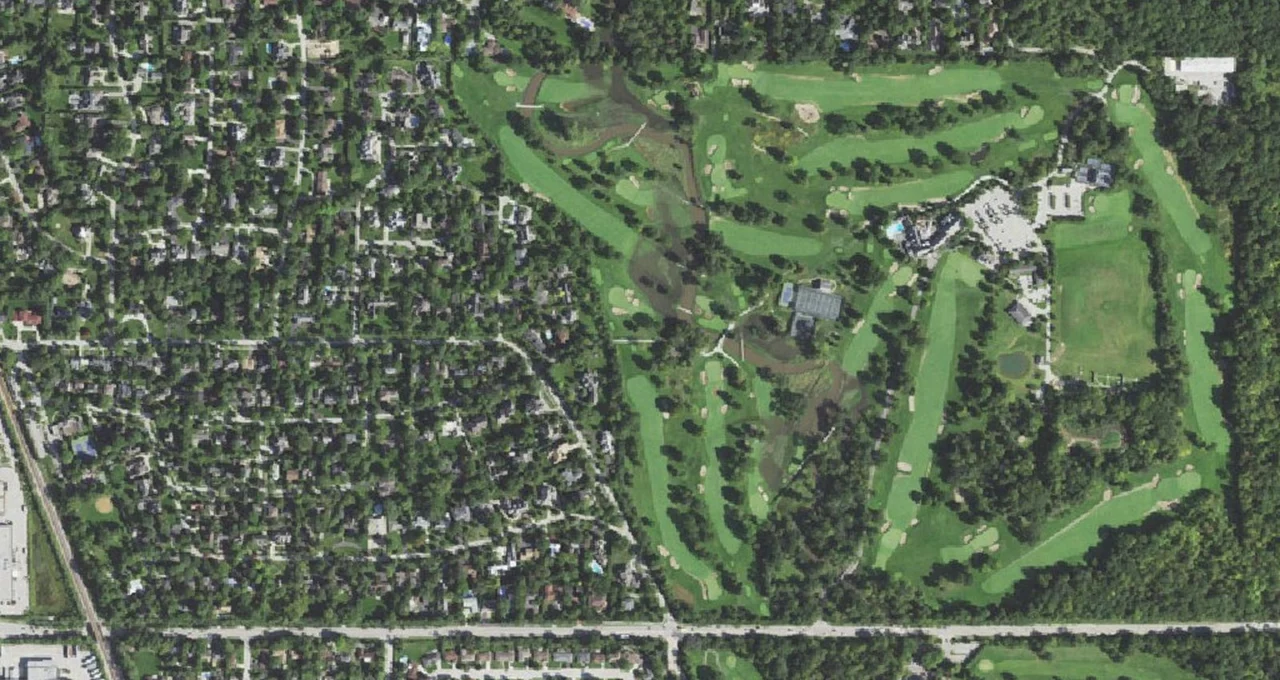
Glen View Club from the air. Aerial imagery USGS, domaine public.
Glen View Club
Holes
18
By
72
Length
6,963 yards from the Mach tees (rating 73.4, slope 139) per the Chicago District Golf Association; other listings give 6,948 or 6,933 yards
Green fee
—
Best season
—
Glen View Club is a private golf club at 100 Golf Road in the village of Golf, Illinois, a small Cook County community on Chicago’s North Shore. The club’s website describes 200 acres of rolling ground about 15 miles from downtown Chicago and calls it one of the oldest clubs in the Chicago area, with one of the earliest 18-hole courses in the country. The course is an 18-hole par 72, and the club’s website credits its present design to William Flynn. It is the club where the Western Golf Association held its first Western Open and Western Amateur in 1899, and it hosted the 1902 U.S. Amateur and the 1904 U.S. Open. This is a members’ club: there is no public tee sheet, and a round is played as the guest of a member.
One point matters before anything else. The club’s caddie page says the golf course closes in mid-June 2026 for a renovation project, which shortens the 2026 season, and that caddie training will resume in spring 2027, before the course reopens. The page gives no reopening date. Greens Visited, a course database that follows classic architecture, reports a reopening planned for spring 2027. As of October 2026, the course described on this page is therefore closed, and the hole-by-hole figures below are those of the course as it stood before the work began. We found no published plan of the renovation, so we cannot say which holes will change.
The numbers, and where they come from
The figures on this page follow the course rating table of the Chicago District Golf Association, the regional golf association that rates courses in the area. It lists six sets of tees for men, all par 72: Mach at 6,963 yards (course rating 73.4, slope 139), Mach/Lang at 6,768 yards (72.5 and 137), Lang at 6,540 yards (71.5 and 135), Lang/Laigh at 6,186 yards (69.9 and 131), Laigh at 5,902 yards (68.6 and 128) and Glen at 5,427 yards (66.4 and 123). For women it lists Lang at 6,540 yards, rated par 72 (77.5 and 137), and four sets rated par 73: Laigh at 5,902 yards (74.8 and 134), Laigh/Glen at 5,691 yards (73.6 and 131), Glen at 5,427 yards (72.2 and 128) and Club at 5,162 yards (70.6 and 125). The tee names are Scots words; a local historian’s blog traces the motto of the club’s member-guest, the Twa Days, to the phrase “laigh and lang”, low and long.
Other sources give other totals. Wikipedia lists 6,948 yards from the back tees with the same 73.4 rating and 139 slope, citing the USGA database as consulted in 2018. GolfPass, a course listing and booking site, gives 6,948 yards with a rating of 74.0 and a slope of 142 in its tee table, but its own hole-by-hole card adds up to 6,963 yards. 18Birdies, a scoring app, shows 6,933 yards because it lists the 18th at 420 yards rather than 450. Golf Digest gives 6,550 yards and a slope of 138, and Foretee, another directory, still shows an older card of 6,550 yards at par 71. We could not reach the USGA course rating database to settle the question, so this page follows the Chicago District Golf Association, whose total matches the hole-by-hole card published by GolfPass and Greens Visited.
A club older than its village
The club’s history page says Glen View was founded in 1897 by Evanston businessmen as a country retreat; Wikipedia says the founders were a group of Chicago businessmen and gives March 29, 1897 as the date, with the original name Glen View Golf and Polo Club, later shortened. Daniel Burnham, the architect and city planner, was a charter member, and according to the club he recommended the site: a wooded farm west of Evanston owned by the Dewes family. The club says the family’s homestead cabin still stands along the 17th hole, and a local history blog places it between the 16th and 17th fairways. The landscape architect O. C. Simonds laid out the grounds, and the first clubhouse was the work of Holabird & Roche, the firm of William Holabird, also a founding member.
The course came together quickly. According to the same blog, the club had about 100 members by the end of 1897 and opened its second nine in August 1898. A 1901 listing that the blog reproduces gives the course a length of 6,051 yards and names its holes, and a 1903 magazine article puts it at 6,266 yards, the figure Wikipedia also gives for the 1904 U.S. Open. The village owes its name to the club. Wikipedia’s article on Golf, Illinois, says the railroad siding where members arrived by private rail car became known as the golf stop, and the village took its name from it. Accounts of the details differ: the Glen View Club article on Wikipedia speaks of a station sign reading Golf, and the local blog credits the staff of a railroad president who visited the club. The village has a population of 514 at the 2020 census, and the club stayed outside its limits until an annexation around 1975.
Five architects on one routing
The design history is layered, and sources do not credit the same people. Wikipedia and the local blog credit the original layout to Richard Leslie, the club’s first professional, working with the member Herbert J. Tweedie; Top 100 Golf Courses mentions Tweedie alone. Wikipedia then lists changes to the hazards by Tom Bendelow in 1910 and work begun in 1913 by Harry Colt and Donald Ross. Greens Visited cites a Chicago District Golf Association history for about 40 new bunkers added in 1913, while noting that little of Ross’s work can be identified on the ground today. We found no primary source that settles Colt’s part in that work.
William Flynn redesigned the course in 1922. Top 100 Golf Courses writes that his course served the members for almost 80 years. The local blog, comparing course maps from 1901 and 1922, concludes that Flynn kept the original routing and changed several holes on the front nine; between those two maps, the 9th and 10th greens were moved back, and the 13th green was moved to the east side of the river, turning the hole into a par 5. Discussion on Golf Club Atlas, an architecture forum, adds that Flynn drew a comprehensive plan in the early 1920s that was never carried out in full.
The more recent work is less well documented. In 1999 Davis Esler restored the course, according to Top 100 Golf Courses; Foretee and Greens Visited spell his first name David. Greens Visited says the work enlarged fairways and greens and rebuilt the bunkers, and an architecture forum thread describes the new bunkering as imaginative and artistic but not faithful to Flynn’s look. Greens Visited also credits Pete Dye with work on the 8th and 15th holes in 1966 and Jim Urbina with a restoration program from 2013 aimed at Flynn’s 1920s character, with irregular bunker edges, greens expanded back toward their old perimeters, new fairway bunkers, tree removal and a rebuilt practice range. We found no second source for the Dye work, and the club itself does not name the architects of its recent projects, so we report those two credits as Greens Visited’s alone.
The championships
Glen View was one of the founding clubs of the Western Golf Association in 1899, alongside Chicago Golf Club, Skokie, Onwentsia and Evanston, according to Wikipedia. That year it hosted the first Western Open, won by Willie Smith, and the first Western Amateur, won by David Forgan. The club says it has hosted five Western Opens; the list of venues on Wikipedia names Glen View only for 1899, and we could not identify the other four. The Western Amateur came back in 1905, won by Chandler Egan, and again in 2021.
The 1902 U.S. Amateur was won by Louis N. James, whose family lived on the club grounds, over Eben Byers, 4 and 2. Wikipedia’s account of the championship says flooding put part of the course out of play, so that the last rounds, including the 36-hole final, were played over the first nine. James was 19, the first teenager to win the title. Two years later the club hosted the 10th U.S. Open, on July 8 and 9, 1904. Willie Anderson won with 303, five strokes ahead of Gilbert Nicholls, to defend his title and take the third of his four U.S. Opens. According to Wikipedia, his closing 72 was the lowest round in the championship’s history at the time, and 1904 was the first U.S. Open with a cut after 36 holes.
The club also claims two Hall of Fame members. Chick Evans, who won the U.S. Amateur and the U.S. Open in 1916 and founded the Evans Scholars program for caddies, was a member according to the club and Wikipedia. Jock Hutchison was head professional from 1917 to 1953, according to the club, which credits him with four major championships, including the 1921 Open at St Andrews. Standard counts give him two, the 1920 PGA Championship and the 1921 Open; the club’s figure appears to include his two PGA Seniors’ Championships. The club history also names Bessie Anthony, winner of the first three Women’s Western Amateurs between 1901 and 1903 and of the 1903 U.S. Women’s Amateur.
The most recent national event was the 119th Western Amateur in July 2021. According to AmateurGolf.com, Michael Thorbjornsen, then a Stanford sophomore, led the stroke play qualifying at 13 under par with 267 and won the final 4 and 3 over Gordon Sargent. His second round of 62, eight under par, set the course record.
What it asks of you
The ground is the first thing to understand. In his guide to golf courses, quoted by Top 100 Golf Courses, the architect Tom Doak describes the front nine as sitting on a low, forested bluff and the back nine in the valley of the river, with water carries on every hole except the 15th and 16th. Sources do not name the stream the same way: Doak writes of the North Fork of the Chicago River, Greens Visited of the North Branch, and the local blog of a fork of the North Branch. The club’s website describes hills that slope gently toward a river. Foretee lists average-sized, well-bunkered greens, water in play on a few holes and mature trees that can affect shots. Greens Visited places the practice range and short-game area on the site of the 1897 polo field.
On the scorecard, each nine is a par 36 built the same way: two par 3s, five par 4s and two par 5s. The yardages below are from the Mach tees, as published by GolfPass and Greens Visited, and the stroke index is the one those sites and 18Birdies show. The hardest hole on that index is the 6th, followed by the 13th and the 3rd; the easiest is the 11th.
The front nine
The 1st is a par 4 of 450 yards, fifth on the stroke index. A 2025 guest review on Top 100 Golf Courses describes the first five holes as running counterclockwise around the practice area and the eastern part of the property. The 2nd is a par 3 of 190 yards. The 3rd, a par 4 of 450 yards, is the third hardest hole; the same review notes mounds in the fairway that change the angle of approach, and bunkers short of the green. The 4th is a par 4 of 400 yards and the 5th a par 4 of 385 yards, again with bunkers set short of the green.
The 6th, a par 5 of 560 yards, is the longest hole and first on the stroke index; the review places its green close to the high ground along the right-hand boundary of the property. The 7th is a par 3 of 175 yards and the easiest hole on the front nine. The 8th is a par 5 of 515 yards and the 9th a par 4 of 360 yards. The local blog notes that a lagoon once lay between the 8th and 9th holes; it had disappeared by the time of a 1939 aerial photograph.
The back nine
The 10th, a par 4 of 440 yards, is fourth on the stroke index, with bunkers short of the green. The 11th is a par 3 of 188 yards, ranked the easiest hole on the card, though in the 2021 final, according to AmateurGolf.com, Thorbjornsen’s birdie there swung the match back his way. The 12th is a par 4 of 360 yards. The 13th, a par 5 of 550 yards and second on the stroke index, is the hole whose green was moved to the east side of the river between 1901 and 1922, according to the local blog. The 14th is a par 3 of 170 yards; the 2025 review notes that its green sits on a rise rather than at the water’s edge, and in the 2021 semifinals Austin Greaser holed a bunker shot there for birdie.
The 15th is a par 5 of 520 yards; AmateurGolf.com called it the hardest hole of the 2021 Western Amateur. The 16th is a par 4 of 400 yards. The 17th, a par 4 of 400 yards, is the hole most often singled out in the commentary we found. The guest review calls it the reviewer’s favorite: few trees, but one that shapes the line, so that a drive played close to it gives the best angle into an elevated green, with a narrow window to the right for a recovery. Greens Visited attributes the elevated, slightly doglegged green to Flynn. The 18th is a par 4 of 450 yards, the figure on the cards of GolfPass, Greens Visited and the Chicago District Golf Association total; 18Birdies lists it at 420 yards.
What golfers are saying
Public reviews of Glen View are few, because only members and their guests play it. The material behind this section is the guest review and the architecture notes on Top 100 Golf Courses, the summary of the Golf Digest panel as shown by search engines, the review scores and comments on 18Birdies, GolfPass and Greens Visited, and discussion on Golf Club Atlas. The points below are other people’s opinions, not ours; nobody from Panxis has played the course, and we quote no one by name.
What comes up in its favor
- The routing, described as old-school and well paced, with holes that use modest slopes to create angles rather than relying on forced penalties.
- The 17th, praised for using a single tree as a real strategic element rather than as framing.
- Conditioning, with fast greens and well-kept fairways mentioned across review sites.
- The rolling ground, which some panel comments liken to a links feel.
- The clubhouse, the staff and the dining, which come up often in general reviews of the club.
What comes up against
- Access, first of all: without a member to host you, there is no way on.
- The river and creek play a smaller part than visitors expect, and some find the elevation change limited.
- The opening holes around the practice area are seen as less interesting than the holes further west.
- Several bunkers sit well short of the greens and are seen as mostly visual from the fairway.
- Architecture commentators judged the 1999 bunkering artful but not true to Flynn, a point the later restoration work was meant to address.
- Reviews are scarce enough that any summary, this one included, rests on a small number of accounts.
How to play it
Glen View is a private club. The club’s website offers no public tee times and no visitor booking; its guest information page is written for golfers arriving with a host, who drop their bag on the north side of the pro shop, take a locker in the clubhouse and wait for their host in the grill or at the pro shop. Purchases in the pro shop are charged to the host’s account, or to the account of a member of a reciprocal club, so guests from other clubs should ask their own professional whether an arrangement exists. In any case, the course is closed for renovation from mid-June 2026, and the club gives spring 2027 only as the time when its caddie program resumes.
The club has its own rules, and guests are expected to follow them. On the course, men wear slacks or Bermuda-length shorts with a collared shirt tucked in, and women slacks, golf skirts, skorts or shorts of appropriate length; denim, cargo, athletic and cut-off clothing are not allowed. Phones must be silenced everywhere on the grounds, calls are limited to phone booths, unused rooms upstairs or your car, and the club forbids posting photos or videos that identify the club, its members or its guests on social media. The club has a no-gratuities policy. Smoking is allowed only on the 18th terrace.
Glen View runs a caddie program, with an application page on its website, and the club is tied to the Evans Scholars Foundation through the Western Golf Association. The club’s website does not publish a cart policy, and this page lists none. It has a practice range and short-game area, and the club also offers tennis, platform tennis, pickleball, swimming, and skeet and trap shooting. This page lists no green fee: guest rates are not published, and they are a matter for your host.
Getting there and when to go
The club is at 100 Golf Road, Golf, IL 60029, in Cook County, bordered by Glenview and Wilmette to the north and Skokie to the east, according to Wikipedia. The Golf station on Metra’s Milwaukee District North Line serves the village, the same rail line whose stop gave the place its name. The club’s website does not publish its season, and this page gives none; for 2026, the renovation ends play in mid-June. The clubhouse can be reached at 847-729-6500 and the golf pro shop at 847-729-3611, according to the club’s website.
How this page was made
The factual frame comes from public sources consulted in October 2026: OpenStreetMap and Wikidata for the location; the club’s website for the address, the acreage, the founders, the championships, the Hall of Fame members, the guest rules, the caddie program and the 2026 closure; the Chicago District Golf Association for the tees, ratings and slopes; GolfPass and Greens Visited for the hole-by-hole card, and those sites with 18Birdies for the stroke index; Wikipedia for the founding date, the early architects, the 1904 U.S. Open, the 1902 U.S. Amateur, the Western championships and the village of Golf; a local history blog for the early course, the land and the tee names; Top 100 Golf Courses for Tom Doak’s description, the 1922 and 1999 work and a 2025 guest review; Greens Visited and Golf Club Atlas for the later restoration; AmateurGolf.com for the 2021 Western Amateur. Where sources disagree, as they do on the length and ratings, the yardage of the 18th, the founders, the naming of the village, the number of Western Opens, the early architects, the name of the river and Hutchison’s majors, we say so and name the source we follow.
Several sources could not be read directly: the USGA course rating database, Golf Digest, the GolfPass scorecard page, Golf Club Atlas and a Western Amateur program, which blocked automated requests. For those, we relied on the excerpts shown by search engines and say so above. We could not confirm the 1966 Pete Dye work or the details of the restoration since 2013 with a second source, nor the reopening date of the course. The opinion section summarizes public reviews; we report recurring themes rather than individual voices, and we reproduce no quotations. Nobody from Panxis has played or visited this course, and this page is no substitute for a round.
The club has not paid for this page, has not seen it before publication and has no say over its content. This page contains no commercial link and earns us no commission. If you know the course and something here is wrong or out of date, write to us and we will correct it.
Other courses nearby
Closest to this one in our United States directory:
- Tam O’Shanter Golf Course — 3 mi
- Sunset Ridge Country Club — 4 mi
- Rolling Green Country Club — 9 mi
- Chevy Chase Country Club (Traditions at Chevy Chase) — 10 mi
The hole to know
A par 5 of 560 yards from the Mach tees, the longest hole and first on the stroke index of published scorecards; a 2025 guest review places its green close to the high ground on the property's right-hand boundary.