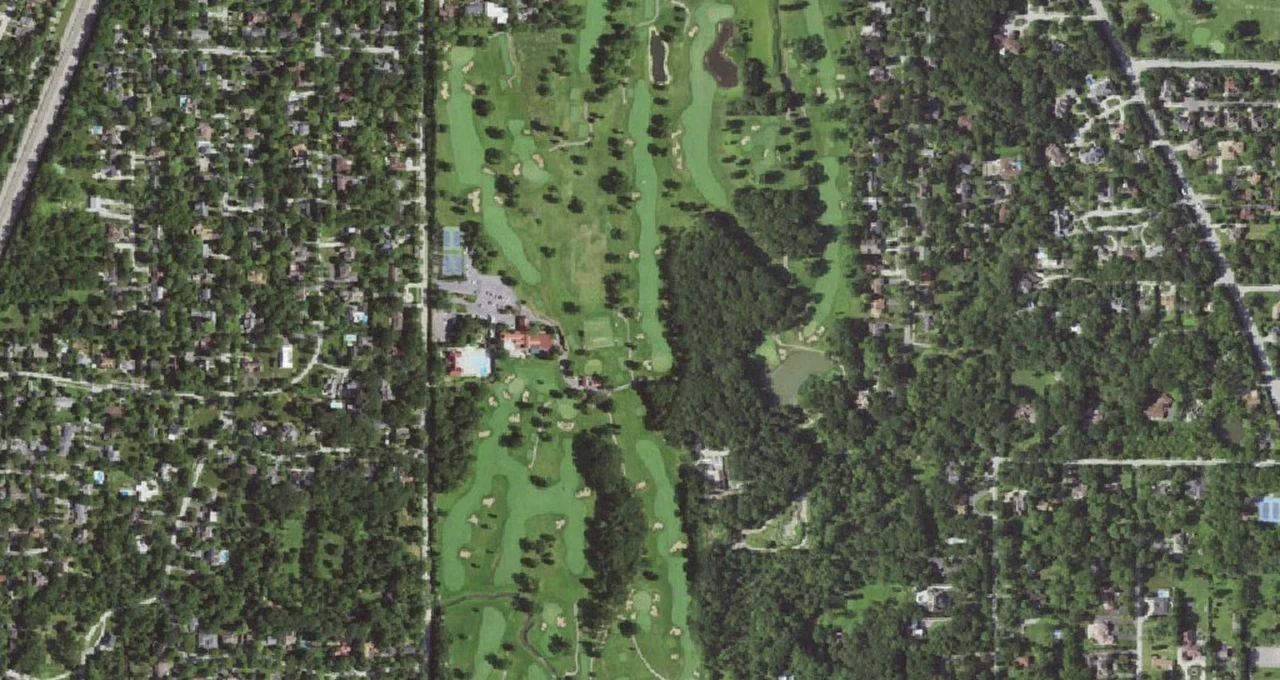
Flossmoor Country Club from the air. Aerial imagery USGS, domaine public.
Flossmoor Country Club
Holes
18
By
72
Length
7,136 yards from the Black tees in course directories (rating 75.5 or 75.8 depending on the source, slope 144); the club's card gives 6,764 yards
Green fee
—
Best season
—
Flossmoor Country Club, which now trades as Flossmoor Golf Club, is a private club at 1441 Western Avenue in Flossmoor, Illinois, in the southern suburbs of Chicago in Cook County. Wikidata and Wikipedia place it in Bloom Township, just outside the village limits. The club was founded in 1899 as Homewood Country Club, and the club itself describes it as one of the first clubs established in the Midwest. The course is an 18-hole par 72, with 36 on each nine, laid out by Herbert J. Tweedie, and it was restored by the architect Raymond Hearn in the second half of the 2000s.
The name needs a word of explanation, because sources use both. Encyclopedic entries and most golf directories still say Flossmoor Country Club. The club’s own website, the Illinois PGA and recent press say Flossmoor Golf Club. A column published in August 2023 by the Chicago golf writer Len Ziehm in the Daily Herald reports that the club was a country club until a group headed by George Goich took it over about four years earlier and changed the name. The same column says membership stood at 89 when the group bought the club and at 274 in 2023. This page uses both names, since both designate the same club and the same course.
The length depends on the tees and on the source. The club’s website publishes a hole-by-hole card of 6,764 yards, par 72. Two course directories list six sets of tees, all par 72 for men: Black at 7,136 yards, Blue at 6,764 yards, White at 6,437 yards, Gold at 6,112 yards and Red at 5,503 yards. For the Black tees, a booking platform gives a course rating of 75.5 and a slope of 144, while a second directory gives 75.8 and 144; for the Blue tees, the figures are 73.7 and 138 on the first and 74.0 and 138 on the second. The booking platform also carries an older summary of 6,928 yards with a rating of 73.3 and a slope of 135, and another club directory lists a 6,528-yard White tee. We could not reach the USGA course rating database to settle the question, so this page gives both sets of ratings and follows the 7,136-yard Black and 6,764-yard Blue cards, whose hole yardages match those published by the club and by a review on The Fried Egg.
A club older than its village
The club began as Homewood Country Club in 1899. A history quoted by the Top 100 Golf Courses website credits Herbert James Tweedie with the design, with help from a doctor, H. W. Gentles, and the club professional of the time, Jack Pearson; that site dates the design itself to 1900, a year after the founding. The Fried Egg describes Tweedie as a player from Royal Liverpool who had helped Charles Blair Macdonald lay out Chicago Golf Club and had already designed Glen View in 1897 and Midlothian in 1898, and calls Flossmoor the first championship course south of Chicago. A golf history forum thread says that the club took the name Flossmoor to end confusion about its location; the Encyclopedia of Chicago, as indexed by search engines, dates the change to 1914.
The course a visitor plays today owes almost as much to Harry Collis as to Tweedie. According to the Top 100 Golf Courses history, Collis, who came from Blackheath in London, worked at the club from 1905 to 1929. After a clubhouse fire in 1914, the building was moved to a more central spot, and the holes were reorganized around it. Collis turned the 5th from a par 5 into a par 4, created the short par 3 7th in 1915, remodelled the 14th into a short par 4 that rewards placement over length, added the bunker that guards the 16th and formed the uphill par 5 18th by combining two old holes. The club’s hole names keep traces of the original routing: the 3rd, called Home, was the 18th in the original design, and the 4th, called Widow, was its first hole. The names of the 11th and 12th, Spion Kop and Tugela, come from a hill and a river in Natal, South Africa.
In the early years the course was long by the standards of the day. A USGA article marking the centenary of the 1910 Women’s Amateur describes it as a 6,080-yard course at that time, and The Fried Egg notes that the architect and writer Robert Hunter listed Flossmoor, at 6,475 yards, among the country’s elite courses.
Championships
For two decades Flossmoor was one of the main national venues in the Midwest. Wikipedia’s list of Western Open champions places the 1905 Western Open at Homewood Country Club, won by Arthur Smith. In 1910 the club hosted the U.S. Women’s Amateur: according to the USGA, Dorothy Campbell beat Mrs. G. M. Martin 2 and 1 in the final, for the second of her three titles. In August 1920 Flossmoor staged the PGA Championship, then a match play event for 32 players; Jock Hutchison beat James Douglas Edgar 1 up in the 36-hole final. In 1923 it hosted the U.S. Amateur, where Max Marston beat the defending champion Jess Sweetser on the 38th hole of the final. Golf history sources also mention several Western Amateurs and Women’s Western Amateurs at the club, without a list of years that we could check, so this page does not count them.
Wikipedia reports that Bobby Jones held the course record, a 66, for more than 60 years, and that a club member broke it with a 65 in 1996. According to The Fried Egg, the neighboring Olympia Fields, which had built four courses by 1925, gradually took over the role of the area’s championship venue. Flossmoor returned to the state calendar in 2023, when it hosted the 74th Illinois Open from July 31 to August 2. The Illinois PGA reports that Vince India and Dylan Meyer finished tied at 8 under par after 54 holes and that India won a three-hole aggregate playoff with a birdie on the last extra hole, for his second Illinois Open title.
The Hearn restoration
According to Raymond Hearn’s firm, the club hired the architect in 2006 to draw up a long-term master plan, addressing tree encroachment, greens that had shrunk over the decades and outdated bunkers. The firm says the main work was done within two years and quotes the club historian, Greg Ohlendorf, on the more than 70 site visits Hearn made over four years. The 13th became a new par 3, replacing a weaker hole; the green of the long par 4 8th was moved closer to the pond; several greens were expanded; and on the 4th a hill in the landing area was leveled to remove a blind drive, the fairway was widened and fairway bunkers were added.
The Fried Egg adds that Hearn worked with the superintendent Bob Lively, removed thousands of trees, changed three holes and redesigned the bunkering, moving fairway bunkers to account for modern distances. A golf news site reports that Golf Magazine named the work its 2009 Renovation of the Year; Hearn’s firm describes the award as the magazine’s best private club renovation in the country. The club’s website says that 14 hole corridors date from 1899 and that Golf.com ranked the course among the 15 best in Illinois in its 2022 and 2023 lists. Top 100 Golf Courses ranks it 11th in the state.
What it asks of you
Flossmoor is a classic parkland course with bentgrass greens and fairways, according to two course directories, which also count between 51 and 60 bunkers and water in play. The two nines are different in character. The Fried Egg describes the front nine as relatively flat and the back nine as having marked rises and drops on almost every hole. The same review calls the greens the course’s strongest feature, with varied sizes and slopes that reward a well-placed drive and a precise approach, and sums the course up as hard par, easy bogey. The club’s own card shows four par 3s, ten par 4s and four par 5s, with the par 5s at the 1st, 9th, 10th and 18th.
On the stroke index published by a course directory, the 3rd is the hardest hole, followed by the 12th, the 6th and the 17th; the 13th, the shortest hole, is ranked the easiest. The club describes the 17th as the most challenging hole on the course.
The front nine
The yardages below are from the 7,136-yard Black tees, with the club’s 6,764-yard card in brackets. The 1st, Road, is a par 5 of 499 yards (488) named after the Road Hole at St Andrews; The Fried Egg calls it a birdie chance with a severely sloped green. The 2nd, Gate, is a par 3 of 213 yards (195), named after an old entrance on Western Avenue. The 3rd, Home, is a par 4 of 434 yards (420) and first on the stroke index, with a creek in play and a green that slopes hard from right to left.
The 4th, Widow, is the short par 4 of 331 yards (319) reshaped by Hearn; The Fried Egg says it offers many options and has ruined many rounds. The 5th, Spring, is a par 4 of 445 yards (431). The 6th, Neuk, a dogleg par 4 of 434 yards (422), is the hole that, according to The Fried Egg, Bobby Jones called the difficult sixth; out of bounds on the left makes the drive intimidating, and Top 100 Golf Courses notes that its tee was moved back about 100 yards. The 7th, Gucks, is a par 3 of 173 yards (161). The 8th, Lane, a par 4 of 461 yards (417), plays between oaks to the green moved toward the pond; The Fried Egg finds it awkward since the restoration, because members kept mature trees on the right. The 9th, Oak, is the longest hole: 626 yards from the Black tees and 560 on the club’s card, with an oak grove on the left and a green that looks sloped but is very flat, for a front nine of 3,616 yards.
The back nine
The 10th, Glade, is a par 5 of 553 yards (522). The 11th, Spion Kop, a par 3 of 187 yards (173), and the 12th, Tugela, a par 4 of 417 yards (408), use the natural slopes; The Fried Egg reads the 12th as a version of the Alps template of Macdonald, with a blind second shot to a punchbowl green. The 13th, Easy, is the new par 3 of 135 yards (122). The 14th, Glen, is the Collis short par 4, 366 yards (334). The 15th, Orchard, a par 4 of 431 yards (424) on the site of a former grove, is one where the club says birdies are rare.
The 16th, Braeside, a par 4 of 425 yards (402), has a shallow plateau green with a false front, guarded by a fingered bunker that The Fried Egg says spells the word JAIL. The 17th, Haugh, is a par 4 of 473 yards (461) with an uphill approach to a green set on a ridge. The 18th, Farm, an uphill par 5 of 533 yards (505), is presented by the club as a last birdie chance, though The Fried Egg warns that the breaks of its green confound most players. The back nine measures 3,520 yards.
What golfers are saying
Because Flossmoor is private, public reviews are scarce. The material behind this section is a detailed review on The Fried Egg, the short user reviews shown in search results for a golf travel site, the summary of the Golf Digest panel review as indexed by search engines and the description of Top 100 Golf Courses, whose page displays a rating without written reviews. The points below are other people’s opinions, not ours; nobody from Panxis has played the course, and we quote no one.
What comes up in its favor
- The greens are the most praised feature, described as varied in size and slope and rewarding good positioning.
- Reviewers single out the par 4s, especially the 3rd, 6th, 15th and 17th, and the variety of the par 3s.
- The closing stretch from the 14th to the 18th is described as a strong finish.
- User reviews praise the conditioning and describe the course as inviting and fairly spacious off the tee.
- The history, from Bobby Jones to the 1920 PGA Championship, and the restored classic character draw fans of old architecture.
What comes up against
- Access is the obvious limit: the club lists the course as members only.
- The bunker style of the restoration divides opinion; The Fried Egg says purists preferred the simpler original bunkers.
- The 8th is described as awkward since the restoration, with mature trees still pinching the right side.
- The front nine is flat compared with the back nine.
- The Fried Egg suggested that more trees could still come out.
How to play it
Flossmoor is a private club. Its website marks the course as members only and does not publish a guest policy; a golf directory describes play as by invitation, reserved for members and their guests. In practice, a round there means playing with a member or joining. The club does not publish membership categories or prices on its membership page; it asks prospective members to fill in an information request or to contact the club, and says membership includes unlimited golf six days a week, games and men’s leagues. One course directory describes the course as open for daily-fee play and gives a different street address; this does not match the club’s own information, and this page follows the club. Details are on the club’s membership page.
The club publishes no green fee. According to its website, the golf course is open from Tuesday to Sunday, 6 a.m. to 8 p.m., and closed on Mondays. A booking platform lists carts, rental clubs and caddies, a dress code and a soft spikes policy. The club runs a caddie program open to young people who do not need to play golf, and says dozens of its caddies have earned Evans Scholarships, which cover tuition and housing at universities such as Illinois, Michigan, Wisconsin and Purdue.
The facilities
The club lists a pro shop, bars and snack shops among the benefits of membership. Course directories mention a driving range, a putting green and a teaching professional. The club does not describe other sports facilities on its website, and this page does not list any.
Getting there and when to go
The club is at 1441 Western Avenue, Flossmoor, IL 60422. The golf season in the Chicago area runs through the warmer months; a booking platform gives March 15 to November 1, but the club does not publish its own dates, and schedules are its call. Contact details are on the club’s website.
How this page was made
The factual frame comes from public sources consulted in October 2026: OpenStreetMap for the location; the club’s website for the address, the founding year, the members only status, the hole names, par and yardages of the 6,764-yard card, the opening hours, the caddie program and the membership benefits; Wikipedia and Wikidata for the location, the founding name, the 1920 PGA Championship, the 1923 U.S. Amateur, the 1905 Western Open and the course record; the USGA for the 1910 Women’s Amateur; the Illinois PGA and the Daily Herald for the 2023 Illinois Open and the change of ownership and name; Raymond Hearn’s firm for the restoration; The Fried Egg and Top 100 Golf Courses for the history, the Collis changes and the hole descriptions; a booking platform and course directories for the tee sets, ratings, stroke index and services. Where sources disagree, as they do on the ratings, the date of the design and the access, we say so and name the source we follow.
Several sources could not be read directly: the USGA course rating database, Golf Digest, Golf Club Atlas, the golf travel site that carries user reviews and the Encyclopedia of Chicago refused our requests, and a Golf Course Industry case study returned no text. For those, we relied only on the excerpts shown by search engines and say so above. The opinion section summarizes public reviews; we report recurring themes rather than individual voices, and we reproduce no quotations. Nobody from Panxis has played or visited this course, and this page is no substitute for a round.
The club has not paid for this page, has not seen it before publication and has no say over its content. This page contains no commercial link and earns us no commission. If you know the club and something here is wrong or out of date, write to us and we will correct it.
Other courses nearby
Closest to this one in our United States directory:
- Olympia Fields Country Club — North Course — 1 mi
- Ravisloe Country Club — 2 mi
- Midlothian Country Club — 8 mi
- Beverly Country Club — 14 mi
The hole to know
Haugh, a par 4 of 473 yards from the Black tees (461 on the club's card), with an uphill approach to a green set on a ridge; the club calls it the most challenging hole on the course.