Basement golf for a Canadian winter: three objects, two square metres and when scores stop counting
A putting mat, an alignment stick and a mirror in two square metres of basement, twenty minutes three evenings a week from Remembrance Day to the thaw, plus Golf Canada's posting dates by province, the BC exception and the Rule an alignment stick can teach you to break.
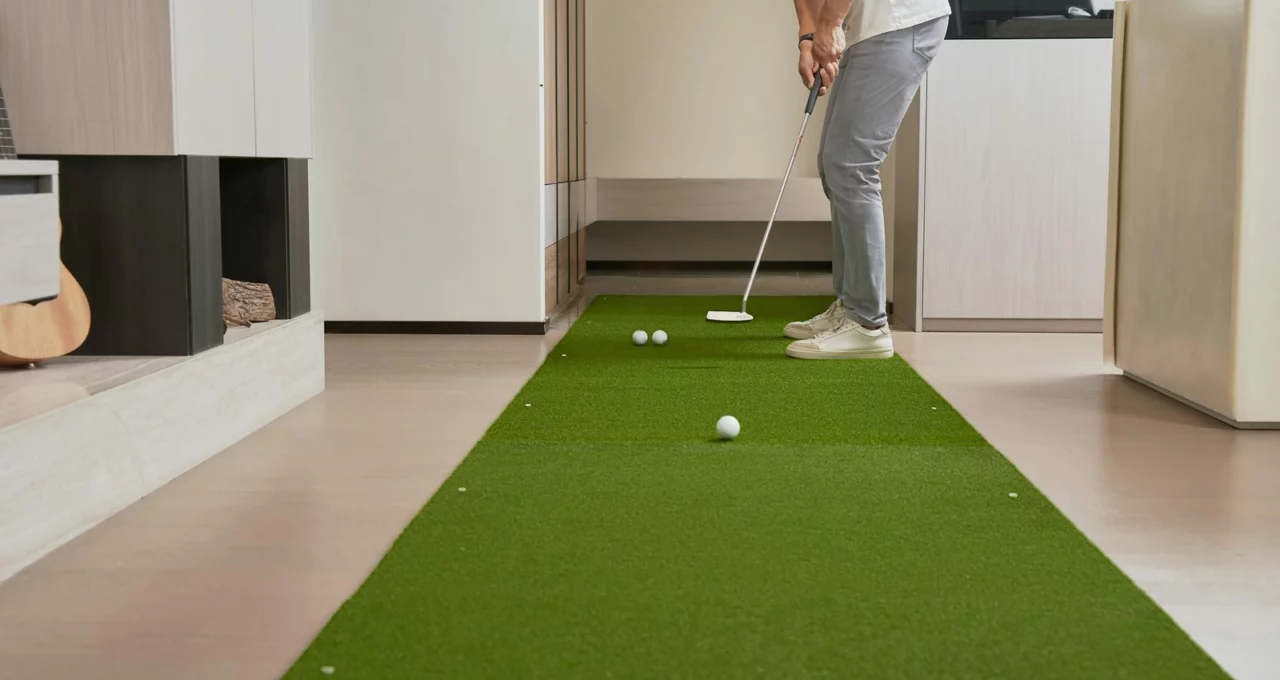
In most of Canada the golf season ends on a date, not with the weather. Golf Canada’s posting window closes on October 31 from Alberta to Nova Scotia, and whatever you shoot after that on frozen fairways does not count. The clubs go downstairs for five or six months, the longest off-season in golf and also its best opportunity: nobody in Arizona gets 160 evenings in a row to fix a setup. Using them takes a putting mat, an alignment stick, a mirror, about two square metres of basement floor, and twenty minutes three evenings a week.
Why a Canadian winter rewards small, boring practice
Between the last posted round and the first one in April, an Ontario or Prairie golfer has more free evenings than there are days in the playing season. Spent on nothing, they produce the May complaint: three rounds gone before the swing comes back. A basement gives no ball flight and no carry in yards, but it gives a yes-or-no answer to the questions that decide most amateur scores: is the body aimed where you think it is, do the eyes sit over the ball, does the putter face return square, does the short putt start on line. Three cheap objects answer those every night.
Motor-learning research keeps returning to the same finding: a skill rebuilt in short, repeated sessions holds better than one crammed into a long one. Twenty minutes, three evenings a week, from Remembrance Day to the thaw, is roughly forty hours.
Start with the mirror, because everything else depends on it
The mirror comes first because setup errors feed every other fault. Any full-length mirror against a basement wall will do. Take your address side-on to it with a 7-iron and look for a forward tilt from the hips rather than a rounded back, arms hanging under the shoulders, and enough knee flex that you could hop. Then face it and check ball position and shoulder line.
The drill that makes the mirror worth more than a checklist is the eyes-closed test. Set up, look, correct. Then close your eyes, step away, step back in by feel alone, and open them. The gap between what you felt and what you see is the whole winter’s work in one picture; in November it is a surprise, by March it should be almost nothing. A small putting mirror laid flat on the mat does the same for the short game.
The alignment stick, and the Rule it must not teach you to break
An alignment stick is a fibreglass rod a little over a metre long. Its first job is the one most golfers skip: lay it along your toe line, set up to a target across the room, and look down. Most amateurs doing this for the first time find their feet pointed well off where they believed; a few weeks beside the stick retrains the picture. Its second job is a plane reference: lean it against the wall at roughly your shaft angle at address and make slow half-swings beside it, no ball, watching in your side vision whether the club goes back and comes down on close to the same line.
Now the caution. Under Rule 10.2b(3) of the Rules of Golf, a player may not set an object on the ground to help with aiming or taking a stance, and the general penalty applies even if the object is picked up before the stroke. A club held across the hips or shoulders is allowed; a stick lying on the ground is not. So practise in two halves, ten setups against the stick and ten without it. A routine that only works with a rod on the floor is one you cannot take to the first tee in April.
The putting mat: a 108-millimetre hole and the three-footer
The mat is the one object worth buying rather than improvising. The specifications are modest: a surface that rolls true, a length of at least two metres, and a target the size of a real hole. The Rules of Golf define the hole as 108 millimetres, or 4.25 inches, across, and a mat with a smaller cup teaches a false sense of accuracy.
Two drills carry the winter. The first is the three-foot streak: ten in a row from three feet, back to zero on any miss. It sounds trivial until the seventh one, and it is the putt that spring greens, bumpy after frost heave, will ask you to hole under pressure. The second is the gate: two loonies set just wider than the putter head about a foot ahead of the ball. If the head passes clean, the face was square; if it clips a coin, you have found the fault without a lesson. When twenty in a row pass, narrow it. What the mat cannot teach is pace: synthetic turf does not behave like bentgrass on a cold April morning, so give the first open putting green of spring the job of speed.
The twenty-minute session, in order
- Minutes 1 to 5, mirror and stick. Five setups with a mid-iron and five with the driver, checked side-on and face-on, the last two of each with eyes closed, the stick along the toe line for the first half only.
- Minutes 6 to 15, mat. The three-foot streak to ten, then twenty putts through the gate. Move back to four and five feet only when three feet feel automatic.
- Minutes 16 to 20, slow swings. Half-swings beside the leaning stick or in front of the mirror, no ball, a folded towel under the trail arm for the last few to keep arms and body moving together.
Keep a one-line note after each session; twelve weeks of entries are worth bringing to your first lesson of the spring.
The Canadian house: ceilings, cold garages and what to leave alone
The practice room in most Canadian homes is the basement, and basements have ceilings. The National Building Code’s residential table sets 2.1 metres, about 6 feet 10 inches, as the minimum for a finished room, and plenty of older basements in Winnipeg, Halifax or the Ottawa Valley sit right there, with ducts and beams lower still. A 7-iron swung by a golfer of average height arcs well above it. Measure the clear height before any swing, keep to half-swings, and treat the furnace and the light fixtures as hazards without relief. The garage is a worse answer here: at minus 20 the grip does not feel like a grip. Foam balls into a hung blanket in a heated room is the realistic way to hit something in January.
The other thing to leave alone is a rebuild. A grip or plane change made alone in the dark months, with no coach and no ball flight to confirm it, is the most common way a Canadian winter produces a worse golfer in May than in October.
Where the Canadian season really ends: Golf Canada’s posting calendar, the domes and the BC exception
The honest marker is the posting calendar, not the first snow. Golf Canada’s handicapping page lists an active season for each province, applied automatically by the Score Centre from the course you played: British Columbia from March 1 to November 15, Alberta from March 1 to October 31, Saskatchewan, Manitoba, Ontario, Quebec and Nova Scotia from April 15 to October 31, New Brunswick from April 21 to October 31, Prince Edward Island from April 16 to November 14, and Newfoundland and Labrador from April 1 to November 30. Scores made at a course observing its inactive season are not acceptable for handicap purposes, because, as British Columbia Golf puts it, winter conditions no longer match the ones the Course and Slope Ratings were set under. A round in Arizona or Florida in February is different: most of the southern United States observes a year-round active season, and that score must be posted.
The exception is the Pacific coast. British Columbia Golf noted in October 2025 that some BC clubs observe a year-round active season, and the Vancouver Island corridor from Victoria to Campbell River markets itself, with 13 courses across four regions, as the only golf trail in Canada open all year. A golfer in Victoria can run a basement routine and a real putting green at the same time, a luxury nobody in Regina enjoys.
That calendar is also why the indoor game has grown so fast here. Golf Canada’s 2024 annual report, published in March 2025, counted nearly six million Canadians who played that year and more than 360,000 members posting close to eleven million rounds. In December 2025 the federation’s chief marketing officer, Tim McLaughlin, said about 23 percent of Canadian golfers had played simulator golf in 2022 and that the figure now stood at 41 percent. Behind that number stand the inflatable domes over driving ranges in Winnipeg, Markham and on the island of Montreal, the simulator bays in old curling rinks, and the studios renting by the hour in strip malls from Surrey to Dartmouth. Use them once a month, with the stick, and read the start direction on the screen rather than the carry. And when a chinook or a coastal thaw opens a club’s putting green, go: one afternoon on a slow, real green teaches pace in a way the mat never will.
Before the clubs go downstairs: the list
- Post your last rounds before your province’s window closes, October 31 for most of Canada.
- Pick the room: two square metres of flat floor, the ceiling measured.
- Gather the three objects: a mat at least two metres long with a 108-millimetre hole, one alignment stick, a full-length mirror.
- Fix the schedule: twenty minutes, three evenings, mirror then mat then slow swings.
- Set the March targets: ten three-footers in a row, a clean gate at the narrow setting, a setup that looks the same with eyes open and closed.
- Rule check: finish every stick drill with ten setups without it; Rule 10.2b(3) is waiting on the first tee.
The golfer who spends the winter in front of a mirror, with a mat and a stick, walks onto a wet April tee with a setup that is right, three-footers that drop and a ball that starts where it was aimed. With the yardage markers still half-buried, that is most of what a score is made of.
How this page was put together: the active-season dates and the rule on inactive-season scores come from Golf Canada’s handicapping page and from British Columbia Golf’s handicapping pages and its October 2025 article on the end of the posting season; the Vancouver Island figures from a September 2022 Turf & Rec report; the participation figures from Canadian Press coverage of Golf Canada’s 2024 annual report and a December 2025 Golf Canada article quoting Tim McLaughlin; the hole size and Rule 10.2b(3) from the Rules of Golf and the USGA’s clarifications; the ceiling minimum from the National Building Code’s ceiling-height table as summarized by municipal building guides. All were read in October 2026. The drills are standard coaching practice and are described as such; nobody at Panxis Golf measured them. Panxis Golf has no commercial relationship with any product, facility or organization mentioned here, and no retailer is named. If a page is ever paid for by a brand, it will say so above its first line.